






Global container shipping is the backbone of international trade. Over 90 percent of the world's manufactured goods move by sea at some point in their journey from producer to consumer, and virtually all of that cargo travels in standardized intermodal shipping containers. Managing the flow of these containers through ports, rail terminals, and inland logistics facilities requires specialized heavy lifting equipment designed specifically for the demands of container handling at industrial scale.
Container cranes are heavy-duty material handling systems used in ports, terminals, and logistics yards to lift, move, stack, and transfer shipping containers efficiently and safely. They are among the largest and most complex pieces of industrial lifting equipment in routine commercial operation, and their performance — measured in container moves per hour, crane availability, and positioning accuracy — directly determines the throughput capacity and competitiveness of every container terminal in the world.
This guide explains what container cranes are, how the different types work, where each is used, and what considerations guide the selection of container crane systems for port and logistics applications.
Índice
What Are Container Cranes?
Container cranes are purpose-designed lifting systems for handling ISO standardized intermodal shipping containers — the 20-foot and 40-foot steel boxes that form the basic unit of global containerized trade. They are distinguished from general-purpose industrial cranes by their spreader lifting attachment, which engages the corner castings of standard containers via twist-lock pins, their capacity ratings in the 30-to-65-ton range appropriate for laden containers, and their design for continuous, high-cycle operation in the demanding environment of a working port or terminal.
The container crane category encompasses several distinct machine types, each engineered for a specific role in the container handling workflow. Ship-to-shore cranes lift containers between vessels and the quay. Container gantry crane systems — primarily RTG and RMG types — stack and retrieve containers in the yard. Straddle carriers transport containers across the terminal between the quay and the stack. Together, these systems form the integrated container handling infrastructure that enables modern ports to process millions of TEUs (twenty-foot equivalent units) per year with consistent speed and accuracy.
The development of container crane technology has tracked closely with the growth of global containerized trade. Early container terminals adapted conventional general cargo crane equipment; modern automated terminals use purpose-engineered crane systems with computer-controlled positioning, optical container identification, and automated stacking algorithms that operate with minimal direct human involvement.
For a detailed comparison of all four types — including STS, RTG, RMG, and straddle carriers — with selection criteria and technical specifications, see our complete guide: 4 Types of Container Cranes: STS, RTG, RMG & Straddle.
How Container Handling Systems Work in Ports
Understanding container cranes requires understanding the operational context in which they work — the sequential workflow that moves a container from a vessel to its final destination or from an inland point of origin to an outbound ship.
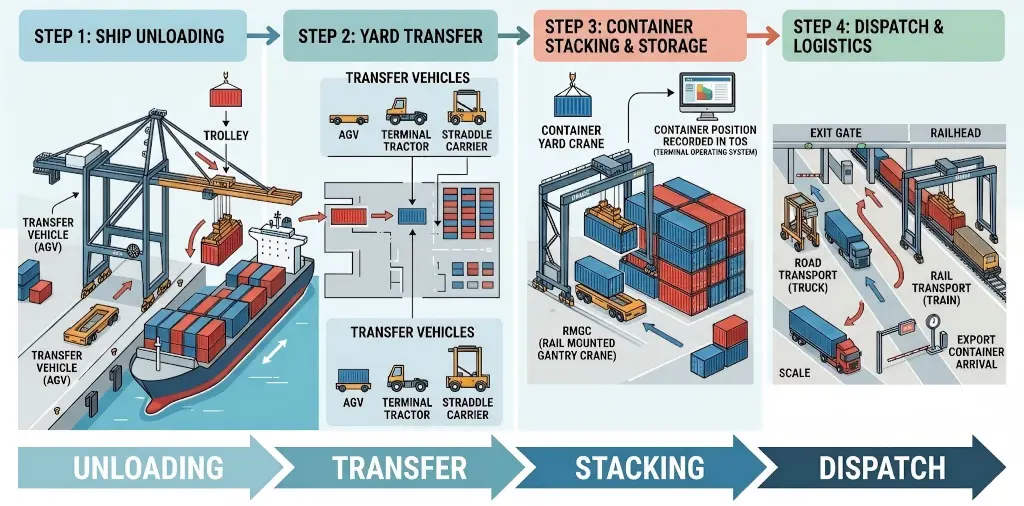
Step 1: Ship Unloading — STS Crane Operation
When a container vessel berths at the quay, ship-to-shore (STS) cranes positioned on the quayside rail system extend their booms over the vessel's deck or open hatch covers. The crane's trolley, carrying a spreader, traverses the boom to position over the target container bay. The spreader descends, engages the container's corner castings, and the hoist lifts the container clear of the ship's cell guides or deck stow.
The crane then transports the container across the boom and lowers it onto a quay transfer vehicle — typically an automated guided vehicle (AGV), a terminal truck, or a straddle carrier — waiting in the crane's landside operating zone. This cycle repeats continuously for the duration of the vessel call. Ship unloading productivity is measured in gross crane moves per hour (GMPH), with modern high-performance STS cranes achieving 30 or more moves per hour on individual cranes and terminals managing multiple cranes per vessel simultaneously.
Step 2: Yard Transfer
Once a container is landed from the STS crane onto a transfer vehicle, it is transported to the container yard — the area of the terminal where containers are stored between arrival and dispatch. Transfer vehicles include terminal tractors with chassis trailers, AGVs, and straddle carriers. The transfer distance and terminal layout determine which vehicle type is most efficient for a given facility.
Step 3: Container Stacking and Storage
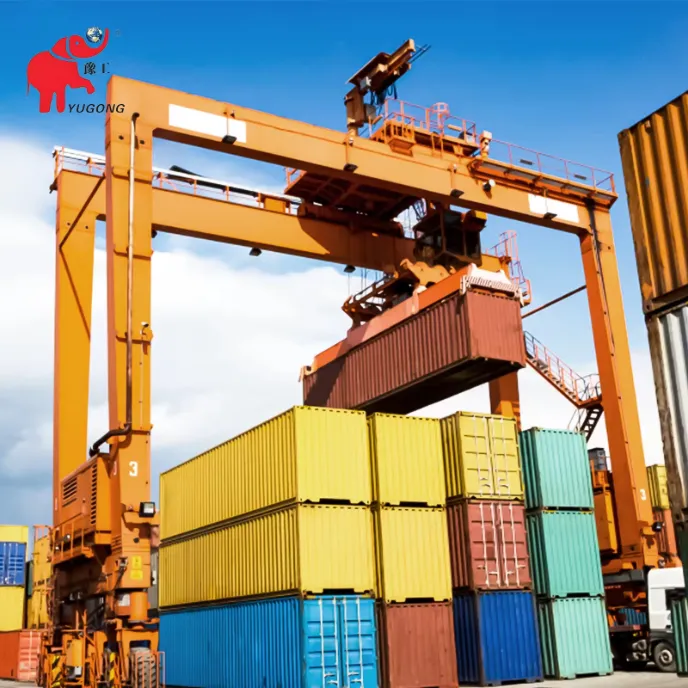
At the container yard, the container is lifted from the transfer vehicle and stacked in a designated slot within the yard block. This operation is performed by container yard cranes — primarily RTG cranes or RMG cranes depending on the terminal's infrastructure and automation strategy. Stacking height ranges from three to seven containers high depending on the crane type and yard design. The container's position in the yard is recorded in the terminal operating system (TOS), which manages all container locations and plans future crane movements.
Step 4: Dispatch and Logistics Distribution
When a container is called for dispatch — for outbound vessel loading, road transport pickup, or rail transfer — the TOS directs a yard crane to retrieve the container from its stacked position and present it to a truck lane, rail transfer station, or internal transport vehicle. For export containers arriving by truck or rail, the sequence reverses: the incoming container is received, weighed, and stored in the yard pending vessel loading.
This four-stage workflow — unloading, transfer, stacking, dispatch — is continuous in a busy terminal, with multiple overlapping cycles in progress simultaneously across dozens of cranes operating around the clock.
Main Types of Container Cranes
Container crane types are defined by their structural configuration, travel mechanism, and operational role within the terminal workflow. Each type is optimized for a specific function; most terminals deploy multiple types working in coordination.
Ship-to-Shore (STS) Cranes
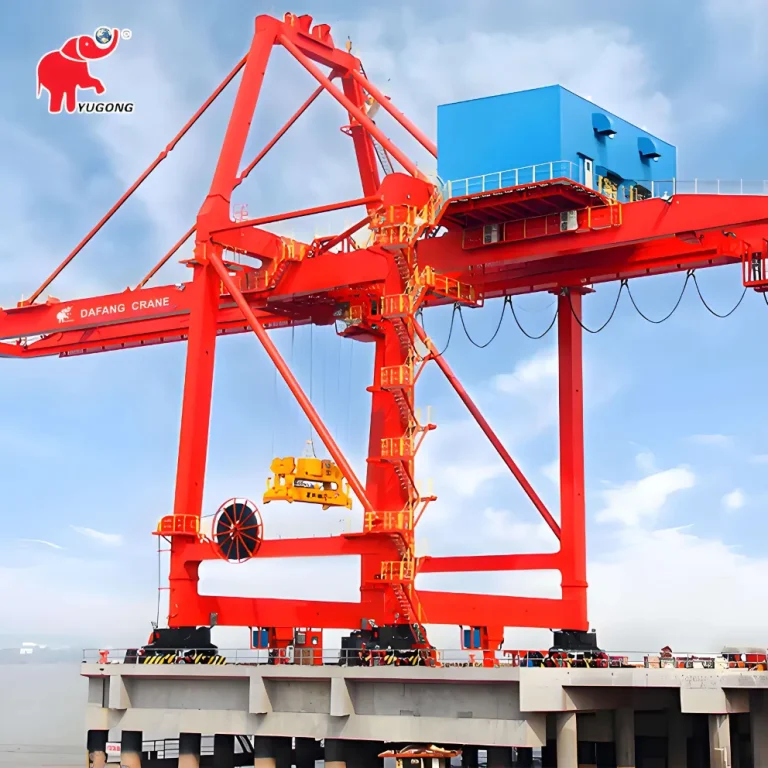
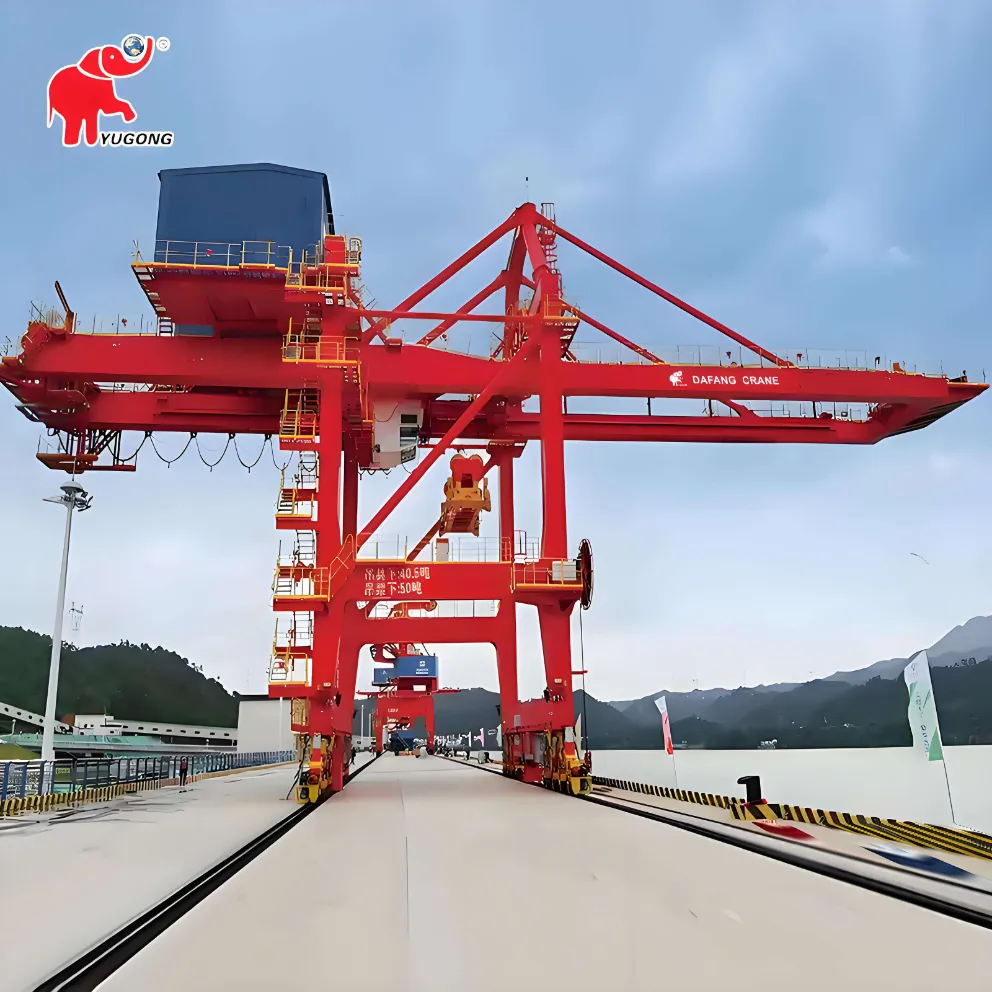
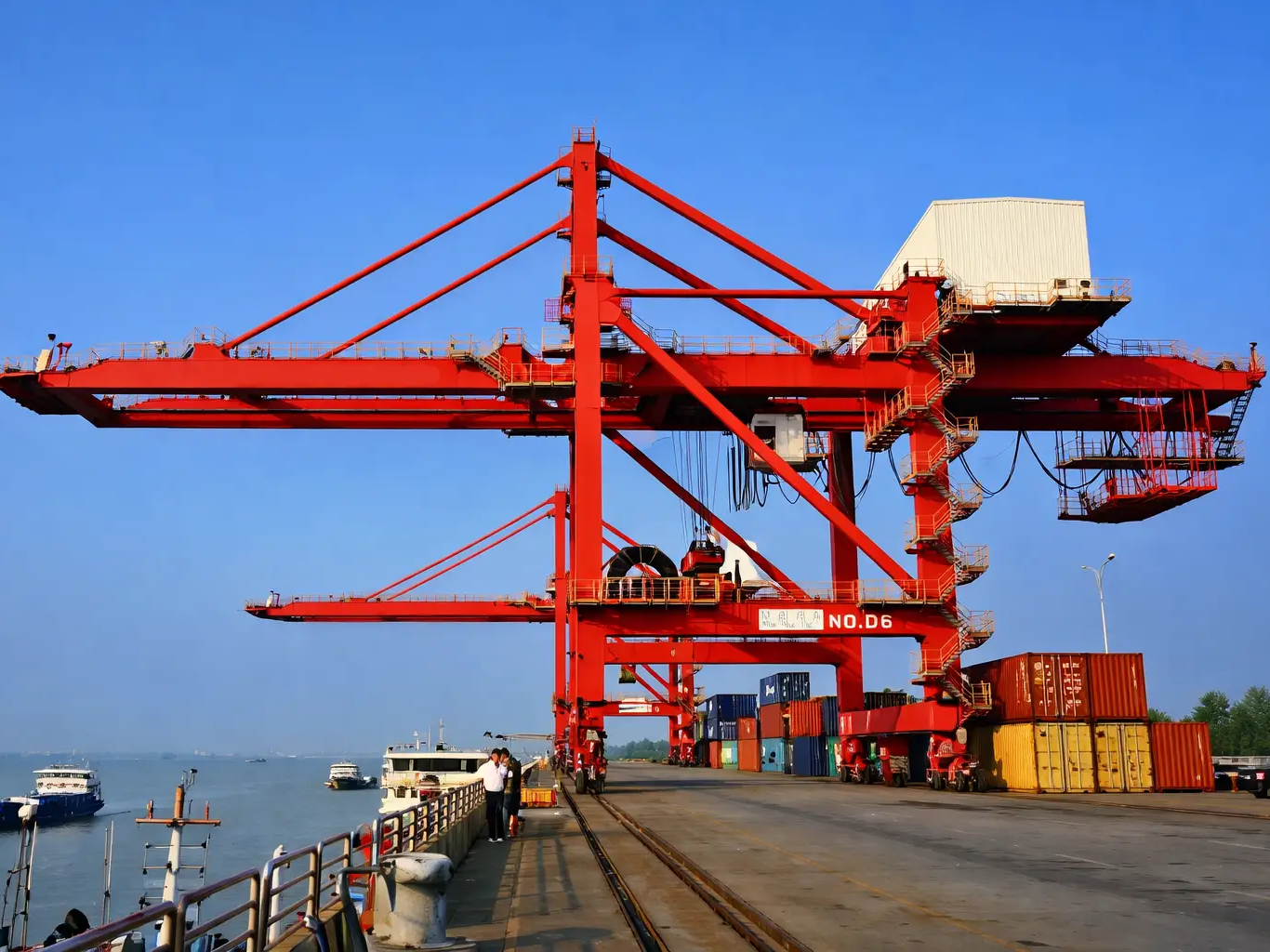
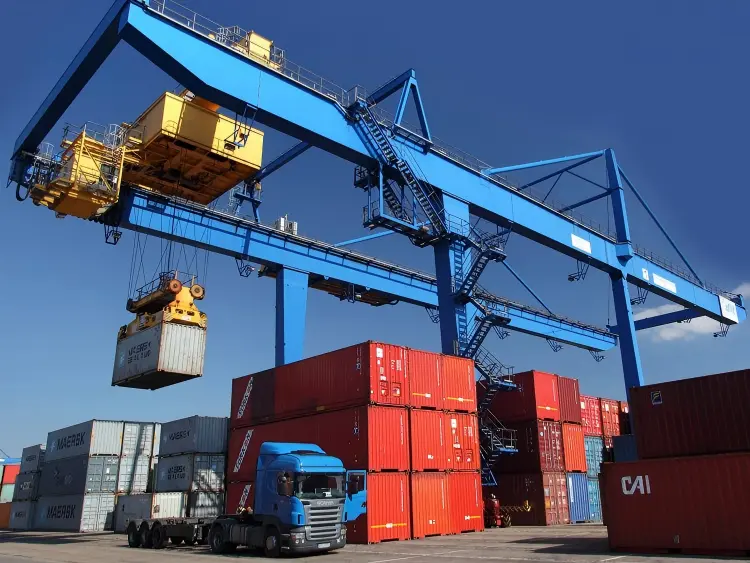
Ship-to-shore cranes — also called quay cranes or portainers — are the most visible and structurally imposing cranes in any container terminal. They are rail-mounted portal structures standing 50 to 80 meters or more in height, with a horizontal boom extending over the vessel to reach the full width of the ship's deck.
STS cranes are classified by their outreach — the distance the boom extends beyond the quayside rail. Panamax STS cranes reach approximately 40 meters, covering the beam of vessels up to the original Panamax size. Post-Panamax cranes reach 50 meters or more, and super post-Panamax cranes serving the largest ultra-large container vessels (ULCVs) can reach 70 meters or beyond, spanning more than 25 container rows across the ship's beam.
STS crane lifting capacity is typically rated at 40 to 65 metric tons under the spreader — sufficient for any laden ISO container including heavy 45-foot units. Dual hoist and tandem lift configurations allow two 20-foot containers to be lifted simultaneously, doubling productivity for single-length container handling.
Rubber Tyred Gantry Cranes (RTG)
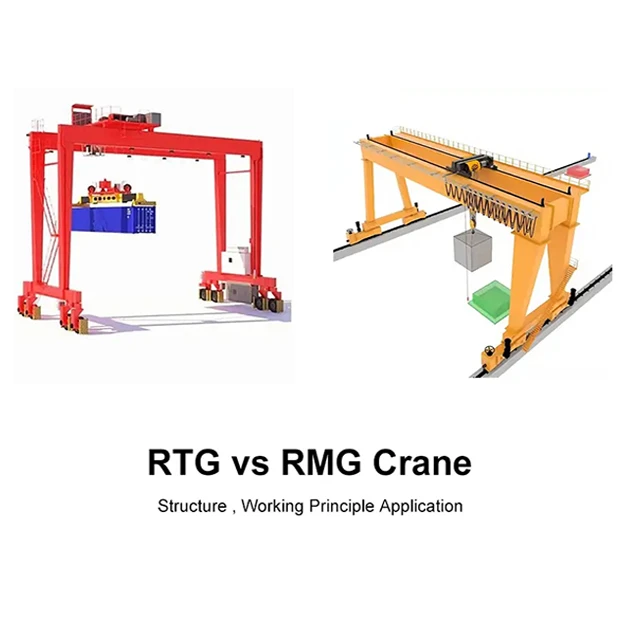
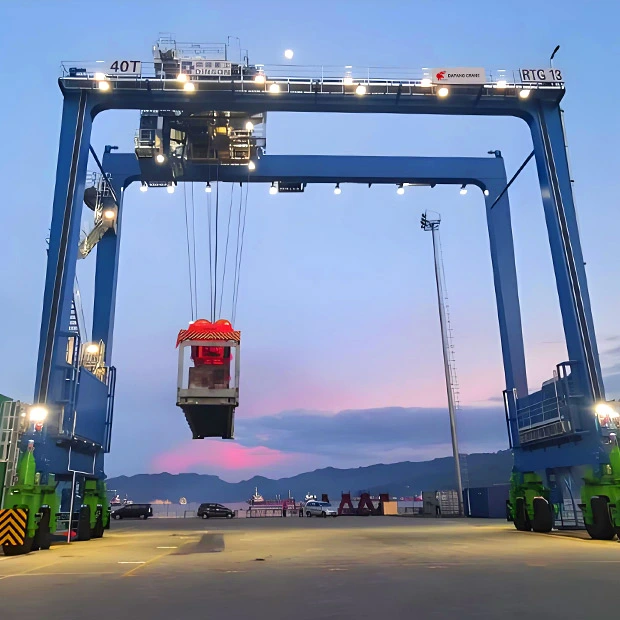
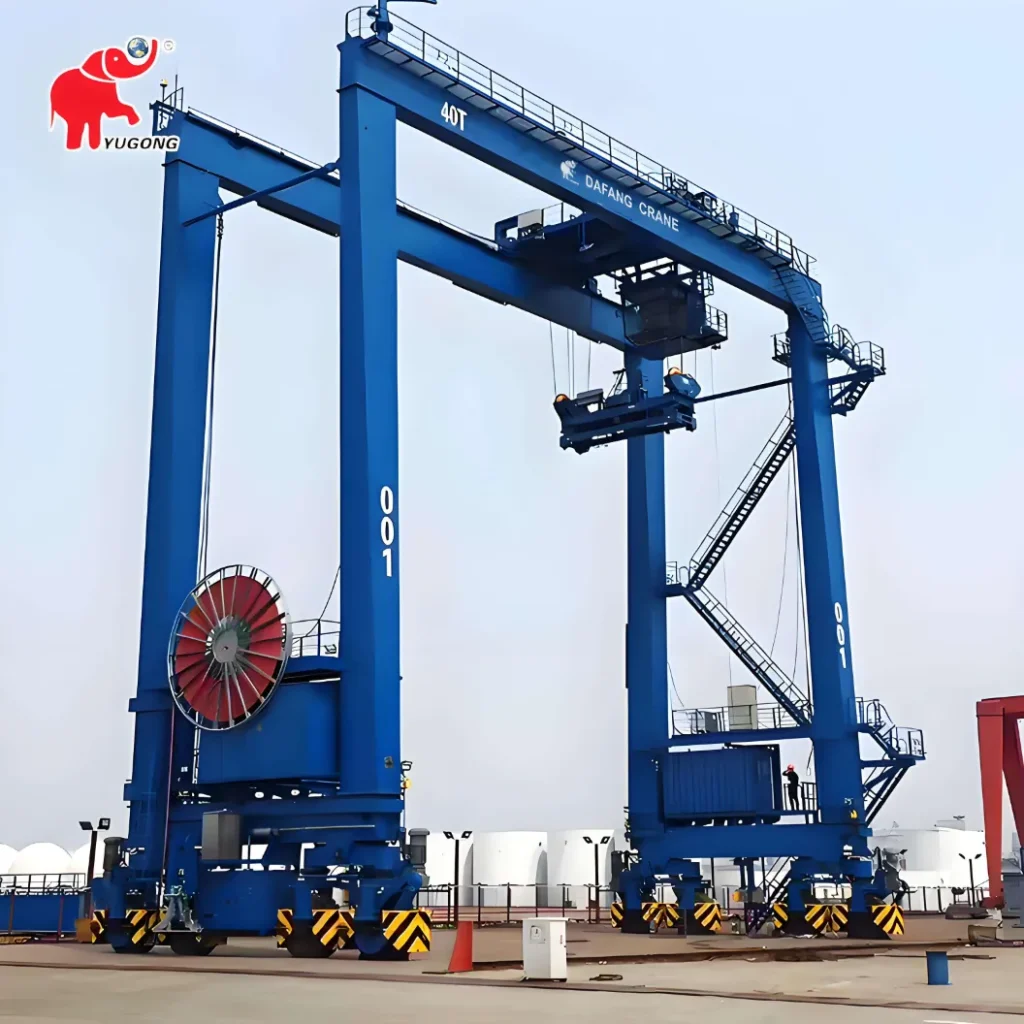
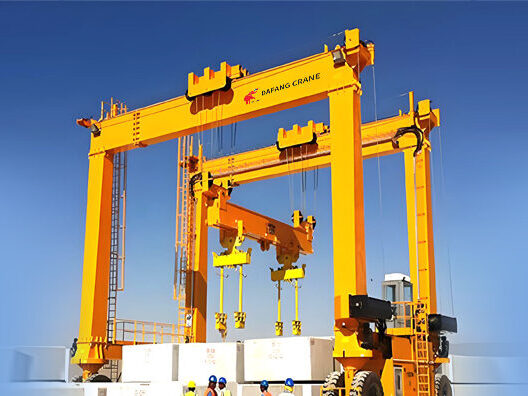
O rubber tyred gantry crane is the most widely deployed container yard crane type in the world. It is a self-propelled portal crane on rubber-tyred bogies that straddles one or more container rows — typically six to ten rows wide plus a truck lane — and uses a traversing hoist trolley to stack and retrieve containers within the block. Standard stacking height is 1-over-4 to 1-over-5, with crane spans covering six to seven container rows in most configurations and up to ten rows in wider installations. Unlike rail-mounted systems, RTG cranes can change lanes by driving across the yard surface, giving terminals the flexibility to reassign cranes between blocks as operational demand shifts — a meaningful advantage in facilities with variable or unpredictable container flows.
Power systems for RTG cranes have evolved substantially. Diesel-hydraulic was the traditional configuration, but the industry has largely transitioned to diesel-electric and increasingly to fully electric operation — powered by trailing cable or overhead conductor rail — delivering significant reductions in fuel consumption, maintenance cost, and emissions per crane move.
Rail Mounted Gantry Cranes (RMG)
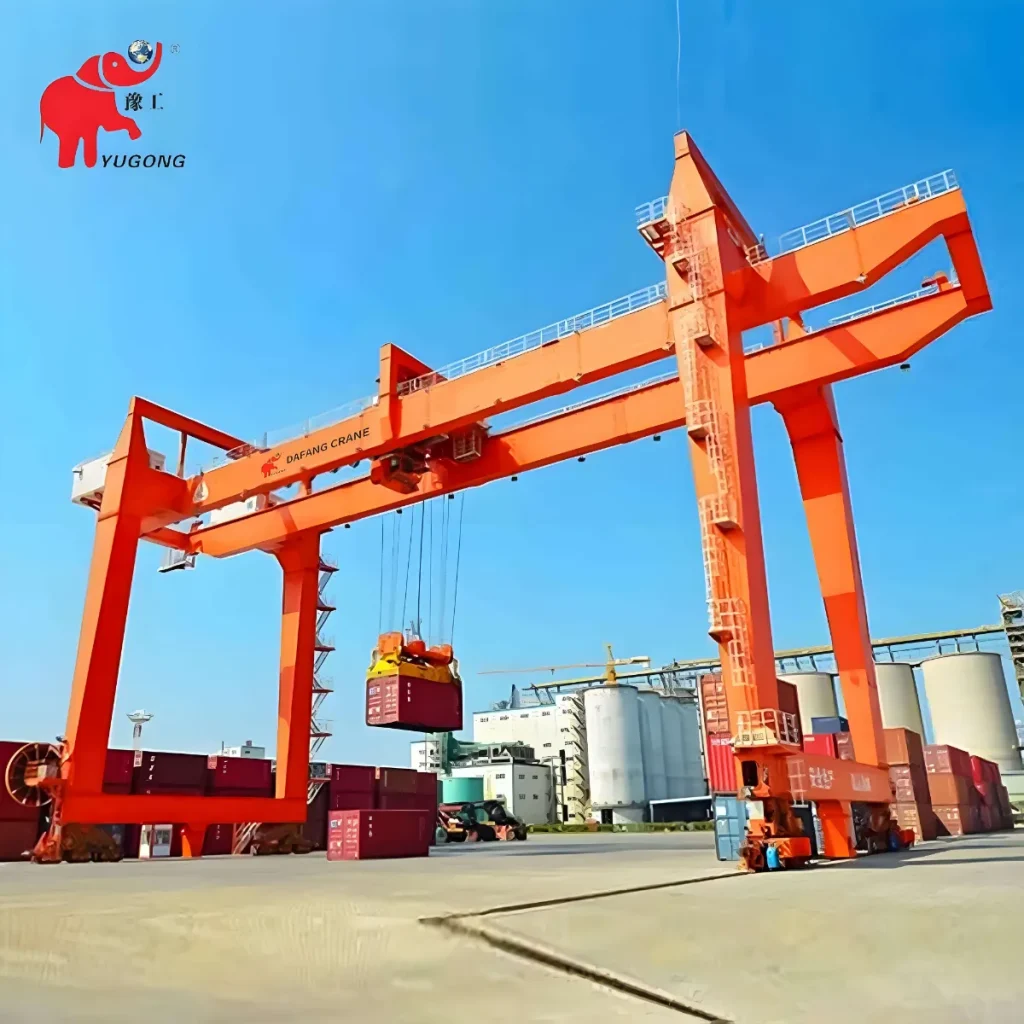
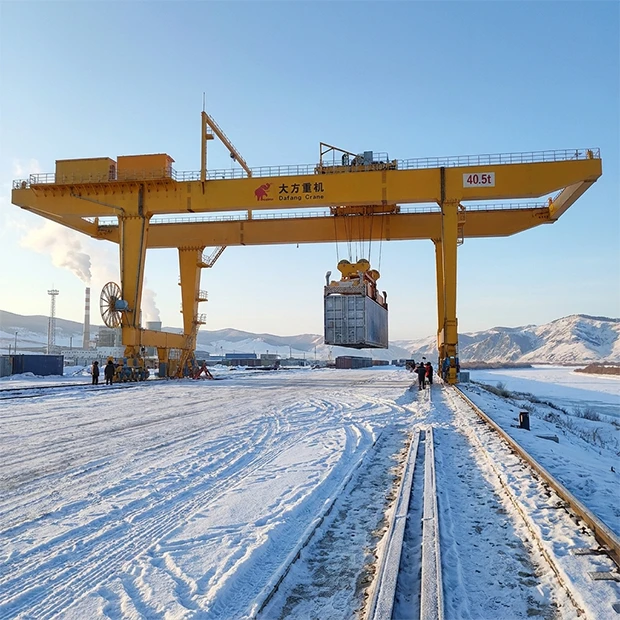
Rail mounted gantry cranes travel on fixed rail tracks embedded in the yard surface. Unlike RTG cranes, they cannot change lanes — each RMG operates within a dedicated block served by its specific rail corridor. This fixed travel path enables more precise position feedback, better suitability for fully automated operation, and lower rolling resistance than rubber-tyred systems.
RMG cranes are the preferred crane type for fully automated container terminals, where the consistent positioning that fixed rails provide is essential for the reliability of automated stacking algorithms and the safety of automated equipment interfaces. Precision position encoding on the rail travel axis, combined with laser or machine vision positioning systems on the trolley, enables RMG cranes to place containers with centimeter-level accuracy without direct operator input.Stacking height capability for RMG systems is typically 1-over-4 to 1-over-6, with some high-density configurations reaching higher. The combination of high stacking density, precise positioning, and full automation makes RMG-based yard systems the highest-productivity yard crane configuration in large-volume automated terminals.
Straddle Carriers
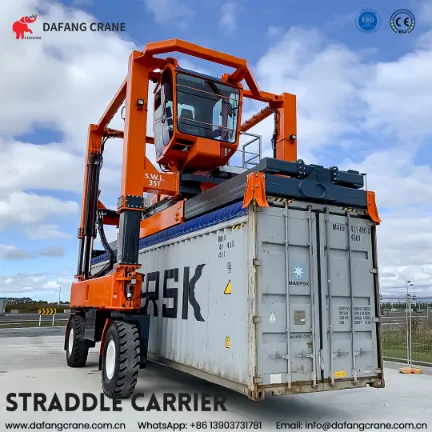
Straddle carriers are not cranes in the conventional sense but are essential members of the container handling equipment family. They are self-propelled, four-legged portal vehicles that straddle and lift individual containers for horizontal transport across the terminal. In straddle carrier terminal layouts, they handle both the transfer function (moving containers from the STS crane landing zone to the yard) and the stacking function within the yard, eliminating the need for separate transfer vehicles and yard cranes.
Straddle carrier systems are flexible, scalable, and well-suited to terminals with moderate throughput and irregular terminal geometries. They are typically most competitive for facilities handling 500,000 to 1.5 million TEU annually.
Obter um orçamento gratuito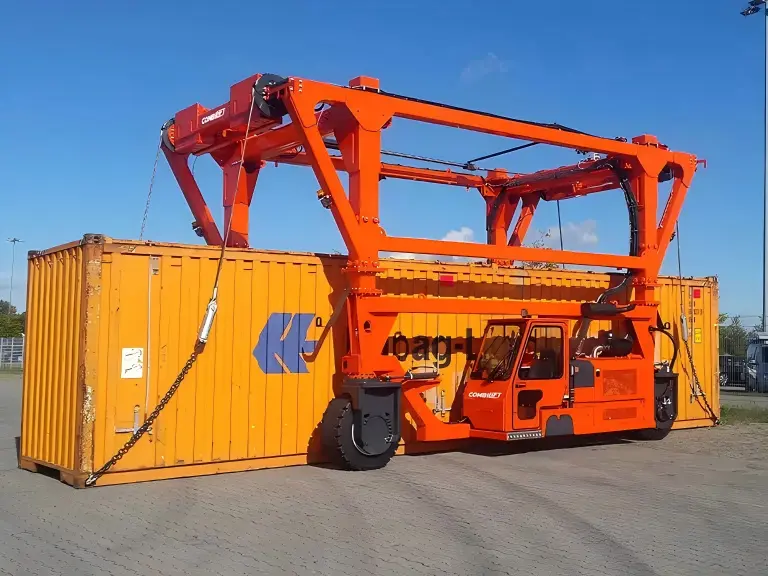
Container Gantry Crane Systems Explained
The container gantry crane — encompassing RTG, RMG, and specialized variants — is the primary tool for container yard management in most container terminals worldwide. Understanding its components and operating principles is essential for anyone involved in terminal planning, equipment procurement, or crane operations.
What Is a Container Gantry Crane?
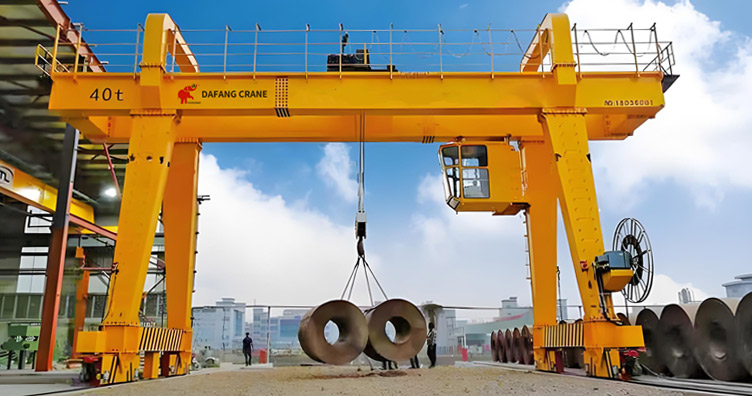
A container gantry crane is a portal crane structure that straddles one or more rows of containers in the yard. Its main girder spans the full stacking width, with a hoist trolley traversing the girder to position the spreader over any container within the crane's reach. The crane travels longitudinally along its yard block to access any bay within its operating zone.
The container gantry crane differs from a ship-to-shore crane primarily in its operating environment and function. STS cranes work at the quayside, spanning vessel widths and loading/unloading ships. Container gantry cranes work in the yard, stacking and retrieving containers in organized blocks for storage and distribution.
Key Components of a Container Gantry Crane
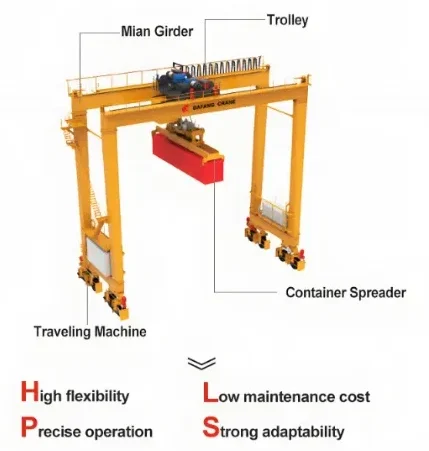
- Main girder: The primary horizontal structure spanning the full crane width between the gantry legs. In most container gantry cranes, this is a box girder structure fabricated from structural steel, engineered for the combination of vertical lifting loads, horizontal trolley travel loads, and dynamic loads from crane travel and braking.
- Hoisting system: The hoist provides vertical lifting motion via wire rope drums, synchronized lifting cylinders (in some configurations), hoist motor, gearbox, and electromagnetic or disc brake. Container gantry cranes typically use wire rope hoisting systems rated at 40 to 65 metric tons, with variable frequency drive control for smooth load management.
- Carrinho: The carriage traversing the main girder, carrying the hoist machinery and spreader suspension. Trolley speed typically ranges from 60 to 120 meters per minute, with variable speed control for precise positioning at the container placement point.
- Espalhador: The spreader is the interface between the crane and the container. Standard telescopic spreaders adjust between 20-foot and 40-foot length settings to handle both container sizes without manual reconfiguration. Corner twist-locks engage the container's ISO corner castings for secure lifting. Spreader skew, trim, and list adjustments allow the crane to compensate for load imbalance and container misalignment during placement.
- Electrical control system: The crane's programmable logic controller governs all motions — hoist, trolley, bridge travel, and spreader functions — through motor drive units, position encoders, and safety interlock logic. In automated configurations, the control system interfaces with the terminal operating system for work order reception and container tracking.
Working Principle in Port Operations
During a typical container gantry crane cycle, the crane receives a work order from the terminal operating system specifying the container to be handled and its target position. The crane travels to the correct bay, the trolley positions over the source container, and the spreader descends to engage the container's corner castings. After confirmation of secure engagement, the hoist raises the container to travel height, and the crane transports it to the target position — either a stack position for storage or a truck lane or transfer vehicle position for dispatch. The spreader lowers the container, releases, and the crane prepares for the next cycle.
Cycle time — the elapsed time from the start of one container placement to the start of the next — is the primary productivity metric for container gantry cranes. Typical cycle times in manual or semi-automated operation range from 90 to 120 seconds. In fully automated operation with optimized stacking algorithms, cycle times can be reduced and made more consistent than manual operation allows.
Container Handling Gantry Cranes in Modern Ports
The role of the container handling gantry crane in modern terminals extends beyond simple lifting. In advanced terminal operations, these cranes are integrated into digital management systems that optimize every aspect of container placement and retrieval.
Yard Stacking Operations
Efficient yard stacking is about more than simply placing containers in available slots. The position of each container in the stack affects the number of moves required to retrieve it when called — a container buried under several others that must be moved first (a re-handle) adds cycle time and reduces productive throughput. Automated stacking algorithms minimize re-handles by predicting the likely order of container retrieval and placing containers accordingly.
Semi-Automated and Fully Automated Systems
Container gantry crane automation progresses through several stages:
- Manual operation: An operator in the crane cab controls all motions directly, with visual reference for positioning. This requires a skilled operator for each crane and limits productivity to the operator's speed and consistency.
- Remote operation: The cab is eliminated, and the operator controls the crane from a workstation in a remote operations center using camera feeds. A single remote operator can supervise multiple cranes, switching between cranes during non-critical motion phases and taking direct control for final container placement.
- Semi-automated operation: Crane travel and trolley positioning are computer-controlled, with an operator taking control only for final placement at the truck lane — the step requiring visual confirmation of truck chassis position and container alignment. This is the most common automation level for RTG crane fleets being retrofitted for automation.
- Fully automated operation: The complete crane cycle — travel, positioning, lifting, transport, placement, and spreader engagement/release — is executed without direct operator input, using machine vision, obstacle detection, and automated truck positioning systems. This level requires the most sophisticated infrastructure but delivers the greatest labor efficiency.
Remote Operation Centers
Modern container terminals implementing crane automation invest in purpose-built remote operations centers (ROCs) where operators monitor multiple cranes from ergonomic workstations equipped with multi-screen video displays, intuitive control interfaces, and communication systems linking the ROC to yard personnel. The ROC model allows one operator to oversee two to four cranes simultaneously, compared to one operator per crane in cab-based manual operation.
Shipping Container Cranes in Global Logistics
The role of shipping container cranes extends beyond individual terminal operations to the functioning of the entire global logistics chain.
Deep-Sea Ports
Major hub ports handling the largest container vessels are the most demanding application for container crane technology. Port of Shanghai, Singapore, Rotterdam, and similar mega-hubs process 20 to 50 million TEU per year, requiring continuous operation of large STS crane fleets and extensive automated yard systems. Ultra-large container vessels with capacities exceeding 24,000 TEU require super post-Panamax STS cranes with outreaches of 70 meters or more and the highest available productivity levels.
Inland Terminals
Inland container terminals and dry ports serve as logistics hubs connecting seaport terminals to manufacturing and consumption regions by rail and road. Container cranes at inland terminals — typically RMG systems or smaller RTG configurations — handle lower volumes than seaports but must efficiently interface with rail wagons, trucks, and barge operations. Intermodal efficiency at inland terminals directly affects the cost and speed of the inland logistics chain.
Intermodal Hubs
Rail-to-road intermodal terminals handling domestic and continental cargo use RMG crane systems to transfer containers between rail wagon platforms and truck chassis. These facilities require cranes with sufficient rail car positioning accuracy to place containers in wagon cell guides reliably and with enough automation to maintain throughput with minimal labor.
Comparison of Container Crane Types
| Tipo | Função principal | Sistema de viagem | Typical Automation | Melhor aplicativo |
|---|---|---|---|---|
| Grua STS | Ship loading and unloading | Rail (quayside) | High — remote or semi-automated | Deepwater container terminals |
| Grua RTG | Yard stacking and retrieval | Rubber tyres | Medium to high — manual, remote, or semi-automated | Mid-to-large container yards needing lane flexibility |
| Grua RMG | High-density yard stacking | Fixed rail | High — preferred for full automation | Automated terminals, rail-linked facilities |
| Porta-contentores sobre pneus | Horizontal transport and low stacking | Self-propelled on tyres | Médio | Terminals with integrated transfer and stacking operations |
| Ship-to-Shore (floating) | Vessel operations without fixed quay | Pontoon/barge | Baixo a médio | Transshipment, project cargo, non-fixed quays |
Applications of Container Cranes
Terminais Portuários
Container port terminals are the primary and largest application for the full range of container crane types. A typical container terminal deploys all three major crane types: STS cranes at the quay for vessel operations, RTG or RMG cranes in the yard for stacking, and horizontal transport equipment linking the two zones. Terminal throughput capacity is determined by the combined performance of all crane types working as a coordinated system, not by any single crane type alone.
Pátios de contentores
Inland container yards and depot facilities use RTG or RMG cranes for container storage, empty container management, and pre-positioning of containers for distribution. These facilities typically handle lower throughput volumes than seaport terminals but serve a critical role in the inland logistics network, providing temporary storage and container availability close to cargo origins and destinations.
Railway Logistics Hubs
Rail-road intermodal terminals use RMG cranes almost exclusively for their combination of precision, automation compatibility, and high throughput at fixed positions along the rail corridor. Modern rail intermodal hubs in Europe, North America, and Asia operate fully or semi-automated RMG crane systems that transfer containers between unit trains and truck chassis with minimal manual intervention.
Intermodal Transport Centers
Multimodal logistics centers handling ship, rail, road, and sometimes inland waterway containers require container crane systems that can interface with multiple transport modes simultaneously. These facilities typically deploy a mix of crane types and horizontal transport equipment configured for the specific modal balance and throughput requirements of the site.
Industrial Storage Yards
Some container cranes are used outside the traditional port and logistics context — in industrial facilities handling large quantities of containerized product or components, in port-adjacent distribution centers, and in military and government facilities managing containerized equipment and supplies. RTG cranes are the most common choice for industrial container yard applications due to their flexibility and moderate infrastructure requirements.
Key Selection Factors for Container Cranes
Throughput Capacity
The primary sizing input for any container crane system is the required throughput — the number of container moves per hour the crane fleet must support at peak demand. Throughput requirements determine the number of cranes, the required move rate per crane, and the automation level needed to achieve the target productivity.
Automation Level
The appropriate automation level depends on the terminal's labor cost environment, throughput requirements, and investment horizon. Full automation delivers the lowest labor cost per crane move and the most consistent cycle times but requires higher initial investment in crane hardware, sensing systems, and terminal operating system capabilities. Manual operation has lower capital cost but higher ongoing labor cost and variable productivity.
Port Infrastructure
Crane selection must match the physical infrastructure available or planned at the facility. RMG cranes require rail foundations; RTG cranes require a paved surface capable of supporting rubber-tyred loads. STS cranes require a quay structure designed for the specific crane rail loads and outreach. Infrastructure constraints often narrow the viable crane type options before other selection criteria are applied.
Eficiência Energética
Container crane energy consumption is a significant operating cost and an increasingly important sustainability metric. Electric-powered cranes — whether grid-connected RTGs, fully electric RMGs, or STS cranes with energy regeneration — offer substantially lower energy cost per crane move than diesel-powered alternatives and produce no direct emissions at point of use. Energy regeneration systems on hoist and travel drives recover kinetic and potential energy during deceleration and lowering, reducing net energy consumption per cycle.
Maintenance Requirements
Container cranes operating in the continuous, high-duty cycles of a working terminal accumulate high fatigue loading on structural and mechanical components. Maintenance program scope, preventive maintenance interval, spare parts availability, and the technical support infrastructure of the crane manufacturer all directly affect crane availability — the percentage of scheduled operating time the crane is actually available for work orders.
Investment Budget
Capital cost varies substantially between crane types and automation levels. RTG cranes have lower infrastructure cost than RMG systems. Semi-automated systems cost less than fully automated configurations. STS cranes at large-vessel capacity levels are among the most capital-intensive items of non-vessel port equipment. A total cost of ownership analysis — comparing capital cost, operating cost, and productivity over a 20-to-25-year asset life — provides a more complete basis for investment decisions than initial price alone.
Container Crane Safety Systems
Container cranes operating in active terminal environments with personnel, trucks, and other equipment present must incorporate comprehensive safety systems to protect both equipment and personnel.
- Anti-sway systems: Load pendulum oscillation during crane travel is a primary source of positioning delay and collision risk. Active anti-sway systems use spreader position feedback and predictive control algorithms to apply corrective trolley drive commands that dampen swing during travel, enabling the spreader to arrive at the target position with minimal residual oscillation.
- Overload protection: Load monitoring systems measure the weight of the suspended container and interrupt hoisting if the total load exceeds the crane's rated capacity. Overload protection prevents structural damage from unexpectedly heavy containers and alerts the terminal management system to potential measurement errors in container weight declarations.
- Emergency stop systems: Multiple emergency stop devices — accessible to crane operators, ground personnel, and truck drivers in the truck lane — provide immediate cessation of all crane motions in the event of a hazardous situation. Emergency stop systems must be fail-safe and must require manual reset before crane operation can resume.
- Load monitoring: Real-time display of the lifted load weight at the operator workstation, combined with automatic alerting at defined thresholds, gives operators and supervisors continuous visibility into the weight of containers being handled — important for both safety compliance and container weight verification.
- Collision avoidance: Proximity sensing systems on STS crane booms, RTG crane legs, and automated crane travel paths detect personnel, vehicles, and other cranes in the operating zone and automatically slow or stop crane travel before contact. In fully automated zones, personnel detection and exclusion systems are mandatory safety infrastructure.
- Spreader lock confirmation: Sensors on the twist-lock mechanisms confirm that the spreader is fully engaged in the container corner castings before the hoist is permitted to lift. This interlock prevents accidental partial engagement that could result in a dropped container.
Future Trends in Container Crane Systems
Smart Port Automation
The automation of container crane operations is advancing from semi-automated pilot projects to full-scale deployment at major terminals worldwide. Future container terminals will operate fully automated crane fleets with minimal on-site crane operators — a transformation already demonstrated at automated terminals in Rotterdam, Hamburg, Qingdao, and other leading ports.
AI-Based Crane Control and Yard Optimization
Artificial intelligence applications in terminal operating systems are improving container placement strategy, reducing re-handle rates, optimizing crane deployment across the yard, and predicting maintenance needs from operational data. As AI capabilities mature, the gap between what algorithmic optimization can achieve and what human planners can manage manually will continue to widen.
Remote Operation Systems
The development of low-latency video transmission, improved haptic control interfaces, and more reliable communication infrastructure is improving the ergonomics and effectiveness of remote crane operation. Future remote operation centers will support higher crane-per-operator ratios and handle more complex operational scenarios than current systems allow.
Electrification and Hybrid RTG Cranes
The conversion of diesel-powered RTG crane fleets to electric operation is accelerating globally, driven by fuel cost, port emission regulations, and corporate sustainability commitments. Hybrid RTG cranes combining battery storage with grid connection or regenerative diesel systems are an intermediate step for terminals where full electrification infrastructure is not yet available.
Predictive Maintenance
Sensor networks on container cranes — measuring structural load cycles, drive system performance, spreader mechanism condition, and electrical system health — provide the data foundation for predictive maintenance programs that replace calendar-based service schedules with condition-based interventions. Predictive maintenance reduces both unplanned downtime and the cost of unnecessary preventive maintenance.
Conclusão
Container cranes are the defining infrastructure of modern container logistics. Without them, the containerized trading system that moves the majority of the world's manufactured goods could not function at the throughput volumes and speeds that global supply chains require.
The different container crane types — STS cranes at the vessel interface, RTG and RMG gantry systems in the yard, straddle carriers for terminal transport — each address a specific operational requirement within the container handling workflow. Selecting the right crane type, capacity, and automation level for a given terminal requires matching equipment capabilities to the facility's throughput targets, infrastructure characteristics, labor cost environment, and investment horizon.
As container trade volumes continue to grow and port operators face increasing pressure to improve efficiency and reduce emissions, container crane technology will continue to evolve — toward greater automation, wider adoption of electric power systems, more sophisticated AI-driven control, and deeper integration with the digital management systems that optimize every movement in the global logistics chain.
Contact our engineering team for container terminal equipment consultation.
Explore our container handling system design and specification services.

Perguntas mais frequentes
Q: What is a container gantry crane?
A container gantry crane is a portal-structure crane that straddles one or more rows of containers in a yard, with a traversing trolley and spreader that can lift and position containers anywhere within the crane's working zone. RTG and RMG cranes are both types of container gantry cranes, distinguished by their travel mechanism — rubber tyres or fixed rail respectively. Container gantry cranes are the primary equipment for container yard stacking operations in modern terminals.
Q: What are the main types of container cranes?
The main types of container cranes are ship-to-shore (STS) cranes for vessel loading and unloading at the quay, rubber tyred gantry (RTG) cranes for flexible yard stacking operations, rail mounted gantry (RMG) cranes for high-density automated yard stacking, and straddle carriers for horizontal container transport and low-level stacking. Most container terminals deploy multiple types working in coordination.
Q: How do container cranes work in ports?
Container cranes work in sequence through the port's container handling workflow. STS cranes lift containers from vessel holds or deck stows and lower them onto quay transfer vehicles. These vehicles transport containers to the yard, where RTG or RMG cranes lift them from the transfer vehicle and place them in designated stack positions. When containers are called for dispatch, yard cranes retrieve them and present them to trucks or rail transfer systems for onward transport.
Q: What capacity do container cranes need?
Container crane capacity requirements are governed by the weight of laden shipping containers, which under ISO standards can reach 30.48 metric tons for a 20-foot container and 32.5 metric tons for a 40-foot container. Including the weight of the spreader and lifting gear, container crane hoists are typically rated at 40 to 65 metric tons to provide adequate margin above the maximum container weight. Tandem lift configurations for dual 20-foot container handling require proportionally higher capacity ratings.
Q: How are container cranes powered?
Container cranes use electric power for all drive functions. STS cranes receive power via high-voltage cable or conductor rail systems from the terminal's electrical supply. RTG cranes have historically used diesel-electric power systems (on-board diesel generator powering electric drives) but are increasingly converted to full electric operation via trailing cable or overhead conductor rail. RMG cranes are almost universally powered from the grid via rail-mounted conductor systems, reflecting the efficiency advantages of direct electric supply over on-board generation.