






How much does an overhead crane cost in 2025? A 5-ton single girder bridge crane starts around $5,000 ex-works from China; a 50-ton double girder bridge crane unit can reach $130,000 or more. But overhead crane price is never one number — it shifts with lifting capacity, span, duty class, hoist type, component brand, and a string of hidden site costs that catch most first-time buyers off guard. This guide breaks it all down.
Table of Contents
I. What Is the Average Overhead Crane Price? (5 t / 10 t / 20 t / 50 t)
The question buyers ask most often is: "What is the price per tonne for a bridge crane?" To be honest, the price per tonne of a bridge crane decreases as the lifting capacity increases. A 5-tonne bridge crane might cost between US$1,200 and US$2,400 per tonne, whilst a 50-tonne eot crane could cost as little as US$1,300 to US$2,600 per tonne. This price refers solely to the crane itself and does not include installation or on-site construction costs.
The table below lists reference data for 2025 ex-works prices from a CE/ISO-certified Chinese manufacturer, along with estimated total cost of delivery to major import ports.
| Capacity | Type | Span Range | Ex-Works Price (USD) | Landed Cost Est.* | Duty Class |
| 5 ton | Single girder | 10–22 m | $5,000 – $12,000 | $7,000 – $16,000 | A3–A4 |
| 10 ton | Single girder | 10–28 m | $10,000 – $22,000 | $14,000 – $28,000 | A3–A5 |
| 10 ton | Double girder | 10–28 m | $15,000 – $32,000 | $20,000 – $40,000 | A4–A6 |
| 20 ton | Double girder | 16–32 m | $28,000 – $55,000 | $36,000 – $68,000 | A4–A6 |
| 50 ton | Double girder | 18–35 m | $65,000 – $130,000 | $80,000 – $160,000 | A5–A7 |
* Landed cost estimate includes ocean freight (FCL), basic import duty, and destination port handling. Excludes installation, runway rails, and local electrical connection. Prices are indicative; request a formal quotation for your specific configuration.
* For a detailed breakdown of 10-ton overhead crane pricing, including span and duty class impact, see our dedicated 10-ton cost guide.
Why such wide ranges? Because overhead crane price is determined by a specific combination of technical parameters — not by capacity alone. A 10-ton crane running 24/7 in a steel plant costs far more than a 10-ton crane used twice a day in a maintenance bay. The next section explains exactly why.
II. Top 8 Factors That Affect Overhead Bridge Crane Prices
Understanding these eight overhead crane price influencing factors will help you write a tighter specification, avoid over-engineering, and negotiate from a position of knowledge. Each factor interacts with the others — which is why accurate specifications matter more than any discount you can negotiate.
| Factor | Price Impact | Direction | One-Line Rule |
| Lifting Capacity | ★★★★★ | ↑ Exponential | Spec only the true SWL (load + all attachments); never pad capacity |
| Span | ★★★★☆ | ↑ Linear | Measure to ±100 mm; every extra metre adds steel and rail cost |
| Hoist Type | ★★★☆☆ | ↑ Tiered | CD < MD < NE < European; match to frequency, not just capacity |
| Duty Class | ★★★★☆ | ↑ Stepped | Count daily cycles honestly; A5→A6 jump can add 30–40% |
| Control System | ★★☆☆☆ | ↑ Options | Remote adds $800–2,000; automation adds more — spec what ops needs |
| Component Brand | ★★★☆☆ | ↑ 20–50% | CE standard export sufficient for most markets; OEM for EPC contracts |
| Special Features | ★★★☆☆ | ↑ Significant | Exproof/grab/magnet can add 40–100%; get dedicated quotation |
| Installation & Site | ★★☆☆☆ | ↑ Variable | Budget 15–30% of crane value for site work; confirm building capacity |
1. Lifting Capacity & Span
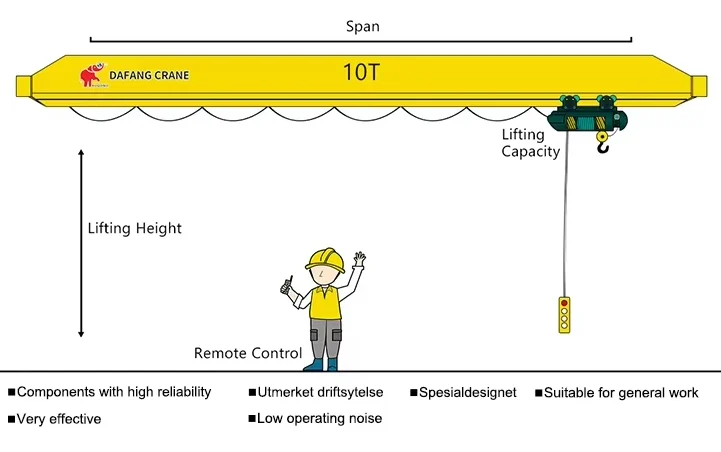
Lifting capacity is the single largest price driver in any EOT crane price breakdown. It determines the hoist motor size, main beam cross-section, runway rail weight, and the strength of every structural connection. As a general rule, each doubling of capacity raises crane cost by 40–80%. Span — the rail-to-rail distance — has a nearly linear effect on beam weight and therefore on both material and shipping cost.
- Safe Working Load (SWL) must include all attachments: hook + sling + spreader bar + load. Buyers routinely under-quote this figure and then need an expensive upgrade.
- Specifying 25 m when 22 m would work wastes beam steel, runway structure, and freight cost — measure on-site before finalising.
- Longer spans (>28 m) almost always require double-girder construction to control mid-span deflection to within the L/700 design limit.
| Capacity Range | Typical Application | Structure Type | Relative Price Impact |
|---|---|---|---|
| 1 – 5 ton | Light workshops, warehouses | Single girder | Baseline |
| 5 – 20 ton | General manufacturing, freight yards | Single or double girder | +20 – 60% |
| 20 – 50 ton | Steelworks, shipbuilding, power plants | Double girder | +80 – 150% |
| 50 ton+ | Heavy metallurgy, port handling | Double girder / custom | +200%+ |
Bridge crane price scales non-linearly. A 20-ton, 28 m double-girder crane can cost 4–5× a 5-ton, 12 m single-girder unit, even though capacity is only 4× larger.
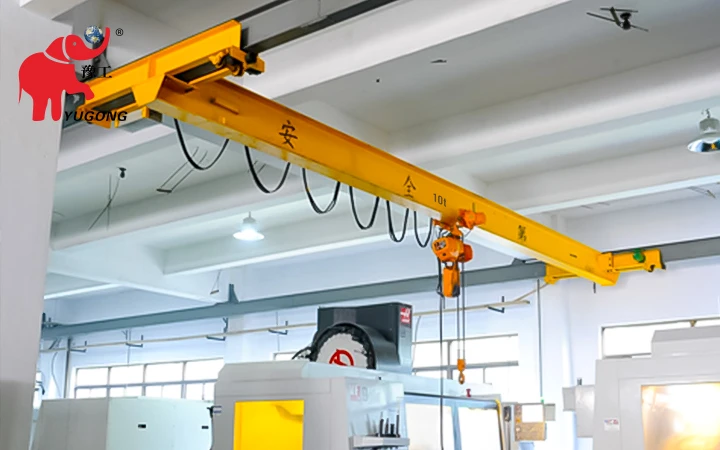
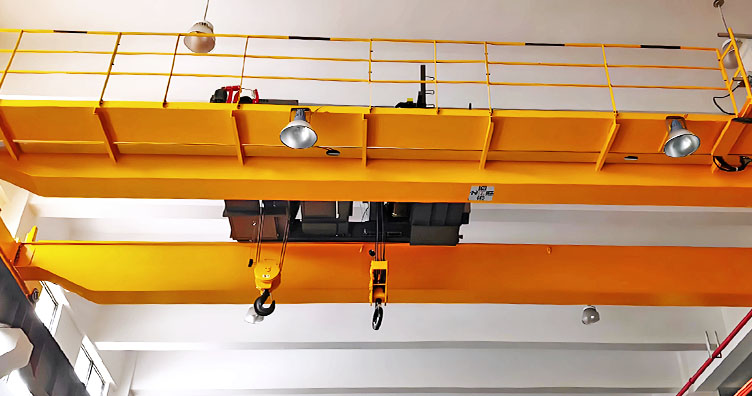
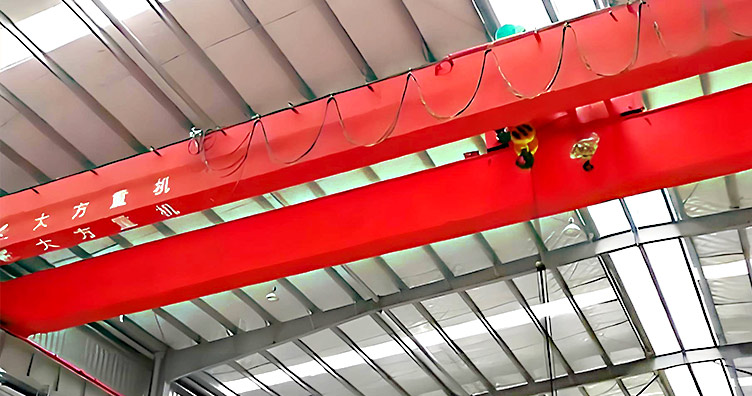
Overhead-Eot-Crane-Nlx-European-Underslung

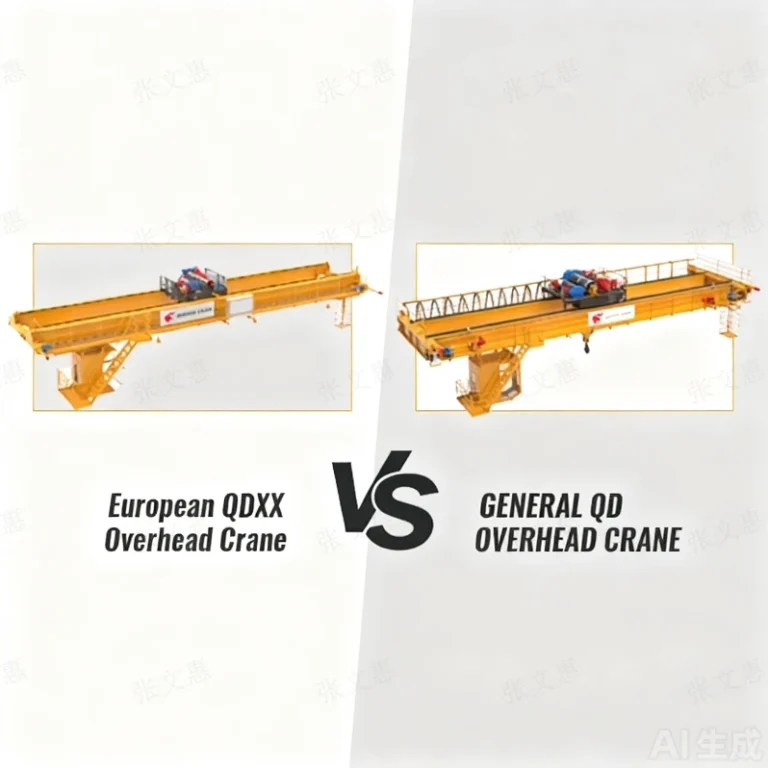
2. Hoist Type (CD / MD / NE / European FEM)
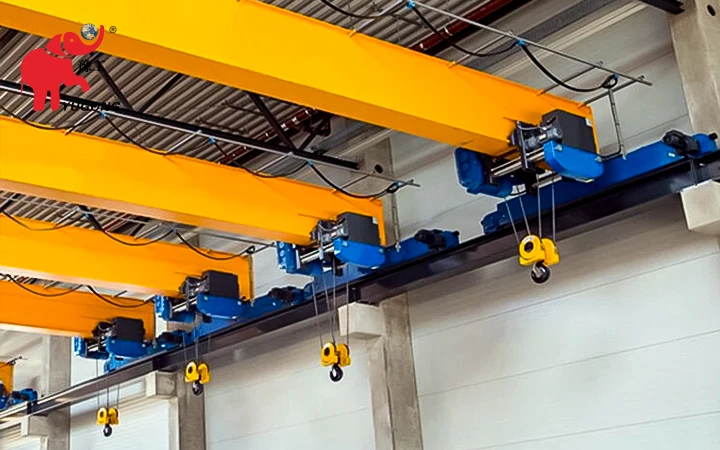
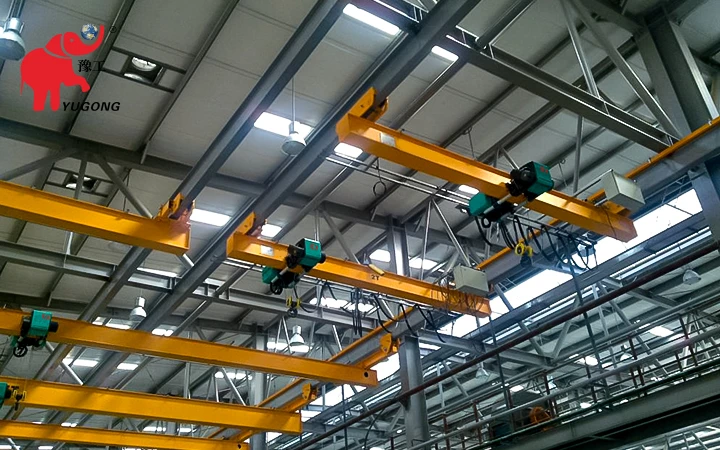
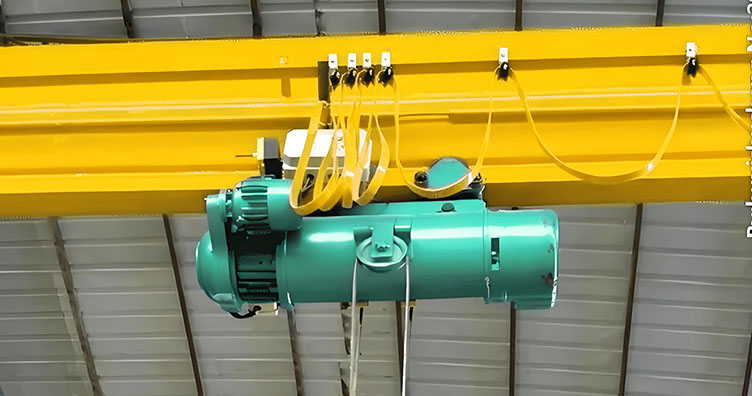
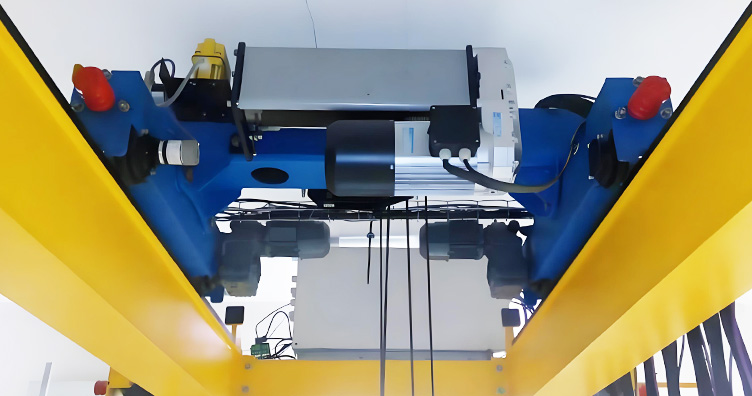
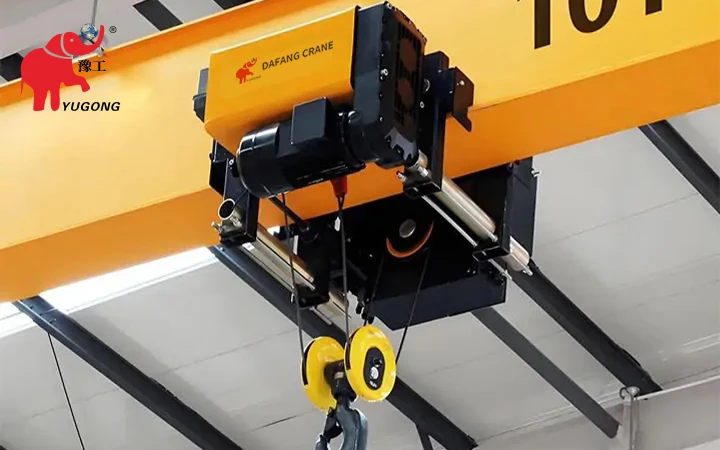
The hoist is the most service-intensive component of any overhead crane, and hoist type selection has a significant effect on both initial price and lifecycle cost. The four main tiers are:
- Single-speed, lowest cost, A3–A4 duty. Ideal for light workshops and infrequent lifts. Most affordable entry point. CD Wire Rope Hoist:
- Dual-speed (precision + production), A4–A5 duty. Most popular for general manufacturing exports. Moderate price premium over CD. MD Wire Rope Hoist:
- Compact low-headroom design, A4–A5 duty. Preferred where vertical space is critical. Similar or slightly higher price than MD. NE / HC Chain Hoist:
- A5–A8 duty, full traceability, local service networks in 60+ countries. Typically adds 25–55% to total crane price vs. equivalent Chinese-brand hoist. European FEM-Class Hoist (Demag, Konecranes, Stahl):
Hoist choice should be driven by daily cycle count and required service life — not by brand preference alone. For A3–A5 applications, CE-certified Chinese hoists deliver comparable MTBF at significantly lower cost.
3. Duty Class (A1–A8 / FEM / DIN)
Duty class — defined under ISO 4301, FEM 1.001, and DIN 15018 — measures how hard the crane works over its full design life. It combines the number of lifts per shift with the proportion of rated load typically handled. Higher duty class demands larger motors, stronger gearboxes, thicker structural steel, and more robust braking systems. The price step from A5 to A6 alone can add 30–40% to total crane cost.
How to determine the correct duty class: count the number of lifts per working day and estimate the average load as a percentage of SWL. A maintenance crane lifting near-rated loads twice a day is A3; a production crane making 80 lifts per day at 60% SWL is A5–A6. Your supplier should provide a duty class calculation worksheet.
| Grade | Utilisation | Daily Cycles | Typical Application | Price vs A3 |
| A3 | Light | < 25% of max | Maintenance bays, infrequent lifts | Baseline |
| A4 | Moderate | 25 – 50% | General manufacturing, assembly lines | +8 – 15% |
| A5 | Heavy | 50 – 100% | Active production, logistics hubs | +20 – 35% |
| A6 | Very Heavy | Continuous | Steel mills, busy freight yards | +40 – 60% |
| A7/A8 | Severe | 24/7 critical | WtE plants, hot metal, non-stop ops | +70 – 120% |
Critical: Specifying A6 instead of A5 when A5 would suffice wastes 30–40% budget. Conduct a proper cycle count analysis before finalising the duty class with your supplier.
⚠️ Specifying a lower duty class to save cost is the most common and expensive mistake in crane procurement. Under-rated components fail early, void warranties, and create safety risks. Duty class must match reality.
4. Control System (Pendant / Remote / Smart Automation)
Control system complexity has a tiered effect on overhead crane cost:
- Ground Pendant: Standard — included in base price. Operator walks below the load. Suitable for low-speed, low-frequency operations.
- Radio Remote Control: Adds USD $800–$2,000 (HBC, Telecrane, or equivalent). Recommended for wide-span cranes, outdoor use, or where operator positioning is constrained.
- Cabin Control: Adds $3,000–$8,000+ depending on cabin size and HVAC. Required for A6+ duty cranes in steel mills and port applications.
- PLC-Based Semi-Automation: Adds $5,000–$15,000. Enables preset positions, load profiling, and anti-sway. Increasingly standard for new manufacturing facilities.
- Fully Automated / Unmanned: Custom pricing. Used in WtE plants, automated warehouses, and industry 4.0 facilities. Requires integration with plant management systems.
Smart crane systems (load monitoring, predictive maintenance alerts, remote diagnostics) are now available at modest cost and can significantly extend service intervals — often delivering ROI within 18 months.
5. Manufacturer & Components Brands
The major impact of component brand on overhead crane price comes from the drive motors, control panels, PLC units, and sensors — not just the hoist itself. Three configuration tiers cover the majority of international project requirements:
| Configuration Tier | Typical Brands (Hoist / Controls) | Best For |
| Standard Export | Dafang hoist + Schneider/Siemens controls | General industry, budget-conscious buyers needing CE/ISO |
| Mid-Range | Demag / Konecranes hoist + brand PLC | European OEM requirements, longer warranty expectations |
| Premium / OEM | Full-brand Demag, Konecranes, or Stahl system | EPC contractors, process-critical uptime, local service network essential |
- Standard Export Configuration: SEW or equivalent geared motors + Schneider or Siemens contactors/PLCs. CE/ISO certified. Covers 90% of B2B export requirements. Best cost-to-compliance ratio.
- Enhanced Configuration: SEW motors + Siemens S7 PLC + Endress+Hauser instrumentation. Common for European EPC contractor specifications and higher uptime requirements.
- Full OEM Premium: Entire crane built to Demag, Konecranes, or Columbus McKinnon standards including drives, controls, and structural system. Adds 30–60% to total crane price vs. standard export.


The key decision driver should be: where will the crane be serviced? If a major European crane brand has no service network in your country, paying a 40% premium for their components delivers no real uptime advantage.
6. Special Features (Explosion-Proof / Grab / Magnet)
Standard overhead cranes are designed for general solid-goods handling in ambient conditions. Specifying any of the following special features adds significantly to both design complexity and overhead crane price:
- Explosion-Proof Configuration (ATEX/IECEx): Required in chemical plants, paint shops, gas storage areas. All electrical components must be rated for the specific hazard zone (Zone 1, 2, or 21/22). Typically adds 40–80% to electrical package cost.
- Grab Bucket Attachment: For loose bulk materials (scrap, coal, grain, waste). Adds powered grab mechanism, increased duty rating for the hoist, and structural reinforcement. Adds 20–50% to crane cost depending on grab type.
- Magnetic Lifting (Electromagnetic or Permanent): For steel plates, billets, and scrap. Requires dedicated power circuit, duty-rated for continuous operation. Adds $3,000–$15,000 depending on magnet size and control system.
- High-Temperature Duty (>60°C ambient): Steel mill and foundry environments require heat-shielded motors, insulated controls, and upgraded braking. Adds 15–30%.
- Corrosion-Resistant / Marine Grade: Galvanised structure + IP65 sealed electrical components for coastal, offshore, or chemical environments. Adds 10–25%.
⚠️ Always specify operating environment in full on your RFQ. Suppliers cannot price special features accurately without knowing the hazard zone class, temperature, humidity, and corrosive agent.


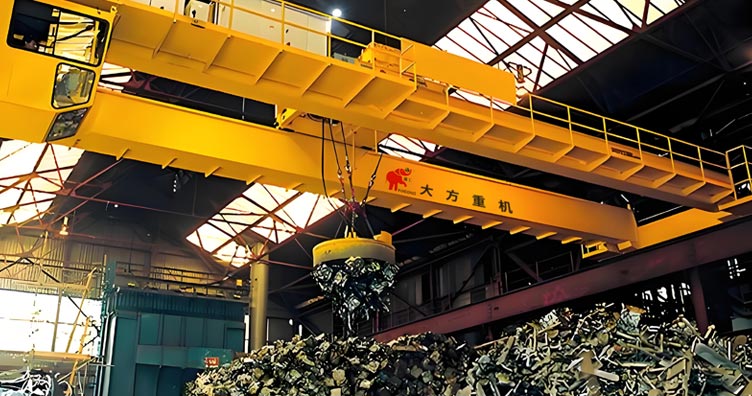
20 Ton QC Electromagnetic Overhead Crane
7. Installation & Site Conditions
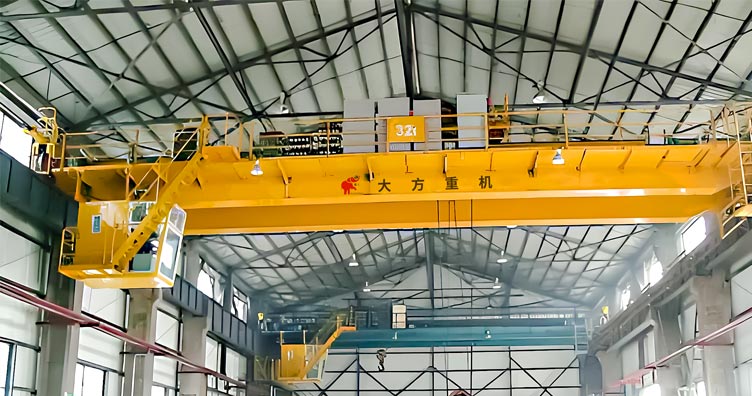
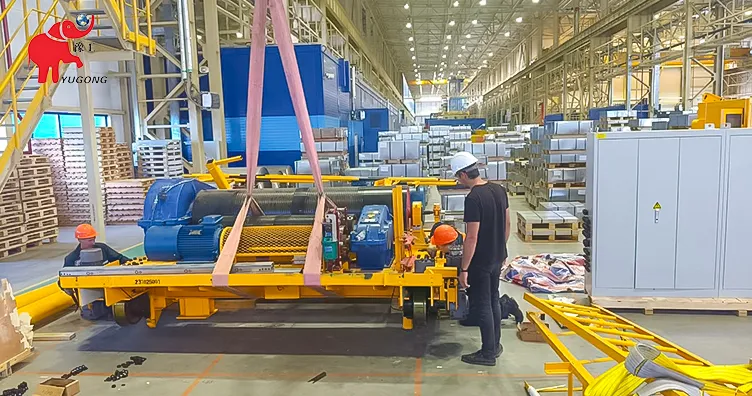
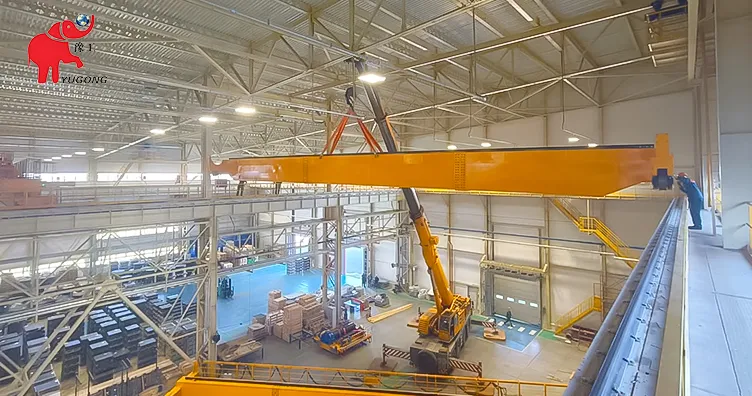
Installation is one of the most underestimated contributors to total overhead crane cost. The crane itself is only part of what you are buying. A complete installation budget should include:
- Runway Rails: Must be matched to crane wheel loading. Rail supply, welding, and alignment typically costs $3,000–$20,000+ depending on bay length and existing structure.
- Structural Assessment: Existing buildings may require reinforcement of columns, roof trusses, or foundations to handle crane loads. Cost ranges from minor ($2,000) to major ($50,000+).
- Electrical Supply: A dedicated electrical feed with correctly-rated disconnect, cable management (festoon or conductor bar), and earthing is mandatory. Budget $2,000–$8,000 for a typical single-crane installation.
- Erection & Commissioning: Labour cost for unpacking, lifting, bolting, wire-reeving, and load testing. $2,000–$15,000 depending on crane size and site conditions.
- Load Testing: Statutory in most markets — crane must be tested at 100% and 125% SWL with calibrated weights. Typically $500–$2,000 if conducted on-site.
Rule of thumb: budget 20–35% of crane ex-works value for site preparation and installation for a new facility. For an existing building with matching runway already installed, budget 10–15%.
8. After-Sales Service & Warranty
After-sales service terms affect both the purchase price and the total cost of ownership over the crane's 20–25 year design life. Key considerations for B2B buyers:
- Standard Warranty: 12 months on parts and workmanship is the export standard. Structural defects in a properly specified and installed crane are rare within this period.
- Extended Warranty (18–24 months): Adds approximately 2–5% to unit price. Value increases with duty class — for A6+ cranes, extended warranty reduces first-year maintenance exposure significantly.
- Spare Parts Availability: Ask for a critical spares list and price list with your quotation. Confirm whether parts ship from stock or require production lead time.
- Remote Diagnostic Support: Modern smart crane systems offer real-time monitoring via IoT gateway. Annual subscription typically $500–$2,000 — often recovers its cost from a single averted breakdown.
- On-Site Service Dispatch: Confirm whether the supplier can dispatch a technician to your country and at what cost. For remote sites, training local maintenance staff is essential.
Emergency Services
Maintenance Services
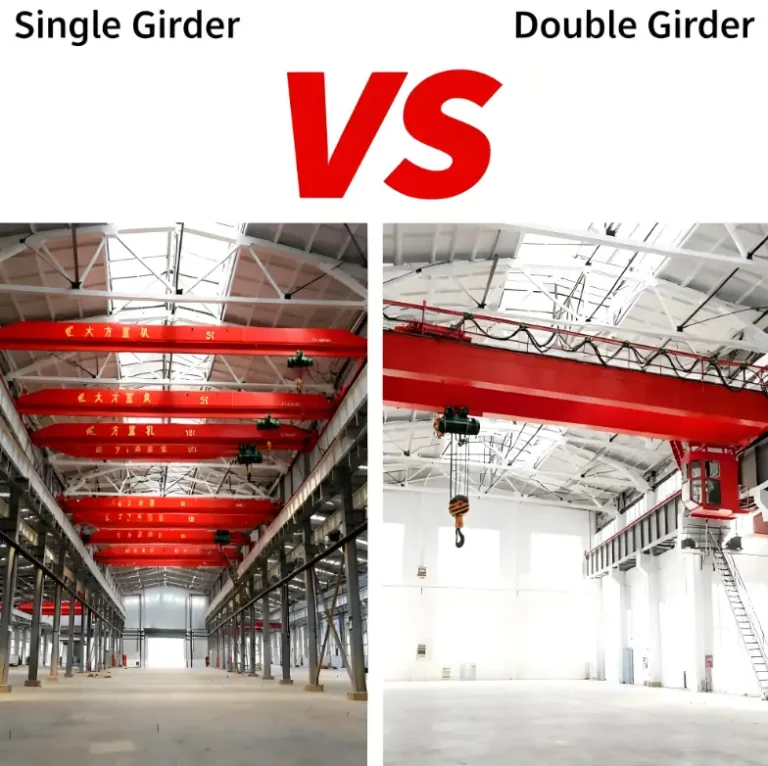
III. Single Girder vs Double Girder EOT Crane Price Difference
The choice between single and double girder construction is often the first and most significant structural decision in any crane procurement. It has a direct impact on overhead crane price, building headroom requirements, and long-term maintenance access. The table below provides a direct comparison across the most important procurement criteria.
| Feature | Single Girder | Double Girder | Buyer Guidance |
| Structure | One main beam + CD/MD hoist on lower flange | Two main beams + NE/wire rope hoist on trolley | Double girder standard for ≥20 t or spans ≥22 m |
| Price Premium | Baseline | +30 – 80% vs. equivalent single girder | Justify with duty cycle, not just capacity |
| Headroom Required | Less — hoist hangs below beam | More — trolley sits between girders | Check building height before specifying |
| Span Capability | Up to ~28 m efficiently | Up to 35+ m with good deflection control | Over 28 m: double girder almost always required |
| Hook Approach | Limited by hoist housing width | Better — hook can travel closer to columns | Critical for facilities with tight column spacing |
| Typical Use | Workshops, warehouses, light duty | Steel plants, shipyards, heavy manufacturing | Match to daily lift count + max load frequency |
The critical buyer insight is this: single girder is not simply a 'cheap' option — it is the correct option for its design envelope. Specifying a double girder crane for a 10-ton, 16 m application where A4 duty is all that is required adds 30–50% in cost with no operational benefit. Conversely, specifying single girder for a 25-ton, 30 m application creates a deflection problem that no amount of price saving can justify.
✅ When requesting quotations, ask suppliers to provide both single and double girder options for your capacity and span. The price difference will make the correct choice obvious for your specific application.
IV. New Vs. Used Overhead Crane — Is It Worth It?
The question 'is buying a used crane worth it?' comes up regularly in B2B procurement discussions. The short answer is: sometimes — but only under specific conditions, and only after a rigorous pre-purchase inspection. The table below maps the key decision criteria so buyers can assess their own situation objectively.
| Criterion | New Overhead Crane | Used / Refurbished Overhead Crane |
| Purchase Price | Full market price | 30–60% lower upfront — but inspect thoroughly |
| CE / ISO Status | Certified at point of sale | May lack current certification; re-certification costs $2,000–$8,000 |
| Remaining Life | Full design life (20–25 years) | Unknown without inspection report — risk of hidden fatigue damage |
| Lead Time | 20–35 days production + transit | Faster if local — but finding right spec is hit-or-miss |
| Warranty | 12 months standard; 18–24 months optional | Often none, or 30–90 days parts-only |
| Spare Parts | Guaranteed availability from manufacturer | Obsolete parts risk — especially for 10+ year old units |
| Hidden Cost Risk | Low — full spec agreed before production | High — inspection, transport, re-commissioning, upgrades often add 20–40% |
| Verdict | Preferred for new facilities and A5+ duty | Consider only for A3–A4 duty, domestic sourcing, and when budget is fixed |
The crane overhead ROI calculation changes significantly when you factor in used crane risks. A used 10-ton crane at $8,000 that requires $3,000 for re-certification, $2,000 for a new hoist rope, $1,500 for brake relining, and $5,000 for re-commissioning has an effective cost of $19,500 — potentially more than a new CE-certified unit delivered ex-works. Run the full landed cost calculation before committing.
How long does an overhead crane last? A properly specified, correctly maintained crane has a design life of 20–25 years. The overhead crane lifespan is determined less by calendar age than by duty class adherence and maintenance quality. A used crane with poor maintenance records at 10 years may have less remaining structural life than a well-maintained 15-year-old unit.
⚠️ Never buy a used crane without: (a) an independent structural inspection report, (b) a full electrical safety check, and (c) confirmation of the original duty class specification and actual operating history.
V. How to Get the Best Overhead Crane Price from Suppliers?
Getting the best overhead crane quotation is not about finding the lowest number — it is about getting the most accurate price for a correctly specified crane, with all site costs included, from a supplier who can actually deliver on their commitments. Follow this pre-RFQ checklist before approaching any supplier.
| ✅ Define your REAL max SWL — include hooks, slings, spreaders ✅ Measure span and lift height on-site, not from drawings ✅ Count actual daily/weekly lift cycles before fixing duty class ✅ Decide control mode before RFQ — changes cost significantly ✅ Request itemised quotation (hoist, beam, controls separately) | ✅ Compare ≥3 suppliers on identical spec — not on headline price ✅ Request CE certificate + test report as part of the contract ✅ Include installation, commissioning, training in contract scope ✅ Ask for spare parts price list and local stocking availability ✅ Confirm Incoterms — FOB vs DAP affects total landed cost by 15–25% |
Three additional negotiating points that most buyers overlook:
- Request an itemised bill of materials (BOM) — not just a headline price. This allows genuine apple-to-apple comparison between suppliers and reveals where each one is making their margin.
- Order spare parts in the same purchase order as the crane. Suppliers bundle their best price on first-purchase spares; standalone spare parts orders later are always priced at full margin.
- Negotiate the payment terms as carefully as the price. Standard is 30% deposit, 70% before shipment. For larger orders, requesting a letter of credit (LC) at sight gives you documentary protection without paying more.
How to reduce overhead crane cost without compromising safety: the most effective lever is duty class accuracy. Most buyers over-specify by one class. A correctly specified A4 crane will outperform a mistreated A5 unit every time.
VI. Hidden Overhead Crane Costs to Watch Out For
Every experienced B2B buyer has a story about an overhead crane purchase where the 'cheap' quote became the expensive delivery. The table below identifies the nine most common hidden costs in international crane procurement and how to mitigate each one before signing a purchase order.
| Hidden Cost Item | Typical Range (USD) | Frequency | Mitigation |
|---|---|---|---|
| Runway rail supply & installation | $3,000 – $20,000+ | Always | Confirm rail spec with supplier before signing PO |
| Electrical supply cable & festoon | $800 – $4,000 | Always | Include in RFQ scope clearly |
| Import duty & port handling | $1,500 – $8,000 | International | Request HS code from supplier; verify duty rate in advance |
| Inland freight to site | $500 – $5,000 | Always | Get DAP quote; compare vs FOB + local freight |
| Crane installation & commissioning | $2,000 – $15,000 | Always | Include in supplier scope or get local rigger quote |
| Structural modifications to building | $5,000 – $50,000+ | New buildings | Share crane load data with structural engineer early |
| Re-certification in destination country | $2,000 – $8,000 | Some markets | Confirm acceptable certs (CE/GOST/AS) before ordering |
| Operator training | $500 – $2,000 | First purchase | Include in supplier contract; request training manual |
| Spare parts initial stock | $1,000 – $5,000 | Recommended | Order consumables (brake pads, hoist rope) with crane |
The most common single hidden cost trap is runway rails. Many buyers assume the supplier's 'crane price' includes rails — it almost never does. The second most common is building structural modification: a 20-ton crane on a structure designed for 5 tons requires engineering assessment and potentially major reinforcement before the crane can safely operate.
VII. Ready to Get an Accurate Overhead Crane Price?
Overhead crane price is not a catalogue number — it is the output of a technical specification process. The buyers who get the best value are the ones who arrive at the RFQ stage with a clear specification, a realistic site survey, and an understanding of what drives cost in each technical parameter.
Dafang Crane's engineering team provides free specification consultation and itemised quotations for all qualified project inquiries. We work with B2B buyers in 60+ countries across manufacturing, logistics, energy, port handling, and special industries. Share your application details and we will return a complete technical proposal with FOB pricing within 24 hours.

VIII. Price Factor Summary
The table below ranks all five factors by their typical impact on total crane cost and provides one-line procurement guidance for each.
| Factor | Price Lever | Key Guidance |
| Lifting Capacity | ★★★★★ (Highest) | Every doubling of capacity ≈ +40–80% cost; spec only what you need |
| Span | ★★★★☆ | Each +1 m span adds beam weight; specify to nearest 0.5 m |
| Lifting Height | ★★★☆☆ | Affects hoist drum, rope, end travel length; review carefully for new buildings |
| Duty Class | ★★★★☆ | Going A5→A6 can add 30–40%; audit daily cycle count before specifying |
| Brand & Config | ★★★☆☆ | CE standard export covers most markets; premium brands add 20–50% for hoists |
IX. Making a Smarter Overhead Crane Buying Decision
The most expensive overhead crane is not necessarily the most suitable one. Over-specification is as costly — in capital terms — as under-specification is in maintenance and downtime. Before issuing an RFQ, every B2B buyer should confirm: the true maximum load including all attachments; the actual building span to the nearest 0.5 m; the required hook height under realistic load conditions; a genuine daily cycle count to determine duty class; and the certification and after-sales support requirements for the destination country.
Dafang Crane's engineering team provides free specification consultation for qualified project inquiries. Share your application details and we will return a detailed technical proposal within 24 hours.
X. Frequently Asked Questions — Overhead Crane Price
Q1: How much does a 5-ton overhead crane cost?
A 5-ton single-girder overhead crane typically costs $5,000–$12,000 ex-works from a CE/ISO-certified Chinese manufacturer in 2025, depending on span, hoist type, and control configuration. Total landed cost to a major import port, including freight and basic import duty, is typically $7,000–$16,000.
Q2: Why are overhead cranes so expensive compared to other industrial equipment?
Overhead cranes are custom-engineered capital equipment with a 20–25 year design life. Every unit is assembled from a specific combination of structural steel, precision mechanical components (hoist, gearbox, brakes), and electrical systems matched to the application. Unlike standard machinery, there is no mass-produced 'off-the-shelf' overhead crane — every build starts with the buyer's specification.
Q3: What is the cost per ton of an overhead crane?
Overhead crane price per ton varies from approximately $1,000–$2,500/ton for standard single-girder units (5–20 ton range) to $1,300–$2,600/ton for double-girder cranes in the 20–50 ton range. The cost-per-ton metric is useful for rough budgeting only — always request a quotation based on your exact specification.
Q4: Is a Chinese overhead crane cheaper than a European brand, and is quality comparable?
Chinese manufacturers typically offer 30–50% lower ex-works prices for CE/ISO-certified cranes with equivalent structural and electrical specifications. For A3–A5 duty applications without stringent OEM service requirements, quality and service life are comparable. For A6+ duty or EPC projects requiring European brand service networks, premium brands are justified.
Q5: What is the total cost of ownership for an overhead crane over 20 years?
Total overhead crane operating cost over 20 years typically amounts to 2–4× the initial purchase price, including maintenance, inspections, consumable parts (brake pads, wire rope, hoist blocks), and occasional major overhauls. Higher duty-class cranes have higher maintenance costs but also generate more productive output — overhead crane ROI should always be calculated on a throughput basis, not cost alone.