






Table of Contents
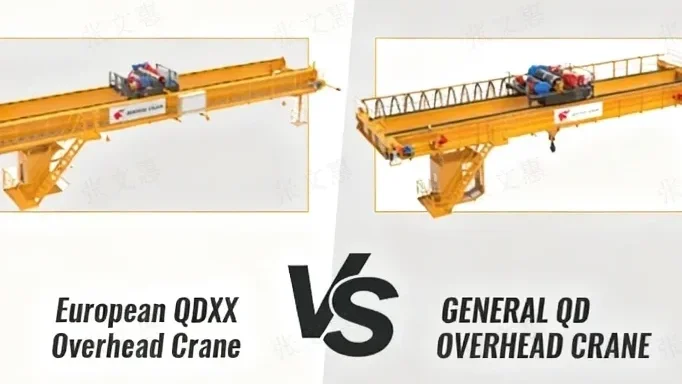
European double girder overhead cranes follow FEM/ISO/DIN standards — lighter, quieter, and more precise than traditional QD-type designs, which conform to GB/T 14405. European models save 20–35% energy and last 20–25 years; QD types cost less upfront but carry higher long-term maintenance expense. Choose European for precision, low headroom, or export compliance. Choose QD for budget-constrained heavy-duty or rough-environment operations.
1. Why Choosing Between European and QD-Type Overhead Crane
The decision between a European-standard double girder overhead crane and a traditional QD-type model shapes production efficiency, energy cost, and facility compatibility for the next 15–25 years. Both crane types carry loads — but their structural philosophy, performance envelope, and total cost of ownership diverge sharply from the first day of operation.
European models follow FEM 1.001, ISO 4301, and DIN standards, prioritising lightweight precision design. QD-type cranes conform to GB/T 14405 Chinese national standards, built for durability and lower entry cost in rough-duty environments. Understanding where each design excels prevents costly over-specification or underperformance.
2. Core Design and Structural Differences
The structural philosophy separating these two crane families determines nearly every downstream performance outcome:
European Double Girder Overhead Crane — Lightweight Precision
European-standard cranes use thin-web, high-strength steel box girders that weigh 15–30% less than QD equivalents at the same rated capacity. The compact three-in-one integrated drive (motor, reducer, brake in a single housing) eliminates the coupling and gearbox shaft of traditional split-drive systems. As a result, the trolley sits lower on the girder, recovering 300–800 mm of usable hook height in the same building — a critical advantage in facilities with fixed headroom.
Traditional QD-Type Double Girder Crane — Robust and Universal
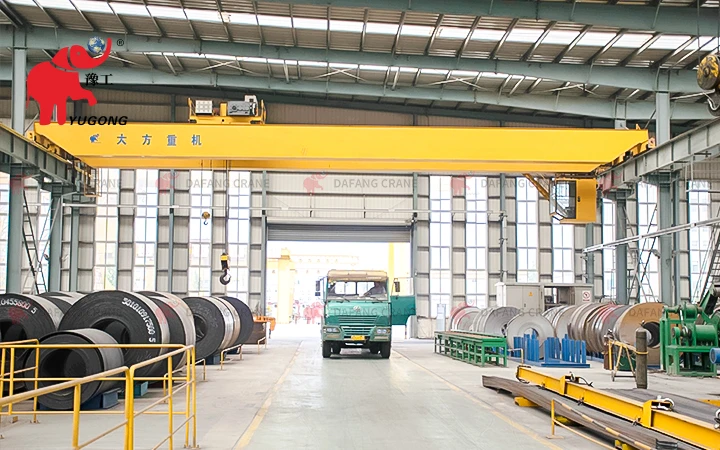
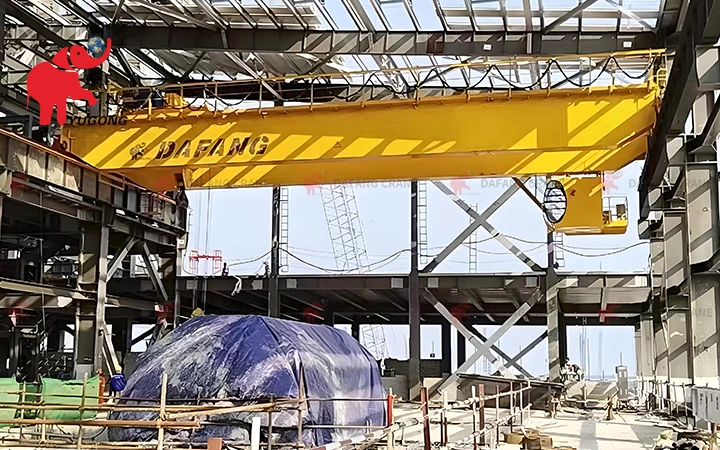
QD-type cranes use heavy box-section girders with conservative structural margins, designed for long service in dusty, high-temperature, or vibration-intensive environments such as steel mills, foundries, and material yards. The split drive train (motor + coupling + gearbox + drive shaft) is field-repairable with standard tools. However, the higher structural mass and larger cross-section impose greater wheel loads on the runway beam — often triggering reinforcement requirements in older buildings.
Rooted in FEM, ISO, and DIN standards, it follows the principles of lightweight, compactness, and precision. It integrates advanced manufacturing technologies to prioritize energy efficiency, low noise, and modular maintenance, catering to modern industrial needs.
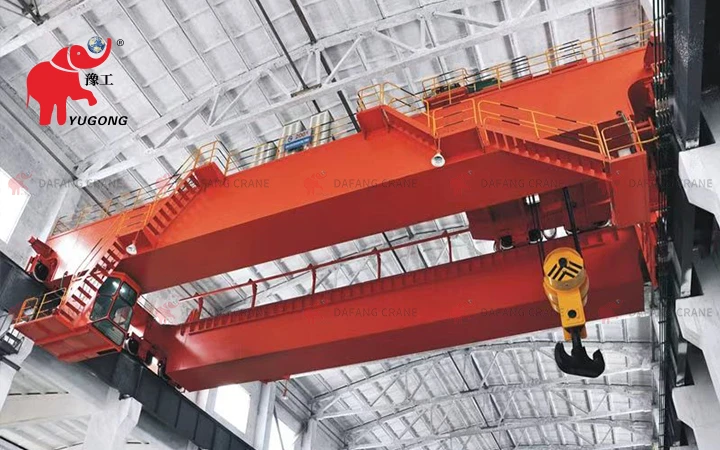
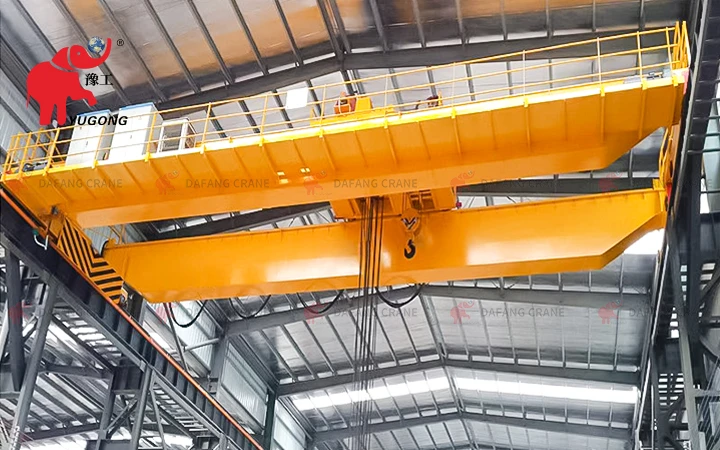
3. Performance Comparison: 15 Key Criteria
The table below covers 15 decision-relevant criteria with a direct edge assessment for each (EU = European; QD = QD-type; Depends = context-specific):
| Comparison Criterion | European Double Girder Crane | QD-Type Double Girder Crane | Edge |
|---|---|---|---|
| Design standard | FEM 1.001, ISO 4301, DIN standards | GB/T 14405 Chinese national standard | EU ✓ |
| Main girder weight | 15–30% lighter — high-strength steel, thin-web box section | Heavy box section; thick plate; conservative sizing | EU ✓ |
| Hook height (same building) | Higher usable hook height — low-profile compact trolley sits on top of girder | Lower usable height — hoist underslung; tall cross-section reduces headroom | EU ✓ |
| Wheel load on runway | Low — typically no runway beam reinforcement needed for existing buildings | High — older facilities often require structural reinforcement | EU ✓ |
| Drive mechanism | Three-in-one integrated motor (motor + reducer + brake); compact | Split: motor + coupling + gearbox + drive shaft; more components | EU ✓ |
| Speed control | Full VFD on all axes; smooth start/stop; no mechanical shock | Single-speed or dual-speed wound-rotor; noticeable jerk at start/stop | EU ✓ |
| Positioning accuracy | ±5 mm with micro-creep speed | ±20–50 mm typical; visible load swing | EU ✓ |
| Noise level | ≤75 dB operating noise | Higher mechanical noise and vibration | EU ✓ |
| IP protection | IP55–IP65 on electrical enclosures | IP44 standard | EU ✓ |
| Energy consumption | 20–35% lower than equivalent QD — VFD regeneration + lighter mass | Higher energy draw; significant reactive power loss | EU ✓ |
| Design service life | 20–25 years; low failure rate with modular maintenance | 15–18 years; more wear-prone components | EU ✓ |
| Maintenance workload | Modular; few lubrication points; service intervals longer | Many discrete components; significant lubrication and adjustment workload | EU ✓ |
| Headroom demand | Low — compact trolley saves 300–800 mm vs QD equivalent | Higher — requires greater floor-to-ceiling clearance | EU ✓ |
| Initial purchase cost | 30–50% higher than QD equivalent capacity | Lower entry cost; most affordable per-ton capacity | QD ✓ |
| Suitable environment | Precision workshops, new buildings, low headroom, export projects | Steel mills, foundries, material yards, rough heavy-duty sites | Depends |
Edge assessment is operational, not commercial. 'EU ✓' indicates European design delivers a measurable technical advantage on that criterion. 'QD ✓' indicates QD-type delivers a clear cost or application advantage. Performance data sourced from FEM 1.001, GB/T 14405, and manufacturer technical documentation.
4. Structural & Performance Differences
The structural design directly impacts operational efficiency and adaptability. Here’s a detailed breakdown:
| Comparison Items | European Double Girder Bridge Crane (NLH/European) | Standard QD-Type Traditional Double Girder Bridge Crane |
|---|---|---|
| Design Standards | FEM European Standards, ISO, DIN Standards | Chinese National Standard GB/T 14405, Traditional Mechanical Design Standards |
| Overall Structure | Lightweight box-type main girder with a low cross-section and thin web | Heavy-duty box-type main girder, with a large cross-section and thick plates |
| Total Machine Weight | 15%–30% lighter than models of the same tonnage, using high-strength steel | Heavy weight, bulky structure, thick plates for main girder |
| Factory Clearance Requirements | Low clearance, compact trolley height, saving factory floor-to-ceiling height | High clearance requirements, occupies more upper factory space |
| Wheel Load | Low wheel load; no reinforcement required for older factory buildings | High wheel load; existing facilities often require structural reinforcement |
| Drive mechanism | Integrated and Compact. Integrated three-in-one motor (motor + reducer + brake) | Split design: motor + coupling + gearbox + drive shaft |
| Speed control | Full variable-frequency control; smooth start/stop with no impact | Single-speed/dual-speed wound-rotor motors; significant jerking during start/stop |
| Positioning accuracy | ±5mm High-precision micro-movement; positioning error ±5 mm | Rough positioning, noticeable wobble, large error range |
| Operating Noise | Low noise (≤75dB), smooth operation | Relatively high noise, noticeable mechanical vibration |
| Protection Rating | Electrical IP55–IP65, excellent dust and water resistance | Standard IP44, average protection rating |
| Walkway Design | No wide external walkway, simple and compact | Standard wide maintenance walkways on both sides + guardrails |
| Control Method | Standard: Inverter + Remote Control + Operator Cab | Standard: Operator Cab, optional basic remote control |
| Energy Efficiency | 20%–35% energy savings, long-term power savings | High energy consumption, significant reactive power loss |
| Service Life Design life | 20–25 years, extremely low failure rate | Design life: 15–18 years, many wear-prone parts |
| Maintenance Difficulty | Modular integration, few maintenance points, simple and time-saving | Many separate components; significant lubrication and maintenance workload |
| Appearance and Design | Simple, neat, and industrially stylish | Rugged and traditional; exposed, cluttered structure |
| Suitable Facilities | New facilities, limited ceiling height, precision workshops, export projects | Old facilities, ample ceiling height, heavy-duty workshops |
| Purchase Price | 30%–50% more expensive than standard models | Lower initial purchase price; best entry-level value |
| Total Cost of Ownership | Higher upfront cost, but lower long-term electricity and maintenance expenses, resulting in lower total cost. | Lower upfront cost, but higher long-term electricity consumption and maintenance expenses. |
| Suitable Applications | Precision manufacturing, new energy, export-oriented businesses, smart warehousing | Steel mills, roughing shops, material yards, general machining |
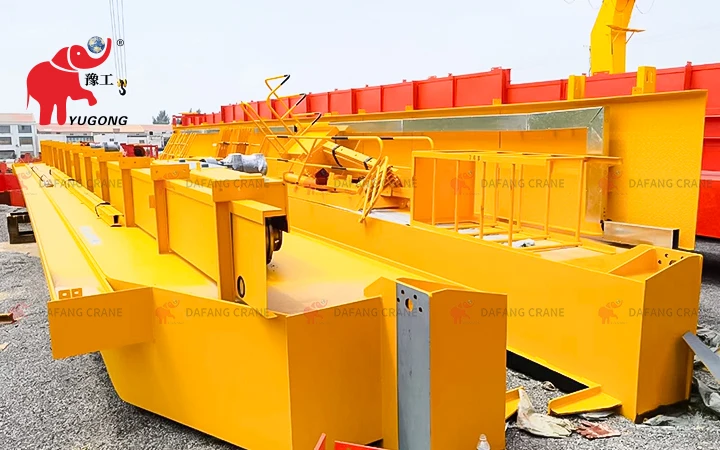
European QDXX Crane Beams
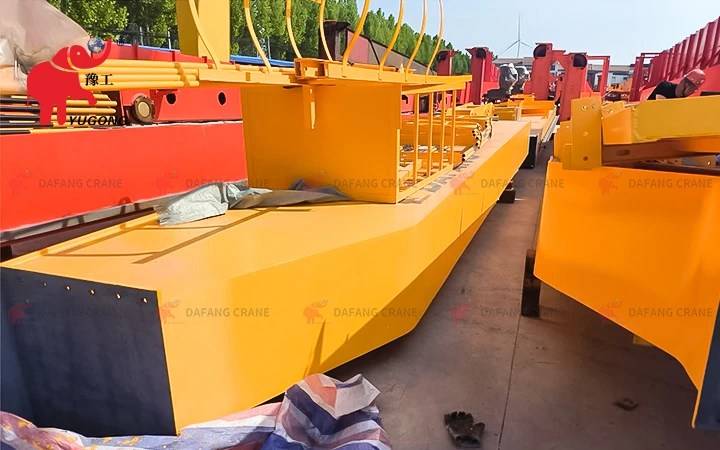
General QD Crane Beams
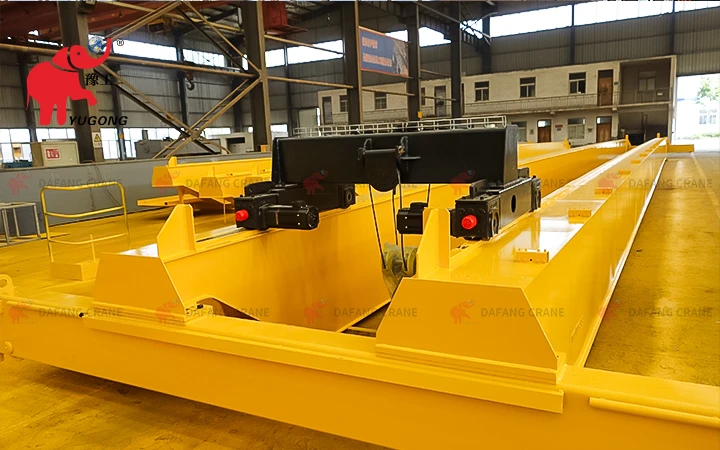
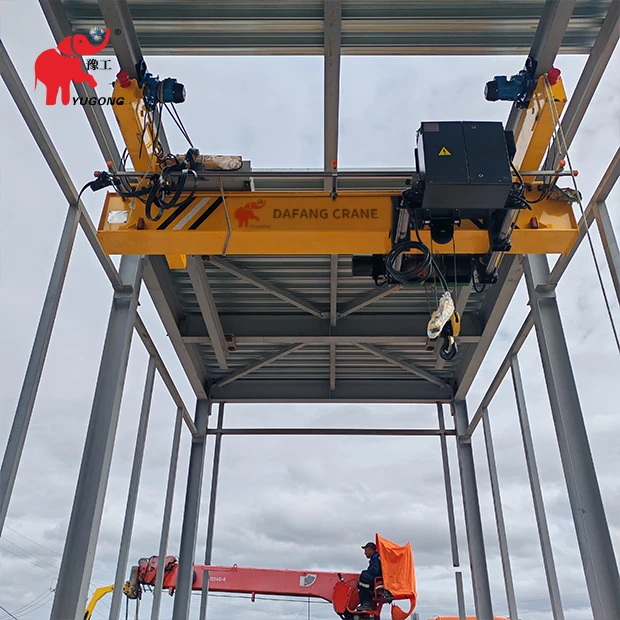
European QDXX Crane Trolley
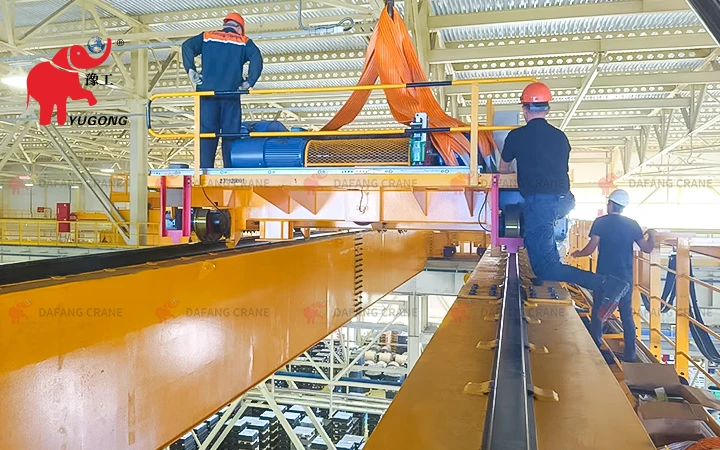
General QD Crane Trolley
5. Which Crane Type Suits Your Application?
European Double Girder Crane: Ideal For
- New factory buildings or workshops with limited headroom where every usable millimetre of hook height matters.
- Precision manufacturing, equipment assembly, EV battery production, and new energy applications (wind turbine, photovoltaic) where ±5 mm positioning is a process requirement.
- Automated production lines and smart warehouses where PLC integration, inverter control, and encoder feedback are prerequisites.
- Export-oriented facilities or joint-venture factories requiring FEM/ISO/DIN certification for client or regulatory compliance.
QD-Type Double Girder Crane: Ideal For
- Existing buildings with sufficient headroom and no structural reinforcement budget for higher wheel loads.
- Steel mills, foundries, scrap yards, and raw material handling where rough conditions and high dust levels demand conservative IP44-standard, serviceable designs.
- Budget-constrained projects or temporary installations where lowest initial acquisition cost is the primary constraint.
- High-temperature or corrosive environments where existing maintenance teams are trained on traditional drive systems.
6. Energy Consumption and Total Cost of Ownership
Total cost of ownership over a 10-year horizon often reverses the initial price advantage of QD-type cranes. Three factors drive this:
- Energy saving — variable-frequency drives on European models reduce motor energy draw by 20–35% versus wound-rotor motors on QD-type. For a crane running 2,000 hours per year at 30 kW average draw, this represents substantial annual electricity saving depending on local tariff.
- Maintenance workload — European modular drives have fewer lubrication points and longer service intervals. QD-type split drive trains require more frequent coupling alignment, gearbox oil changes, and brake adjustment — workload that adds up in facilities without dedicated crane maintenance staff.
- Design life — European models are rated 20–25 years at FEM duty class; QD-type typically 15–18 years under equivalent cycle rates. The longer replacement cycle reduces capital expenditure frequency.
The crossover point — where European total cost drops below QD total cost — typically falls at 5–8 years of two-shift operation, depending on energy tariff and maintenance labour rate. For short-term projects or low-utilisation environments, the QD-type's lower entry cost remains the practical choice.
7. Cost Comparison: Initial vs Long-Term Investment
Purchase Price (2026 Market Quotation)
| Capacity | European Double Girder Crane ($) | Traditional QD-Type Crane ($) |
|---|---|---|
| 5T | 35,000–70,000 | 25,000–35,000 |
| 10T | 45,000–65,000 | 32,000–45,000 |
| 20T | 72,000–115,000 | 50,000–72,000 |
| 50T | 142,000–258,000 | 100,000–172,000 |
Long-Term Operating Cost
- European Model: Saves 20%–35% energy, design life 20–25 years, 50% less maintenance work. Lower total cost of ownership over 5–10 years.
- Traditional Model: Higher energy consumption, design life 15–18 years, frequent replacement of wearing parts. Higher long-term maintenance and energy costs.
8. Quick Decision Guide
Key Factors for Decision-Making
- Factory Conditions: Choose European if headroom is limited; traditional if space is sufficient.
- Work Requirements: European for precision, stability, and automation; traditional for heavy-load, rough operations.
- Budget & Cycle: Traditional for short-term, low-budget projects; European for long-term cost savings.
- Export Needs: European complies with FEM/ISO standards for overseas markets.
Use the matrix below as a first filter before requesting a detailed crane specification:
| Choose European Double Girder if… | Choose QD-Type if… |
|---|---|
| Building headroom is limited or fixed | Existing building has ample ceiling height |
| Positioning accuracy below ±10 mm is required | Operation is heavy-duty with low precision requirements |
| The crane must comply with FEM/ISO/DIN for export | Project is domestic with GB/T 14405 acceptance |
| Energy saving over a 5–10 year horizon is a priority | Budget is constrained and short payback is required |
| Integration with automation or PLC-controlled lines is planned | Environment is dusty, high-temp, or corrosive at IP44 level |
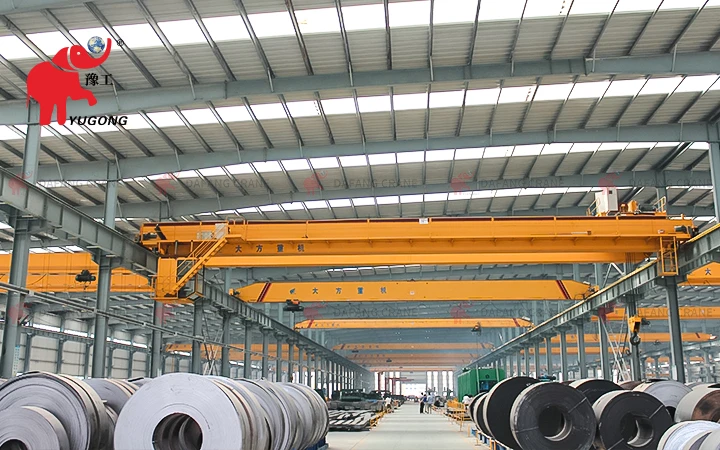
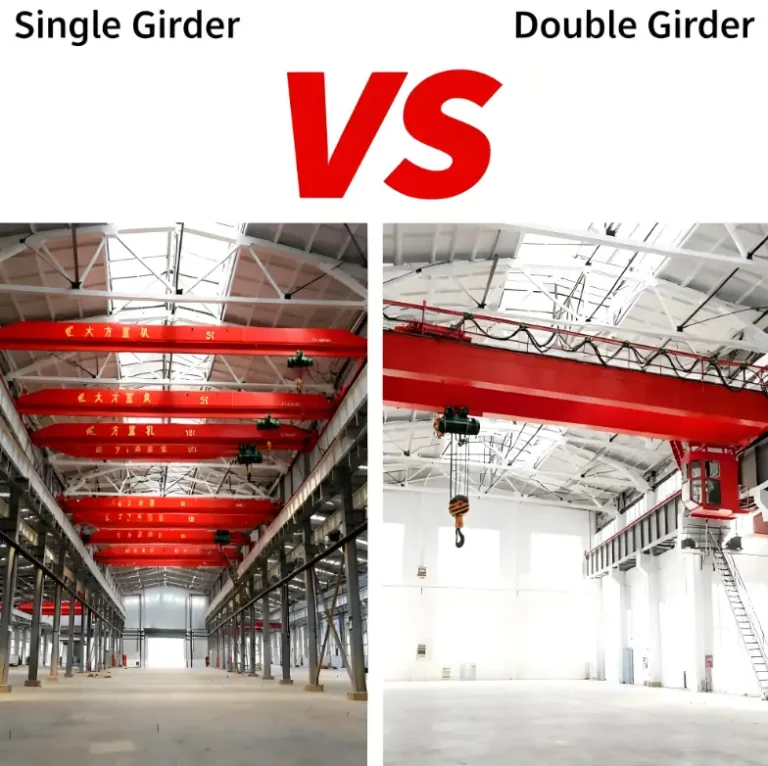
European QDXX Overhead Crane
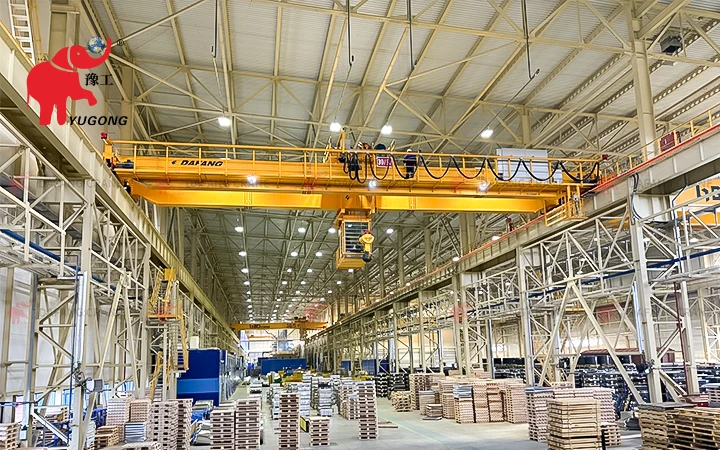
Traditional QD Overhead Crane
9. How Dafang Supplies Both European-Standard and QD-Type Cranes?
Henan Dafang Crane manufactures both European-standard double girder overhead cranes (compliant with FEM 1.001, ISO 4301, and CE-certified under Machinery Directive 2006/42/EC) and traditional QD-type double girder cranes (per GB/T 14405). Both product lines share the same structural steel specification discipline — FEA-verified main girder deflection ≤ L/1000 at rated load — and ship with full CE and ISO 9001:2015 documentation.
For clients who are undecided, Dafang's engineering team runs a facility review covering building headroom, runway beam load capacity, annual operating hours, and required positioning accuracy — then recommends the type and duty class that delivers the lowest 10-year total cost for the specific application.
10. Dafang — Your Final Double Girder Overhead Crane Selection Choice
Henan Dafang Crane designs and manufactures European-standard and QD-type double girder overhead cranes, gantry cranes, grab bucket cranes, and electric transfer carts from its integrated Henan production base. The company delivers CE-certified, FEA-verified lifting equipment to clients in more than 30 countries. Contact the Dafang engineering team for a facility review, crane type recommendation, or a full technical and commercial proposal.
The European double girder crane excels in efficiency, precision, and long-term economy, making it the top choice for modern, high-standard production. The traditional QD-type crane remains reliable for budget-constrained, rough working environments. Evaluate your actual needs—factory space, operational precision, budget, and long-term plans—to select the optimal model.

11. Frequently Asked Questions
What is the main structural difference between European and QD-type double girder cranes?
European cranes use thin-web high-strength steel girders and an integrated three-in-one drive, weighing 15–30% less at the same capacity. QD-type uses heavy conservative box girders and a split drive train — simpler to field-repair but heavier and taller.
Can a European double girder crane fit in a building designed for a QD-type?
Often yes, with headroom to spare. The compact European trolley profile recovers 300–800 mm of hook height compared with a QD-equivalent in the same building. However, runway beam spacing and rail gauge must match the European crane's wheel base — verify before ordering.
How much energy does a European crane save versus a QD-type?
VFD-controlled European models consume 20–35% less electricity than wound-rotor QD equivalents at equivalent duty. Actual saving depends on load profile, daily operating hours, and local electricity tariff. For high-utilisation facilities, this margin compounds significantly over the crane's 20–25 year design life.
Which crane type meets CE export certification requirements?
European-standard cranes certified to FEM 1.001, ISO 4301, and CE Machinery Directive 2006/42/EC satisfy EU and most international export documentation requirements. QD-type cranes built to GB/T 14405 require additional certification steps for export markets that mandate CE marking.
Is the QD-type crane still being manufactured, or is it being phased out?
QD-type cranes remain in active production and are widely specified for domestic Chinese heavy-industry applications, particularly in steel, mining, and foundry sectors where their robustness and serviceability outweigh the performance advantages of European-standard designs.