






Global container trade moves through a relatively small number of critical infrastructure systems. Among these, container cranes are the machines that determine how fast a terminal can load and discharge vessels, how densely containers can be stored in the yard, and how efficiently cargo flows between ship, stack, and landside transport. When a terminal's crane system is mismatched to its operational requirements, throughput suffers — regardless of how well everything else is managed.
Container cranes are specialized lifting machines designed for loading, unloading, transporting, and stacking shipping containers in ports, terminals, and logistics yards. They improve container handling efficiency through advanced lifting, traveling, and positioning systems.
Modern container terminals use four primary crane types, each suited to a different operational role: Ship-to-Shore cranes (STS) for quayside vessel operations, Rubber Tyred Gantry cranes (RTG) for flexible yard stacking, Rail Mounted Gantry cranes (RMG) for high-density automated stacking, and Container Straddle Carriers for integrated lifting and horizontal transport. Understanding how each type works, where it performs best, and how it compares to alternatives is the foundation of sound terminal equipment planning.
Tabla de Contenidos
What Are Container Cranes
Definición
Container cranes are purpose-engineered lifting and handling machines designed for the specific dimensional and operational requirements of ISO shipping containers — primarily 20-foot (TEU) and 40-foot (FEU) units, with some terminals also handling 45-foot and high-cube variants. Unlike general industrial cranes, container cranes are designed around the spreader — a telescopic lifting frame that locks onto the corner castings of containers to provide a secure, standardized connection for every lift.
Main Functions
Container cranes perform four distinct operational functions within the terminal container handling chain:
- Ship unloading and loading. Quayside cranes transfer containers between vessel hatch positions and the terminal yard — the most time-critical operation in the terminal cycle, directly affecting vessel turnaround time and berth productivity.
- Container yard stacking. Yard cranes stack containers in defined storage blocks, managing the yard inventory to maximize density while maintaining accessibility for retrieval.
- Container transfer. Straddle carriers and horizontal transport vehicles move containers between the quayside crane handoff point and the yard crane working area.
- Terminal operation efficiency. The combined performance of all crane types in the terminal determines overall throughput — measured in TEU moves per hour, vessel moves per crane per hour, and annual terminal capacity.
Key Crane Systems
- Hoisting system. The spreader engages the container corner castings through twist-lock mechanisms. Wire rope or hydraulic systems raise and lower the spreader and load. Hoisting motor capacity is selected for rated load plus spreader weight at the required lifting speed. Anti-sway control systems — active or passive — reduce container swing during travel, improving positioning speed and safety.
- Traveling system. STS and gantry cranes travel on steel rails. RTG cranes travel on rubber tires. Straddle carriers are self-propelled on solid rubber tires with all-wheel steering. Travel speed and acceleration characteristics directly affect cycle time and throughput.
- Control system. Modern container cranes use PLC-based control with anti-sway algorithms, semi-automatic or fully automatic spreader landing, and operator assistance systems. Automated container cranes add machine vision, laser positioning, and real-time communication with terminal management systems for fully automated operation without cab-based operators.
Overview of 4 Main Types of Container Cranes
| Tipo de grúa | Aplicación principal | Movement Method | Typical Location |
|---|---|---|---|
| Grúa STS | Vessel loading and unloading | Rail travel along quay | Quayside berth |
| Grúa RTG | Container yard stacking and retrieval | Rubber tire travel between blocks | Container yard |
| Grúa RMG | High-density yard stacking, automation | Rail travel within fixed block | Container yard, intermodal terminals |
| Portaequipajes | Container transport and stacking | Self-propelled rubber tire, all-wheel steering | Yard and quay transfer zones |
Grúa de barco a tierra (Grúa STS)
What Is an STS Crane
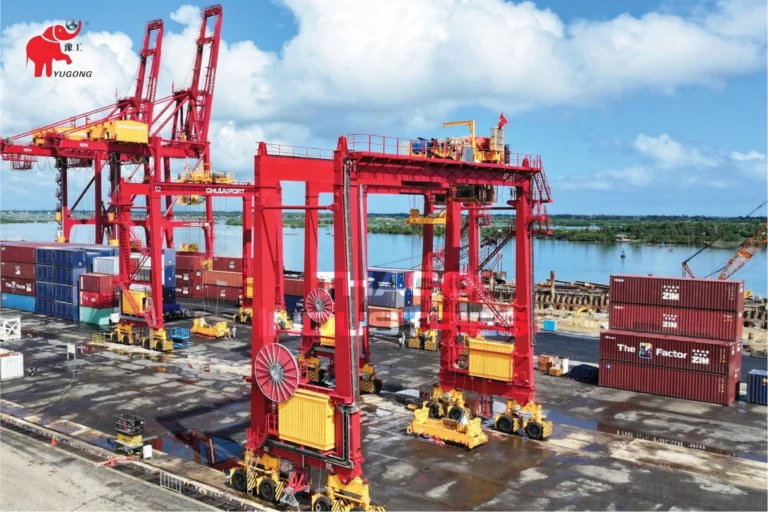
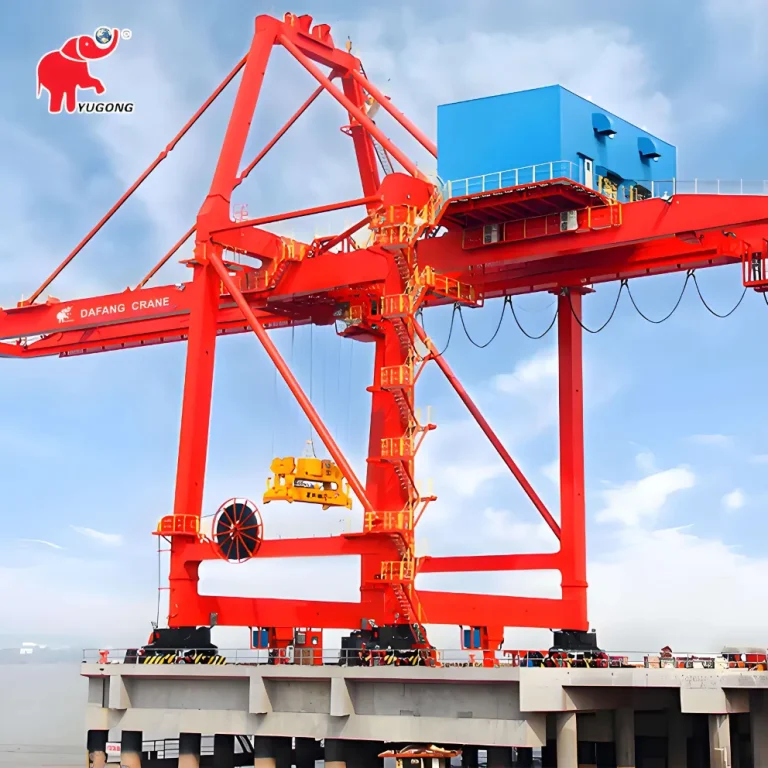
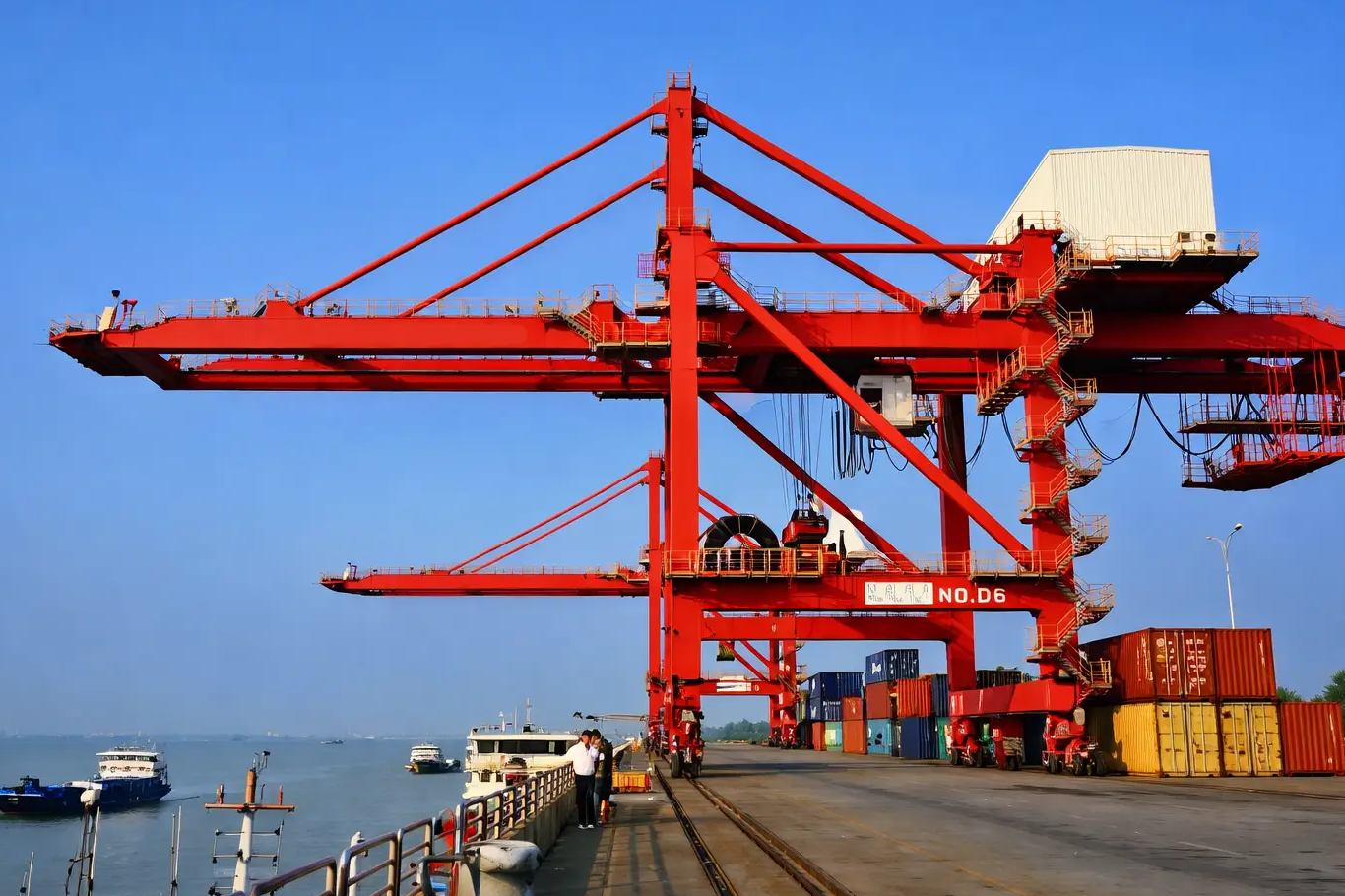
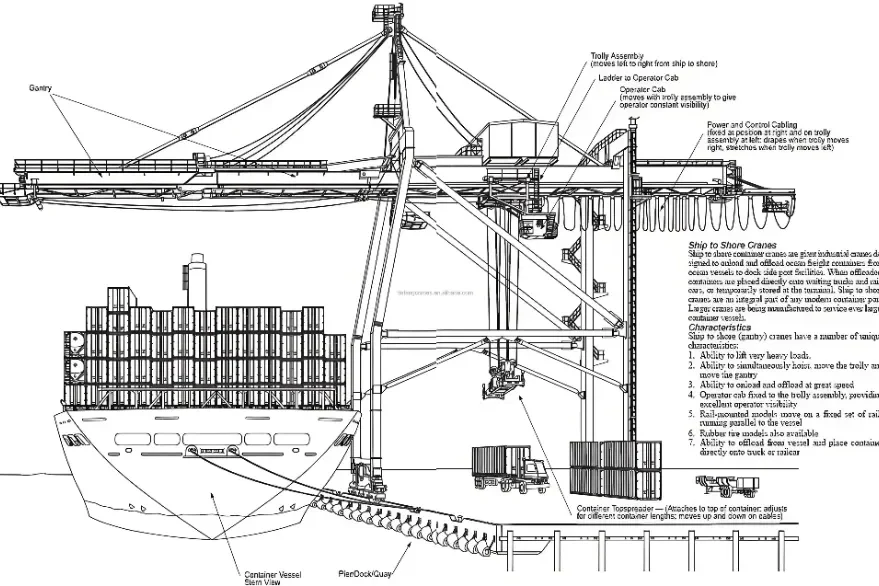
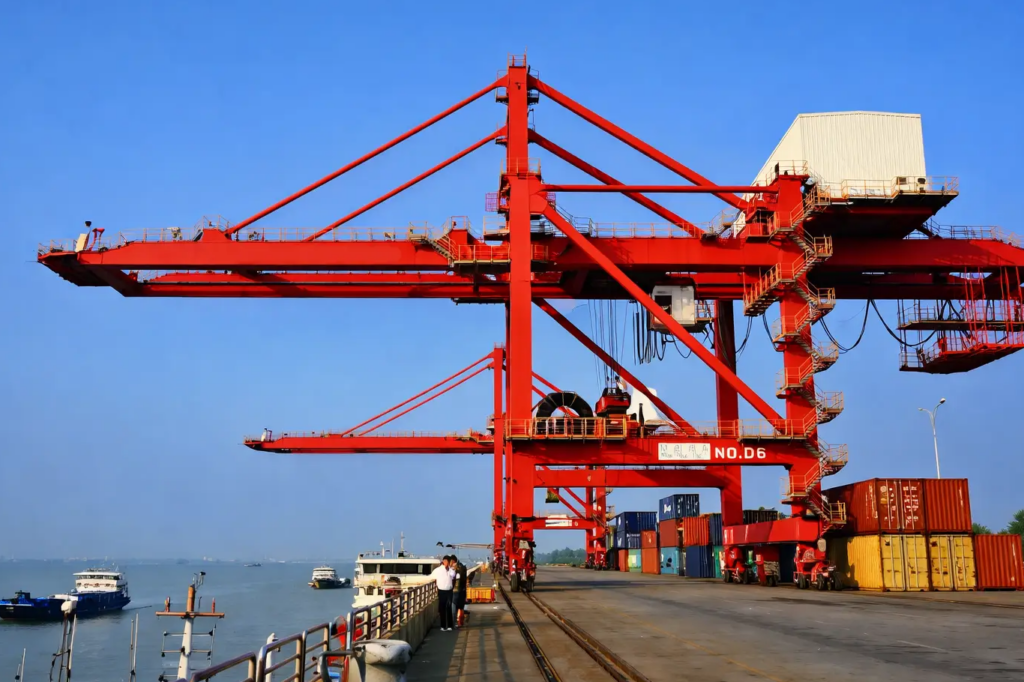
A Ship-to-Shore crane — also called a quay crane or STS gantry crane — is a large rail-mounted gantry crane positioned at the quayside berth for direct container exchange between vessels and the terminal. It is the largest and most capital-intensive piece of equipment in a container terminal, and its productivity — measured in container moves per crane per hour — is the primary constraint on vessel turnaround time.
Modern STS cranes are designed for the world's largest container vessels. Ultra-large container ships (ULCS) carry 20,000 TEU or more and have beam widths requiring crane outreach of 70 meters or beyond to reach the outermost container rows. Lifting heights above the quay of 50 meters or more are standard for vessels with 25 or more container tiers above deck.
Estructura y principio de funcionamiento
- Boom structure. The STS crane boom extends horizontally over the vessel when lowered for operation and raises to a near-vertical position when vessels are approaching or departing the berth. The boom is supported by a rope system from the upper portal structure and is counterbalanced to minimize the structural loads on the portal frame during raising and lowering.
- Trolley mechanism. The crane trolley travels along the boom rail, carrying the spreader from the ship's hatch position to the handoff point on the quay — where it transfers the container to a horizontal transport vehicle or directly to a yard crane. Trolley speed and acceleration determine the crane's cycle time and directly affect moves-per-hour performance.
- Spreader system. The telescopic spreader adjusts to fit 20-foot and 40-foot containers (and intermediate sizes on some designs) and engages corner castings through automatically actuated twist locks. Twin-lift spreaders — handling two 20-foot containers simultaneously — are standard equipment on high-productivity STS cranes at major container terminals.
- Container lifting process. The operator (in the cab or remote control station) positions the trolley above the target container, lowers the spreader, engages the twist locks, and hoists the container clear of the vessel or quay. Anti-sway control systems reduce pendulum motion during trolley travel, improving landing accuracy and cycle speed.
Ventajas
STS cranes provide the highest container handling rates of any terminal equipment type. Productive rates of 30 to 40 moves per crane per hour are achievable at well-managed terminals with optimized vessel planning. They handle the full range of vessel types from small feeder vessels to the largest ultra-large container ships, and their quayside position provides direct vessel access that no other equipment type can replicate.
Aplicaciones
STS cranes are installed at deep-water international container terminals, transshipment hubs, and mega-vessel berths where vessel size and call frequency justify the capital investment. Gateway ports handling direct vessel calls from major trade lanes, and hub ports where large vessels discharge to smaller feeder vessels, are the primary STS crane markets.
Rubber Tyred Gantry Crane (RTG Crane)
What Is an RTG Crane
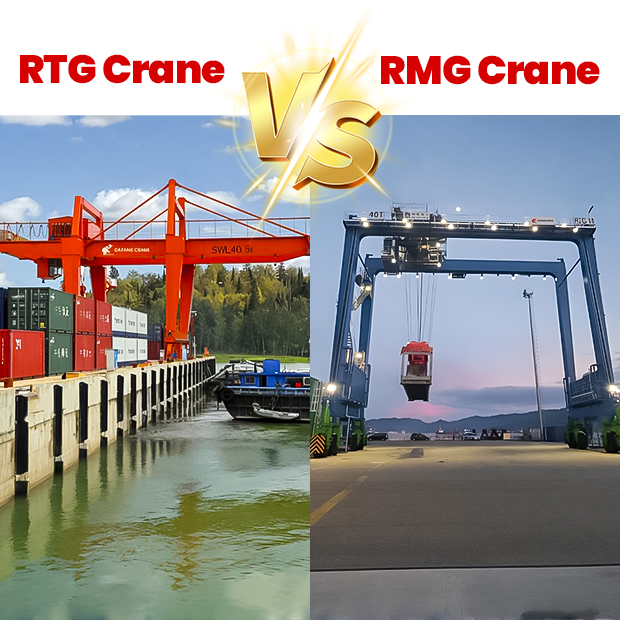
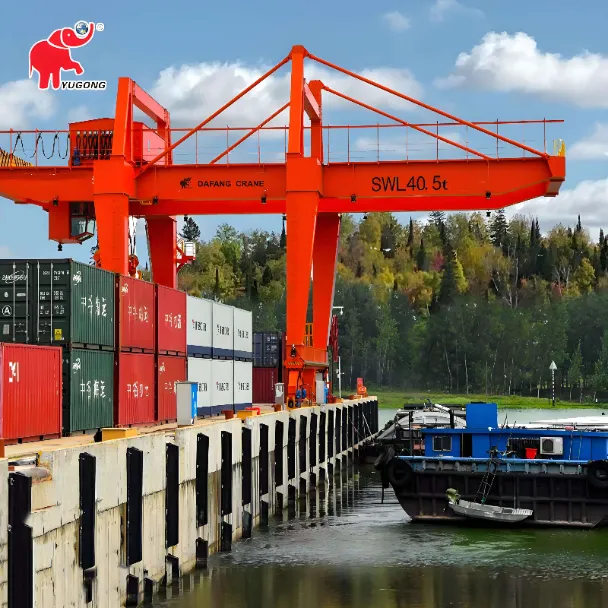
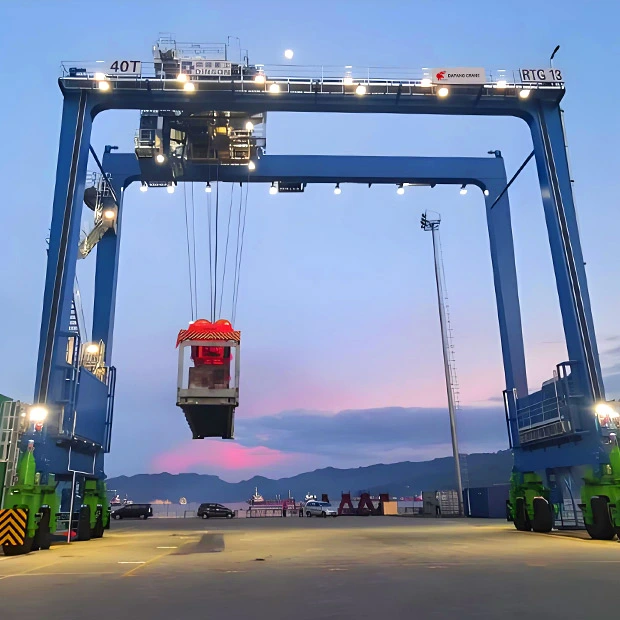
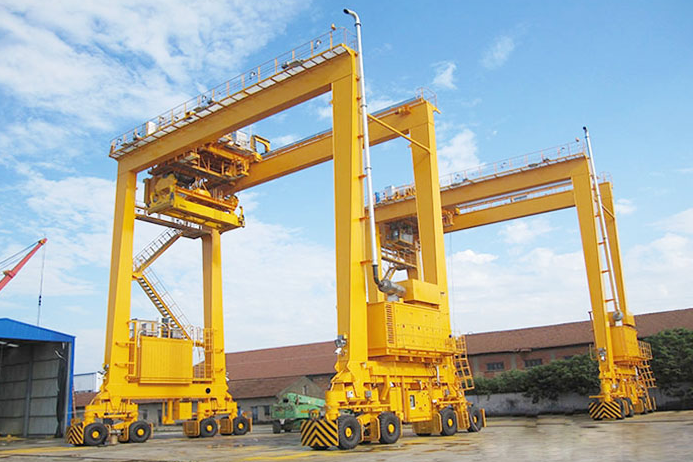
A Rubber Tyred Gantry crane is a free-standing gantry crane mounted on solid rubber tires that travels along container storage rows within the yard. Unlike rail-mounted equipment, the RTG crane can be relocated between container blocks by driving on its rubber tires — a repositioning capability that gives terminal operators flexibility to reallocate crane capacity as yard demand patterns change.
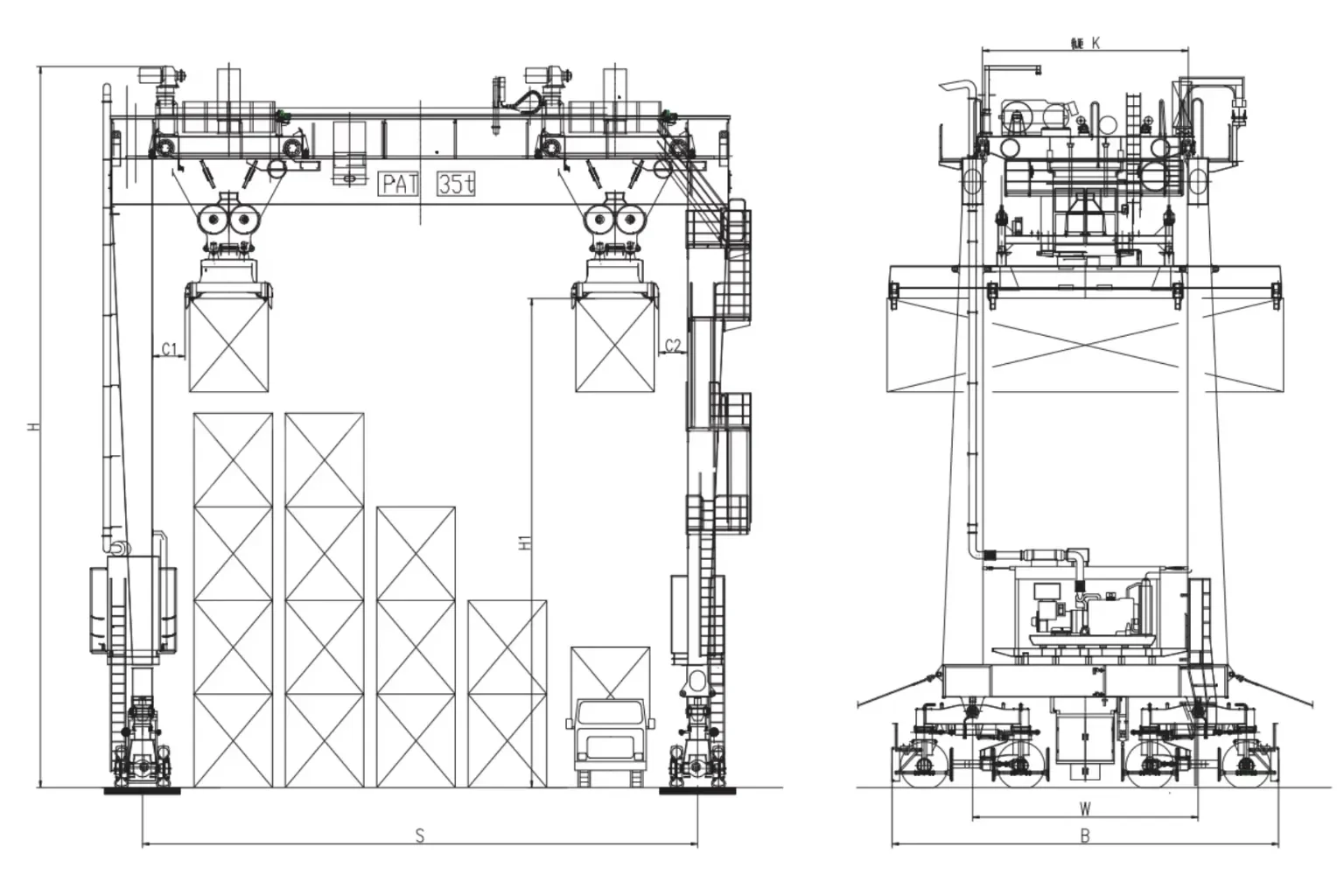
RTG cranes span a defined number of container rows — typically 6 to 10 containers wide — and stack containers to heights of 4 to 6 containers high. They are the most widely deployed yard crane type globally, operating at mid-size and large container terminals across all major port regions.
Principio de funcionamiento
The RTG crane travels along the length of a container block on its rubber tires, driven by diesel-electric or electric drive systems. The gantry spans the full width of the container block — plus one truck lane on one or both sides for landside vehicle access. The trolley travels across the gantry width, and the hoist raises and lowers the spreader to position containers at any point within the block.
When block reallocation is required, the RTG crane drives on its rubber tires to the new block location at speeds of approximately 30 km/h. This mobility distinguishes RTG cranes from rail-mounted alternatives and allows terminal operators to respond to yard demand shifts without moving containers or rebuilding block configurations.
Ventajas
- High mobility. The ability to relocate between blocks is the defining operational advantage of RTG cranes. Terminal operators can match crane capacity to demand across the yard without fixed infrastructure constraints.
- Flexible yard operation. RTG cranes do not require fixed rail infrastructure beyond the container block pavement. This reduces the civil construction requirements for new terminal development and simplifies yard reconfiguration as terminal operations evolve.
- Lower infrastructure requirements than RMG. No overhead rail structure, no rail maintenance, and no requirement for a fixed block assignment from day one of operation. This flexibility makes RTG cranes the preferred choice for terminals where throughput patterns are uncertain or expected to change.
- Established global supply chain. RTG cranes have the largest installed base of any yard crane type, with well-established manufacturing, parts supply, and maintenance knowledge available globally.
Aplicaciones
RTG cranes are used at mid-size and large container terminals, inland container depots, and intermodal yards where operational flexibility is a priority. They are the standard yard crane choice for terminals handling 500,000 to 3,000,000 TEU annually that are not pursuing full automation as an immediate operational goal.
Rail Mounted Gantry Crane (RMG Crane)
What Is an RMG Crane
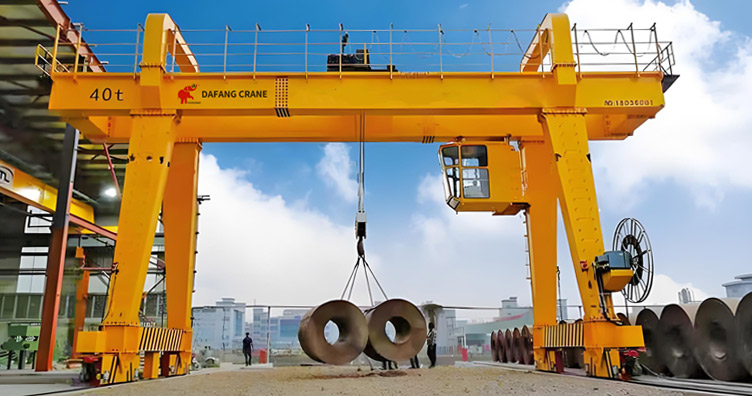
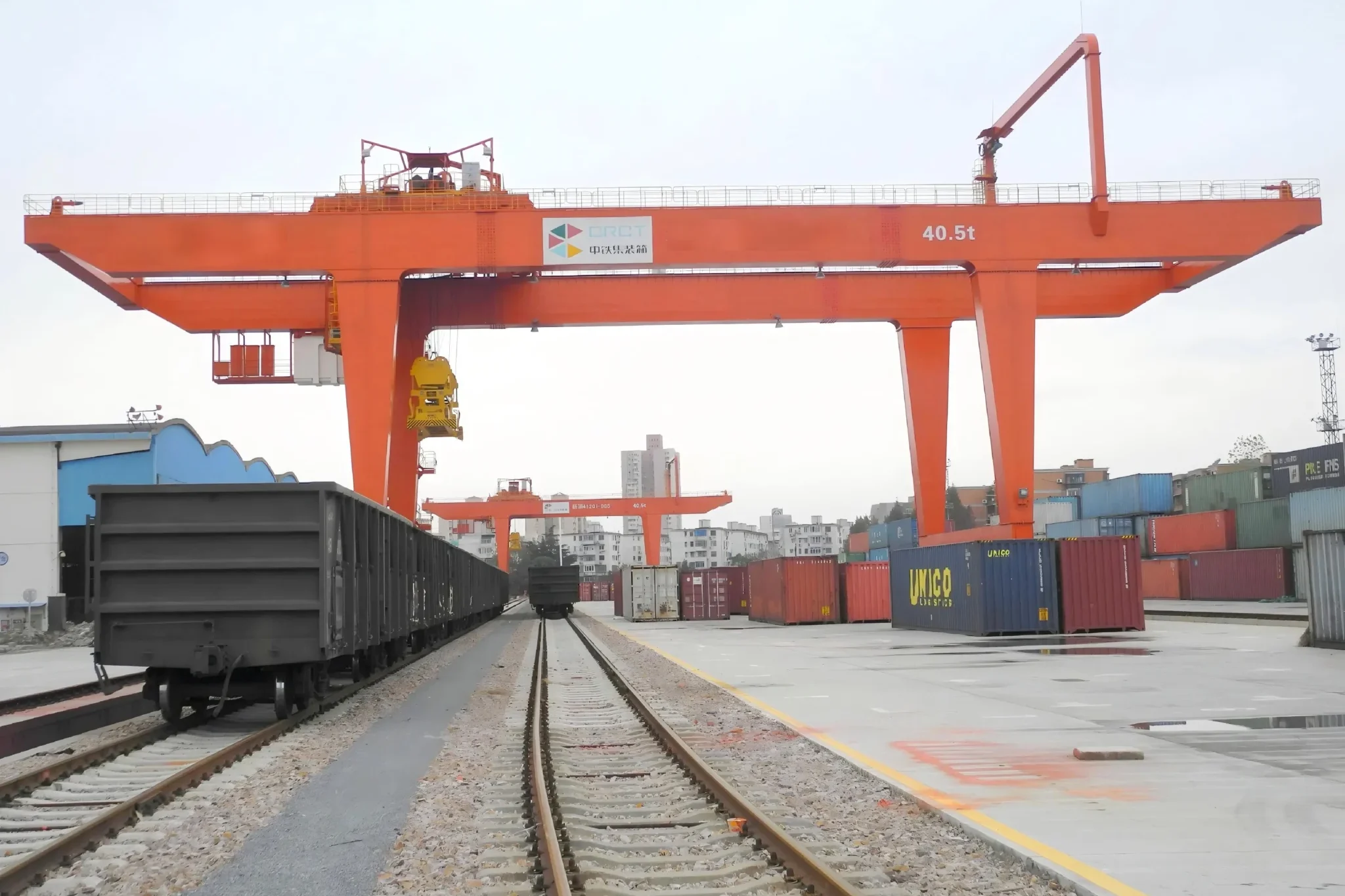
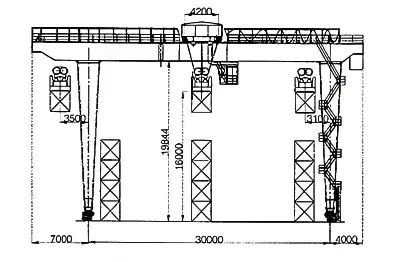
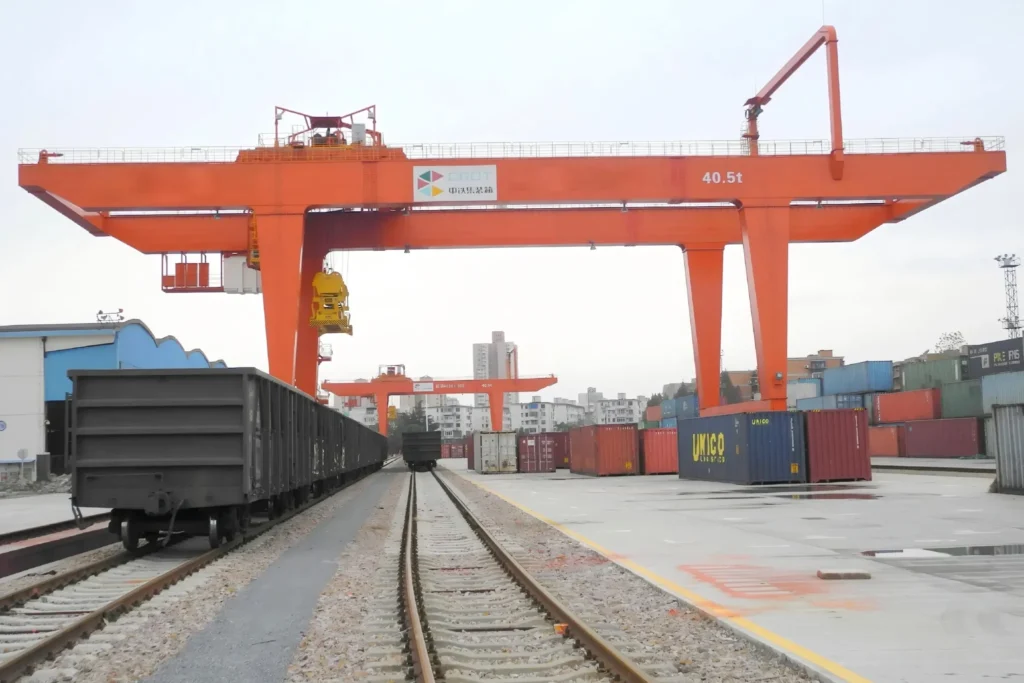
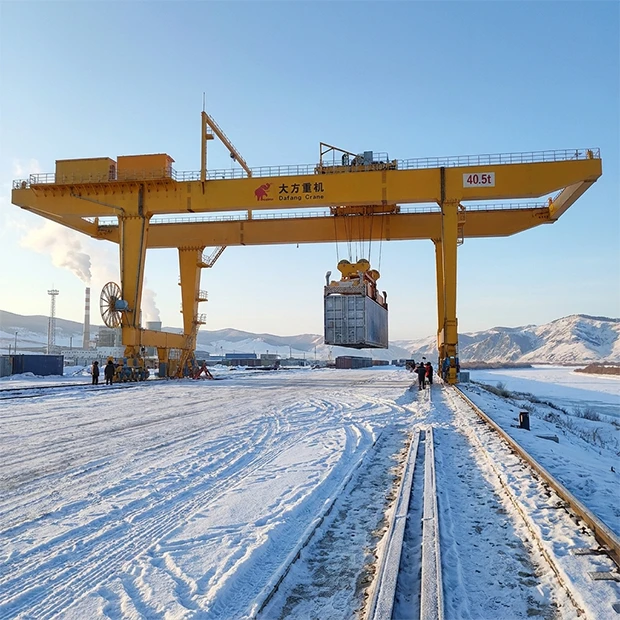
A Rail Mounted Gantry crane is a gantry crane that travels on steel rails installed at ground level or on elevated structures within fixed container storage blocks. Unlike RTG cranes, RMG cranes cannot be relocated between blocks — they are permanently assigned to the rail infrastructure on which they were installed. This fixed assignment is traded for higher positioning precision, greater stacking height capability, and suitability for full automation.
RMG cranes are the standard equipment choice for automated container terminals, where their precise rail guidance, predictable travel dynamics, and compatibility with automated operating systems enable fully unmanned operation.
Working Features
- Rail travel mechanism. RMG cranes travel on steel rails at precise gauge, providing positioning accuracy that rubber tire systems cannot match. Rail guidance eliminates the lateral drift that occurs on RTG cranes during travel, allowing automated spreader landing systems to function reliably without manual correction.
- Precision positioning. The combination of rail guidance and modern laser or vision-based positioning systems allows automated RMG cranes to land spreaders on container corner castings consistently and reliably — a fundamental requirement for fully automated operation.
- Automated operation capability. RMG cranes are the preferred platform for automated stacking crane (ASC) systems. Automated RMG systems receive stack assignments from the terminal management system, execute moves autonomously, and report completion — with human oversight from a remote monitoring center rather than an on-crane cab operator.
Ventajas
- Better space utilization. RMG cranes can stack containers higher than RTG cranes — up to 8 or 9 containers high in some automated terminal designs — and operate in narrower block configurations, improving TEU capacity per unit of yard area.
- High operational efficiency. Automated RMG systems operate consistently across all shifts without the variability introduced by operator skill differences. Cycle times are predictable, machine utilization is high, and throughput per crane is consistent.
- Suited for automation. The rail guidance system, precise positioning capability, and integration with terminal management systems make RMG cranes the preferred platform when terminal operators are investing in automated or semi-automated operations. Major automated terminal projects globally — including those in Rotterdam, Hamburg, Shanghai, and Los Angeles — use RMG-based automated stacking crane systems.
- Lower long-term operating cost. Automated RMG systems reduce labor costs significantly compared to manually operated crane fleets. For high-throughput terminals where labor cost is a significant operational expense, this reduction justifies the higher infrastructure investment of rail installation and automation systems.
Aplicaciones
Automated container terminals with high throughput volumes and long planning horizons are the primary RMG crane market. Railway intermodal terminals where precise positioning for rail car loading is a functional requirement, and large logistics hubs optimizing for maximum density and automation, also use RMG configurations.
Portacontenedores
What Is a Container Straddle Carrier
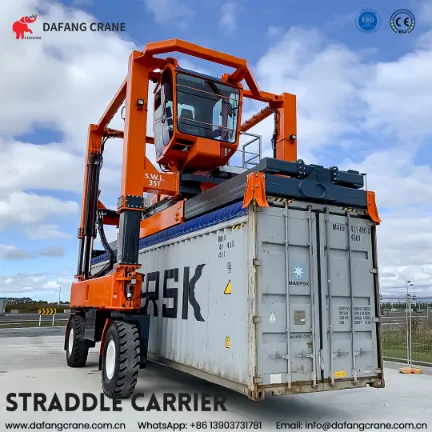
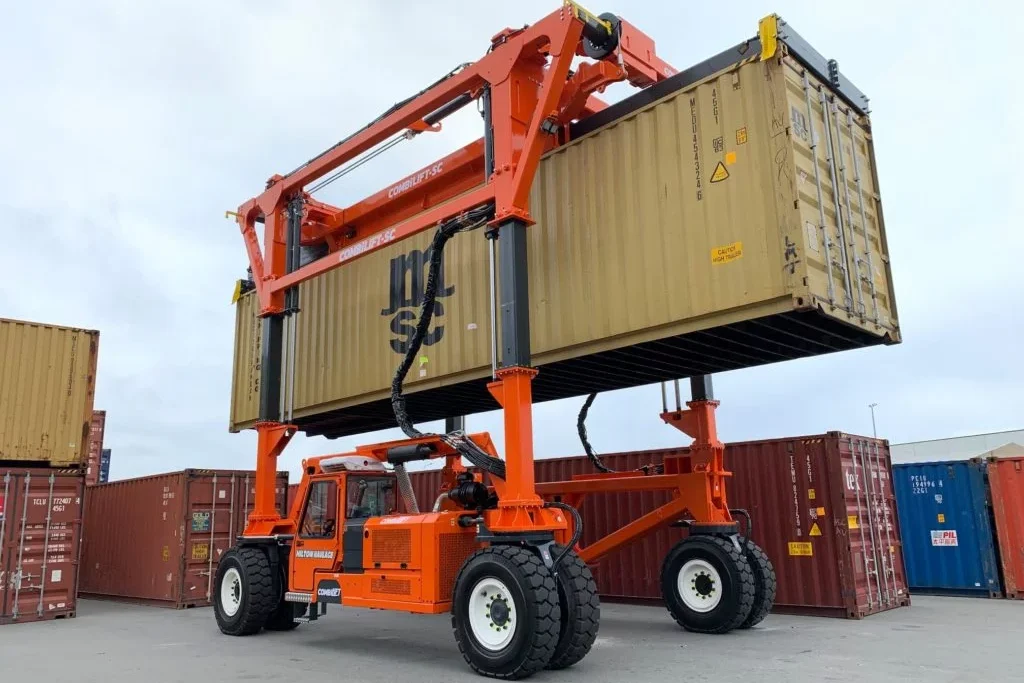
A portacontenedores a horcajadas is a self-propelled rubber-tired vehicle that straddles containers and lifts them using a built-in hydraulic or mechanical hoisting system. Unlike gantry cranes — which are stationary during stacking and move only along their travel axis — the straddle carrier combines the lifting and horizontal transport functions in a single machine. It picks up a container at one location and drives it to another, without requiring a separate horizontal transport vehicle.
Straddle carriers are used in two distinct operational roles: as the primary horizontal transport between quayside STS cranes and yard storage blocks, and as combined yard handling and storage machines in straddle carrier terminal layouts where they replace both gantry cranes and horizontal transport vehicles.
Principio de funcionamiento
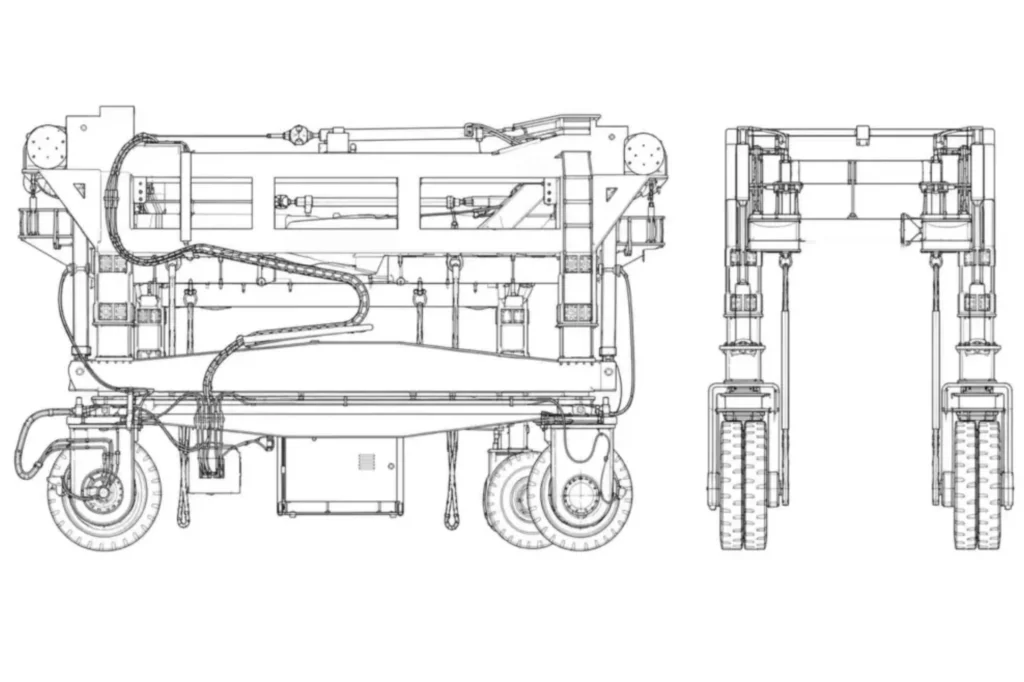
- Hydraulic lifting system. The straddle carrier's hoisting mechanism — hydraulic or electro-hydraulic — raises and lowers the spreader system between the carrier's structural legs. The spreader engages container corner castings in the same manner as gantry crane spreaders. Standard configurations lift to one container high over two stacked containers (1 over 2), with high-straddle variants lifting one over three.
- Container support structure. The carrier frame straddles the container row with two structural legs on each side. The leg clearance — the clear span between legs — determines the maximum container beam dimension the carrier can handle. Standard containers (2,438mm wide) fit all straddle carrier designs; specialized cargo or wide-body containers require confirmed leg clearance specifications.
- Steering system. Modern straddle carriers use all-wheel steering — including lateral (crab) steering — allowing the machine to move sideways without rotating the entire vehicle. This maneuverability is essential in compact terminal layouts where turning radius is constrained.
Ventajas
- Flexible operation. Straddle carriers operate without fixed rails, fixed power supply, or fixed travel paths. They can reach any point on the hardstand within the terminal's road network. This flexibility makes them well suited to terminals with complex yard layouts or variable traffic patterns.
- Integrated transport and stacking. A single machine handles both horizontal transport and stack placement — eliminating the handoff step between transport vehicle and yard crane that adds time and potential delay in gantry crane terminal layouts.
- Fast container transfer. Straddle carrier cycle times in quay-to-yard transfer are competitive with — and in some configurations faster than — separate transport vehicle plus gantry crane combinations, particularly for short transport distances.
- No fixed infrastructure. Beyond a paved hardstand designed for the carrier's wheel loads, straddle carriers require no fixed infrastructure. Yard layout can be reconfigured without civil construction.
Aplicaciones
Straddle carriers are used at ports and container terminals where operational flexibility is the priority and yard density requirements are moderate. They are particularly common at terminals handling mixed cargo types, terminals with variable throughput patterns, and facilities where the combined transport-and-stack function delivers efficiency advantages over separate system alternatives.
Container Crane Comparison
| Característica | Grúa STS | Grúa RTG | Grúa RMG | Portaequipajes |
|---|---|---|---|---|
| Main function | Vessel loading and unloading at berth | Container yard stacking and retrieval | High-density yard stacking, automated operation | Container transport and stacking combined |
| Working area | Quayside berth | Container yard blocks | Fixed container yard blocks on rail | Entire hardstand area |
| Movilidad | Fixed rail along berth — travels along quay only | High — can be relocated between yard blocks on rubber tires | Fixed to rail infrastructure — cannot be relocated | Very high — self-propelled to any location on hardstand |
| Stacking height | Not applicable (transfers to yard equipment) | Up to 5–6 containers high | Up to 8–9 containers high (automated designs) | 1 over 2 or 1 over 3 containers high |
| Yard density | Not applicable | Moderado | High | Lower than gantry crane systems |
| Automation level | Semi-automatic to fully automatic | Manual to semi-automatic; full automation emerging | Full automation standard in modern designs | Manual to semi-automatic |
| Infrastructure requirement | High — quay rail, power supply, portal foundation | Moderate — paved yard, power supply or diesel | High — precision rail installation, overhead power | Low — paved hardstand only |
| Investment cost | Very high | Moderado | High (including rail and automation systems) | Moderate to high per unit; fleet size scales with throughput |
| Best application | Deep-water terminals, large vessel calls | Mid-size terminals, flexible operations | High-throughput automated terminals | Smaller terminals, flexible operations, quay transfer |
How to Choose the Right Container Crane for Your Port or Terminal
1. Terminal Layout
The physical configuration of your terminal — berth length, yard depth, yard width, and the relationship between quayside and yard — constrains which crane types are operationally viable. STS cranes require a quayside rail system and are fixed to the berth they serve. RTG cranes require yard pavement and block lane width sufficient for gantry travel. RMG cranes require precision rail installation within fixed block configurations. Straddle carriers require continuous hardstand area throughout the operating zone.
Define your terminal layout constraints before evaluating crane specifications. A terminal with a deep yard and high storage density targets is better served by RMG stacking systems. A compact terminal with a short transport distance from quay to yard may use straddle carriers efficiently. A terminal with variable throughput patterns and evolving block configurations favors RTG flexibility.
2. Container Throughput
Annual TEU volume and peak daily handling requirements determine the number of crane units required and the productivity specification each unit must achieve. At low throughput volumes, the capital cost of large gantry crane systems is difficult to justify. At high throughput, the labor cost of manually operated equipment makes automation investment economically compelling.
As a general reference: terminals below 500,000 TEU annually typically use RTG or straddle carrier systems. Terminals in the 500,000 to 2,000,000 TEU range most commonly deploy RTG cranes. Terminals above 2,000,000 TEU with automation targets use RMG automated stacking crane systems. STS crane specifications are driven by vessel size and call frequency rather than annual TEU volume.
3. Space Utilization Requirements
If land is constrained and maximum TEU per square meter of yard area is a priority, RMG stacking systems with high stacking capability provide the best ground utilization. Automated RMG systems stacking 8 or 9 containers high with narrow block configurations deliver yard densities that RTG and straddle carrier systems cannot approach.
If land is available and operational flexibility is more important than maximum density, RTG or straddle carrier systems are more appropriate. The lower infrastructure investment can be partially redirected to additional yard area.
4. Automation Requirements
Automation goals significantly influence crane type selection — particularly for yard equipment. RMG cranes are the preferred platform for fully automated stacking crane systems. Their rail guidance, precision positioning, and integration with terminal management systems are proven in automated terminal operations globally. RTG automation is technically feasible but less mature than RMG automation. Straddle carrier automation is an active development area but has a smaller commercial installed base.
If full or near-full automation is a planning goal within the terminal's development horizon, specifying RMG infrastructure from the outset is more cost-effective than building RTG infrastructure and retrofitting automation later.
5. Environmental Conditions
Coastal container terminals operate in demanding environments. Wind load is a primary structural design driver for tall STS cranes — high outreach booms at 70 meters or beyond create significant wind-induced forces. Saltwater corrosion affects structural steel, electrical systems, and mechanical components. Tropical humidity affects control system reliability. Sub-zero temperatures in northern port locations affect lubricant specification and hydraulic system design.
Define the operating environment — maximum wind speed at crane operating conditions, ambient temperature range, humidity, and corrosive atmosphere classification — as part of the specification process. These factors affect structural design, coating system selection, electrical enclosure ratings, and material specifications across all container crane types.
How to Select a Reliable Container Crane Manufacturer
Engineering Experience
Request documented port crane project references at comparable scale and complexity to your project. A manufacturer with verified STS crane, RTG crane, or RMG crane installations at international terminals brings operational experience that reduces specification and delivery risk.
Port Project Experience
International port projects involve complex logistics, export documentation, installation coordination with terminal civil works, and commissioning support at the installation site. Confirm that the manufacturer has completed comparable international delivery and commissioning projects — not just domestic installations.
Manufacturing Capability
Container cranes are large, complex fabrications. Confirm the manufacturer's ability to produce the structural steel components, gantry frames, and boom structures within their own production facility — rather than subcontracting major structural fabrication.
Quality Control System
ISO 9001 certification confirms documented production processes. Factory acceptance testing — structural load testing, functional testing of all drive and control systems, and spreader operation testing — should be completed before shipment, with test certificates provided as contractual deliverables.
Automation Technology
For terminals with automation goals, confirm the manufacturer's experience with automated crane systems — including the control system platform, integration with terminal operating system (TOS) interfaces, and reference installations of automated equipment in commercial port operation.
Soporte Postventa
Container cranes have operational lives of 25 to 30 years. Spare parts availability, technical support response, and the manufacturer's long-term commitment to the product platform are procurement factors that affect total cost of ownership across the full equipment life. Request information on parts stocking policy, typical lead times for critical components, and service engineer availability in your region before finalizing supplier selection.
Conclusión
Modern container terminals operate as complex systems where crane selection, terminal layout, throughput planning, and automation investment interact. No single crane type serves all roles. Understanding what each type does well — and where its limitations lie — is the foundation of sound terminal equipment planning.
STS cranes define quayside productivity and vessel turnaround time. RTG cranes deliver flexible yard operations at manageable infrastructure investment. RMG cranes maximize yard density and enable full automation for high-throughput terminals. Straddle carriers provide integrated transport and stacking flexibility for smaller and more compact operations.
The right selection depends on your terminal's specific combination of throughput targets, land constraints, automation goals, and capital availability. For terminals at the planning or expansion stage, detailed simulation modeling — comparing crane system alternatives against projected traffic and operational scenarios — provides the most reliable basis for equipment selection decisions.
Ready to evaluate container crane solutions for your terminal? Contact our port crane engineering team to discuss your terminal layout, throughput requirements, and automation goals. We provide RTG crane, RMG crane, and STS crane solutions with full engineering support from specification through commissioning and long-term operational service.

Preguntas frecuentes
Q1: What are the main types of container cranes?
The four main types are: Ship-to-Shore cranes (STS) for direct vessel loading and unloading at the quayside berth; Rubber Tyred Gantry cranes (RTG) for flexible container yard stacking with the ability to relocate between blocks; Rail Mounted Gantry cranes (RMG) for high-density and automated container stacking within fixed rail blocks; and Container Straddle Carriers for combined lifting and horizontal transport across the terminal hardstand. Most large container terminals use a combination of these types — STS cranes at the berth and either RTG or RMG cranes in the yard — with straddle carriers used for quay-to-yard transport or as the primary yard handling system at smaller terminals.
Q2: Which crane is suitable for container yards?
RTG cranes are the most widely used yard crane type globally, offering flexible block assignment and adequate stacking height for most terminal throughput levels. RMG cranes are the preferred choice for high-throughput terminals pursuing automation, offering higher stacking capability and precise positioning at the cost of fixed rail infrastructure. Straddle carriers can also function as yard handling machines in smaller terminals or in straddle carrier terminal layouts, combining transport and stacking in a single machine.
Q3: Are RMG cranes suitable for automated ports?
Yes. RMG cranes are the preferred platform for automated stacking crane (ASC) systems in modern automated container terminals. Their rail guidance system provides the positioning precision required for reliable automated spreader landing. Integration with terminal operating systems and position detection systems enables fully unmanned operation. Major automated terminal projects globally — including the most productive container terminals in Europe, Asia, and the Middle East — use RMG-based automated stacking systems as the primary yard crane infrastructure.
Q4: How does a container straddle carrier work?
A straddle carrier straddles the container or container stack between its structural legs, lowers its spreader to engage the top container's corner castings, locks the twist locks, and hoists the container clear of the stack. It then drives to the destination location, lowers the container onto its target position, releases the twist locks, and raises the spreader clear. The entire pick-up, transport, and set-down cycle is performed by one machine — eliminating the handoff between horizontal transport vehicle and yard crane that gantry crane terminal layouts require.
Q5: How do container cranes improve port efficiency?
Container cranes improve port efficiency through several mechanisms. STS cranes reduce vessel turnaround time — the critical measure of berth productivity — by achieving high moves-per-hour rates that minimize the time vessels spend at berth. Yard cranes enable high container stacking density, maximizing TEU storage capacity within the terminal footprint. Automated crane systems operate consistently across all shifts, eliminating productivity variability from operator skill differences and reducing labor cost per TEU. Anti-sway and automated landing systems reduce cycle time per move, improving crane utilization and throughput.
Q6: How much does a container crane cost?
Container crane costs vary significantly by type, capacity, and specification. STS cranes for ultra-large container vessels are among the most expensive port infrastructure investments — a single crane represents a major capital commitment. RTG cranes for mid-size terminals range from several million to over ten million USD per unit depending on capacity, automation level, and drive system (diesel or electric). RMG cranes include both the crane structure and rail infrastructure costs, with automated systems adding control system and integration costs. Straddle carriers range from approximately two to five million USD per unit depending on capacity and specification. For accurate current pricing, request formal quotations from manufacturers with your specific operational requirements and site conditions defined.