






Container terminals are under sustained pressure to handle more volume, with fewer errors, lower emissions, and tighter cost control. Labor-intensive manual crane operations can no longer reliably deliver the throughput efficiency and consistency that modern supply chains demand. Automated RTG cranes are one of the clearest responses the industry has developed to that pressure.
The rubber tyred gantry crane has been a fixture in container yards for decades. What has changed dramatically is what the crane can do without a human in the cab. Today's automated RTG crane integrates GPS positioning, optical character recognition, anti-sway control, remote operation platforms, and AI-assisted logistics management into a single system that improves cycle times, reduces accidents, lowers labor dependency, and generates operational data that conventional crane fleets cannot provide.
This guide explains how automated RTG technology works, what drives the transition from manual to intelligent container handling systems, and what terminal operators need to evaluate when planning an automation project.
What Is an Automated RTG Crane?
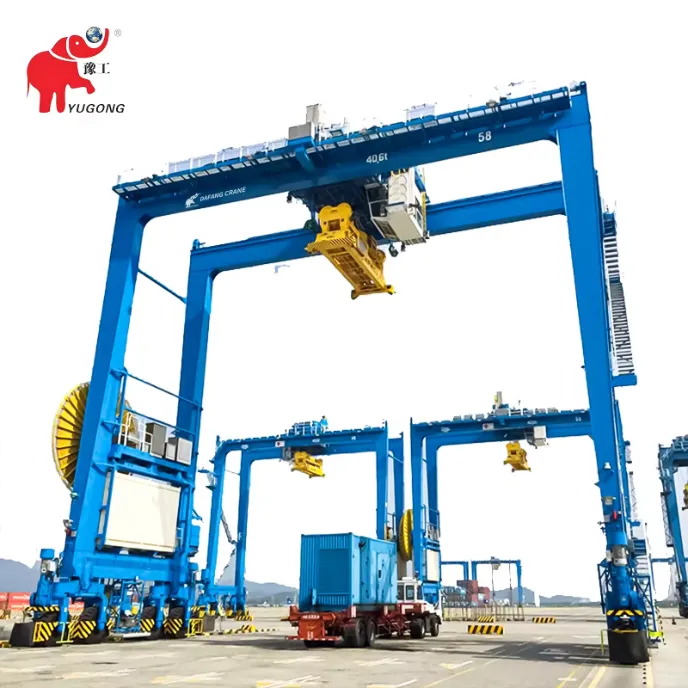
An automated RTG crane — short for automated rubber tyred gantry crane — is a self-propelled portal crane that operates in a container yard with reduced or eliminated reliance on a human operator in the machine cab. In a fully automated configuration, the crane travels between container positions, identifies the correct container, lifts and places it with millimeter precision, and coordinates its movements with other yard equipment — all under the direction of a terminal management system and remote supervision.
Get Free Quote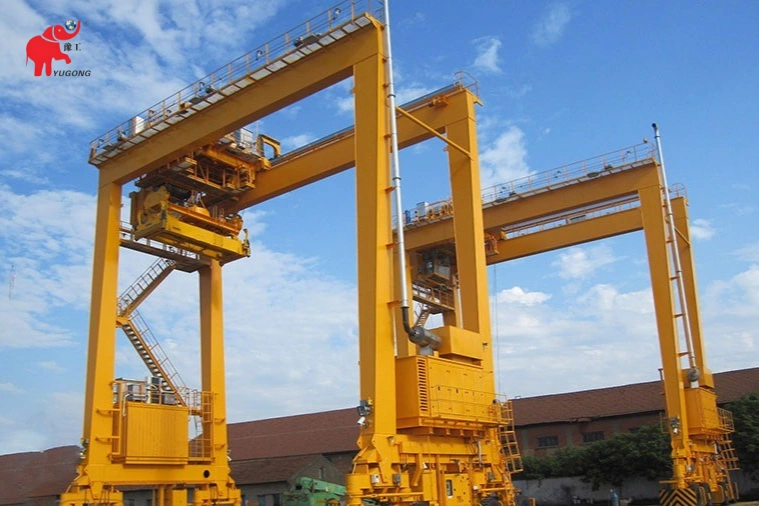
Key Components of an Automated RTG Crane
- Automated Control System: The crane's onboard controller receives movement commands from the terminal management system (TMS) and executes them autonomously, managing drive, steering, hoisting, and spreader functions without manual input.
- Positioning Sensors: A combination of GPS receivers, laser range finders, and wheel encoders gives the crane continuous awareness of its position in the yard, the height of container stacks, and the precise location of the spreader relative to its target.
- Anti-Sway Technology: Electronic anti-sway systems actively dampen the pendulum motion of suspended containers during travel and landing, reducing cycle time and improving stack accuracy — particularly critical in automated systems where human visual correction is absent.
- Communication Network: Automated RTG cranes rely on a high-bandwidth, low-latency wireless network — industrial Wi-Fi or private 5G — for constant data exchange between the crane, the TMS, and the remote operation center.
- Remote Operation Platform: A centralized control room allows human operators to supervise multiple cranes simultaneously, intervene in non-standard situations, and manage exceptions that the automated system cannot resolve independently.
- Intelligent Monitoring System: Onboard sensors track crane health metrics — motor temperature, hydraulic pressure, structural vibration, tyre condition — feeding data to predictive maintenance systems that schedule service before failures occur.
How Traditional RTG Cranes Evolved into Automated Systems
The path from conventional manual crane operation to fully automated intelligent container handling systems has been a progression through several distinct stages, each adding capability while reducing the operational burden on human operators.
Conventional RTG Operations
Early rubber tyred gantry cranes were entirely operator-dependent. A driver in the cab controlled all crane motions — travel, steering, hoist, spreader alignment — using joysticks and switches. Productivity depended on operator skill and fatigue management. Consistency across shifts and between operators varied. There was no automatic data capture of crane movements or container positions.
Semi-Automated RTG Systems
The intermediate stage introduced electronic assistance without removing the operator. Automated positioning systems guided the spreader to the correct lane and height using laser sensors, reducing the precision demands on the operator during landing. Automated travel steering allowed cranes to follow programmed lane paths without continuous steering input. The operator remained responsible for final positioning and exception handling but was relieved of the most repetitive control tasks. Many terminals currently operate at this level.
Fully Automated RTG Cranes
Fully automated systems remove the cab operator entirely for routine operations. The TMS assigns crane tasks, the crane executes them autonomously, and a remote supervisor monitors multiple cranes from a centralized control room, intervening only when exceptions arise — blocked lanes, damaged containers, equipment faults, or situations outside the automated system's decision parameters. These systems deliver the highest consistency, the best data quality, and the greatest potential for labor cost reduction over the long term.
The acceleration in automation adoption reflects a combination of technology maturity, labor cost pressures, and the availability of the wireless communication infrastructure on which automation depends.
Benefits of Automated RTG Cranes in Smart Ports
Higher Container Handling Efficiency
Automated RTG cranes operate with consistent cycle times that are not subject to the variability of manual operation. In well-implemented systems, automation typically delivers 10–25% improvement in crane moves per hour compared to manual operation, depending on yard layout and task mix. Truck turnaround times improve because automated cranes can be pre-positioned to receive trucks based on appointment data, reducing waiting. Night and weekend shifts operate at the same efficiency as day shifts, which is not reliably achievable with purely manual operations.
Improved Safety
Removing personnel from active crane operating zones is the most direct safety benefit of automation. Ground-level workers — truck drivers, maintenance crews, container inspectors — are separated from moving crane and vehicle traffic by physical barriers and access control systems. Automated cranes do not exceed rated loads, do not travel at unsafe speeds, and do not make the operational errors that cause many crane incidents in manually operated terminals. Incident rates at fully automated container terminals are measurably lower than at comparable manual operations.
Lower Operating Costs
Labor represents a substantial portion of operating cost in a conventional container terminal. Automated RTG systems reduce direct crane operator headcount significantly, though they create new roles in remote supervision, automation systems management, and IT maintenance. Energy efficiency also improves — automated cranes optimize acceleration and deceleration profiles to minimize energy consumption per cycle, and electric RTG cranes with energy recovery systems return energy to the grid during lowering and braking. Predictive maintenance reduces unplanned downtime and the cost of emergency repairs.
Better Yard Space Utilization
Precise automated stacking improves storage density by reducing the clearance margins that manual operators require for safe container placement. Automated systems can stack containers to designed stack heights consistently, whereas manual operations often leave stack heights below maximum capacity due to operator caution. Optimized stack planning by the TMS reduces unnecessary container reshuffling and improves access to containers that are needed next — a significant source of hidden inefficiency in manually managed yards.
Enhanced Data Visibility
Every crane movement in an automated system is recorded, timestamped, and attributed to a specific container, position, and task. This produces a continuously updated digital model of the container yard that supports real-time inventory queries, performance analytics, shift reporting, and long-term capacity planning. Terminal managers can monitor crane productivity, identify bottlenecks, and make evidence-based operational adjustments — capabilities that are significantly harder to achieve in a manual terminal where data capture depends on human reporting.
The Role of Electric RTG Cranes in Sustainable Ports
Electrification and automation are increasingly implemented together. Electric RTG cranes — whether grid-connected via cable reels or catenary systems, or battery-powered — eliminate diesel engine emissions at the crane level. Combined with automation, they support the sustainability commitments that major port operators and their shipping line customers have made under net-zero and green port initiatives.
Hybrid RTG cranes with diesel-electric powertrains and energy recovery systems represent an intermediate step, delivering 40–60% fuel consumption reduction compared to conventional diesel cranes while still operating in areas without electrical infrastructure. Battery-electric RTG cranes are moving into commercial deployment at progressive terminals, with charging infrastructure integrated into the crane's travel lanes or overnight charging at designated positions.
For ports operating under emissions regulations or facing carbon pricing, the combination of electric drive and automation optimization delivers measurable reductions in energy consumption per container move — a metric increasingly reported by ports to shipping customers, investors, and regulators as part of environmental performance disclosure.
Challenges of Implementing Automated RTG Cranes
A balanced assessment of automation must acknowledge the real challenges that terminals face during implementation.
High Initial Investment: Automated RTG cranes carry a significant price premium over conventional manual machines. The additional cost covers automation hardware, software licensing, communication infrastructure, and the system integration work required to connect the crane fleet to the TMS and other terminal systems. The capital commitment is substantial, and the payback period must be evaluated against realistic productivity and labor cost savings projections.
Infrastructure Upgrades: Automation requires communication infrastructure — wireless network coverage across the entire operating area — that many existing terminals do not currently have. Physical separation between the automated crane zone and areas where personnel and non-automated vehicles operate requires barrier systems and access control. Power supply infrastructure for electric cranes may require substation upgrades.
Cybersecurity Requirements: Automated terminal systems create cybersecurity exposure that conventional mechanical crane operations do not. Network-connected crane control systems, TMS platforms, and remote operation centers are potential targets for cyber interference. Terminal operators must invest in cybersecurity architecture, monitoring, and incident response capability proportionate to the automation level they deploy.
Workforce Transition: Automation changes the workforce composition of a terminal rather than simply reducing headcount. Experienced crane operators need retraining for remote supervision roles. IT and automation systems engineers become critical staff where they were previously absent. Managing this transition — particularly in unionized workforces — requires careful planning, early stakeholder engagement, and realistic timelines.
System Integration Complexity: Automated RTG cranes do not operate in isolation. They must be integrated with the TMS, gate systems, vessel planning systems, truck appointment platforms, and sometimes automated guided vehicle (AGV) or automated straddle carrier systems operating in adjacent zones. Integration complexity is often underestimated in project planning and is a frequent source of project delays and cost overruns.
Smart Port Case Studies and Industry Adoption Trends
Automated RTG crane deployments are now operational across major container hubs on multiple continents. Common patterns emerge from these implementations that inform current procurement and planning decisions.
Terminals that began with semi-automated RTG fleets — using automated positioning but retaining cab operators — consistently report that the transition to full automation is more manageable when operators already understand the assisted-operation mode. The phased approach reduces the cultural and operational shock of removing cab operators entirely and allows the automation system to be validated in service before full deployment.
High-volume transshipment terminals report the most rapid ROI on automation investments, because the productivity gains from consistent cycle times are multiplied across very high annual move counts. Medium-volume terminals with strong labor cost pressures — particularly in markets where port labor costs are high — also demonstrate attractive ROI models.
Terminals that have implemented intelligent container handling systems with full OCR integration consistently report significant reductions in inventory discrepancies and container misplacement incidents compared to their pre-automation baseline. The data quality improvement has secondary benefits in customer service, customs clearance speed, and carrier billing accuracy.
Future Trends in Automated RTG Crane Technology
AI-Assisted Crane Operations: The current generation of automated RTG systems follows programmed rules for task execution. The next generation will use machine learning to optimize crane behavior dynamically based on real-time yard conditions, vessel arrival patterns, and equipment status — making decisions that rigid rule-based systems cannot.
Digital Twin Technology: A digital twin of the container yard — a continuously updated virtual model that mirrors the physical terminal in real time — allows operators to simulate operational scenarios, test configuration changes, and train staff without disrupting live operations. Several technology providers are developing digital twin platforms specifically for automated container terminals.
Autonomous Container Yard Management: The logical endpoint of automation is a container yard where the TMS, automated cranes, and other equipment coordinate independently to optimize throughput with minimal human intervention. This level of autonomy is already partially realized in the most advanced terminals and will become more common as AI systems mature.
5G Communication Networks: The transition from industrial Wi-Fi to private 5G networks in port environments improves communication reliability, reduces latency, and supports higher device density — all of which benefit automated crane fleet management. Several major ports are already deploying private 5G as the communication backbone for their automation systems.
Fully Electric RTG Fleets: As battery technology improves and charging infrastructure costs fall, fully electric RTG fleets will become economically viable across a wider range of terminal sizes and layouts. This shift will be accelerated by tightening port emissions regulations and rising carbon pricing in major maritime economies.
Predictive Maintenance Systems: Sensor data from automated cranes enables maintenance scheduling based on actual equipment condition rather than fixed time intervals. Predictive maintenance reduces unplanned breakdowns, extends component service life, and lowers total maintenance cost over the crane's operating life.
Conclusion
Automated RTG cranes are not a future technology — they are an operational reality in a growing number of container terminals globally, and the adoption curve is accelerating. The combination of GPS positioning, OCR identification, anti-sway control, remote operation, and AI-assisted logistics management delivers measurable improvements in throughput, safety, sustainability, and data quality that conventional manual crane operations cannot match at scale.
The transition requires serious investment — in capital, infrastructure, workforce development, and operational change management. But for terminals facing rising throughput demands, labor market pressure, and sustainability commitments, the question is increasingly not whether to automate but when and how to do it effectively.
The most successful implementations share a common approach: phased deployment, early infrastructure planning, rigorous vendor selection, and a workforce transition strategy that brings experienced terminal staff into new roles rather than simply displacing them.
Request a customized automated RTG crane solution for your terminal project. Contact our engineering team for smart port automation consultation. Discuss your container terminal automation requirements with our technical specialists.

Frequently Asked Questions
What is the difference between a semi-automated and a fully automated RTG crane?
A semi-automated RTG crane retains a human operator in the cab or at a remote station who controls all crane movements, but is assisted by electronic systems — automated lane travel, assisted spreader positioning, anti-sway control — that reduce the precision demands on the operator and improve consistency. A fully automated RTG crane operates without a dedicated operator for each crane during routine tasks. The TMS assigns tasks, the crane executes them autonomously, and a remote supervisor monitors multiple cranes from a centralized control room, intervening only for exceptions. Full automation delivers higher labor efficiency and more consistent cycle times, but requires more sophisticated communication infrastructure, safety systems, and software integration than semi-automated operation. Most terminals transition through semi-automation before committing to full automation.
How does an automated RTG crane know where to place a container in the yard?
The crane's position in the yard is tracked continuously using a combination of differential GPS, laser sensors, and wheel encoder data, giving the control system a real-time location accurate to within a few centimeters. The terminal management system maintains a digital map of the container yard, recording the position and identity of every container in every stack. When the TMS assigns a crane task — for example, placing a container in row 14, bay 22, tier 3 — it transmits the target coordinates to the crane's control system. The crane navigates to the target lane, positions the spreader above the designated stack location using laser height measurement and lateral positioning sensors, and lowers the container to the correct tier. OCR cameras verify the container identity before and after each move to maintain inventory accuracy.
What wireless communication technology is used for automated RTG crane operations?
Most currently operational automated RTG terminals use industrial Wi-Fi networks — typically IEEE 802.11ac or 802.11ax (Wi-Fi 6) — as their primary communication backbone. These networks are engineered specifically for port environments, with weatherproof access points mounted on crane rail structures and yard lighting columns to ensure coverage across the entire operating area. A growing number of new automation projects are specifying private 5G networks instead of or alongside Wi-Fi, because 5G offers lower and more consistent latency, better performance in high-device-density environments, and easier expansion as the automated fleet grows. Communication redundancy — backup network paths that maintain crane control connectivity if a primary link fails — is a standard requirement for any automated crane system deployed in a production terminal.
Can existing conventional RTG cranes be retrofitted for automation?
In principle, yes — the core components of automation (positioning systems, anti-sway electronics, spreader sensors, communication hardware, and control system interfaces) can be installed on existing RTG cranes. In practice, the viability of retrofitting depends on the age and design of the existing crane's control system, the condition of the structural and mechanical components, and the economics of retrofit versus new procurement. Cranes with older relay-logic or first-generation PLC control systems are generally poor retrofit candidates. Cranes with modern PLC-based controls and modular drive systems are more amenable to automation upgrades. Most terminal operators commissioning full automation choose new-build automated cranes rather than retrofitting existing fleets, because new machines can be designed from the outset for automation integration and typically carry full warranty coverage on both hardware and software from a single supplier.
How long does it take to implement an automated RTG crane system in a container terminal?
The timeline from project initiation to operational automated crane fleet varies significantly by project scope, terminal complexity, and vendor. A typical phased implementation — covering terminal assessment, system design, infrastructure installation, crane procurement and delivery, software integration, testing, and staff training — runs 24 to 48 months from contract award to full commercial operation. Crane manufacturing lead times alone are typically 12 to 18 months. Software integration between the automation system and the terminal management system is frequently the most time-consuming and risk-prone element. Terminals that have invested in TMS upgrades and communication infrastructure before beginning crane procurement consistently achieve shorter and more predictable implementation timelines than those attempting all workstreams simultaneously.