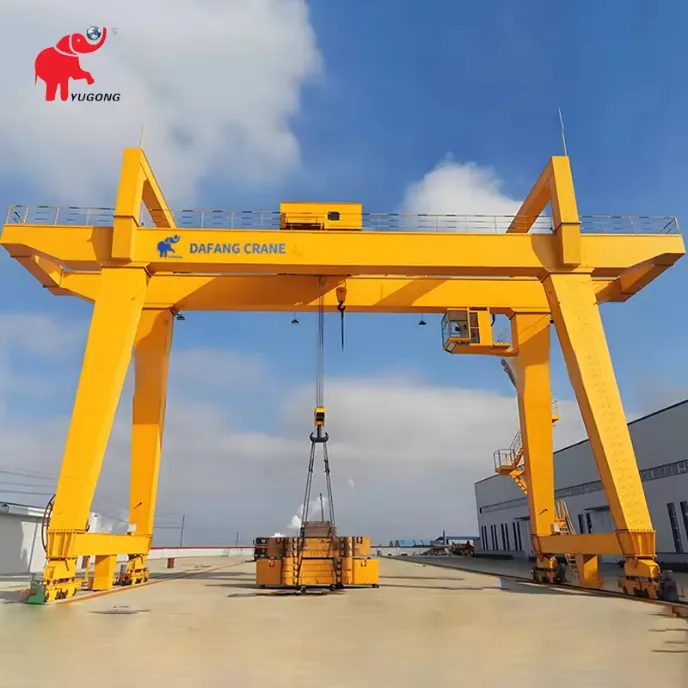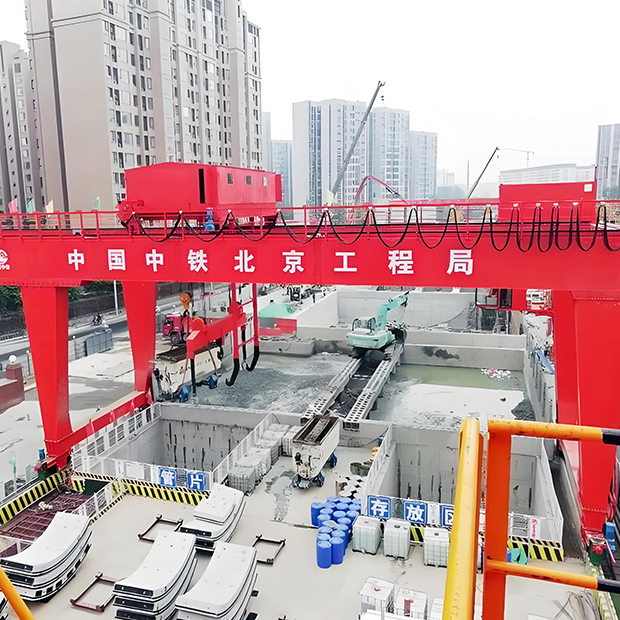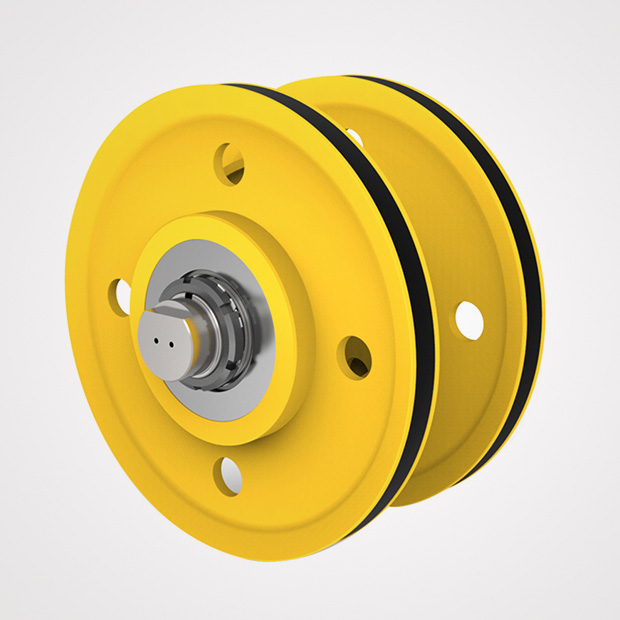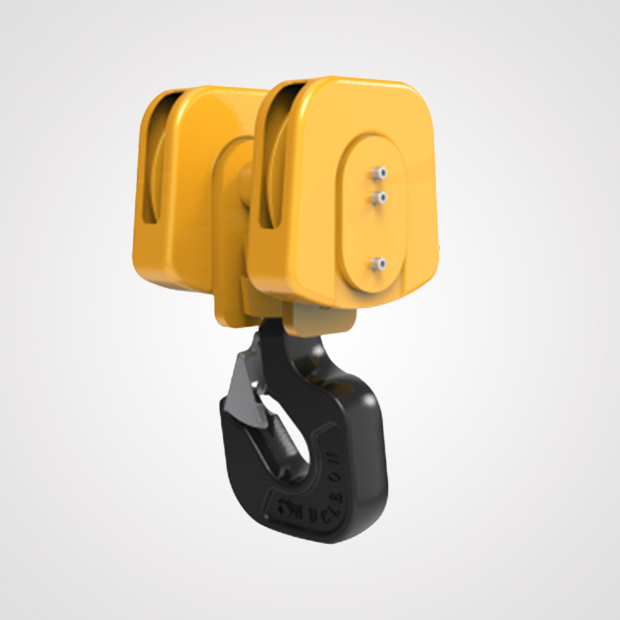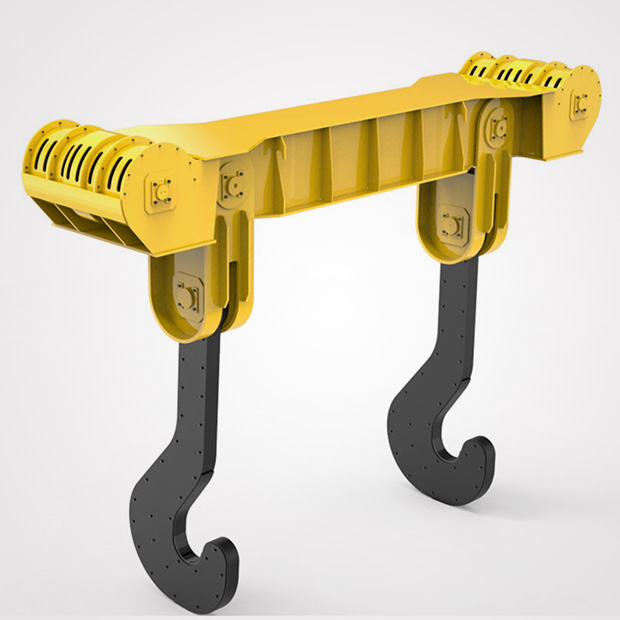







Choosing an RTG (Rubber-Tyred Gantry) crane isn't a matter of picking the biggest machine available. The right capacity depends on your terminal's throughput, the container weights you handle most often, how many layers you need to stack, and the load your yard surface can actually support.
Dafang currently offers RTG cranes in three main capacity classes — 35 ton, 41 ton, and 70 ton — covering everything from mid-sized inland depots to heavy-duty port terminals. This guide breaks down what separates them, what each parameter actually means for day-to-day operations, and how to match a capacity class to your real operating conditions.
Table des matières
What the Key Specs Actually Tell You
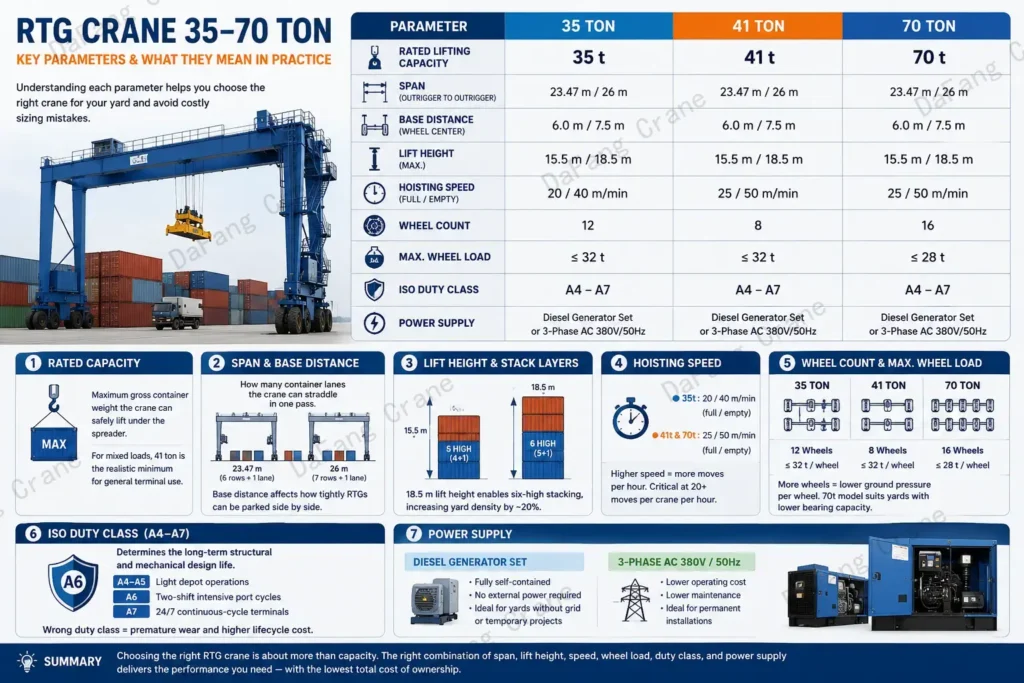
Rated lifting capacity is the first number most buyers check, but it's not the only spec that determines whether a crane fits your yard. Understanding what each parameter drives in practice helps you avoid the most common sizing mistakes.
Capacité nominale is the maximum gross container weight the crane can safely lift under the spreader. The practical implication: if your average loaded 40' container runs 26–28 tons but you occasionally receive 32-ton units, a 35-ton crane leaves almost no headroom. Most operators handling mixed loads treat 41 tons as the realistic minimum for general terminal use.
Span and Base Distance determine how many container lanes the crane can straddle in one pass. The standard 23.47 m span covers six container rows plus one truck lane; the 26 m option adds one extra container row. Base distance — the footprint between the two outrigger legs — affects how tightly RTGs can be parked side by side when repositioning in a congested yard.
Lift Height and Stack Layers directly set your yard storage density. At 15.5 m, an RTG reaches five-high stacking (4+1 over the spreader); at 18.5 m, it reaches six-high (5+1). The difference is meaningful: a six-high block on the same ground footprint holds roughly 20% more TEU than a five-high block.
Vitesse de levage is where the 35-ton model separates from the other two. At 20/40 m/min (full/empty), it completes fewer moves per hour than the 41-ton and 70-ton models, which both run at 25/50 m/min. At moderate throughput levels the difference is minor; at terminals running 20+ moves per crane per hour, the slower hoist becomes a measurable cycle time bottleneck.
Wheel Count and Maximum Wheel Load are often underweighted in early procurement discussions, but they directly determine the civil engineering requirements for your yard pavement or reinforced concrete foundation. A lower wheel count concentrates the same total crane weight on fewer contact points, increasing point load per wheel. The 70-ton crane achieves a lower per-wheel load than the 41-ton's 8-wheel configuration precisely because its weight is distributed across 16 wheels — meaning a 70-ton crane can sometimes be installed on a yard surface with a lower bearing capacity rating than you might expect.
ISO Duty Class (A4–A7) governs the long-term structural and mechanical design life of the crane. A4–A5 suits light depot operations; A6 covers two-shift intensive port cycles; A7 applies to 24/7 continuous-cycle terminals. Specifying the wrong duty class is one of the most common ways buyers undersize equipment for long-term use — the crane may perform fine in year one and degrade prematurely by year five.
Alimentation électrique determines site infrastructure requirements. The diesel generator set option makes the crane fully self-contained and mobile — suitable for yards without grid connection or for temporary logistics hubs. The three-phase AC 380V/50Hz option reduces fuel and maintenance costs significantly for permanent installations.
35-Ton RTG Crane: Where Budget and Light Infrastructure Are the Priority
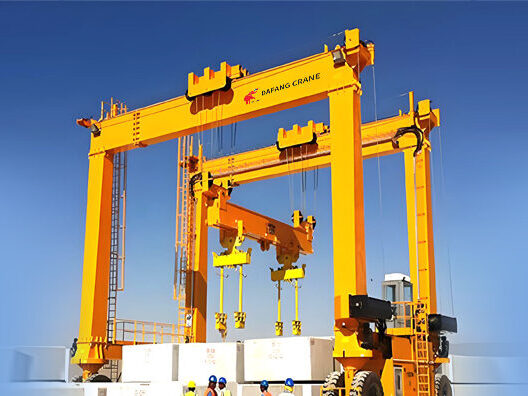
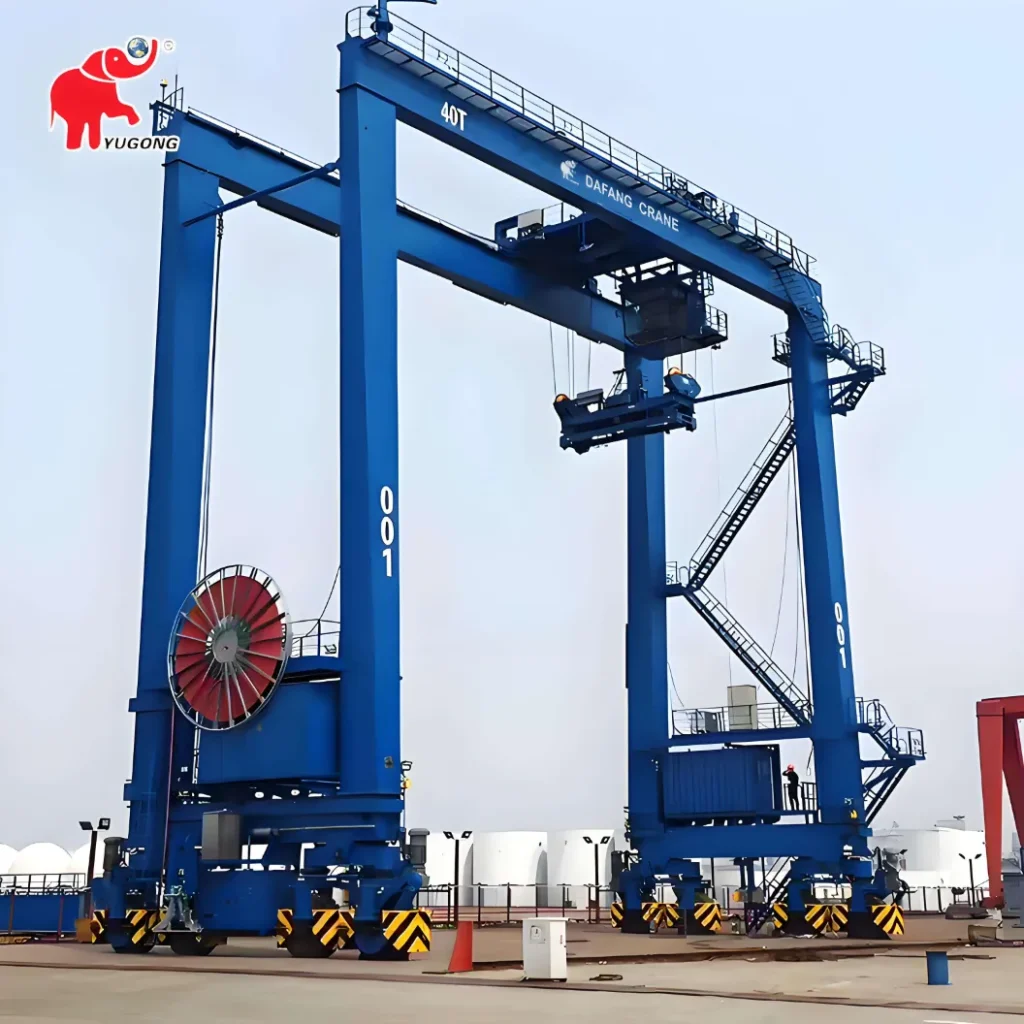
The 35-ton model is built for operations where the container mix is predominantly light-to-medium loaded boxes, and where upfront investment and foundation costs carry significant weight in the procurement decision.
The honest case for the 35-ton class isn't just price — it's the pavement. With 8 wheels and a maximum wheel load of 300 kN, it places less load per contact point than the 41-ton's 8-wheel configuration, which at 320 kN sits near or above the bearing capacity of older or lighter-grade yard surfaces. For inland container depots built on standard industrial concrete rather than purpose-built port pavement, the 35-ton crane can often be installed without foundation reinforcement that a heavier model would require.
Where it becomes a poor fit is in operations that regularly handle near-maximum-weight containers. A 35-ton rated capacity with full containers averaging 28–30 tons leaves limited margin, and the slower hoisting speed (20/40 m/min versus 25/50 on the other two models) compounds into measurably longer cycle times at higher throughput. If your current volume is light but you anticipate significant growth within the crane's operational life, the 41-ton class is usually worth the incremental investment.
41-Ton RTG Crane: The Standard for General Terminal Operations
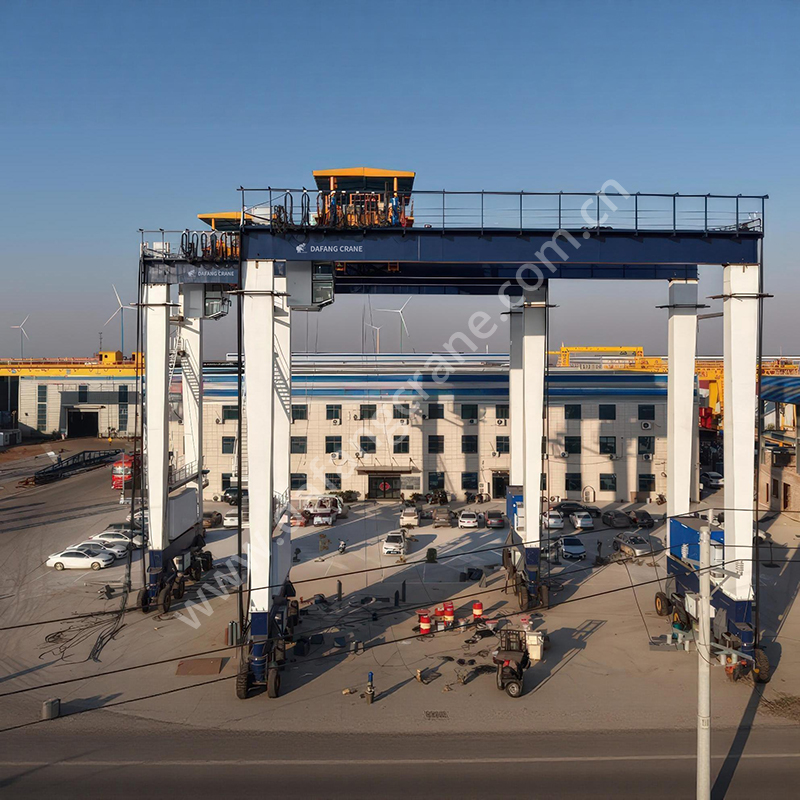
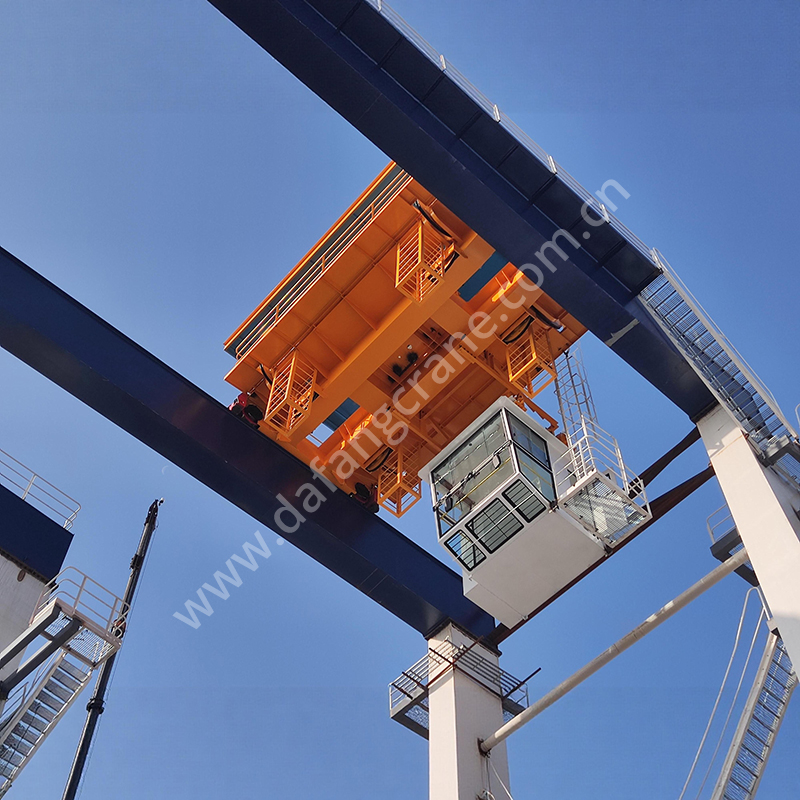
The 41-ton model is the most widely ordered configuration across Dafang's RTG range, and the pattern reflects real market logic: it handles the full spectrum of standard container weights without the infrastructure demands of the 70-ton class, and it runs at the faster 25/50 m/min hoisting speed that keeps cycle times competitive.
The configurable wheel arrangement is worth examining carefully. The 8-wheel option (320 kN max wheel load) suits yards with reinforced port pavement; the 16-wheel option drops the per-wheel load to 180 kN, which is lower than the 35-ton's 8-wheel configuration despite the higher total crane weight — an important consideration for terminals with older infrastructure or softer subgrade. If wheel load is a constraint for your site, specifying the 16-wheel configuration on a 41-ton crane often solves the problem without moving to the 70-ton class.
Currently In Stock: 2 Units of the 41-Ton Configuration
Dafang currently has two 41-ton RTG cranes in stock and ready for inspection and shipment — a configuration that would normally require a full production cycle of several months on a new order. These units are built around a premium component set including a Siemens hoist motor, SEW reducers, a ZPMC electric telescopic spreader compatible with 20'/40'/45' containers, and a Volvo diesel engine paired with a Stamford generator set.
For terminals that have already confirmed 41-ton capacity as the right fit, this in-stock availability can compress the procurement timeline significantly. Contact Dafang's sales team for current availability, technical drawings, and shipping lead times.

70-Ton RTG Crane: Built for Heavy Loads and Long-Term Capacity Planning
The 70-ton crane is the right choice when the question is not just what you're lifting today, but what your terminal will be handling in five to ten years. It is designed for operations that consistently move dense or heavy cargo, and for operators who want to avoid the disruption and cost of a second capacity upgrade as throughput grows.
The structural argument for the 70-ton class at major terminals goes beyond rated capacity. The 16-wheel configuration spreads the crane's total weight across more contact points, bringing the maximum wheel load down to 200 kN — lower than both wheel configurations on the 41-ton model. For terminals planning significant pavement expansion alongside the crane purchase, this matters: the same pavement spec that accommodates 200 kN/wheel may not need upgrading if volume grows and a second crane is added later.
The 70-ton model is also the appropriate choice when the terminal's duty cycle demands A6 or A7 classification under ISO 4301. Running a mid-range crane at the upper edge of its duty class compresses service life and increases maintenance frequency; specifying a heavier crane with appropriate structural and mechanical ratings from the outset is usually more economical over a 15–20 year operational horizon.
Side-by-Side Specification Comparison
| Paramètres | 35 Ton | 41 Ton | 70 Ton |
|---|---|---|---|
| Capacité nominale | 35 t | 41 t | 70 t |
| Base Distance | 7 m | 7 m | 7.5 m |
| La portée | 23.47 m / 26 m | 23.47 m / 26 m | 23.47 m / 26 m |
| Lift Height | 15.5 m / 18.5 m | 15.5 m / 18.5 m | 15.5 m / 18.5 m |
| Empiler les couches | 4–5 | 4–5 | 4–5 |
| Container Sizes | 20', 40', 45' | 20', 40', 45' | 20', 40', 45' |
| Hoisting Speed (full/empty) | 20 / 40 m/min | 25 / 50 m/min | 25 / 50 m/min |
| Gantry Travel Speed (full/empty) | 30 / 130 m/min | 30 / 130 m/min | 30 / 130 m/min |
| Trolley Travel Speed | 70 m/min | 70 m/min | 70 m/min |
| Numéros de roue | 8 | 8 or 16 | 16 |
| Charge maximale de la roue | 300 kN | 320 / 180 kN | 200 kN |
| Alimentation électrique | Diesel genset or 3-phase AC 380V / 50Hz | Diesel genset or 3-phase AC 380V / 50Hz | Diesel genset or 3-phase AC 380V / 50Hz |
| Certification | CE / ISO 9001:2015 | CE / ISO 9001:2015 | CE / ISO 9001:2015 |
| Current Stock | Built to order | 2 units in stock | Built to order |
A Practical Checklist Before You Request a Quote
Working through these questions in advance will usually narrow the decision to one model — or identify the configuration options within a model that matter most for your site.
1. What is your average and peak container weight? Average weights in the 24–28 ton range leave adequate margin on a 35-ton crane. If peak weights frequently reach 30+ tons, the 41-ton baseline is the safer choice for long-term reliability.
2. What container sizes dominate your traffic? All three models handle 20'/40'/45' ISO containers. The difference shows up at heavier 45' loads, where the faster hoisting speed on the 41-ton and 70-ton models reduces cycle time per move.
3. What is your yard's pavement bearing capacity? Check your site's design wheel load specification (typically expressed in kN per wheel or tonnes per square metre) against the maximum wheel load figures in the table above. The 41-ton crane in 16-wheel configuration or the 70-ton crane may actually impose a lower point load than the 35-ton's 8-wheel setup on weaker surfaces.
4. What duty class does your operating cycle require? Terminals running two or three shifts daily should specify A6; continuous 24/7 operations need A7. Confirm the duty class with your engineering team and make sure the crane's structural and mechanical components — including wire rope, gearboxes, and wheel bearings — are rated accordingly.
5. Are you sizing for today's volume or the next 5–10 years? If your throughput forecast shows meaningful growth within the crane's service life, the incremental cost of stepping up one capacity class is almost always lower than a mid-life equipment replacement.
6. Do you need TOS or automation integration? All three models use PLC-based control systems that can interface with terminal operating systems (TOS) via OPC-UA, Modbus/TCP, or PROFINET. If automated work order dispatch, position reporting, or predictive maintenance data feeds are in scope, confirm the interface specification with Dafang's engineering team before finalizing the order.
7. How quickly do you need delivery? New-build lead times for the 35-ton and 70-ton models run several months depending on production schedule. If 41-ton capacity fits your requirements, the two currently in-stock units are available for inspection and shipment now.
Final Thoughts
As a general rule: choose 35 ton when budget and lighter yard infrastructure requirements are the priority; choose 41 ton when you need the best balance of capacity, cycle speed, and cost for standard terminal operations; and choose 70 ton when you handle consistently heavy loads, need the most favorable wheel load distribution, or are planning for long-term throughput growth.
Dafang has supplied RTG cranes to terminals and inland depots across more than 30 countries since 2006, and can advise on the right configuration based on your yard layout, pavement spec, container mix, duty cycle, and site conditions. If the 41-ton model matches your requirements, two units are currently in stock and can ship ahead of a standard production timeline.
Contact Dafang's sales team for a detailed quote, site-specific technical drawings, or to check current stock availability.