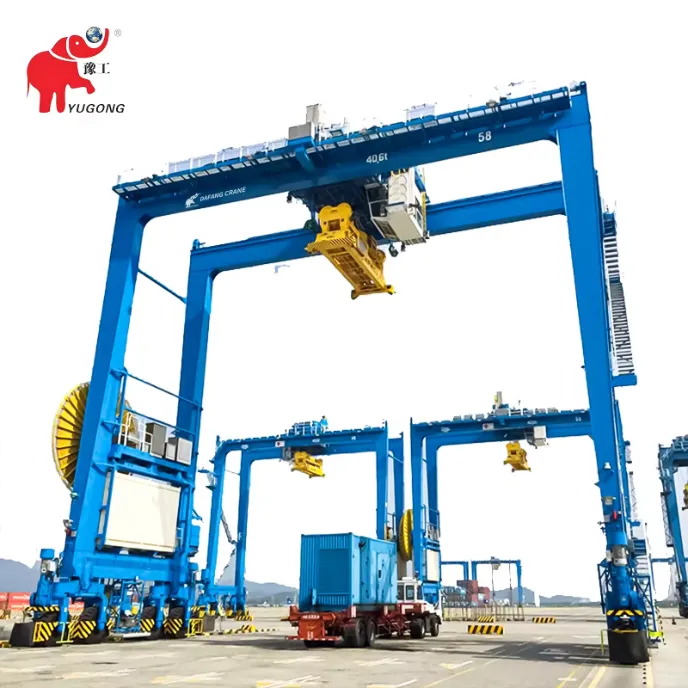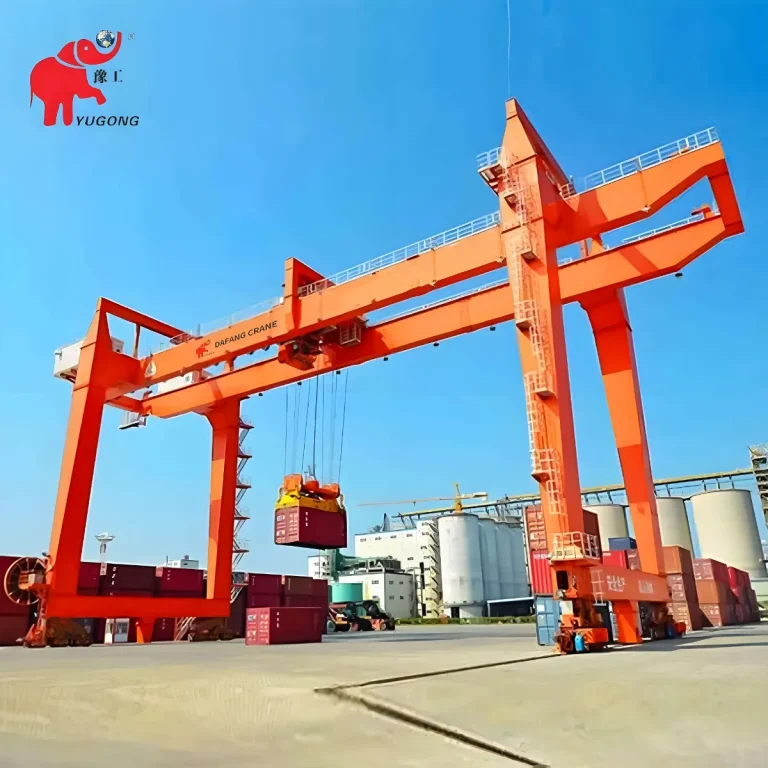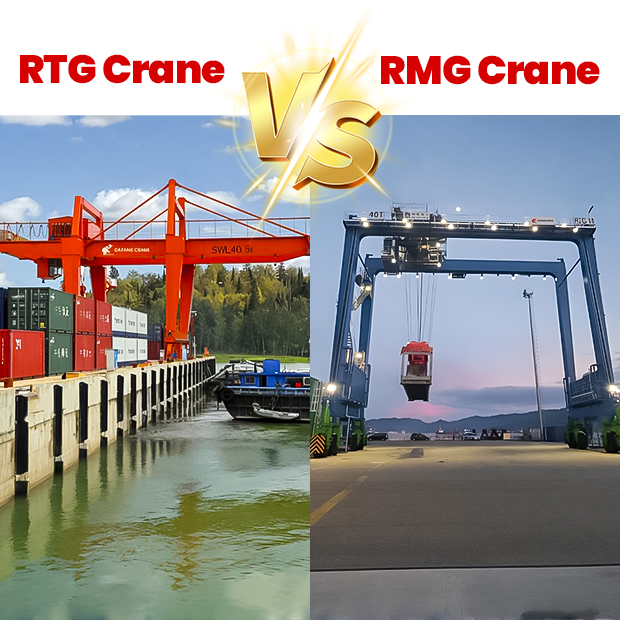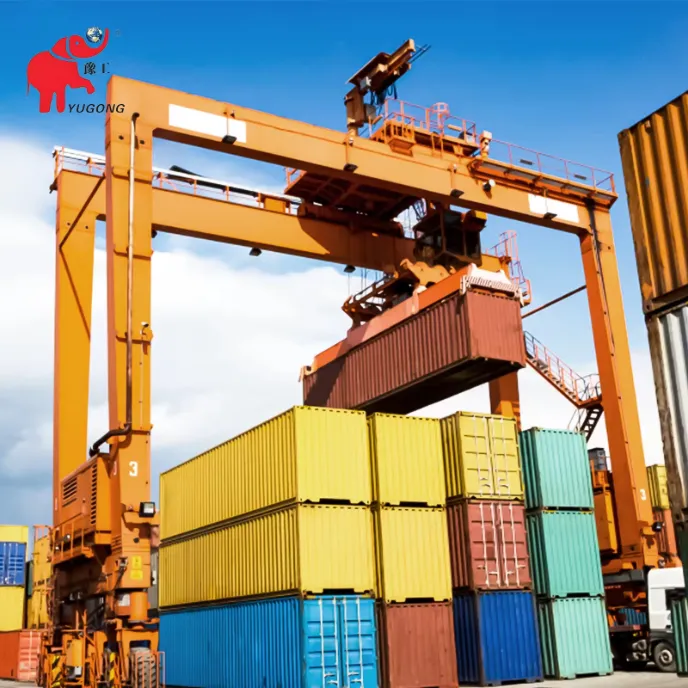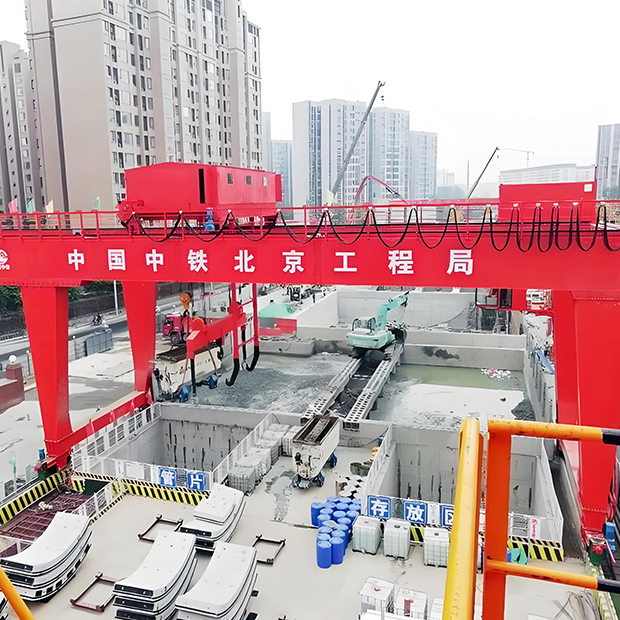







RTG cranes (Rubber-Tyred Gantry Crane) offer yard flexibility and lower civil cost for mid-size or evolving terminals. RMG cranes (Rail-Mounted Gantry Crane) deliver higher throughput and automation potential for large, fixed-layout automated ports. The right choice depends on terminal size, throughput target, automation roadmap, and budget, not brand preference.
Why the RTG vs RMG Decision Matters?
The choice between a rubber-tyred gantry crane and a rail-mounted gantry crane (RTG VS RMG) is one of the most capital-consequential decisions a port operator makes. Both handle ISO containers in the yard; both stack multiple tiers high. However, their infrastructure requirements, automation ceilings, throughput limits, and lifetime cost structures differ substantially. And a mismatched choice locks a terminal into the wrong operating model for 20–25 years.
Neither RTG crane nor RMG crane is universally superior. The right answer depends on four variables: terminal throughput target, yard layout stability, automation ambition, and available capital. The comparison below addresses each.
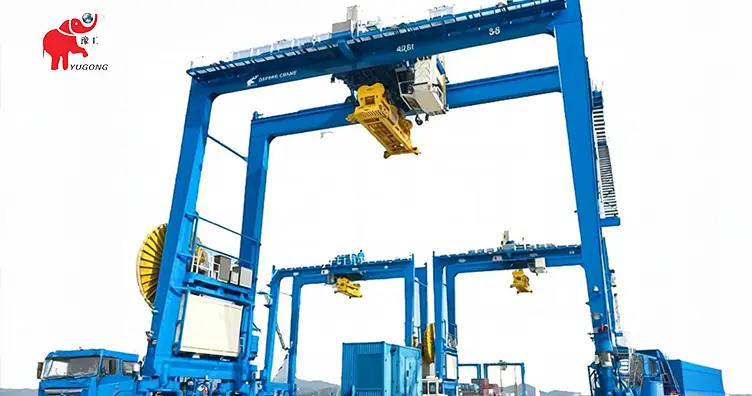
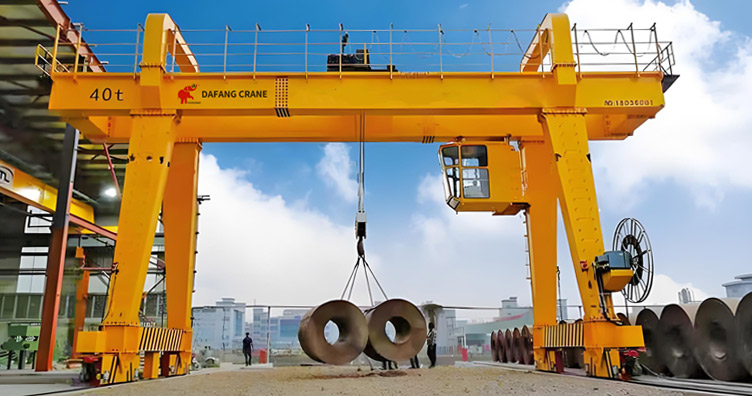
How RTG and RMG Cranes Differ Structurally?
The fundamental difference is the travel mechanism. An RTG crane rides on 16 rubber tyres across a paved yard surface, so it repositions freely between container blocks without any track constraint. An RMG crane runs on precision steel rails set in a concrete subbase — faster, more energy-efficient, and automation-ready, but permanently committed to that lane.
This single structural difference drives nearly every downstream trade-off: civil cost, throughput rate, automation grade, and operating emissions. Specifically:
- RTG civil cost is 40–60% lower than RMG per lane installed, because it requires no rail foundation or drainage infrastructure — only a flat, load-rated yard surface.
- RMG travel speed reaches 45 m/min versus 20 m/min for RTG, directly raising potential crane moves per hour from ~25 (RTG) to ~35–40 (RMG at full automation).
- RMG cranes integrate with terminal operating systems (TOS) and SCADA platforms more naturally, because rail-guided positioning eliminates the GPS uncertainty that semi-automated RTG systems must compensate for.
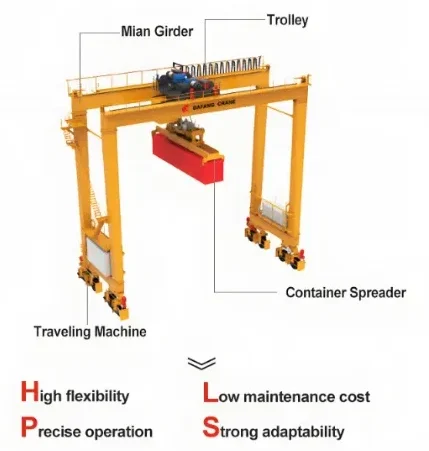
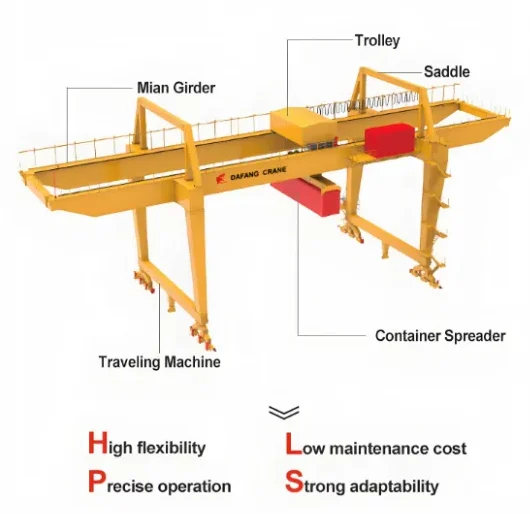
RTG vs RMG: Full Decision Comparison
The table below covers twelve decision factors relevant to port equipment selection teams:
| Decision Factor | Grúa RTG | Grúa RMG | Advantage |
|---|---|---|---|
| Civil infrastructure cost | Low — rubber tyres on paved yard; no rail track civil works | High — precision rail installation, drainage, and civil subbase required | RTG ✓ |
| Yard layout flexibility | High — reposition between blocks without track modification | Fixed — lane changes require new rail installation | RTG ✓ |
| Max travel speed | 0–20 m/min (tyre friction limit) | 0–45 m/min (steel wheel on rail) | RMG ✓ |
| Crane moves per hour | 20–28 moves/hr typical | 28–40 moves/hr at full automation | RMG ✓ |
| Automation level | Semi-automated; full auto with DGPS/laser positioning | Full automation standard; integrates with TOS/SCADA natively | RMG ✓ |
| Capacidad de elevación | 35–70 ton (ISO container + spreader) | 30–100 ton (wider range available) | RMG ✓ |
| Stack height | 5+1 (15.5 m) or 6+1 (18.5 m) | Up to 8+1 possible on deep-stack RMG | RMG ✓ |
| Alimentación | Diesel-electric or shore power plug-in | Grid-connected — lower energy cost per move | RMG ✓ |
| CO₂ per container move | Higher on diesel; shore-power RTG comparable | Lower — grid power + energy regeneration on braking | RMG ✓ |
| Terminal scale fit | Mid-size ports; 100,000–800,000 TEU/yr | Large hubs; 500,000–5,000,000+ TEU/yr | Depende |
| Payback flexibility | Lower upfront; phased expansion possible | Higher capex; optimised at scale | RTG ✓ |
| CE / ISO compliance | CE 2006/42/EC; ISO 9001:2015; ISO 4301 A4–A7 | CE 2006/42/EC; ISO 9001:2015; ISO 4301 A5–A8 | Both ✓ |
Moves-per-hour figures are industry-representative ranges. Actual throughput depends on stack density, truck call rate, and terminal operating system efficiency. CE / ISO compliance applies to Dafang-manufactured units.
Which Type Should You Choose? A Quick-Decision Matrix
Use the matrix below as a first filter before engaging crane suppliers for detailed proposals:
| Choose RTG if… | Choose RMG if… |
|---|---|
| Terminal throughput < 800,000 TEU/year | Terminal throughput > 500,000 TEU/year with growth plan |
| Yard layout is likely to change in 3–5 years | Yard layout is fixed and long-term |
| Civil budget is constrained | Automation and energy cost savings are the priority |
| Phased investment approach is required | Full automation with TOS/SCADA integration is planned |
| Site has multiple discrete container blocks | High-density single-block stacking is the operating model |
Many ports of 400,000–700,000 TEU/yr start with RTG and later convert lanes to RMG as throughput justifies the rail investment. Dafang designs RTG units with RMG-conversion spacing in mind where clients request it.
What RTG and RMG Cranes Share?
Despite their operational differences, both crane types share the same compliance baseline and functional requirements:
- Certificación CE under Machinery Directive 2006/42/EC — required for operation in the EU and for international tender compliance.
- ISO 9001:2015 quality management — covering design, fabrication, and testing traceability from steel to commissioning.
- ISO 4301 duty class (A4–A8) — crane working grade specifies structural steel, wire rope, and gearbox selection for the intended cycle rate.
- Anti-sway control and VFD drives — both types use variable-frequency drives for smooth acceleration and electronic anti-sway to reduce cycle time and structural fatigue.
How Dafang Supports RTG VS RMG Selection?
Henan Dafang Crane designs and manufactures RTG cranes, RMG cranes, ship-to-shore cranes, gantry cranes, and overhead cranes for port, mining, and industrial clients in more than 30 countries. The company has no commercial incentive to push one over the other. Instead, Dafang's port engineering team runs a terminal layout review — covering annual TEU, block configuration, automation roadmap, and power supply — before recommending a crane type and specification.
For terminals that are undecided, Dafang offers a comparison study covering: total installed cost, 10-year operating cost estimate, moves-per-hour modelling, and automation upgrade path — all based on the client's actual site data rather than generic benchmarks. Both crane types ship with full CE documentation, load test certificates, ISO 9001:2015 quality records, weld inspection reports, and bilingual O&M manuals. Dafang's RTG units conform to ISO 4301 A4–A7; RMG units to A5–A8 for high-intensity automated operation.
Contact the Dafang port engineering team for a terminal layout review, crane type recommendation, or full technical proposal.
Obtener presupuesto gratuitoPreguntas frecuentes
Can a terminal start with RTG cranes and convert to RMG later?
Yes, with planning. If RTG lane spacing matches future RMG rail gauge, concrete rail foundations can be added later without relocating existing blocks. Dafang designs RTG units with potential RMG-conversion geometry for clients who request it during the specification phase.
What throughput level justifies switching from RTG to RMG?
Most port planners treat 500,000–700,000 TEU/year as the crossover range where RMG automation returns outweigh the higher civil investment. Below 400,000 TEU/year, RTG flexibility typically delivers better return. Above 1,000,000 TEU/year, RMG is almost always the correct answer.
Which type is better for automated container terminals?
RMG cranes reach full automation more reliably because rail guidance provides absolute position accuracy without GPS dependency. RTG automation requires DGPS or laser positioning, adding system complexity. However, semi-automated RTG is a mature, cost-effective solution for mid-tier terminals.
How do operating costs compare over a 10-year period?
RMG running on grid power typically costs 30–45% less per container move in energy alone versus diesel-electric RTG. However, RMG's higher civil and capex cost means total 10-year cost parity often requires 600,000+ TEU/year throughput to break even versus RTG.
What certifications should I require from any crane supplier for port equipment?
Minimum: CE Declaration of Conformity (2006/42/EC), ISO 9001:2015 quality certificate, ISO 4301 duty class documentation, ISO 3874 spreader compliance, and a factory load test certificate. For automated systems, also require ISO 13849 PL-d safety function certification on the control system.