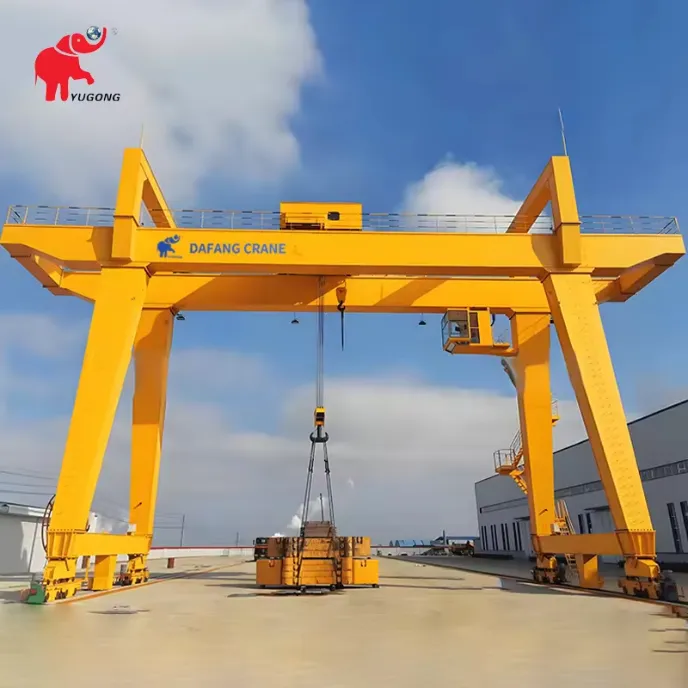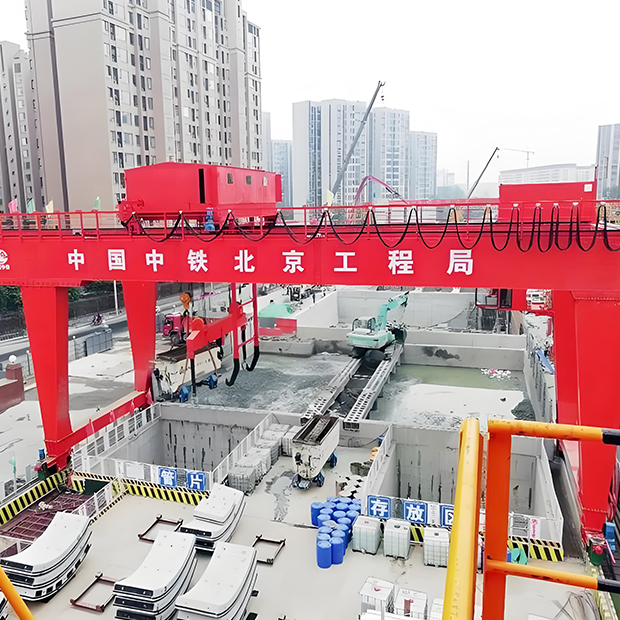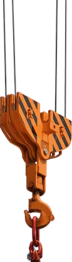

A lançador de vigas de ponte — also called a beam launcher ou girder launching gantry — is a heavy-duty, self-propelled machine built specifically to lift precast concrete or steel girders and place them span by span onto bridge piers. Unlike a general-purpose gantry crane that works in a fixed yard, a bridge girder launcher travels along the structure it is building, repositioning itself after each beam is set so the next span can follow immediately. Dafang's range covers 60 to 200 tonnes of rated capacity, handling bridge spans from 20 to 50 metres in a single pass.
Engineers and procurement teams searching for this equipment often encounter all three names — lançador de vigas de ponte, beam launcher, e girder launching gantry — used interchangeably. All three refer to the same machine category; the differences are regional convention, not technical distinction.
This article walks through how the machine is built, how each major component contributes to the erection cycle, what kinds of projects it is designed for, and what limitations to factor into a project plan before selecting one.
Componentes principais de um lançador de vigas de ponte
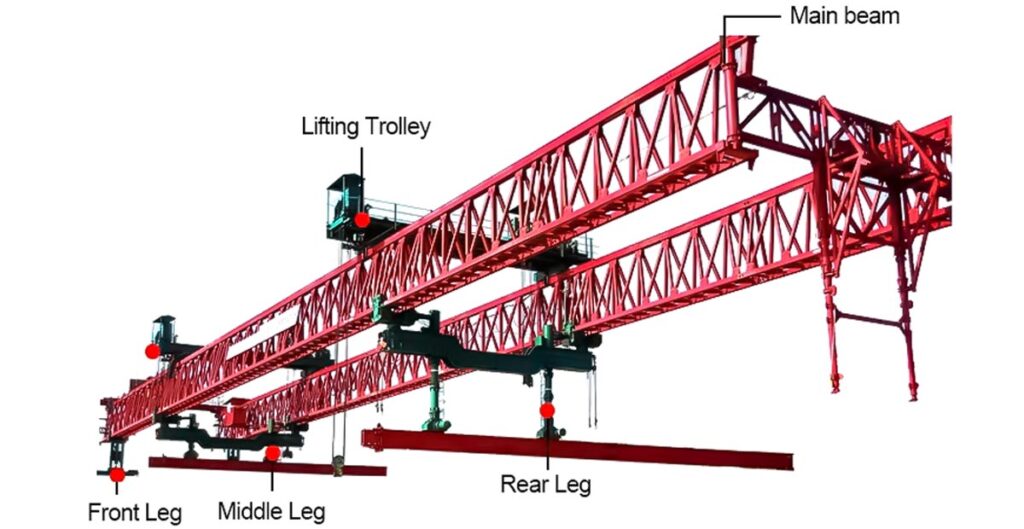
Understanding the machine starts with knowing what each part does. The structure is not just a large crane on wheels — every element is designed to solve a specific constraint unique to bridge construction over obstacles.
Main Girder: The Load-Bearing Spine
The main girder is the central truss or box beam that spans across two piers while a precast girder is being positioned beneath it. It is typically fabricated from high-strength structural steel and engineered with both bending and torsional resistance, because it must hold its shape under asymmetric loads during the launching cycle. On Dafang units, the main girder span reaches up to 50 metres for 200-tonne configurations, meaning the structure must sustain its own weight plus the suspended load while cantilevering over an open gap.
Front and Rear Legs: Stability and Mobility Combined
The legs are not passive supports — they are the machine's means of locomotion. The front legs typically stand on the already-completed bridge deck ahead of the current span, while the rear legs ride on tracks or pier caps behind. Height adjustment is hydraulic, allowing the machine to compensate for longitudinal slopes up to 5% and transverse cross-slopes up to 5%, and to handle curved alignments down to a 200-metre radius (for the 60-tonne model) or 400-metre radius (for the 200-tonne model). When one span is complete, the rear legs retract, the whole machine walks forward, and the front legs land on the next pier cap.
Lifting Trolley: Precision Placement
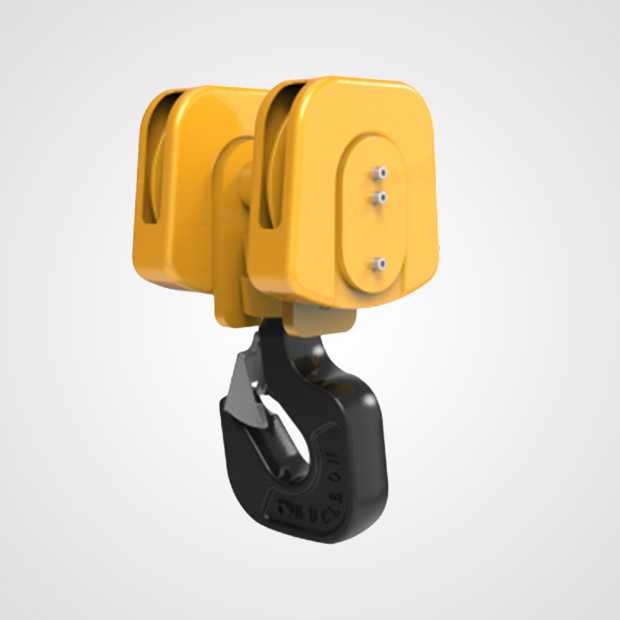
The electric lifting trolley travels longitudinally along the main girder and also moves laterally — typically at 3 m/min in both directions on Dafang machines. Variable-frequency drive (VFD) control governs all movements, which means acceleration and deceleration are smooth rather than jerky. That matters because a sudden stop on a suspended 100-tonne girder generates shock loads that can crack a freshly cured precast element. Lifting speeds are inversely proportional to capacity: the 60-tonne configuration lifts at approximately 0.9 m/min, while the 200-tonne version operates at roughly 0.41 m/min — slower, but with proportionally greater control.
Balance Beam and Rail System: Load Distribution
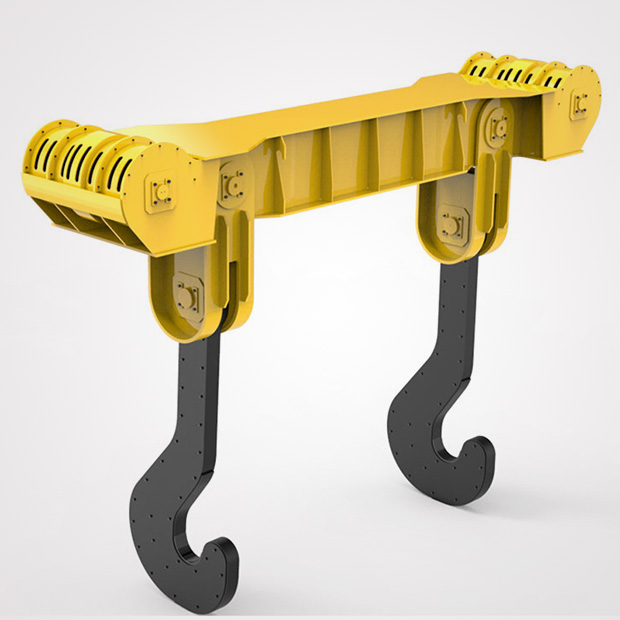
The balance beam distributes the load across multiple lifting points when a girder is picked up, preventing point-load stress concentrations that would overstress the precast section. The rail system — running the full length of the main girder — guides the trolley and the supporting legs, keeping lateral drift within millimetres across a 50-metre span.
How the Beam Launcher Erects a Bridge, Step by Step
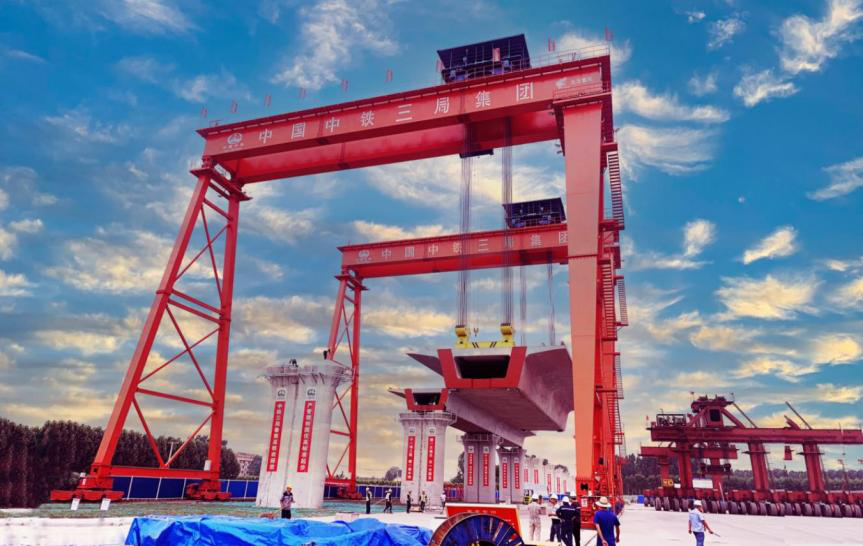

The erection cycle is repetitive by design, which is what makes it efficient on multi-span viaducts. Here is how a single span is completed.
Positioning the Machine Over the Target Span
With the front legs already resting on the forward pier cap and the rear legs on the previous pier cap, the machine straddles the gap where the next girder will land. At this stage the lifting trolley is parked at the rear of the main girder. The precast girder is transported by a girder transporter (a low-flatbed carrier that travels on the completed bridge deck) and positioned beneath the rear trolley hook.
Lifting, Traversing, and Lowering the Girder
The trolley lifts the girder clear of the transporter and travels forward along the main girder rail until the girder is positioned directly over the bearing pads on the pier caps below. Lateral fine-adjustment moves the girder into exact alignment — this is the step where the 3 m/min cross-travel speed provides enough control to meet millimetre-level bearing tolerances. The trolley then lowers the girder onto the bearing pads at the slow, controlled lifting speed.
When a Standard Crane Is Not the Right Tool
A common question from project planners is why a conventional mobile crane or gantry crane cannot simply do this job. The answer is access. Mobile cranes need a stable ground surface directly below the placement point — which means no water, no existing traffic, and no open-air gap. A standard gantry crane is fixed in place and cannot self-advance from span to span. The bridge girder launcher solves both problems by carrying its own support structure and travelling along the alignment of the bridge itself, which makes it the only practical solution for river crossings, active highway overpasses, and long viaducts where ground access is blocked or environmentally restricted.
Launching the Machine to the Next Span
Once all girders for the current span are placed, the rear legs retract or fold, the machine slides forward on its rail system, and the front legs extend to reach the next pier. The cycle repeats. On a well-organized site, a skilled crew can complete one span per day on a standard highway viaduct.
Applications: Where Bridge Girder Launchers Are Used
Not every bridge project uses this machine — project size, terrain, and span length all factor into the decision.
Highway and Expressway Viaducts
This is the core application. Multi-span highway viaducts — particularly those crossing valleys, rivers, or active roads — are the most common use case. The machine's ability to operate without ground support beneath the span makes it ideal for crossings where scaffolding would be impractical or environmentally prohibited.
High-Speed Railway and Metro Construction
Railway bridge construction adds an extra constraint: track geometry tolerances are tighter than highway standards, and beam placement errors of a few millimetres can affect ride quality at speed. The VFD-controlled trolley and hydraulic leg adjustment of a bridge girder launcher address this directly. Dafang machines are specified for both mainline railway bridges and urban metro elevated lines.
Curved and Inclined Bridges
Standard erection equipment struggles with curved alignments and steep grades. The Dafang launcher handles longitudinal slopes up to 5%, cross-slopes up to 5%, and inclined bridge angles up to 45° — coverage that is relevant for mountain-route railways and urban interchange structures where the alignment rarely runs straight and flat.
Water Conservancy and Long-Span Projects
For bridges across rivers, straits, or reservoir areas where access from below is impossible, the launcher's self-contained support system is the deciding factor. The 200-tonne model with its 50-metre span coverage handles most large river-crossing viaducts that use precast box girder construction.
Certifications and What to Verify Before Procurement
Any bridge girder launcher entering service on an international infrastructure project should carry traceable certification. Here is what matters and why.
Bridge construction equipment typically needs to comply with Marcação CE (Machinery Directive 2006/42/EC) for European markets, ISO 9001 for manufacturing quality management, and relevant lifting standard ISO 4301 for duty classification. In railway applications, the owning authority may also require FEM group classification documentation and proof-load test records. Dafang holds CE and ISO certification on its bridge construction equipment line.
For buyers, verification is straightforward: request the EC Declaration of Conformity, the overload test report (typically 125% of rated capacity), and the ISO 9001 certificate with a valid scope that explicitly covers lifting machinery. These documents should arrive with the equipment, not on request after the contract is signed.

Perguntas mais frequentes
Q1:What is the difference between a bridge girder launcher, beam launcher, and girder launching gantry?
All three terms describe the same category of equipment. "Bridge girder launcher" and "beam launcher" are common in Chinese and Southeast Asian engineering contexts, while "girder launching gantry" or "launching gantry" appears more frequently in European and North American civil engineering literature. Technically there is no distinction; the choice of term is regional convention.
Q2:What lifting capacity do I need for a typical highway viaduct?
For standard highway precast box girders in the 20–40 metre span range, beam weights typically fall between 80 and 160 tonnes. A 100-tonne launcher covers most highway applications; projects with longer spans or heavier prestressed T-beams may require 160 or 200-tonne capacity. Confirming the actual girder weight per your structural drawing before specifying capacity is essential.
Q3:Can a bridge girder launcher work on curved or sloped alignments?
Yes, though the radius and slope limits vary by model. Dafang's 60-tonne unit handles curve radii down to 200 metres; the 200-tonne model handles down to 400 metres. Longitudinal and cross-slopes up to 5% are accommodated across the range. For tighter curves or steeper gradients, confirm the specification with the manufacturer before purchase.
Q4:How much does a bridge girder launcher cost?
Market pricing for new equipment varies considerably with capacity and configuration. As a general reference, a 60-tonne unit in the 30-metre span range typically starts around $40,000–60,000 USD, while a 100-tonne unit with 40-metre span coverage generally ranges from $90,000 to $130,000. A 200-tonne heavy-duty configuration can reach $150,000–280,000 or more, depending on auxiliary equipment, control system specification, and delivery terms. Request a project-specific quotation based on your actual girder weight, span, and site constraints rather than relying on catalogue list prices.
Q5:What safety systems does a bridge girder launcher typically include?
Standard safety provisions include overload protection (load cells that cut power if the rated capacity is exceeded), travel limit switches on all trolley and leg movements, emergency stop buttons at operator stations and at ground level, and anti-tipping interlocks on the leg system. For railway or metro projects, remote-control operation capability is increasingly specified to keep operators away from the live work zone.