
Choose a jib crane when most of your lifts repeat at one workstation and stay within about 5 tons. Choose an overhead crane when loads must travel across the bay or exceed that range. That is the short answer to the jib crane vs overhead crane question, and your building decides the rest.
Most buyers hesitate because both machines lift loads. A jib crane, also sold as a cantilever crane, sweeps an arc or circle around one column or wall bracket. An overhead crane runs on runway beams and covers a full rectangular bay. Behind both sits a practical question: can your floor, wall or columns carry the equipment you pick?
This guide compares coverage, capacity, duty class and structural needs, then shows which jib crane type suits which site and which documents to check before you buy. A quick comparison table comes first.
Índice
Quick comparison: jib crane vs overhead crane
| Jib crane (cantilever crane) | Grua suspensa | |
|---|---|---|
| Cobertura | Circle or arc around one pivot (180°–360°) | Full rectangular bay under the runway beams |
| Capacity in Dafang's range | 80 kg to 5 t, depending on type | Up to 320 t (industrial range) |
| Duty class (ISO 4301) | A3 on most models, A3–A5 on wall-travelling | A3–A8, depending on type |
| What the building must provide | Foundation (floor-mounted) or a strong wall or column (wall-mounted) | Columns or steel structure able to carry runway beams |
| Best for | Repeated lifts at one machine, cell or dock | Moving loads across the bay, heavy or continuous duty |
| Main limit | Reach stops at the arm radius | Needs runway structure and headroom |
Not sure which column describes your plant? Send an inquiry with your heaviest lift and building type, and an engineer will help you narrow it down.
Obter um orçamento gratuitoJib Crane vs Overhead Crane: The Core Differences

A jib crane covers a circle, while an overhead crane covers the whole bay
A jib crane serves one fixed zone around its pivot, while an overhead crane serves every point under its runway.
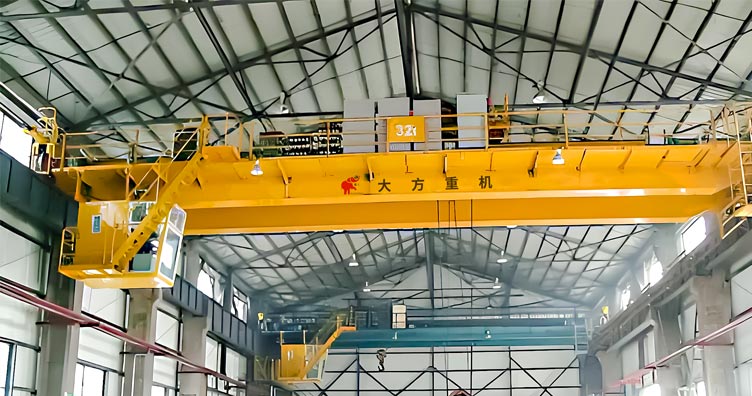
The jib arm rotates 180° to 360° around a column or wall bracket, so the working area is a circle or arc set by the arm radius. Dafang's floor-mounted model, for example, lists a valid radius of about 4–6 m. An overhead crane moves a bridge along two runway beams with a trolley across it, so one hook reaches the whole bay, corners included. Dafang's industrial overhead range is built for spans of 10–35 m.
You see the difference quickly in a machine shop. A jib crane serving a CNC cell cannot carry a part to the packing area on the far side of the hall. A bridge crane can. That is the practical gap in any jib crane vs overhead crane comparison.
Jib cranes stop at light-to-medium capacity, while overhead cranes scale from a few tons to hundreds
Jib cranes are light-to-medium equipment, while overhead cranes scale from a few tons to hundreds of tons.
Dafang's jib range starts at 80 kg for an articulating arm and reaches 5 t for floor-mounted and wall-travelling types, while its wall-mounted BX type is rated 0.5–1 t. Its industrial overhead range goes up to 320 t. Reach also matters: the bending load on the column and foundation grows with radius, so quote the longest radius you need, not the average one.
Duty class separates occasional lifts from all-day production
Duty class, not just load weight, decides whether a crane survives your shift pattern.
ISO 4301 classifies cranes by how often and how heavily they lift. Dafang lists its floor-mounted and wall-mounted jib cranes at working grade A3 and the wall-travelling type at A3–A5. Its overhead range spans A3–A8, with A7–A8 reserved for continuous heavy work such as ladle handling in steel mills. A jib that feeds a press 40 times a shift needs a duty check even when each lift is light. If your plant runs several shifts near rated load, ask the supplier whether a higher-duty configuration is available. In a jib crane vs overhead crane decision, this check often matters more than the arm length or span.
When a Jib Crane Is the Right Choice
Choose a jib crane when lifts repeat at one workstation
A jib crane earns its place where the same load moves between the same two points many times a day.
Typical sites are CNC and machining cells, welding stations, assembly lines, loading docks and maintenance bays. The operator stands next to the load, and a jib crane with an electric chain hoist gives fast, precise positioning without waiting for a shared bridge crane. Because the lift is short and repeated, a lighter, dedicated machine often fits better than a large system.
Match the jib crane type to what your building offers
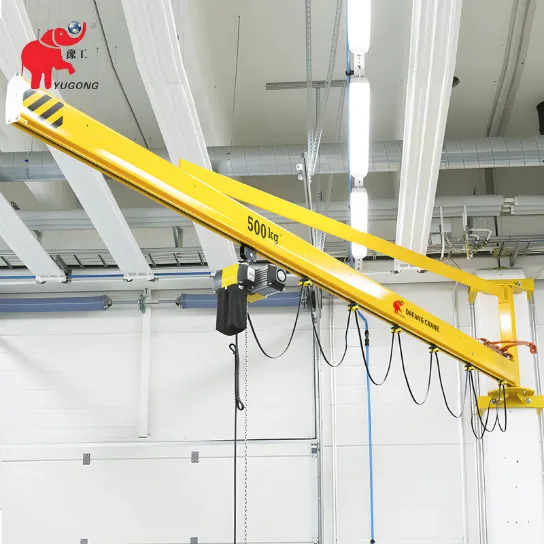
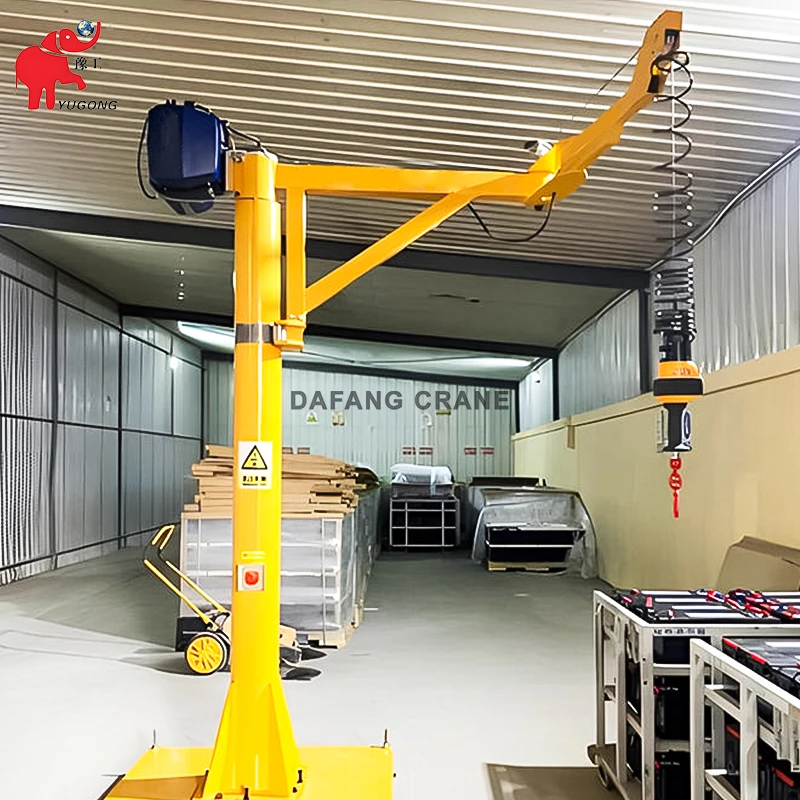
The mounting type should follow your floor, walls and layout, not the other way round.
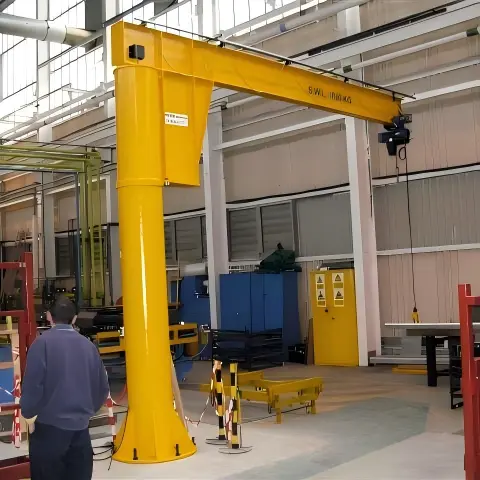
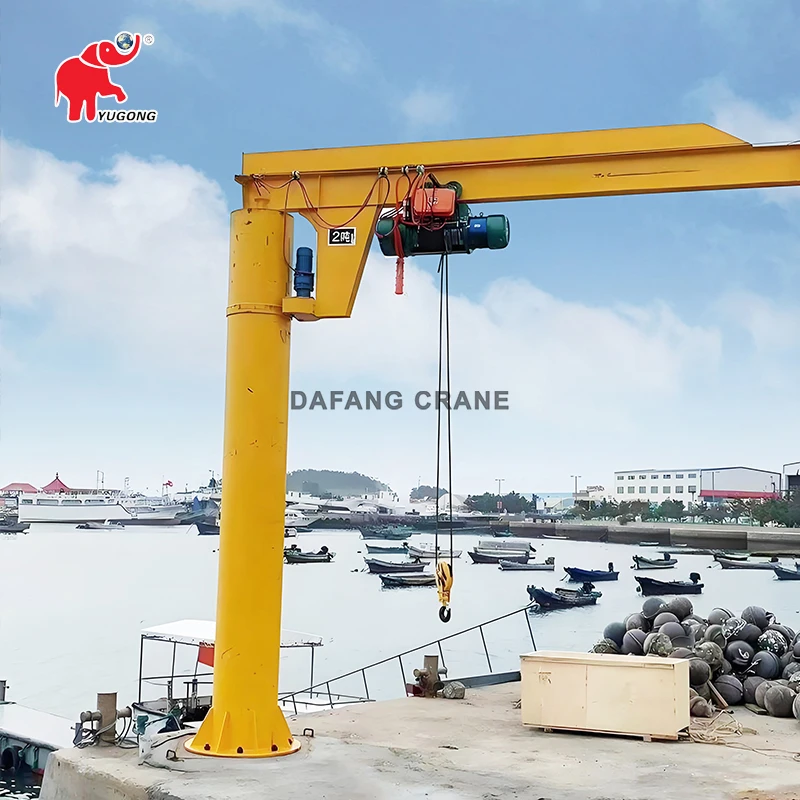
- Floor-mounted jib crane: stands on its own foundation and rotates up to 360°. In Dafang's range it lifts 0.5–5 t at a valid radius of about 4–6 m. Best when no suitable wall exists.
- Wall-mounted jib crane: bolts to a wall or column and uses no floor space. The BX type rotates 180° and is rated 0.5–1 t. Best for light loads along a strong wall.
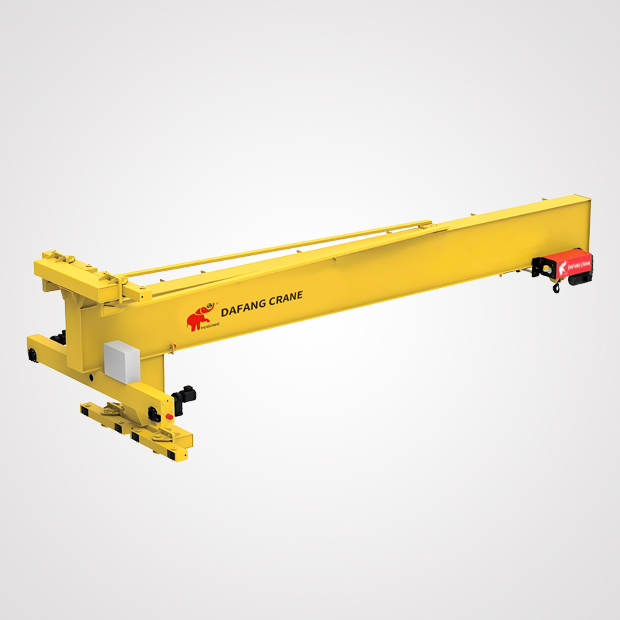
- Wall-travelling jib crane: runs on a rail along the wall, so one arm serves a longer strip. It covers 0.5–5 t at A3–A5.
- Column articulating jib crane: a two-segment arm reaches around machines and columns. It handles 80–600 kg with hand control, so it suits fine positioning of light parts.
If you are unsure, start with the wall. When it cannot carry the load moment, a floor-mounted unit is the safer choice. The full range is on the cantilever crane page.
Know the limits of a jib crane before you buy
A jib crane cannot reach beyond its arm radius, needs a strong foundation or wall, and is not built for heavy continuous lifting.
- Reach: anything outside the arc needs a second pick or a different crane.
- Structure: wall-mounted units depend on the host wall. A partition wall or old masonry may not take the rotating load, so have a structural engineer confirm it. Even the light articulating model on Dafang's site cites a typical minimum of 150–200 mm reinforced concrete under the column, and heavier floor-mounted units need an engineered foundation.
- Clearance: check the free height under the arm and the hook approach, especially in low-roofed older plants.
When an Overhead Crane Beats a Jib Crane
Choose an overhead crane when loads travel across the bay
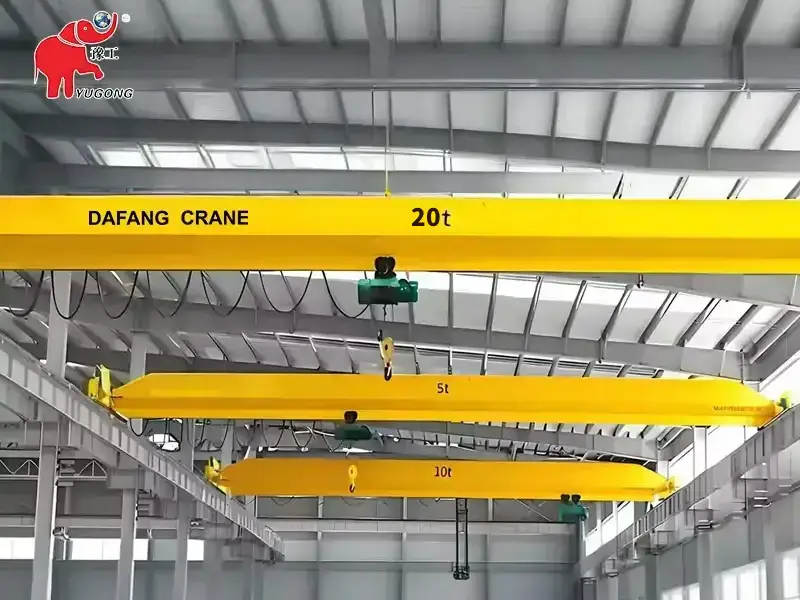
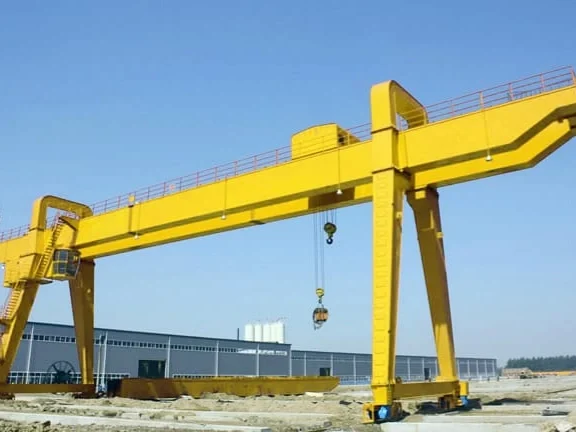
An overhead crane is the right tool when one lifting system must serve several stations or carry loads end to end.
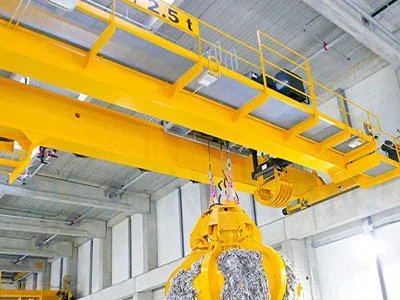
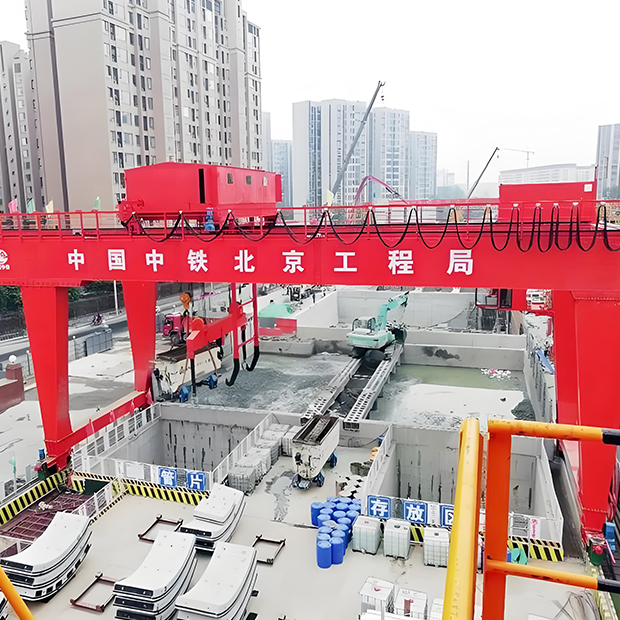
Fabrication halls, auto-parts plants, warehouses and power stations typically use bridge cranes because the load has to cross the building. Dafang's industrial overhead crane range covers seven types: LH/NLH electric hoist double girder, QB explosion-proof, QDY metallurgical, QY insulated, QC/QCL electromagnetic, QZ grab bucket and power-station cranes. That range handles heavy and special environments a jib crane cannot. For lighter bays, browse the ponte rolante monoviga models.
An overhead crane needs a building that can carry the runway
Overhead cranes need columns or a steel structure strong enough to carry the runway beams, plus enough headroom above the hook.
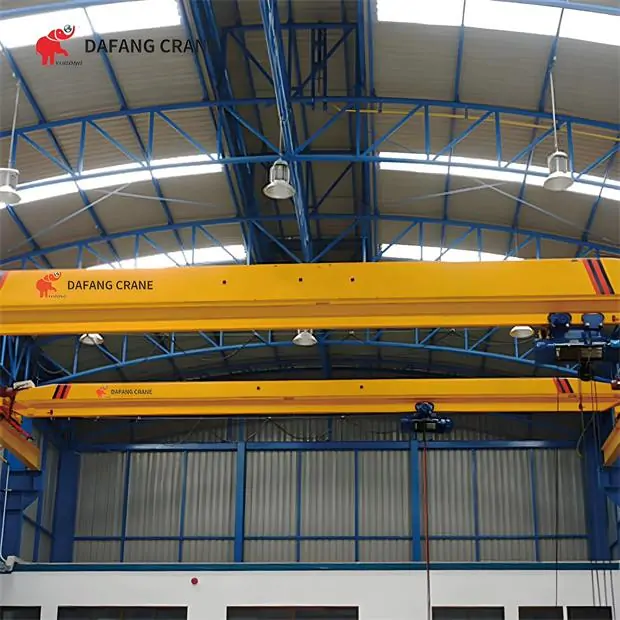
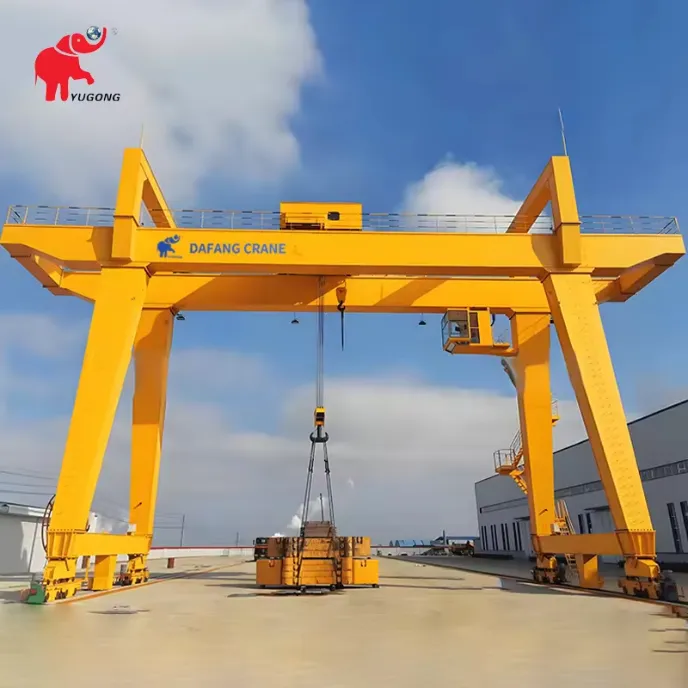
In older plants the limit is often the structure, not the crane. Roof trusses and columns designed decades ago may not take crane loads, and low roofs cut hook height. Underhung or suspension designs, which Dafang offers in its single girder range, can help when headroom is tight. If the building cannot carry a runway at all, a gantry crane with its own legs and rails, or a floor-mounted jib, are the usual alternatives.
Installation also takes longer. Dafang quotes 1–2 days on site for its light articulating jib, while an overhead system with runways usually needs more time for beam alignment, rail levelling and load testing.
Use both when short picks keep blocking the bridge crane
Many plants run a bridge crane for bay-wide moves and jib cranes at the stations that need constant, short lifts.
The jib crane or overhead crane question is often a false choice. The bridge crane stays free for heavy transfers, while the jib handles repeated point lifts, which reduces waiting for the hook. Wall-mounted and wall-travelling jibs are a common choice here because they add no floor obstruction. If you want light-load coverage over a wider area without a full bridge crane, ask about workstation-type systems. Dafang lists a flexible combined workstation crane in its single girder range.
Get a tailored quote from our engineers. Send your heaviest lift, working radius or span, roof height and column spacing, and we will settle the overhead crane vs jib crane question for your plant, whether the answer is one machine or both.
Obter um orçamento gratuito
Certifications to Check Before You Buy a Jib Crane or Overhead Crane
Which standards buyers usually check
Export buyers usually ask for CE conformity, ISO 9001 certification and a stated ISO 4301 duty class.
The same checks apply on either side of the jib crane vs overhead crane choice. Pick the ones that match your market:
- EU and many other markets: CE marking under Machinery Directive 2006/42/EC, with an EC declaration of conformity.
- Eurasian Economic Union: EAC conformity.
- United States: OSHA 1910.179 applies to top-running overhead and gantry cranes. Jib cranes may follow different consensus standards, so confirm with your local inspector.
- Design basis: FEM rules are often referenced for structure and duty classification.
Dafang's industrial overhead crane page lists CE (2006/42/EC), ISO 9001:2015, FEM 1.001 structural design and ISO 4301 duty classification. For any jib crane, ask for the documents that cover the exact model you are buying.
Why certification matters at customs, insurance and plant audits
Missing paperwork can delay customs clearance, complicate insurance claims and fail a plant safety audit.
Importers in CE markets typically need the declaration of conformity before equipment goes into service. Insurers and inspectors usually ask for rated-load test records. A documented duty class also shows that the crane matches your shift pattern, which matters when an auditor asks why a light-duty jib is running three shifts.
How to verify documents before you order
Ask the crane supplier for documents, not assurances: the EC declaration, ISO 9001 certificate, load test report and duty class calculation.
Check that each certificate names your model and that the issuing body is identifiable. Request the factory acceptance report and overload test result before shipment. For floor-mounted jib cranes, ask for the foundation drawing and anchor-load sheet. Dafang's overhead page says every unit ships with a load test certificate and factory acceptance report, and its articulating jib page says a foundation template and load specification sheet come with each order. Ask for the same paperwork for your specific model.
Talk to a Dafang Engineer About Your Jib Crane vs Overhead Crane Choice
Dafang builds jib, overhead, gantry and port cranes at an 850,000 m² production base with 2,600+ employees, so we can compare options without favouring one machine. Send us your layout, lift weight and building details, and we will tell you whether a jib crane, an overhead crane or both fit your plant.

FAQ
Q1:Can a jib crane replace an overhead crane?
Only when all your lifts happen within one jib's radius and stay in its capacity range. A jib crane serves a circle or arc around one pivot, while an overhead crane covers the full bay. If loads must cross the building or exceed roughly 5 tons, plan for an overhead crane, or use jib cranes alongside one.
Q2:How much can a jib crane lift?
In Dafang's range, jib cranes lift from 80 kg up to 5 tons, depending on type. Articulating models sit at the light end (80–600 kg), wall-mounted BX models are rated 0.5–1 t, and floor-mounted and wall-travelling types reach 5 t. Confirm rated capacity at your longest working radius and duty class.
Q3:Does a jib crane need a special foundation?
Floor-mounted jib cranes need a rated concrete foundation; wall-mounted ones need a load-bearing wall or column. Even Dafang's light articulating model cites a typical minimum of 150–200 mm reinforced concrete, and heavier units need an engineered foundation. Send your floor and wall details to an engineer before ordering.
Q4:Can a workshop use a jib crane and an overhead crane together?
Yes, and many plants do: the overhead crane handles bay-wide moves while jib cranes serve individual stations. This keeps the bridge crane's hook free for heavy transfers and reduces waiting for repeated short lifts. Wall-mounted and wall-travelling jibs are common here because they add no floor obstruction.
Q5:Which certificates should I ask a crane supplier for?
Ask for the CE declaration of conformity, ISO 9001 certificate and a load test report for your exact model. Add the duty class under ISO 4301 and, for floor-mounted jib cranes, a foundation drawing. Requirements differ by country, so confirm local rules with your inspector or insurer.