Products


Oil refineries, chemical plants, and paint manufacturing facilities operations handle flammable materials daily. In these environments, standard electric hoists pose serious ignition risks regardless of their lifting capacity or duty rating. A single electrical arc from a worn motor brush, static discharge from ungrounded components, or surface temperature exceeding auto-ignition thresholds can cause catastrophic explosions.
ATEX Directive 2014/34/EU and IECEx standards classify hazardous areas based on gas group (IIA, IIB, IIC) and temperature class (T1-T6). Equipment operating in Zone 1 or Zone 2 atmospheres must be certified explosion-proof through one or more protection methods: flameproof enclosures (Ex d), increased safety (Ex e), or intrinsic safety (Ex i).

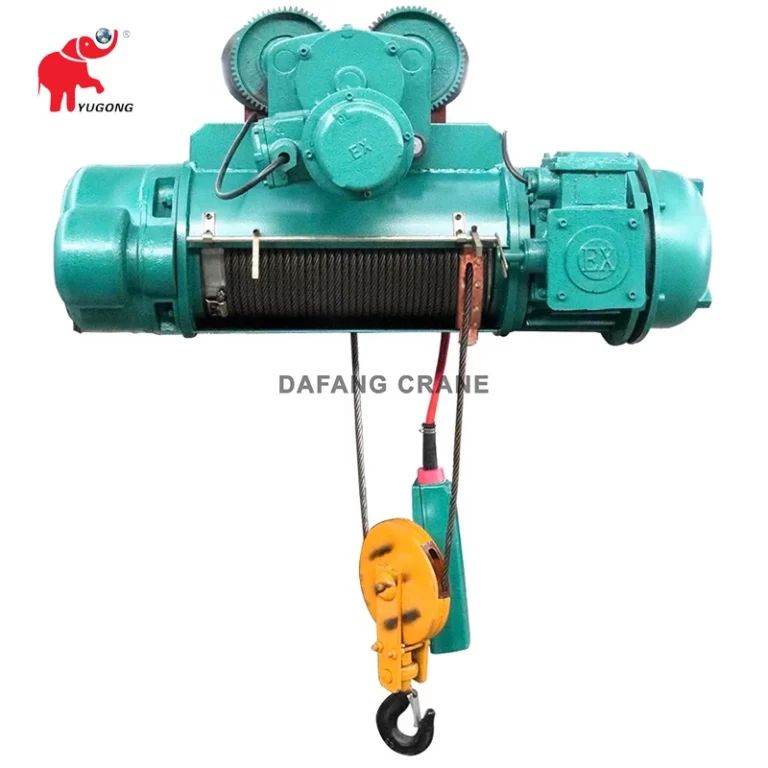
Dafang manufactures two types of explosion-proof electric hoists: wire rope and chain, each for different capacity ranges, lifting heights, and operational needs. Understanding their differences helps procurement teams choose appropriate equipment for their specific hazardous applications.

Flameproof Motor Enclosure (Ex d)
Cast iron or cast steel motor housing contains internal explosions without allowing flame propagation to external atmosphere. Flamepath joints maintain specified gap dimensions preventing hot gas escape. Motor surface temperature remains below T4 classification (135°C maximum) even under continuous operation.
Sealed Control Components
Limit switches, contactors, and electrical junction boxes use flameproof enclosures meeting IP65 minimum ingress protection. All electrical terminations occur within certified enclosures—no exposed connections exist in hazardous atmosphere.
Wire Rope and Drum System
Galvanized or stainless steel wire rope (6x19 or 6x37 construction) winds on grooved drum. Anti-rotation guides prevent rope twisting during lifting. Rope diameter and reeving configuration determine lifting capacity and speed. Multi-layer spooling requires precise drum grooving to maintain rope alignment.

Compact Flameproof Design
Smaller overall dimensions versus wire rope hoists at equivalent capacity. Integrated motor and gearbox assembly reduces component count and potential leak paths. Lower hook approach dimension (distance from hoist body to hook) benefits applications with headroom constraints.
Load Chain and Pocket Wheel
Alloy steel load chain (typically Grade 80 or 100) engages precision-machined pocket wheel. Chain configuration (single-fall or multi-fall) determines capacity and lifting speed relationship. Chain requires periodic lubrication but tolerates side-loading better than wire rope.
Friction Brake System
Spring-loaded friction brake holds load when motor power disengages. Brake operates mechanically—not electrically—maintaining holding capacity during power failure. Asbestos-free friction material meets environmental and safety requirements.
| Specification | Explosion-proof Wire Rope Hoist | Explosion-proof Chain Hoist |
|---|---|---|
| Capacity Range | 1-32 tons | 0.5-10 tons |
| Lifting Height | 6-30 meters | 3-12 meters |
| Lifting Speed | 2-8 m/min (dual-speed common) | 2-4 m/min (typically single-speed) |
| Hook Approach | 450-800mm (capacity-dependent) | 350-500mm (more compact) |
| Duty Classification | M3-M5 (moderate to intensive) | M3-M4 (light to moderate) |
| Maintenance Interval | Wire rope inspection every 3-6 months | Chain inspection every 6-12 months |
| Installation Complexity | Requires precise drum alignment | Simpler installation, more tolerant |
| Side-Loading Tolerance | Low (wire rope damage risk) | Moderate (chain accommodates angle) |
| Typical Cost | Higher (complex drum/rope system) | Lower (simpler mechanism) |
| Best Applications | Heavy capacity, tall lifts, frequent use | Light-medium capacity, low headroom |
Procurement teams must specify gas group and temperature class based on facility's hazardous area classification documents. Under-specifying equipment certification creates compliance violations and safety risks


Procurement teams evaluating explosion-proof hoists for specific facility classifications are encouraged to request:
Contact Dafang Crane's technical team to discuss zone classification requirements, customization options, and delivery timelines for your project.
Monthly: Visual rope inspection for broken wires, kinking, diameter reduction
Quarterly: Drum groove inspection, limit switch function verification
Annual: Rope replacement (recommended), motor enclosure gasket inspection, load testing
Monthly: Chain lubrication, pocket wheel inspection
Quarterly: Brake function test, electrical enclosure seal verification
Annual: Chain elongation measurement, friction brake adjustment, load testing
Both configurations require periodic verification that flameproof enclosures maintain certification status:
Facilities operating under ATEX or IECEx regimes must document inspection results and maintain equipment certification files supporting regulatory compliance.
Dafang Heavy Machine ranks among the top 3 crane and hoist manufacturer in China by production volume, with annual output exceeding 30,000 electric hoists. Dafang manufactures explosion-proof electric hoists compliant with ATEX Directive 2014/34/EU and IECEx standards. For facilities with remote monitoring requirements, Dafang introduced industrial crane remote monitoring technology in 2016 and achieved certification for unmanned intelligent crane systems in 2021.
Dafang's production capability is increasingly specified in modern hazardous-facility projects. Our engineering team analyzes facility hazardous area classifications, gas groups, temperature requirements, and operational parameters to specify appropriate equipment configurations. Contact our technical team with your facility's hazardous area classification documents, capacity requirements, and operational environment details. We provide certified equipment specifications, installation guidance, and documentation supporting regulatory compliance.

Henan Dafang Heavy Machinery Co., Ltd.
ATEX Certified Explosion-Proof Wire Rope Hoists and Chain Hoists
CE · ISO 9001 · ExdIIBT4/ExdIICT4 · 20+ Years Hazardous Applicaiton Experience
No. Explosion-proof certification requires integrated design—motor enclosures, control components, and structural elements specifically engineered for hazardous locations. Retrofitting cannot achieve certified protection.
Wire rope hoists typically operate 15-20 years with proper maintenance; chain hoists 10-15 years. Differences stem from wire rope's susceptibility to abrasion and fatigue versus chain's simpler wear patterns.
Certification itself doesn't expire, but equipment must maintain original certified condition. Annual inspection verifying explosion protection integrity satisfies most regulatory requirements. Modifications require recertification.
ExdIIBT4 covers Group IIB gases including ethylene and propane, with a maximum surface temperature of 135°C (T4 class). ExdIICT4 extends coverage to Group IIC gases—hydrogen and acetylene—the most ignition-sensitive industrial atmospheres. If your facility handles hydrogen, specify ExdIICT4. For most petrochemical and solvent environments, ExdIIBT4 is sufficient. Confirm zone classification and gas group with your facility's hazardous area document before specifying.
Yes. Power supply configuration is specified at order stage to match local infrastructure—380V/50Hz, 460V/60Hz, or other combinations. Explosion-proof equipment requires that any field modification to electrical components be performed by certified personnel; Dafang's engineering team handles pre-delivery configuration to eliminate this requirement.
M3 suits light-duty maintenance applications with infrequent lifts. M5 is appropriate for production environments with regular loading across multiple shifts. For continuous-operation chemical or refinery applications, confirm daily operating hours and average load percentage against FEM classification tables. Underspecifying duty class is the most common cause of premature component wear in industrial hoist applications.
Dafang supplies high quality overhead cranes, gantry cranes, jib cranes, electric hoists and crane spare parts etc. You can fill out the form below, and we will contact you as soon as possible
Stella