






Global container trade volumes continue to grow, and the pressure on terminal operators to handle more boxes in less space — faster and with fewer errors — has never been greater. Modern container terminals are not simply storage yards. They are precision logistics systems where equipment reliability, stacking density, and automation capability directly determine throughput capacity and profitability.
At the center of high-performance container yard operations is the rail mounted gantry crane. Selecting the right RMG crane and the right manufacturer is one of the most consequential infrastructure decisions a terminal operator or logistics investor will make. The choice affects not just the capital cost of the initial installation, but terminal throughput, operational efficiency, long-term maintenance expenditure, and the facility's ability to integrate with future automation platforms.
This guide provides a structured framework for understanding RMG crane technology, evaluating manufacturers, and making informed procurement decisions for container terminal, intermodal rail yard, and inland logistics applications.
Table of Contents
What Is an RMG Crane?
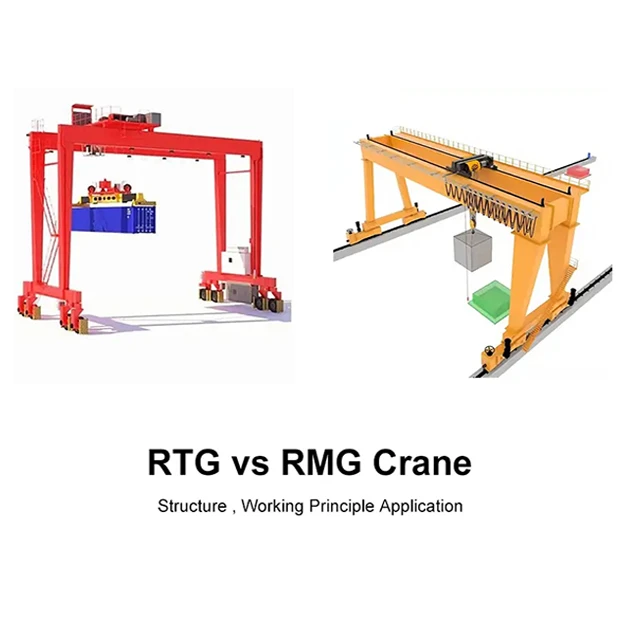
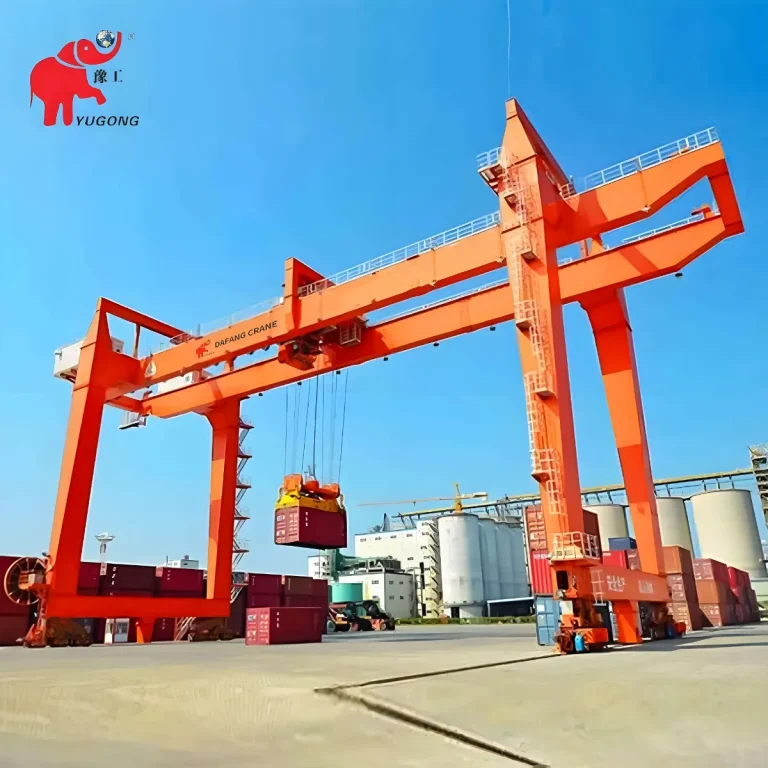
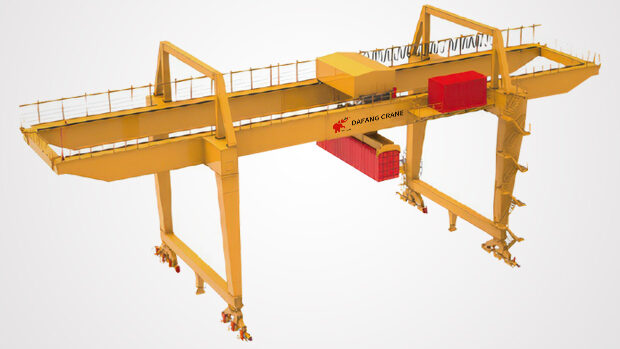
A Rail Mounted Gantry Crane (RMG crane) is a large-span, rail-traveling overhead structure used to lift, move, and stack intermodal containers within a defined yard lane. The crane straddles one or more container rows, traveling along fixed rail tracks embedded in or attached to the yard surface. A trolley traverses the main girder horizontally, and a spreader device below the trolley engages standard ISO containers for lifting.
Unlike mobile equipment, the RMG crane operates within a fixed corridor defined by the rail gauge and the length of the track installation. This constraint is precisely what enables the high stacking density, automation compatibility, and energy efficiency that make RMG cranes the preferred solution for modern automated terminals.
Get Free QuoteMajor Structural and Operational Components
- Main girder: The horizontal bridge spanning the full working width of the crane. It carries the trolley and supports all dynamic lifting loads during operation.
- Gantry structure: The leg assemblies and cross-bracing that elevate the main girder to the required operating height. Gantry geometry determines stacking clearance and container access configuration.
- Trolley mechanism: The carriage that travels horizontally along the main girder. The trolley carries the hoist machinery and the spreader suspension system.
- Spreader system: The telescoping frame that engages container corner castings via twist-lock pins. Modern spreaders handle 20-foot and 40-foot containers and can be configured for tandem lift operations on high-throughput installations.
- Rail traveling system: The drive and guidance system that moves the entire crane along its ground-level tracks. Drive systems are typically distributed across multiple bogies to manage axle loads on the rail foundation.
- Electrical and control system: The power distribution, drive electronics, programmable logic controllers, and operator interface systems that govern all crane motions. In automated configurations, this system interfaces with the terminal operating system (TOS) and position sensing hardware.
- RMG cranes are the foundation of automated container yards because their fixed travel path enables precise, repeatable positioning — a prerequisite for unmanned operation.
Key Technical Specifications of RMG Cranes
| Parameter | Typical Range |
|---|---|
| Lifting Capacity | 30 – 65 tons (standard ISO containers) |
| Crane Span | Customized to yard layout and row configuration |
| Stacking Height | 1-over-4 to 1-over-6 and above |
| Lifting Height | Determined by stacking specification |
| Long Travel Speed | Project-dependent (typically 120 – 240 m/min) |
| Trolley Speed | Project-dependent (typically 60 – 120 m/min) |
| Hoisting Speed | Project-dependent (typically 20 – 45 m/min) |
| Power Supply | Electric (rail-mounted busbar or festoon cable) |
| Automation Level | Manual, semi-automated, or fully automated |
Specifications vary considerably based on terminal throughput requirements, container mix, stacking configuration, and the degree of automation specified. Buyers should resist comparing manufacturers on single-parameter specifications without considering the complete operational context. A crane optimized for cycle time at lower stacking height performs differently from one configured for maximum density at 1-over-6 stacking.
Safety systems on modern RMG cranes typically include anti-sway control, load weighing, overload protection, end travel limits, collision avoidance, and personnel detection in automated zones. The integration and reliability of these systems are as important as the structural and mechanical specifications.
Main Applications of RMG Cranes
Container Terminals
Port container terminals use RMG cranes in the container yard to stack import and export boxes, manage dwell time, and sequence containers for vessel loading. High-stacking configurations of 1-over-5 or 1-over-6 maximize ground slot utilization, reducing the footprint required for a given storage capacity. Automated RMG crane systems allow terminals to operate with reduced labor per move while improving consistency and reducing damage rates.
Intermodal Rail Yards
Intermodal rail yards use rail mounted gantry cranes to transfer containers between rail wagons and truck chassis, or between rail and short-term storage. The crane's ability to span multiple rail tracks within a single structure makes it well-suited to high-throughput rail transfer operations. Automated intermodal yard cranes reduce train turnaround time and improve container traceability through integrated identification systems.
Inland Container Depots (ICDs)
Inland container depots serve as distribution hubs connecting seaport terminals to inland production and consumption centers. RMG cranes at ICDs provide organized, high-density container storage with efficient truck dispatch capability. As ICD throughput grows, the fixed infrastructure of an RMG system supports scalable capacity expansion through track extension rather than equipment replacement.
Automated Logistics Centers
Smart logistics centers serving e-commerce, manufacturing supply chains, and distribution networks are increasingly integrating RMG-based container handling systems into their yard management platforms. These installations prioritize digital integration, with container movements driven by warehouse management systems and tracked through IoT sensor networks. The precision and repeatability of RMG crane operations align well with the data-driven requirements of automated logistics infrastructure.
What Makes a Good RMG Crane Manufacturer?
Selecting an RMG crane manufacturer is not simply a matter of comparing price per unit. The manufacturer's engineering depth, production capability, automation technology, and service infrastructure all directly affect the success of a terminal project.
Engineering Capability
Strong manufacturers have in-house structural engineering teams capable of designing for specific site conditions, load requirements, seismic zones, wind exposure categories, and foundation constraints. The ability to adapt standard platforms to project-specific requirements — rather than forcing site conditions to fit a catalog product — distinguishes capable manufacturers from basic suppliers.
Automation engineering capability is increasingly critical. Manufacturers who develop their own automation software and sensor integration platforms offer tighter technical integration and more responsive support than those who rely entirely on third-party automation suppliers.
Manufacturing Capacity
Large-scale RMG crane projects require significant fabrication volume within a defined delivery schedule. Manufacturers with adequate production floor space, CNC fabrication equipment, qualified welding personnel, and documented quality management systems can consistently meet delivery commitments. Buyers should request evidence of production capacity and recent project delivery records, not just capability claims.
Quality control systems should include material traceability, weld inspection procedures, dimensional verification, and factory acceptance testing before shipment. These processes directly affect the reliability of equipment once installed.
Automation Technology
The automation capability of an RMG crane is increasingly a primary selection criterion rather than an optional upgrade. Key automation technologies to evaluate include:
- Optical Character Recognition (OCR): Automated container identification at crane pickup and delivery points, eliminating manual input and improving traceability.
- Anti-sway systems: Active load control that dampens spreader oscillation during crane travel, improving cycle time and placement accuracy.
- Remote operation: Cab-free crane operation from a central remote control center, reducing operator exposure and enabling one operator to oversee multiple cranes.
- TOS integration: Direct communication between the crane control system and the terminal operating system for automated work order execution and real-time position reporting.
- Obstacle detection: Sensor systems that detect personnel and vehicles in automated operating zones, preventing collision incidents.
Manufacturers who have delivered fully automated container terminal projects with these technologies in operational service provide a more reliable reference than those offering automation as a theoretical option.
Quality Certifications
Reputable RMG crane manufacturers hold relevant quality and product certifications including ISO 9001 quality management certification, CE marking for equipment supplied to European markets, and compliance with FEM (Federation Europeenne de la Manutention) crane design standards. Compliance with local market standards may also be required depending on the project location.
Project Experience
Track record matters in heavy industrial equipment procurement. Manufacturers with documented experience delivering RMG crane projects for container terminals and intermodal rail yards — including projects of similar scale and automation level to the one being tendered — demonstrate proven engineering and project management capability.
Dafang Crane successfully exported a 40.5-ton RMG Gantry Crane to Mongolia for container yard operations. The crane features a 40.5-ton lifting capacity, 37-meter span, and intelligent anti-sway control system, helping the customer improve container handling efficiency by 40% while reducing energy consumption. This project demonstrates the reliability of RMG cranes in harsh environments and high-throughput container terminals.
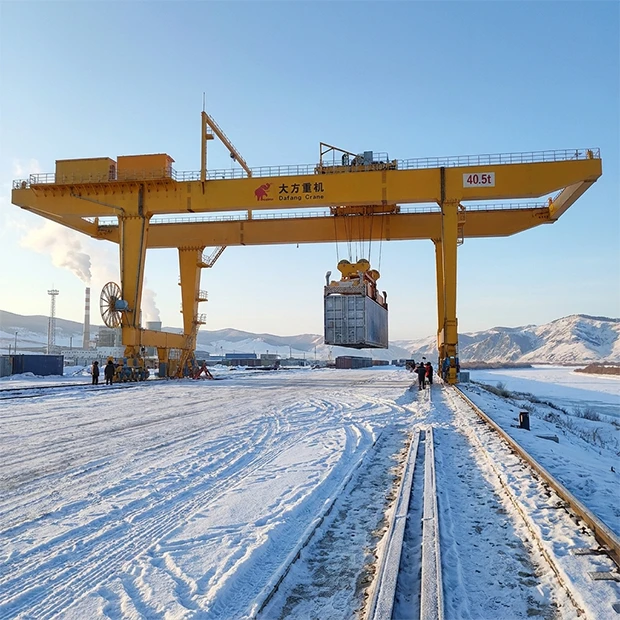
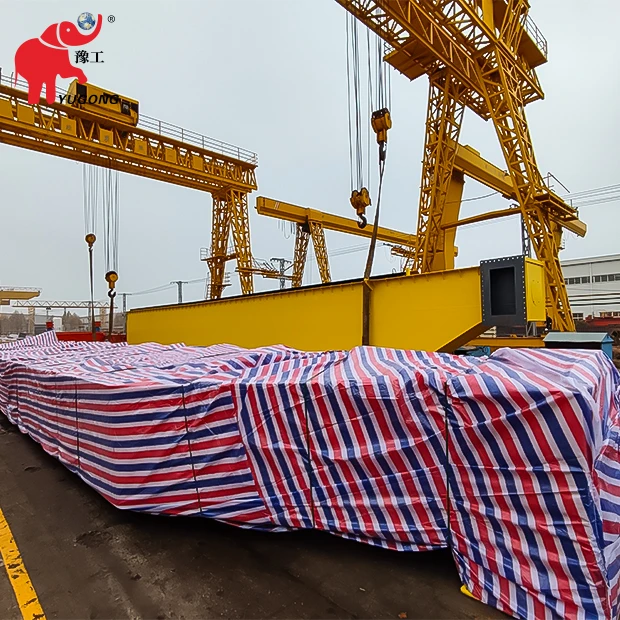
Dafang Crane has successfully delivered a 50 Ton RMG Container Crane to Russia for container yard operations. The project demonstrates the crane's ability to handle heavy container loads with high precision, stable operation, and reduced maintenance requirements. Its robust structure and intelligent control system make it suitable for harsh environments and high-throughput logistics terminals.
How to Evaluate an RMG Crane Supplier
Technical specifications are the starting point for supplier evaluation, not the complete picture. The following factors should be assessed systematically during the procurement process.
Technical Support: Evaluate the manufacturer's ability to provide engineering support during project development, including structural analysis, foundation load data, automation integration documentation, and site survey participation.
Customization Capability: Confirm the manufacturer's ability to accommodate project-specific requirements such as non-standard spans, special stacking configurations, extreme climate specifications, or unique automation interfaces.
Delivery Lead Time: Establish realistic delivery schedules based on current production capacity, not best-case estimates. Late delivery of major terminal equipment carries significant project cost implications.
Installation Services: Assess whether the manufacturer provides supervised erection, commissioning, and operator training services or relies entirely on third-party contractors. Manufacturer-led commissioning generally reduces technical risk.
Spare Parts Availability: Long-term operability depends on access to critical spare parts within reasonable lead times. Evaluate the manufacturer's spare parts inventory policy, regional distribution capability, and commitment to parts availability over the equipment's operating life.
After-Sales Support: Service response time, availability of field service engineers, remote diagnostics capability, and the quality of technical documentation all affect operational availability once equipment is in service.
Lifecycle Cost Analysis: Request a full lifecycle cost comparison rather than evaluating capital cost alone. Energy consumption, scheduled maintenance intervals, expected component replacement schedules, and labor requirements over a 20-year horizon typically reveal significant differences between suppliers that are not visible in the purchase price.
Customization Options for RMG Cranes
Standard catalog RMG crane configurations rarely match the exact requirements of a specific terminal project. Experienced manufacturers offer a range of customization options that improve operational performance and long-term value.
Span Customization: Crane span is determined by the number of container rows to be served and the required truck lane width beneath the structure. Custom span design ensures the crane fits the terminal layout without compromising structural efficiency.
Lifting Height Customization: Stacking height requirements vary by terminal density targets and container mix. Lifting height is specified to provide adequate clearance above the maximum stack height with sufficient margin for safe operation.
Automation Packages: Automation can be specified at varying levels — from fully manual with provision for future upgrade, through semi-automated with remote operation, to fully automated with TOS-integrated work order execution. Specifying the correct automation level at initial procurement avoids costly retrofits.
Smart Monitoring Systems: Condition monitoring systems that continuously measure structural stress, drive system performance, and component health provide early warning of developing faults and support predictive maintenance programs.
Remote Operation Centers: Custom remote operation center design, including operator workstation ergonomics, crane camera systems, and network infrastructure, should be coordinated with the crane manufacturer to ensure integration with the crane's control architecture.
Extreme Climate Adaptation: Terminals operating in high-wind coastal environments, arctic conditions, high-humidity tropical climates, or seismic zones require specific structural, electrical, and mechanical adaptations. Manufacturers experienced in delivering equipment for these conditions provide more reliable solutions than those adapting standard designs without relevant project history.
Common Mistakes When Choosing an RMG Crane Manufacturer
Focusing only on purchase price: The lowest-priced crane procurement frequently becomes the highest total cost of ownership. Structural quality, automation reliability, spare parts availability, and manufacturer support all affect the multi-decade cost of operating a terminal crane fleet. Buyers who evaluate total lifecycle cost rather than capital price alone make better procurement decisions.
Ignoring automation compatibility: Purchasing RMG cranes without considering future automation requirements can lock a terminal into equipment that cannot be upgraded without major retrofit cost. Specifying automation-ready architecture at initial procurement, even if full automation is not planned immediately, protects the terminal's strategic flexibility.
Overlooking maintenance requirements: Cranes with lower purchase prices sometimes incorporate components that require more frequent service, have longer spare parts lead times, or lack adequate local service support. Maintenance cost and complexity should be explicitly evaluated during supplier selection.
Choosing inadequate stacking specifications: Underspecifying stacking height to reduce initial cost limits the terminal's density capacity. Given the long service life of RMG crane infrastructure, the capacity headroom provided by an additional stacking tier often justifies a modest incremental investment at initial procurement.
Underestimating future expansion needs: Container terminal throughput projections frequently prove conservative. Specifying crane infrastructure without provision for track extension, additional crane units, or capacity upgrade leaves terminals with expensive reconfiguration projects as volumes grow. Manufacturers who plan expansion compatibility into the initial design provide long-term value that is difficult to quantify at tender stage but significant in practice.
Conclusion
RMG cranes are the enabling infrastructure for high-density, high-efficiency container handling in modern port terminals, intermodal rail yards, and inland logistics facilities. The decision of which manufacturer to select — and how to specify the equipment — has consequences that extend across the full operational life of the terminal.
The most capable manufacturers combine deep structural engineering expertise with proven automation technology, documented project experience, and a credible service and parts support organization. Buyers who evaluate these factors systematically, rather than optimizing on purchase price alone, consistently achieve better outcomes over the lifecycle of their investment.
As automation, digital integration, and sustainability requirements continue to shape container terminal development, the gap between strong and weak RMG crane manufacturers will widen. Choosing a partner with the engineering depth and technology roadmap to support long-term operational requirements is as important as the initial equipment specification.
Request a customized RMG crane solution for your container terminal or intermodal project.
Contact our engineering team for a container terminal crane consultation.

Frequently Asked Questions
Q: What is the typical service life of an RMG crane?
Well-designed and properly maintained RMG cranes have operational service lives of 25 to 30 years or more. Structural components typically outlast mechanical and electrical systems, which are subject to scheduled replacement over the crane's life. The quality of initial design, material specification, and fabrication directly affects how the crane ages under operational loading.
Q: How long does it take to commission a new RMG crane?
Lead time from order to commissioning varies by project complexity and manufacturer production scheduling, but major RMG crane projects typically require 18 to 30 months from contract award to full operational commissioning. This includes design, fabrication, shipping, site erection, electrical installation, and system testing. Buyers should establish realistic schedules at tender stage and build contractual milestone commitments accordingly.
Q: What civil infrastructure is required for RMG crane installation?
RMG crane installation requires a reinforced concrete rail foundation designed to the manufacturer's specified rail loads, an electrical power supply infrastructure including transformer stations and rail-mounted power distribution systems, and a yard surface capable of supporting truck and container handling traffic beneath the crane. Foundation design should be coordinated between the crane manufacturer's engineering team and the project's civil engineer early in the project development phase.
Q: Can existing RTG crane yards be converted to RMG crane operation?
Conversion from RTG to RMG operation is possible but involves significant civil infrastructure investment, including new rail foundations, revised power supply systems, and reconfiguration of the yard surface. The economics of conversion depend on the terminal's throughput trajectory, automation objectives, and the condition of existing infrastructure. A feasibility study with full cost-benefit analysis is recommended before committing to a conversion project.
Q: What is the difference between semi-automated and fully automated RMG cranes?
Semi-automated RMG cranes execute crane travel and positioning under automatic control but require a remote operator to supervise and confirm container placement, particularly at the truck lane interface. Fully automated RMG cranes execute the complete operational cycle without direct operator intervention, using machine vision, obstacle detection, and automated truck positioning systems to manage the truck lane interface. Fully automated configurations require more sophisticated safety and sensing systems but deliver the greatest labor efficiency.