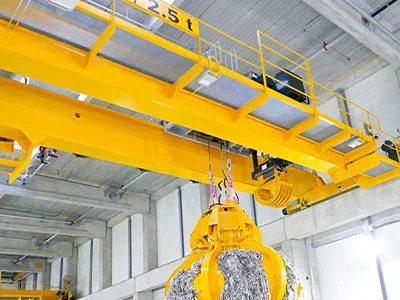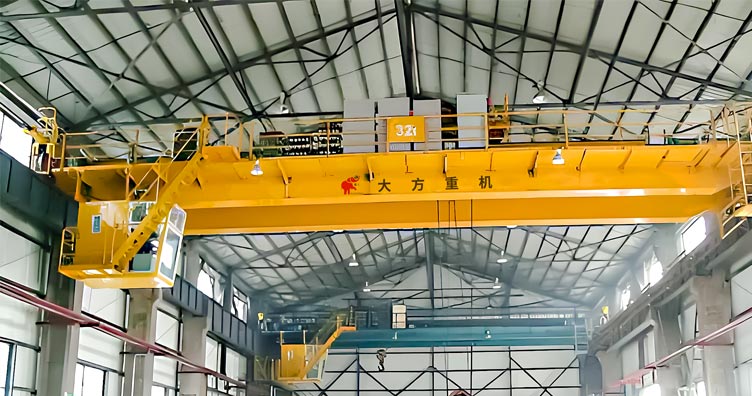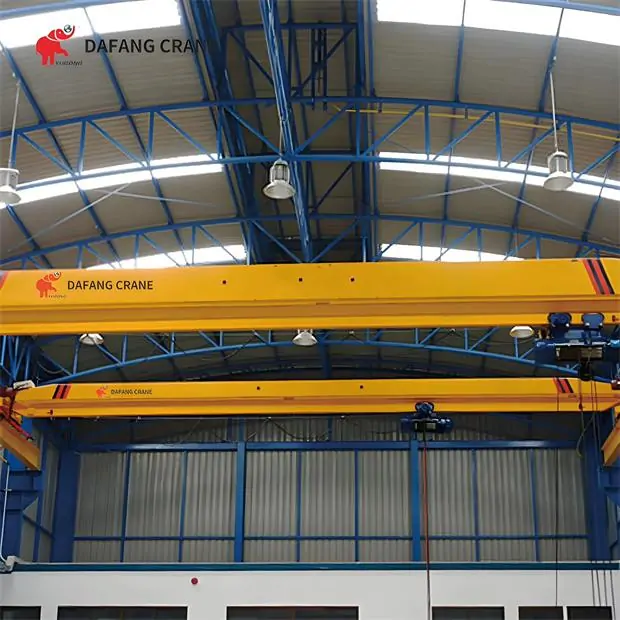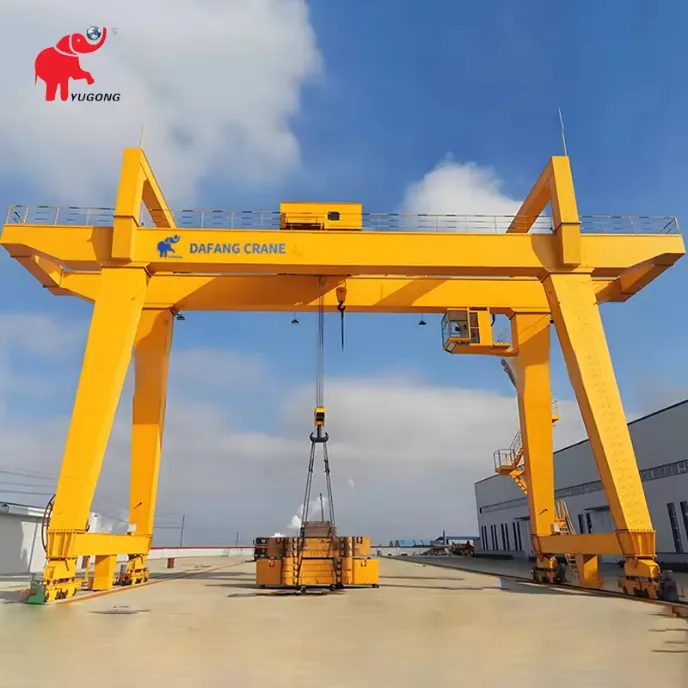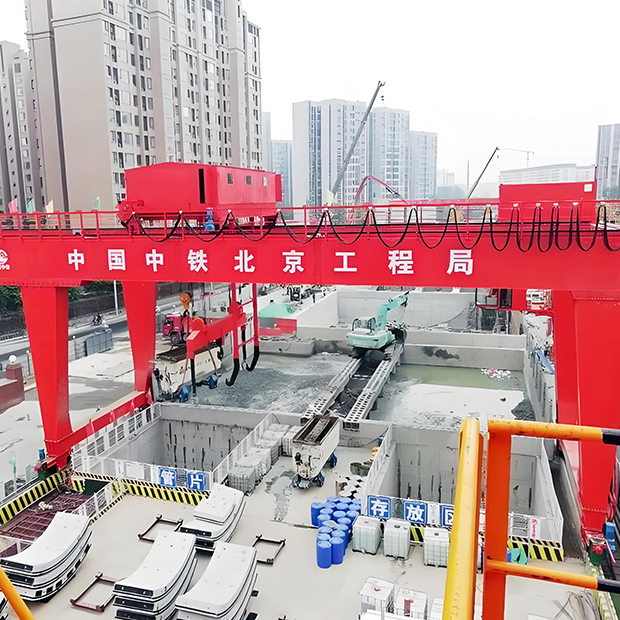







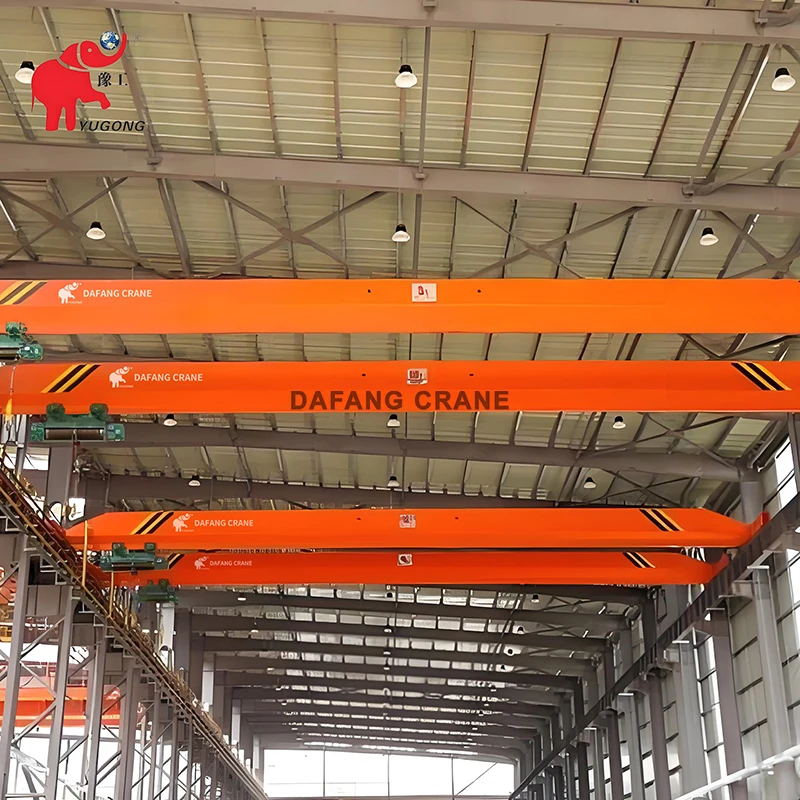
A single-girder LB explosion-proof overhead crane covers most light-to-medium petrochemical lifting needs from 1 to 32 tons across spans up to 28.5 m (ExdⅡBT4 or ExdⅡCT4, duty class A3). When your application exceeds those structural limits — loads above 32 tons, spans beyond 28.5 m, or duty cycles that run multiple shifts continuously — the double-girder QB steps in, rated up to 100 tons across spans to 31.5 m at the heavier A4 duty class. Both series are designed for Zone 1 and Zone 2 hazardous gas atmospheres, where a standard overhead crane with unsealed electrical components is a compliance failure and a genuine ignition risk.
If you are evaluating an explosion-proof bridge crane for a refinery, petrochemical processing bay, or chemical storage facility, the decision is more nuanced than tonnage alone. Gas group (IIB versus IIC), duty class against your actual lift cycle count, corrosion requirements in hydrogen sulphide or acid-laden atmospheres, and the certification pathway your destination market requires — these four factors shape the correct specification more than any single parameter does.
This guide walks through the LB/QB comparison, the certification documents your procurement team should require before issuing a PO, the corrosion and maintenance considerations specific to petrochemical environments, and how to put together an RFQ that gets you an accurate quote on the first submission.
Quick Comparison: LB Single-Girder vs QB Double-Girder Explosion-Proof Crane
| Paramètres | LB Single-Girder | QB Double-Girder |
|---|---|---|
| Capacité de levage | 1–32 t | 5-100 t |
| La portée | 7.5–28.5 m | 10–31.5 m |
| Hauteur de levage | 6–40 m | 12–18 m (main hook) |
| Classe ouvrière | A3 | A4 |
| Qualité antidéflagrante | ExdⅡBT4 / ExdⅡCT4 | ExdⅡBT4 / ExdⅡCT4 |
| Typical Petrochemical Use | Maintenance lifts, drum handling, fuel storage | Reactor vessel installation, turnaround lifts, heavy equipment positioning |
| Price Reference (ex-works) | Market range from low four figures (1 t) to mid five figures (32 t) | Starts mid five figures; 50-ton configurations upward |
Need a specific quote? Send your load, span, lifting height, daily cycle count, and destination market to Dafang — get a tailored price and Ex documentation scope from our engineering team .
Obtenir un devis gratuit
What Makes a Crane Genuinely Explosion-Proof — and What Does Not
System-Level Protection Is the Baseline, Not an Option
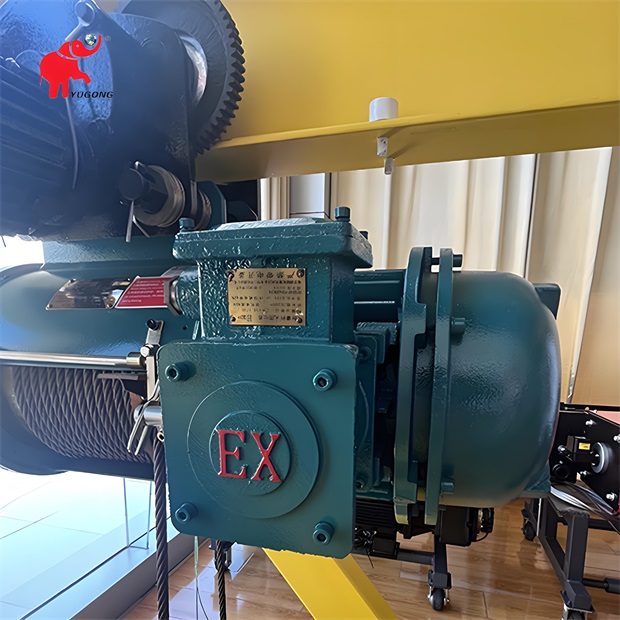
An explosion-proof overhead crane is not a standard bridge crane fitted with an Ex-rated hoist motor. In a Zone 1 gas environment — the classification typical of an active petrochemical processing bay — every ignition-relevant component must individually carry Ex certification: the hoist motor, electrical control cabinet, travel limit switches, end-of-travel buffers, cable entry glands, and the pendant or wireless remote control. A single non-Ex limit switch tripping under load in a Zone 1 atmosphere creates a genuine arc-ignition risk, and a plant safety audit will flag it.
Dafang's LB and QB explosion-proof series are designed as complete Ex-compliant systems. The hoist trolley pairs with an explosion-proof electric wire rope hoist or Ex-rated chain hoist, the control cabinet carries sealed, certified enclosures, and all wiring runs in Ex-rated conduit with certified gland fittings throughout.
Understanding ExdⅡBT4 vs ExdⅡCT4 — The Gas Group Decision
The explosion-proof grade on the nameplate encodes two decisions that affect both safety and cost.
Gas group IIB covers the flammable gases and vapors most common in petrochemical processing: hydrogen sulphide (H₂S), ethylene, propylene, propane, and the majority of refinery-grade petroleum derivatives. ExdⅡBT4 is the standard specification for crude oil processing facilities, solvent handling areas, and petroleum storage. Both Dafang LB and QB series ship at ExdⅡBT4 as the base configuration.
Gas group IIC adds coverage for hydrogen and acetylene — the highest ignition-sensitivity gases encountered in chemical synthesis, certain fertiliser production environments, and battery manufacturing. Specifying IIC when your hazardous area classification only identifies IIB gases adds cost and extends lead time without a safety benefit. Specifying IIB in a hydrogen-classified area creates a compliance gap that will surface during insurance underwriting or a regulatory inspection.
Temperature class T4 limits all component surface temperatures to ≤135°C, which sits safely below the auto-ignition temperature of virtually all common petrochemical solvents and gases. T4 is a standard, not a premium, on both LB and QB.
Your facility's hazardous area classification document should state the gas group explicitly. If it does not, resolve this with your EHS or process safety team before contacting any supplier — the gas group drives component selection across the entire crane system.
LB vs QB: Matching the Series to Your Petrochemical Application
When the LB Single-Girder Is the Right Fit
The LB series handles 1–32 tons across spans up to 28.5 m at A3 duty. In practice, A3 means the crane is sized for light-to-moderate lifting frequency — batch-process lifts with meaningful idle time between cycles, not continuous production-line throughput.
In petrochemical environments, this profile covers a broader range of applications than many buyers initially expect:
- Maintenance and turnaround lifts in Zone 2 areas: Equipment changeouts, valve replacements, pump sets, and heat exchanger bundles where lifts happen during planned shutdown windows rather than continuously.
- Drum and IBC handling in solvent and chemical storage: Typically 1–5 ton loads at moderate frequency, with Zone 1 or Zone 2 classification depending on vapour concentration assessments.
- Fuel storage facilities and LPG/LNG receiving stations: Infrequent lifts during delivery, installation, and periodic maintenance.
- Smaller-span processing bays: Where the 28.5 m span limit is not a constraint and loads stay within the single-girder structural envelope.
A common scenario where LB is the structurally simpler and more economical answer: a refinery maintenance crew handling 10–20 ton compressor sets or motor assemblies during a scheduled turnaround, with lifts spread over a multi-week window. That usage pattern is well within A3 duty — and the lower component count of a single-girder design means fewer Ex-rated interfaces to inspect and certify during annual audits.
When the QB Double-Girder Is the Required Specification
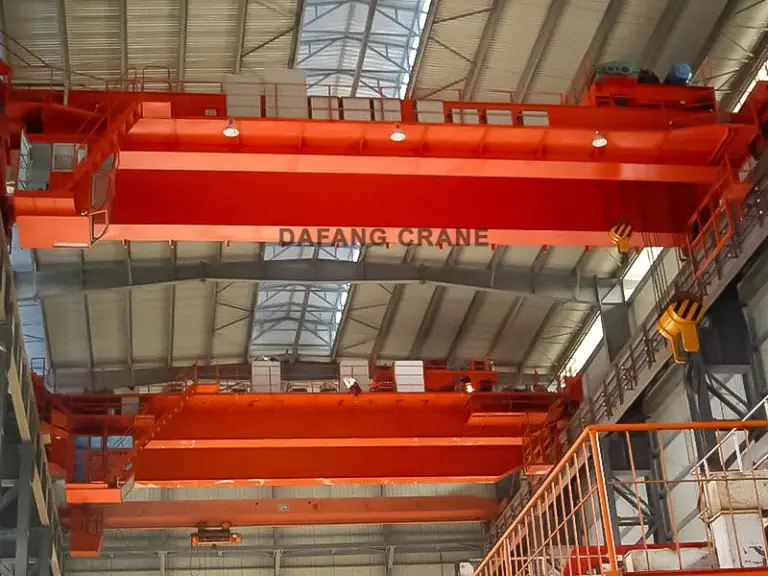
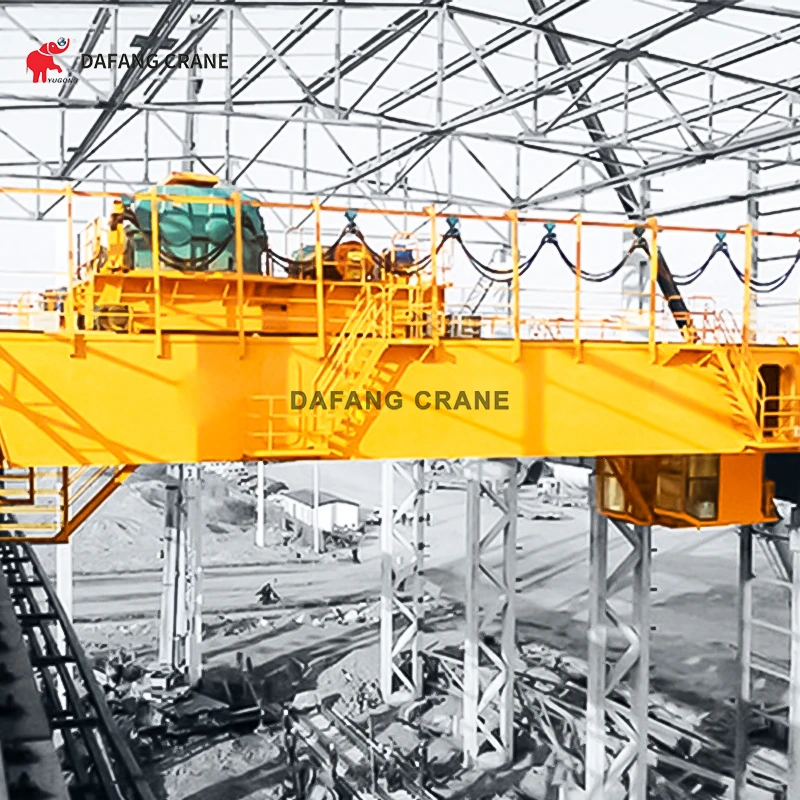
The QB series is designed for loads between 5 and 100 tons, spans from 10 to 31.5 m, at A4 duty — which translates to a substantially heavier workload and longer cumulative service life than A3.
Double-girder construction delivers two engineering advantages that become functional requirements in demanding petrochemical environments. First, the twin-beam structure provides greater mid-span rigidity, reducing deflection under full load — important when precision placement of heavy equipment (reactor lids, pressure vessel heads, heat exchanger shells) is the primary task. Second, the QB allows hook approach distances significantly closer to the runway end walls than a single-girder design, which matters in tight reactor bays where the crane needs to position loads within 300–500 mm of a wall-mounted nozzle flange.
Applications that consistently require QB in petrochemical plants:
- Reactor vessel installation and major overhaul: 20–100 ton lifts during construction or periodic turnarounds in Zone 1 classified bays.
- Large pressure vessel and column handling: Shell-and-tube exchangers, distillation column sections, and separator vessels where loads exceed the LB envelope or spans push beyond 28.5 m.
- Heavy compressor and turbine handling: Multi-ton drivetrain assemblies requiring precise lowering alignment over foundation bolt patterns.
If your application produces 40 or more lift cycles per hour across two or three shifts — a continuous chemical feed process rather than a periodic maintenance task — A4 duty on the QB is the structurally correct specification. Fitting an A3-rated LB crane to a continuous-duty application means the gearbox and hoist components accumulate fatigue load faster than their design life accounts for, and an unplanned failure requiring repair inside a Zone 1 environment is both a safety event and an expensive production loss.
Corrosion Protection in H₂S and Acidic Petrochemical Environments
Standard steel overhead crane components are not appropriate for petrochemical atmospheres containing hydrogen sulphide, chlorine vapours, or salt spray — all of which are common in coastal refineries and chemical plants. Corrosion in an Ex crane is not only a structural concern; it can compromise the sealing integrity of explosion-proof enclosures, creating a compliance failure that a surface-level inspection may not catch until the next formal audit.
Dafang's explosion-proof bridge cranes for petrochemical applications can be specified with:
- Epoxy or polyurethane anti-corrosion coatings on structural members and end beams, rated for the specific chemical exposure of your facility.
- Stainless steel fasteners and fittings at electrical enclosure interfaces to prevent galvanic corrosion at the seal boundary.
- IP65-rated enclosures on all electrical cabinets and junction boxes, providing both dust exclusion and fluid ingress protection where washdown or atmospheric condensation is routine.
When submitting an RFQ, include your facility's corrosive medium (H₂S concentration in ppm, presence of acid vapours, salt spray zone if applicable). This information affects paint specification, material selection for running components, and enclosure IP rating — all of which should be confirmed at design stage, not discovered during installation.
Get a specification matched to your site conditions. Share your application details — load, span, hazardous zone classification, corrosive media, and certification requirements — with Dafang's engineering team. Contact account manager Stella via WhatsApp +86 136 0373 2637 or call +86 0373 2157333.
ATEX, IECEx, and GB Certification: What to Verify Before You Pay
Choosing the Right Certification Standard for Your Market
Three certification systems govern explosion-proof crane equipment, and which one applies depends on where your facility is located:
ATEX (Directive 2014/34/EU) is mandatory for equipment installed in EU member states. The certification must cover each individual Ex component — motor, control cabinet, limit switches, pendant, cable glands — with a certificate issued by a Notified Body and verifiable through the EU ATEX Equipment Database. A crane-level CE mark does not substitute for component-level Ex certificates.
IECEx is the international standard recognised across more than 50 countries outside the EU, including GCC states, Southeast Asia, Australia, and parts of South America. A single IECEx certificate is accepted across member countries without re-testing, making it the practical specification for export-market installations or operations spanning multiple regions. Certificate numbers are publicly verifiable through the IECEx OD-001 register.
GB / CNEX (GB 3836 series, certified through CNEX) is China's national standard — required for cranes installed domestically. GB is technically aligned with IEC 60079 but is a separate certification pathway; an ATEX-only crane requires additional assessment for Chinese installation.
For international buyers sourcing from China: specify ATEX for EU destinations, IECEx for all other export markets. If your operations span both regions, request dual certification at RFQ stage. Adding a second certification after manufacturing is completed adds cost and time; building it into the original specification is the efficient path.
The Document Checklist: What to Require Before Issuing a PO
A supplier who describes their crane as "ATEX certified" in a brochure has told you very little. Require the following in writing before payment:
- EC Declaration of Conformity — referencing the specific crane model, series, and serial number range, signed and dated.
- Individual component Ex certificates — separate certificates for: hoist motor, electrical control cabinet, travel limit switches, pendant or wireless remote control, and cable gland fittings.
- Certificate numbers for independent verification — cross-check against the EU ATEX database or IECEx OD-001 register before payment is released.
- Overload protection test report — demonstrating the Ex-rated overload limiter trips correctly at 110% of rated load under the actual Ex-configuration components.
- ISO 9001 quality management certificate — with current validity dates.
- IP rating documentation — all electrical enclosures should carry minimum IP54; IP65 is the preferred specification for petrochemical environments where washdown or condensation is routine.
These are not administrative formalities. They are the evidentiary basis that the equipment will not become an ignition source in a classified zone, and they are what your insurer and regulator will ask for when the crane is commissioned.
Spare Parts and After-Sales Support for Ex Cranes
Spare parts for explosion-proof cranes are not interchangeable with standard crane components. A replacement hoist motor must carry the same Ex certification as the original — fitting a standard motor because it matches the mounting dimensions creates a non-compliant installation and voids the Ex rating of the affected circuit. This distinction matters most during unplanned breakdowns in Zone 1 areas, where the pressure to restore production quickly can lead to shortcuts that create serious risk.
When evaluating suppliers, confirm:
- Ex-certified spare parts stock: Does the manufacturer maintain a supply of certified replacement motors, control contactors, limit switches, and cable glands? Lead times for Ex-certified components typically run longer than for standard parts — 8–20 weeks for motors in some configurations — making local or regional stock availability a genuine operational concern.
- Installation and commissioning support: Commissioning an explosion-proof crane in a live petrochemical zone requires personnel with Ex competency. Dafang provides installation supervision, system testing, and final commissioning support. Confirm at RFQ stage whether this service is included or quoted separately.
- Periodic inspection programme: Ex equipment in Zone 1 environments requires documented periodic inspection — typically annually in most regulatory frameworks — covering enclosure seal integrity, grounding continuity, motor insulation resistance, and overload limiter calibration. A supplier with an after-sales inspection programme is easier to work with at audit time than one whose support ends at delivery.
Certification and Compliance for Petrochemical Crane Buyers
For buyers specifying explosion-proof cranes for global petrochemical projects, the relevant compliance framework covers three areas:
Equipment standards: IEC 60079 series governs Ex protection concepts and testing methods. Relevant parts include IEC 60079-0 (general requirements), IEC 60079-1 (Ex d flameproof enclosures — the protection concept used in both LB and QB series), and IEC 60079-14 (installation in hazardous areas).
Structural and lifting standards: ISO 4301 governs duty classification; FEM 1.001 is the European equivalent. Both LB (A3) and QB (A4) are classified under ISO 4301. ISO 9927 covers periodic inspection of cranes.
Why certification matters at procurement: Beyond safety, Ex certification affects customs clearance (import authorities in many markets require ATEX or IECEx documentation for classified equipment), insurance underwriting (non-compliant equipment in a Zone 1 area can void facility cover), and plant safety audits (both internal and regulatory audits will request component-level certificates).
Buyers can verify certificate validity independently through the EU ATEX database (ec.europa.eu) or IECEx OD-001 register (iecex.com) using the certificate numbers provided by the supplier — a step worth taking before releasing payment for any Ex-rated equipment.
Questions fréquemment posées
Q1:What is the difference between ExdⅡBT4 and ExdⅡCT4 for a petrochemical crane?
Both grades use flameproof (Ex d) enclosures with a T4 surface temperature limit (≤135°C). The gas group is the key distinction: IIB covers the majority of petrochemical environments — hydrogen sulphide, petroleum vapours, ethylene, propylene. IIC adds coverage for hydrogen and acetylene. Your hazardous area classification document should state which gas group applies. If it does not, resolve this with your EHS team before specifying any Ex equipment.
Q2:Can a single crane carry both ATEX and IECEx certification?
Yes — dual certification is available and is the recommended approach for manufacturers supplying both EU and international export markets. ATEX and IECEx share the same underlying technical standard (EN 60079 / IEC 60079), so the engineering requirements align closely. The cost difference between single and dual certification is modest relative to total crane cost; specify dual at RFQ stage to avoid the higher cost of adding it post-manufacture.
Q3:How do I choose between LB and QB for a 20-ton petrochemical application?
Load alone does not decide the series. At 20 tons, LB and QB overlap structurally. The decision turns on: (1) whether your span exceeds 28.5 m — if so, QB is required; (2) your daily lift cycle count and shift pattern — if cycles are continuous across multiple shifts, A4 duty on QB is the correct rating; (3) whether precision hook approach to runway end walls is critical — QB's double-girder geometry provides closer approach. Submit load, span, lifting height, and daily cycle count to Dafang's engineering team and the correct series will follow from the inputs.
Q4:What price premium should I budget for an explosion-proof crane versus a standard model?
Explosion-proof overhead cranes typically carry a significant premium over standard equivalents — commonly 50% to 100% or more — reflecting the cost of Ex-certified components, individual component testing, and longer manufacturing lead times. Exact pricing depends on capacity, span, duty class, gas group (IIB or IIC), and the specific certification pathway required. Contact Dafang with your application data for a factory-direct quotation based on actual specification.
Q5:How long does installation and commissioning typically take for an Ex crane in a petrochemical facility?
Manufacturing lead time for a standard LB configuration typically runs 6–10 weeks ex-works; QB configurations at larger capacities or with dual certification commonly require 10–16 weeks. On-site installation and commissioning add further time depending on runway infrastructure readiness and site access scheduling. For turnaround-critical projects, confirm lead time with Dafang at the inquiry stage and build commissioning contingency into your shutdown planning window