






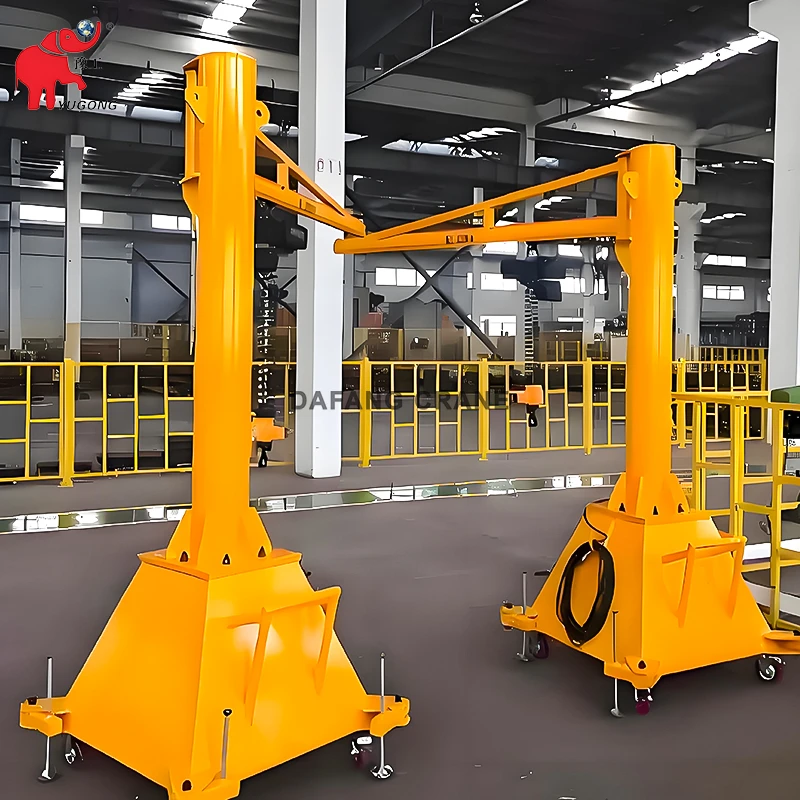
A portable jib crane is a mobile column-and-boom lifting unit—paired with a manual or electric hoist—that workshops move between stations instead of installing a fixed structure. Choosing the right one comes down to matching three things at once: your actual load, your floor layout, and how often the crane needs to move.
Most buyers get stuck comparing load capacity numbers, boom lengths, and wheel types without a clear way to weigh them against each other—and without knowing what a fair price or valid certification actually looks like.
This guide walks through the selection factors in the order they actually matter on a shop floor, then covers certification checks and pricing factors most guides skip.
جدول المحتويات
Quick Selection Snapshot
| Workshop Situation | سعة الحمولة النموذجية | طول ذراع الرافعة | Best Fit |
|---|---|---|---|
| Small maintenance bay, single station | 0.25–1 ton | 2–4 m | Wall-mounted or floor-mounted unit |
| Multi-station workshop, frequent moves | 0.5–2 ton | 3–5 m | Mobile jib crane on wheels |
| Assembly line, obstacles in the way | 0.125–1 ton | 2–6 m | Articulated arm |
| Heavier, fixed-point loads | 2–5 ton | Up to 10 m | Floor-mounted, foundation-anchored |
Need help matching this to your workshop?
احصل على عرض أسعار مجانيWhat Problems Does a Portable Jib Crane Actually Solve?

What Does a Portable Jib Crane Do That an Overhead Crane Can't?
A portable jib crane covers localized, repetitive lifting without the cost or structural commitment of an overhead system. It earns its keep in spots where an overhead crane is overkill and manual handling is too slow—swinging a load a short distance, positioning it precisely, and setting it down again, station by station.
Where Are Portable Jib Cranes Used Most in Workshops?
Two situations account for most real-world use: maintenance bays where technicians lift motors, pumps, and gearboxes on and off equipment repeatedly, and mold-change or small assembly stations where parts need to be swung and set down with precision. In both cases, the crane earns its cost back through reduced manual handling injuries and faster changeover, not through raw lifting capacity.
Key Specifications to Compare When Choosing a Portable Jib Crane
What Load Capacity Does a Portable Jib Crane Need?
Size the crane above your heaviest actual load, not exactly to it. Engineers typically add the weight of hooks, slings, and the hoist itself to the load, then select a rated capacity roughly 10–20% above that total. This margin protects the structural frame and the slewing bearing from repeated overload stress, and it leaves room if a slightly heavier part shows up on the line next year. A 300 kg maintenance load, for example, generally calls for a crane rated closer to 500 kg rather than one rated exactly at 300 kg.
How Long Should the Boom Be, and What Rotation Angle Do You Need?
Boom length determines how much floor area one crane station can cover without repositioning the load by hand. Shorter booms in the 2–3 m range suit single workstations and keep the structure more rigid; booms from 3–5 m cover a wider work zone but need more clearance and a sturdier base to resist tipping. Rotation is usually specified as 180°, 270°, or full 360°—180° suits wall-mounted units working against a fixed backdrop, while 360° suits free-standing units that need to serve stations on multiple sides.
How Do Floor Conditions Affect Crane Mobility?
A crane's mobility rating only matters if your floor can support it. Smooth, sealed concrete allows polyurethane casters to roll and position loads precisely; rougher industrial flooring generally needs steel wheels or reinforced casters to avoid premature wear. Locking brakes matter just as much as the wheels themselves—once the crane reaches its working position, the base needs to stay fixed under load, not just parked.
Manual or Electric Hoist: Which One Fits Your Lifting Frequency?
A manual chain hoist costs less upfront and works fine for occasional, light lifts in a maintenance bay. An electric wire rope hoist costs more but pays that back quickly in any station doing repetitive or heavier lifts, since it cuts operator fatigue and lifting time. As a rough rule: if a station lifts more than a handful of times per shift, the electric hoist's productivity gain usually outweighs the manual hoist's lower purchase price within the first year or two of use.
What Certifications Should a Portable Jib Crane Have?
Buyers exporting to the EU, Middle East, or other regulated markets typically need to check for CE marking under Machinery Directive 2006/42/EC, ISO 9001 quality management certification from the manufacturer, and—for structural design—compliance with recognized duty-class standards such as ISO 4301. In markets like the EAC customs union, an EAC certificate replaces or supplements CE.
This matters at three practical points: customs clearance can stall without the right documentation, insurers may require proof of compliant design before covering the equipment, and your own safety auditors will ask for it during plant inspections.
You can verify a supplier's claims by requesting an EC Declaration of Conformity, a copy of their ISO 9001 certificate, and—for higher-capacity units—an overload test report specific to the model you're ordering. A supplier that can't produce these on request is worth a second look before you commit.
Ready to move forward?
احصل على عرض أسعار مجانيHow Much Does a Portable Jib Crane Cost?
What Does a Typical Price Range Actually Cover?
Light-duty portable jib cranes sold through equipment retailers in the US market—covering roughly 0.125–0.5 ton capacity, structure only, hoist not included—generally list in the $2,000–$9,000 range, with heavier bases and taller units pushing toward the top of that band. That figure reflects US retail pricing for the frame alone; it isn't representative of FOB pricing from an export manufacturer, where the hoist, control system, and base type get quoted together and shipping/duty are separate line items.
What Factors Push the Price Up or Down?
The main variables that move a quote up or down are load capacity, boom length, hoist type (manual vs. electric), base configuration (fixed foundation vs. mobile caster base), and any custom coating or duty-class requirement for harsh environments. Because these vary so much by region and configuration, the only reliable way to get an accurate number is a spec-based quote rather than a published price list.
Why Source Your Portable Jib Crane from Dafang?
Dafang manufactures its cantilever crane line alongside overhead cranes, gantry cranes, and electric hoists across an 850,000 m² production base, which means the same engineering team sizing your unit also handles the hoist and control system that goes with it—rather than sourcing components from separate suppliers. That matters most for buyers who need the base, boom, and hoist rated and documented as one coherent system, not assembled after the fact.

أسئلة شائعة
Q1:What's the difference between a portable jib crane and a fixed jib crane?
A portable jib crane sits on a mobile or wall-mounted base and can be repositioned without foundation work, while a fixed jib crane bolts permanently to a floor, wall, or column. Portable units trade some load capacity and rigidity for flexibility, making them better suited to workshops where lifting points change often.
Q2:What does a portable jib crane typically cost?
Pricing depends heavily on capacity, hoist type, and base configuration, so there's no single fixed number. Light-duty structures alone can run from roughly $2,000 to $9,000 in retail markets, before hoist, shipping, and duty—getting a spec-based quote is the only way to price your specific setup accurately.
Q3:What load capacity do I actually need?
Take your heaviest real load, add the weight of hooks and the hoist, then choose a crane rated 10–20% above that total. This margin protects the structure and hoist from repeated overload stress rather than running them at their exact rated limit.
Q4:Can a portable jib crane be used outdoors or in harsh environments?
Yes, with corrosion-resistant coatings, sealed electrical components, and a base rated for the surface conditions. Outdoor or coastal use generally needs these upgrades specified at the ordering stage, not added afterward.