






Choosing the wrong crane for an automotive manufacturing plant rarely shows up as a line item on the budget — it shows up as downtime. According to the Siemens True Cost of Downtime 2024 report, an unplanned production stoppage in an automotive facility costs an average of $2.3 million per hour. At that rate, a crane that slows a die change by 20 minutes, or trips out during a high-frequency shift, is not a maintenance problem: it is a financial risk that can be quantified.
The question most procurement teams face is not whether to invest in automotive cranes — it is which type belongs in which zone of the plant, and whether the existing building structure can actually accommodate the selection being considered. These two questions are connected, and answering them in the wrong order is the most common source of costly project revisions.
This article walks through the main production zones of an automobile manufacturing plant — from the body shop and stamping press to final assembly — maps each zone to the crane types that fit its duty cycle and load profile, then addresses the structural realities that shape what is actually feasible in a renovation or greenfield build.
Quick Comparison: Automotive Crane Types by Production Zone
| Production Zone | Типичная нагрузка | Recommended Crane Type | Key Requirement |
|---|---|---|---|
| Stamping / Press Shop | 20–100 t dies | Двухбалочный мостовой кран | High duty class (M6–M8), anti-sway |
| Body Shop (BIW) | 0.5–5 t assemblies | European-type single girder / underhung | Low headroom, precise hook approach |
| Coil Storage & Feed | 5–25 t steel coils | Double girder overhead, coil tongs | Anti-sway, load centering |
| Powertrain Assembly | 2–20 t engines/gearboxes | Single or double girder overhead | Variable-speed control, smooth start |
| Painting & Finishing | 0.5–3 t body shells | Cantilever / wall jib crane | Corrosion-resistant components |
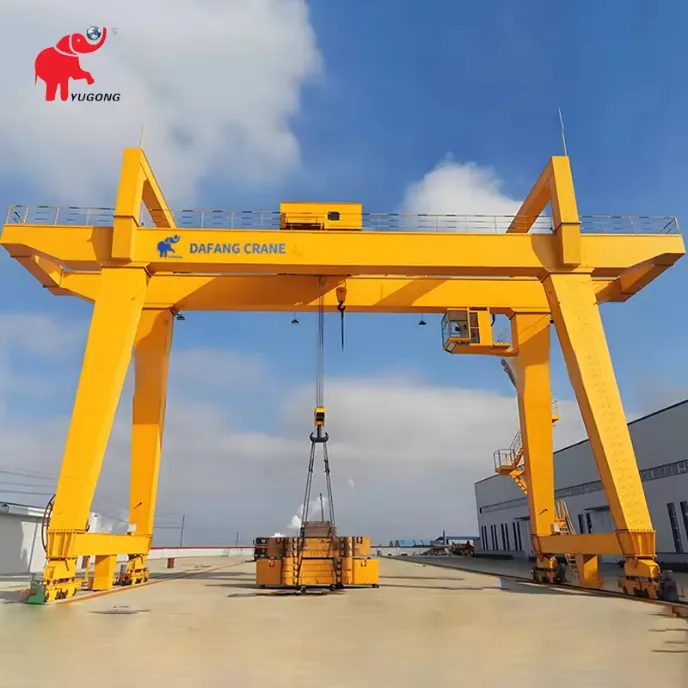
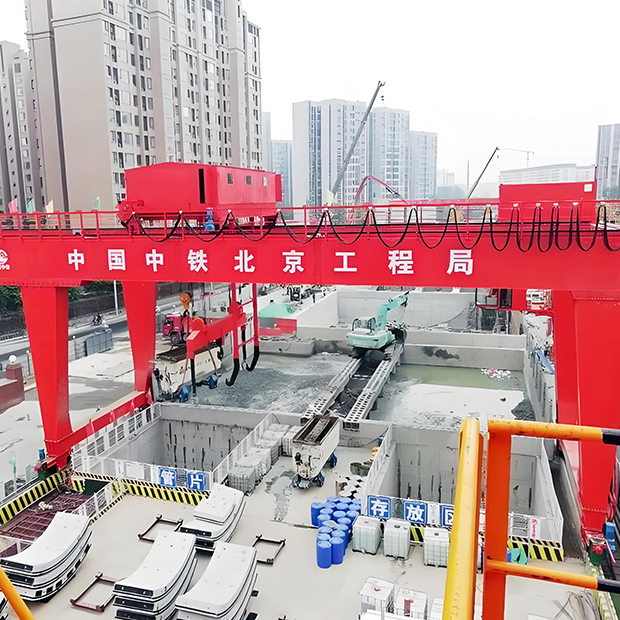
| Outdoor Body Storage / Logistics | 20–200 t | Козловой кран | Large span, weather-resistant |
How Each Production Zone Shapes Crane Selection
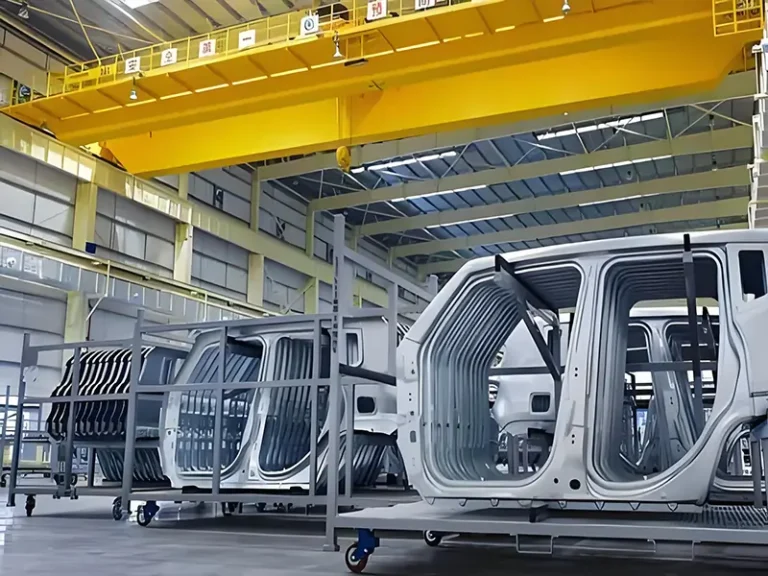
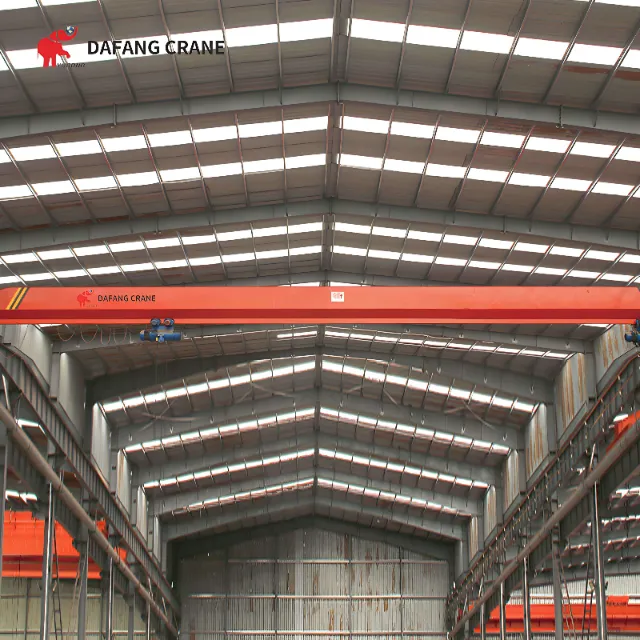
Stamping and Press Shop — Where Duty Class Matters Most
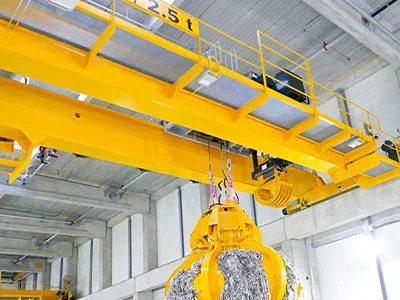
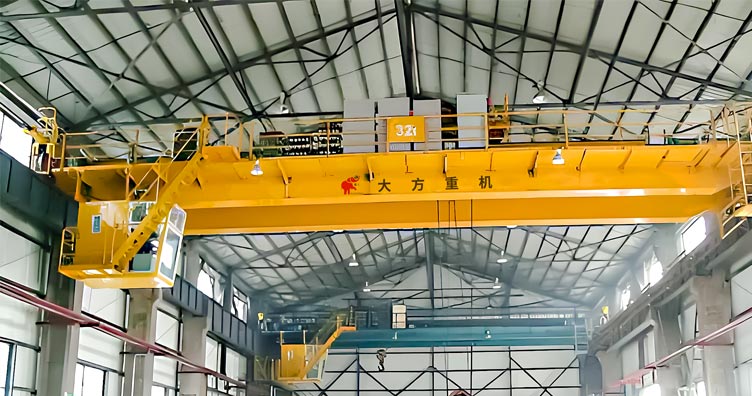
A double girder overhead crane is the standard choice for die handling in stamping operations, because the combination of high loads (often 20–80 tons per die set) and high cycle frequency demands M6 or M7 duty class ratings under ISO 4301. The press shop is where crane selection errors have the most direct impact on line rate: a die change that takes 45 minutes instead of 25 minutes on a multi-shift stamping line translates directly into fewer pressed blanks per day.
Three features are non-negotiable here. First, anti-sway control — whether mechanical damping or electronic — because swinging loads near stamping equipment create both safety risks and positioning delays. Second, precision load centering: the hoist should be able to position a die set within ±5 mm of the press centerline without manual correction. Third, a high top-hook position: double girder bridges allow the hoist trolley to travel between the main beams rather than beneath them, recovering 400–800 mm of lift height compared to a single girder design at the same building height. For plants where the eave height is already constrained, this difference is often decisive.
Body Shop and BIW Assembly — Low Headroom First, Everything Else Second
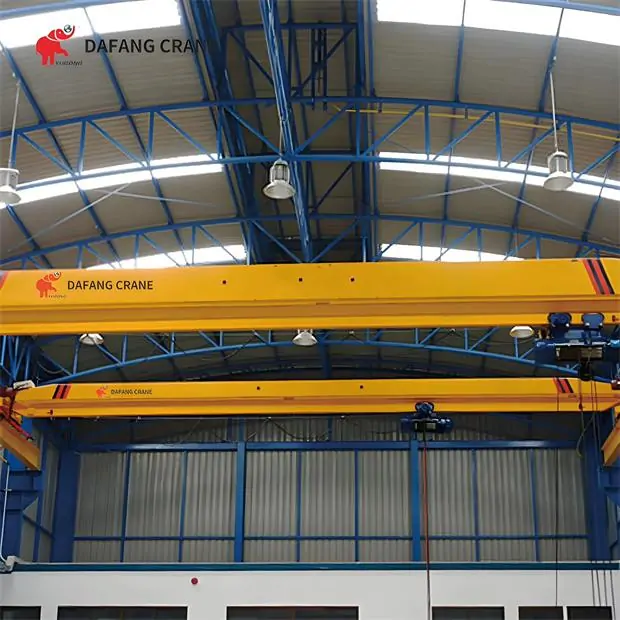
Body-in-white (BIW) assembly areas present the opposite problem from press shops: loads are light (typically 0.5–5 tons), but the workspace is dense with jigs, fixtures, robots, and conveyors at multiple heights. A European-type single girder overhead crane — characterized by compact end carriage design and low-headroom wire rope hoists — is the most common solution because it maximizes the usable lift height in buildings that were rarely designed with crane clearances in mind.
Underhung (underslung) cranes are a practical alternative when the roof structure can carry distributed loads across multiple points: they eliminate the runway rail entirely, which can recover an additional 150–250 mm of vertical clearance. For localized workstation tasks — installing seat assemblies, engine drops, trim fitting — wall-mounted cantilever cranes or jib cranes with 180–270° rotation cover a defined floor footprint without consuming any overhead runway, making them a common complement to the main bridge crane in assembly areas.
Powertrain Lines and Final Assembly — Smooth Control Over Raw Capacity
Engine and gearbox assembly positions require smooth, controllable motion rather than heavy-lift capacity. A 5–20 ton overhead crane with variable frequency drive (VFD) control delivers the slow-speed micro-positioning needed to lower an engine into a chassis tunnel or slide a gearbox onto its mounting without operator fatigue or load oscillation.
The duty class in final assembly is typically lower than in the press shop (M4–M5 is common), but the control requirements are higher. Dual-speed hoisting (a fast travel speed for repositioning, a slow speed for final placement), along with soft-start and soft-stop profiles, protect both the assembled vehicle and the lifting equipment from impact loads. For high-volume plants where the crane cycles 200–300 times per shift, wire rope hoists with helical gearing and oil-immersed brakes significantly reduce maintenance intervals compared to drum-brake designs.
Crane for Automobile Manufacturing Plant — How Retrofit Constraints Change the Calculation
Why Existing Building Structures Complicate Standard Selections
Installing crane infrastructure in a new greenfield factory and retrofitting a crane into an existing automotive plant are fundamentally different engineering tasks. In new construction, column spacing, floor loads, and building heights are designed around the crane specification. In an existing plant — a converted production hall, an older press shop being repurposed for EV battery assembly, or a Tier 1 supplier building being brought in-house — the building dimensions are a fixed constraint, not a variable.
The most common constraints in automotive retrofit projects are: net headroom below the existing roof structure (often 400–700 mm less than the theoretical building height once ducts, cable trays, and sprinkler systems are accounted for); column spacing that was not sized for the wheel loads of a loaded bridge crane; and production schedules that leave only weekends or planned shutdown windows for installation. Each of these affects which crane type is feasible before the question of capacity or duty class is even asked.
Practical Solutions for Low-Headroom and Structural-Limit Scenarios
Low headroom does not automatically rule out an overhead crane; it changes the design strategy. A low-headroom wire rope hoist — where the rope drum is positioned beside the motor rather than beneath it — can recover 200–400 mm of lift compared to a standard hoist in the same capacity class. Switching from a top-running to an underhung configuration recovers the full depth of the runway beam, typically another 150–300 mm. Combining both strategies often brings a project within the available headroom envelope without any structural modification to the building.
When the existing structural steel cannot carry the wheel loads of a full-span bridge crane, two approaches avoid the need for column reinforcement: a reduced-span configuration that covers only the critical lift zone (a single bay rather than the full building width) and uses smaller girder sections that stay within the column's existing load capacity; or a freestanding gantry crane system with its own steel support columns anchored to the floor slab, which transfers crane loads directly to the foundation rather than the building frame. Both approaches are meaningfully faster and less expensive than structural remediation in an active production facility.
Before committing to any retrofit specification, a site survey should capture: maximum available headroom at the lift point (measured to the underside of the lowest obstruction, not to the roof ridge), column spacing and existing crane rail positions if any, floor slab thickness and reinforcement for freestanding column anchors, and the ceiling area of any active production zones that cannot be disrupted during installation.

Certifications and Standards for Automotive Industry Cranes
Which Standards Apply, and Why Procurement Teams Need to Verify Them
Automotive cranes supplied to European OEM facilities and their Tier 1 suppliers are typically required to carry CE marking under the EU Machinery Directive 2006/42/EC, which confirms that the equipment meets essential health and safety requirements for machinery placed on the European market. ISO 4301 (classification of mechanisms) and ISO 9001 (quality management systems) are the most commonly referenced standards in crane procurement specifications, and supply chain auditors at major OEMs often request documentary evidence of both during supplier qualification.
For North American automotive facilities, crane design typically references ASME B30.2 for overhead and gantry cranes, with OSHA 29 CFR 1926.1415 governing operator and inspection requirements. Russian-market facilities and several CIS-country automotive plants additionally require EAC (Eurasian Conformity) certification before a crane can be commissioned.
What Procurement Teams Can Ask Suppliers to Provide
Verify CE marking by requesting the EC Declaration of Conformity (not just a product brochure that mentions CE). For ISO 9001, the supplier's certificate should name the issuing certification body and show a current validity period. Overload test certificates — typically demonstrating 1.25× rated capacity as a static proof load — are standard practice and should be available for every unit before commissioning. If the project involves high-frequency lifting applications, ask the supplier to state the duty class classification explicitly in writing, mapped to ISO 4301 load spectrum and operating class designations, so there is no ambiguity between what was quoted and what was delivered.
ЧЗВ
Q1: What type of crane is used in automobile manufacturing plants?
Automotive plants typically use a combination of crane types matched to each production zone. Double girder overhead cranes handle heavy die sets in the press shop; European-type single girder and underhung cranes serve body-in-white assembly areas where headroom is limited; gantry cranes cover outdoor body storage and logistics zones. The right selection depends on the load profile, duty cycle, and building constraints of each specific area.
Q2: Can I install an overhead crane in an existing automotive plant without modifying the building structure?
In many cases, yes. Low-headroom hoist configurations and underhung designs can recover 400–700 mm of vertical clearance compared to standard setups, often bringing a retrofit project within the available space without structural work. Where column loads are a concern, freestanding gantry systems with floor-anchored supports avoid transferring loads to the existing building frame entirely. The feasibility depends on available headroom, column spacing, and slab capacity — a site survey is the necessary first step.
Q3: How much does a crane for an automobile manufacturing plant cost?
Price depends heavily on capacity, span, duty class, and control specification. As a general reference: a 10-ton single girder overhead crane in a standard configuration typically falls in the $8,000–$20,000 range (equipment only, excluding installation and runway); a 20-ton double girder crane configured for M6 duty and VFD control generally runs $20,000–$60,000. Press-shop cranes with anti-sway systems, high-duty class ratings, and integrated positioning controls sit at the higher end. Contact Dafang for an itemised quotation based on your specific span, lifting height, duty cycle, and site conditions.
Q4: What duty class should an automotive press shop crane carry?
Press shop cranes handling large die sets in multi-shift operations should be classified at M6 or M7 under ISO 4301 — corresponding to heavy to very heavy duty cycles with regular full-load lifts. Using a lighter duty class (M4 or M5) in this application shortens the design service life significantly and increases the risk of unplanned mechanical failures during production shifts, which is where downtime costs are highest.
Q5: How do automotive cranes integrate with jigs, conveyors, and assembly fixtures?
Integration begins at the specification stage, not during installation. Hook approach dimensions, end carriage clearances, runway height, and trolley travel limits all need to be defined against the fixed positions of existing jigs, conveyors, and robot cells before a crane is fabricated. For new production lines, crane runways and process equipment can be co-designed. For retrofits, the crane specification must be built around the existing fixture layout — which is why suppliers with engineering consultation capability, rather than off-the-shelf catalogue supply, are better matched to automotive project requirements.