






Bulk material handling operations depend on one fundamental decision: selecting the right crane attachment for the material being moved. The wrong grab bucket reduces throughput, increases maintenance costs, and creates operational problems that affect production across every shift.
A grab bucket is a crane attachment designed to automatically grab, lift, transport, and discharge bulk materials. Different types of grab buckets — including rope grab buckets, hydraulic grab buckets, clamshell grabs, and orange peel grabs — are designed for different materials, crane systems, and operating environments. No single design handles all materials efficiently. Each type has a defined performance range where it excels and clear limitations where other designs perform better.
This guide compares all four grab bucket types across the factors that matter most to procurement managers, terminal operators, and plant engineers: working principle, material suitability, operational advantages, maintenance requirements, and industry applications. By the end, you will have a clear framework for selecting the right grab bucket for your specific application.
Índice
4 Common Types of Grab Buckets: Overview Comparison
| Tipo de agarrar | Working Method | Melhor material | Main Advantage | Typical Industry |
|---|---|---|---|---|
| balde de agarrar corda | Wire rope tension through pulley blocks | Loose granular bulk: coal, sand, grain, ore | Mechanical simplicity, low maintenance, no hydraulics required | Ports, power plants, grain terminals |
| Caçamba hidráulica | Hydraulic cylinders, independent of crane rope | Scrap, mixed waste, dense irregular materials | Strong independent closing force, precise control | Steel mills, recycling, waste handling |
| Pegada em forma de concha | Two shells, rope or hydraulic, high-volume design | Free-flowing bulk: sand, coal, ore, dredged sediment | High volume per cycle, sealed material retention | Ports, dredging, storage yards |
| casca de laranja | Multi-jaw radial closure, hydraulic | Irregular, interlocked materials: scrap, rock, demolition waste | Multi-directional grip, handles unpredictable material form | Scrap yards, steel mills, recycling |
Balde de agarrar corda
Estrutura
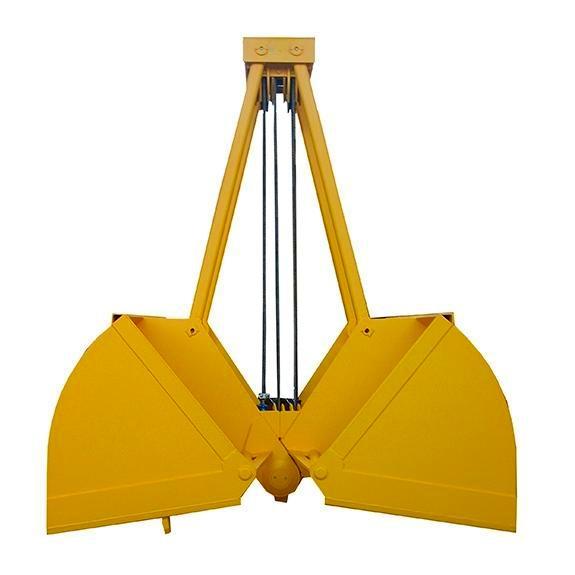
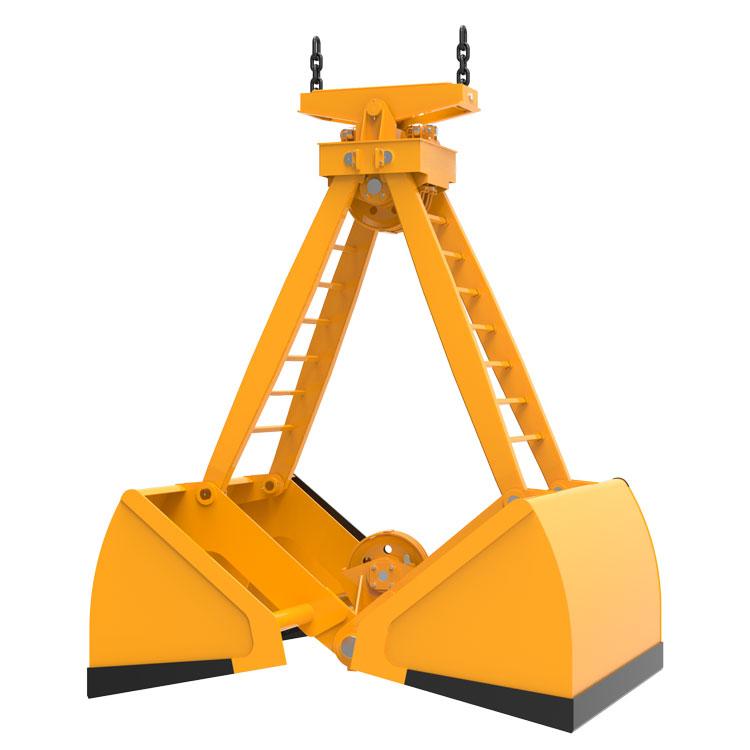
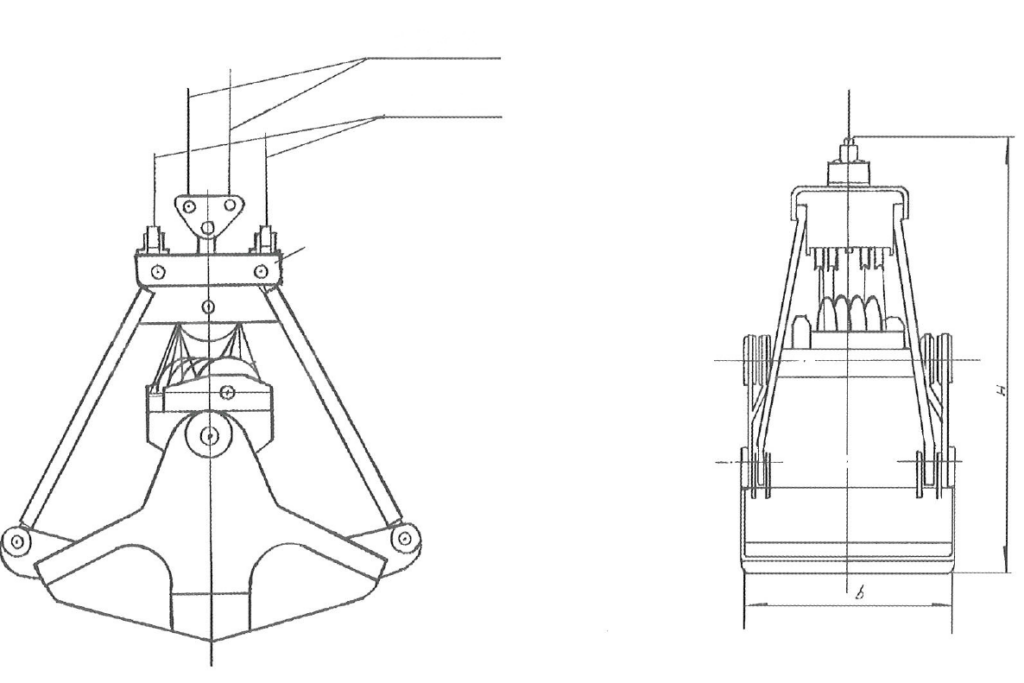
A rope grab bucket uses wire rope running through a pulley block system to generate shell closing force. The crane hoist provides the rope tension; the pulley block multiplies that force to drive the shells together with the closing load required for the material.
- Single-rope designs use one rope for both hoisting and closing — the simplest configuration, suited to light-duty applications where closing force requirements are modest.
- Two-rope designs use separate holding and closing ropes. The holding rope supports grab weight while the closing rope controls shell movement independently. This separation provides better closing force control and is standard for most commercial port and industrial applications.
- Four-rope designs use two holding ropes and two closing ropes for enhanced stability and closing force distribution. Four-rope configurations are standard on large harbor cranes and ship unloaders handling heavy bulk cargoes at high cycle frequencies.
Princípio de funcionamento
The grab descends with shells open — the closing rope slackens under gravity, allowing the shells to spread. When the shells contact the material, the operator tensions the closing rope through the crane hoist, pulling the shells together through the pulley block system. With shells closed and load secured, the crane hoists to travel height. At the discharge point, the closing rope slackens and the shells open under their own weight, releasing the material.
Vantagens
Rope grab buckets offer mechanical simplicity that hydraulic designs cannot match. There are no hydraulic systems to maintain, no cylinders to seal, and no power supply requirements beyond the crane's existing hoist system. This simplicity translates directly to lower maintenance burden, higher operational reliability in remote or resource-limited environments, and easier operator training. For high-cycle port operations where crane uptime is the primary productivity driver, the mechanical robustness of rope grab designs is a significant operational advantage.
Aplicações
Rope grab buckets are the standard choice for port bulk cargo handling — coal, iron ore, bauxite, fertilizer, and grain — where free-flowing material, high cycle rates, and large grab capacities are the primary requirements. Power plant coal handling, grain terminal operations, and cement clinker handling are established application categories. The consistent, granular nature of these materials suits the two-shell closing geometry and the reliance on material flowability for complete shell closure.
Hydraulic Grab Bucket Explained
Estrutura
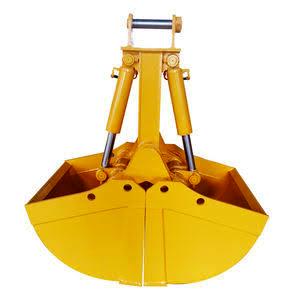
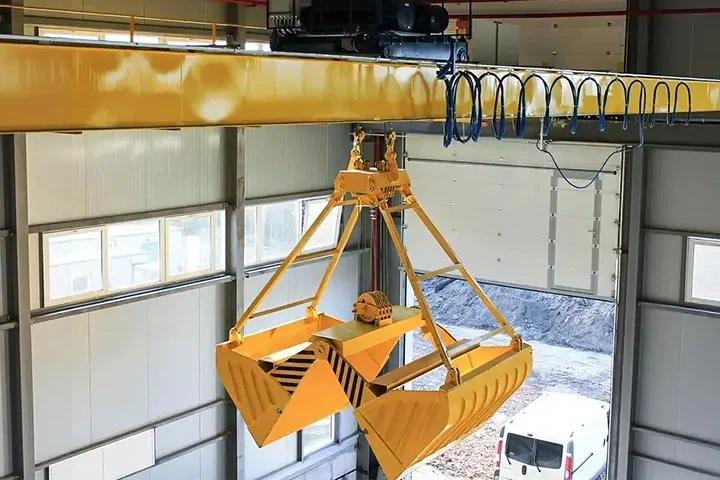
A hydraulic grab bucket uses hydraulic cylinders to drive shell or jaw opening and closing, with the hydraulic power unit — motor, pump, valve block, and reservoir — mounted on the crane or integrated into the grab body. Pressurized hydraulic fluid actuates the cylinders independently of crane rope position or tension.
The control system may be integrated with the crane's cabin controls, operated via pendant, or managed by radio remote. Variable valve control allows the operator to adjust closing speed and force during the operating cycle — a precision capability that rope-operated designs cannot provide.
Vantagens
- Independent operation. The operator can open or close at any hoist position without dependence on rope tension. This independence is the fundamental operational advantage of hydraulic designs over rope alternatives.
- Strong closing force. Hydraulic system pressure translates directly to cylinder force and shell closing load. High closing force allows the grab to penetrate compacted material, capture dense loads, and handle materials that resist rope-operated closing.
- Precise control. Variable valve control allows gradual opening for accurate discharge — critical in furnace charging, hopper feeding, and applications where load placement precision matters.
- High efficiency. Fast hydraulic actuation reduces cycle time compared to rope-dependent designs in applications where closing speed affects throughput.
Aplicações
Hydraulic grab buckets are the preferred choice for scrap metal handling, steel mill material management, recycling operations, and waste handling — applications where material is irregular, dense, or compacted in ways that rope-operated designs cannot reliably address. The strong, independent closing force handles compacted scrap piles, dense demolition debris, and heterogeneous waste streams that rope grabs approach with difficulty. Steel mill furnace charging, scrap yard management, and waste-to-energy plant receiving halls are primary hydraulic grab applications.
Clamshell Grab Explained
Caraterísticas de design
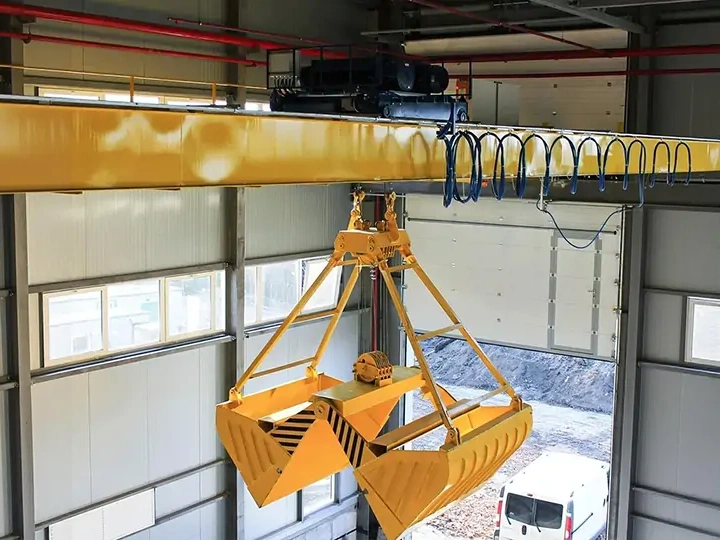
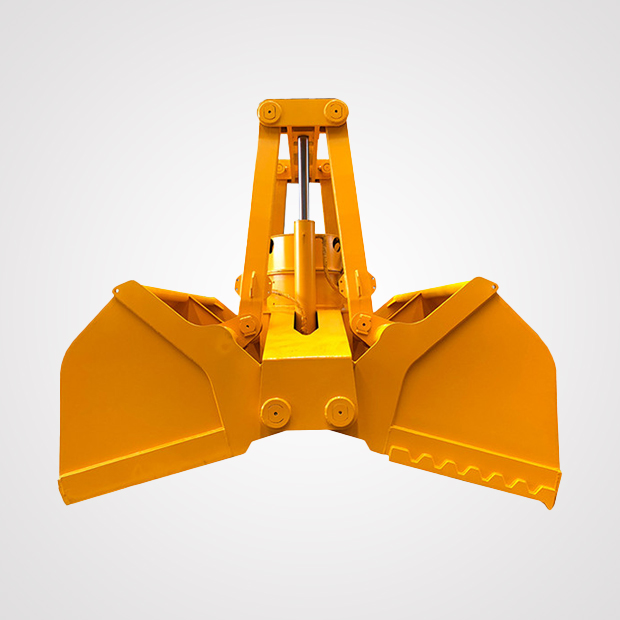
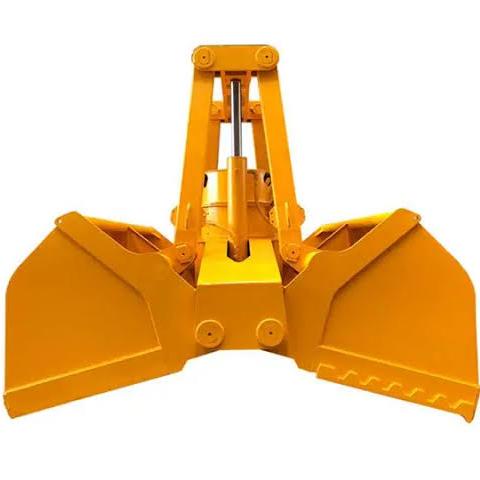
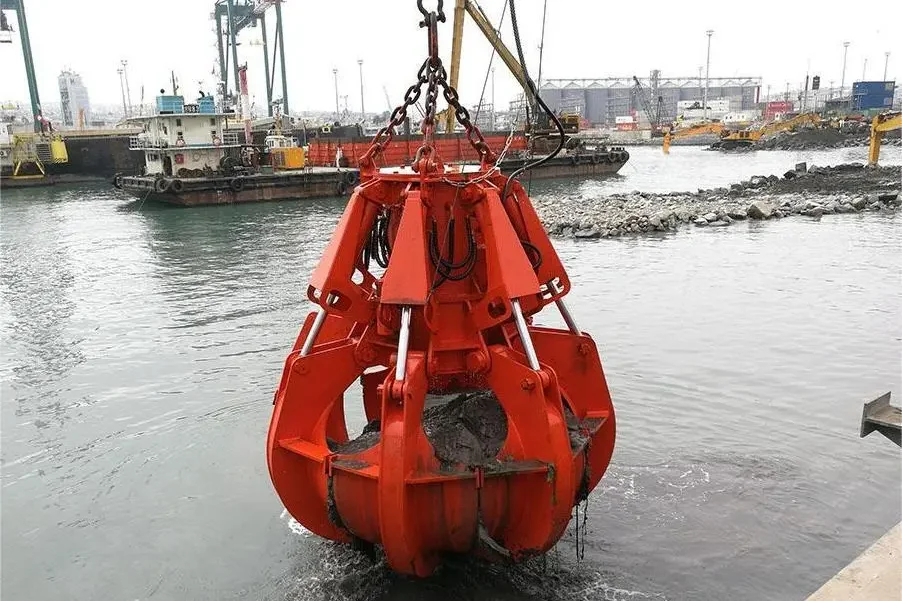
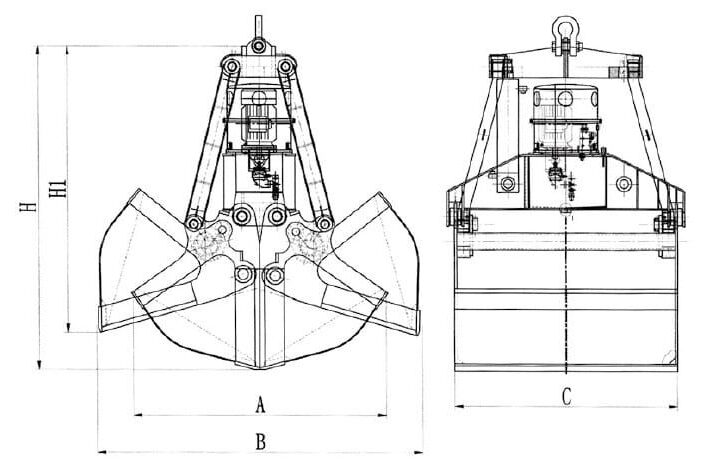
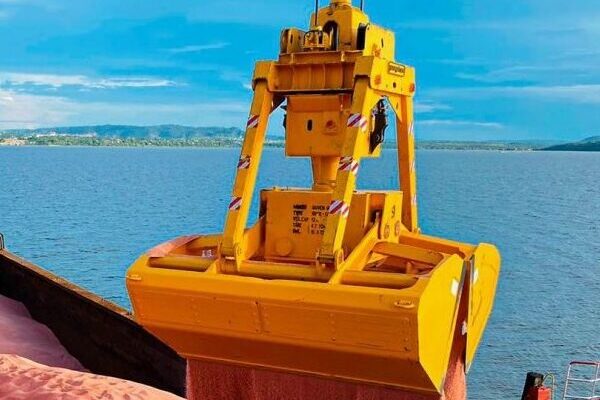
A clamshell grab consists of two symmetrical curved shells hinged together at the top. When open, the shells spread apart to cover a defined plan area. When closed, they form a sealed bucket that retains the captured material during hoisting and travel. The sealed closure is the key design characteristic that distinguishes clamshell grabs from orange peel designs — material is retained within the closed shells regardless of particle size, as long as the particle is smaller than the shell gap at closure.
Clamshell grabs are available in rope-operated (two-rope or four-rope) and hydraulic configurations. Rope-operated clamshell grabs are the standard for most port bulk handling applications. Hydraulic clamshell grabs are used where independent shell control or higher closing force is required.
Shell geometry varies by application. Wider-opening shells improve penetration in loose, low-resistance materials. Reinforced cutting edges on the shell lips improve penetration in compacted or partially consolidated material.
Vantagens
- High volume per cycle. The sealed two-shell design captures and retains large volumes of loose, granular material per cycle — typically 1 to 30 cubic meters depending on grab size and material density. This volume efficiency makes clamshell grabs the standard for high-throughput port bulk handling.
- Fast operating cycle. The simple two-shell mechanism opens and closes quickly, supporting high cycle rates in demanding port and terminal environments.
- Versatile material handling. With appropriate shell geometry and cutting edge selection, clamshell grabs handle materials ranging from fine grain through coarse ore to dredged sediment. The sealed closure retains even fine-particle materials that would fall through the jaw gaps of multi-jaw designs.
- Dredging capability. Watertight clamshell grabs designed for submerged operation are the standard attachment for crane-barge dredging operations — handling saturated sediment, sand, and gravel from harbor channels and river beds.
Aplicações
Ports and bulk terminals use clamshell grabs for coal, iron ore, grain, fertilizer, sand, and cement clinker unloading from vessels and transfer between storage areas. Dredging operations use marine-grade watertight designs for underwater sediment excavation. Sand and gravel quarries, power plant coal yards, and grain storage facilities are established clamshell grab application categories. The common requirement across all applications is material that is granular, free-flowing, or loose enough to be captured by a two-shell closing action without requiring multi-directional penetration.
Orange Peel Grab Explained
Caraterísticas de design
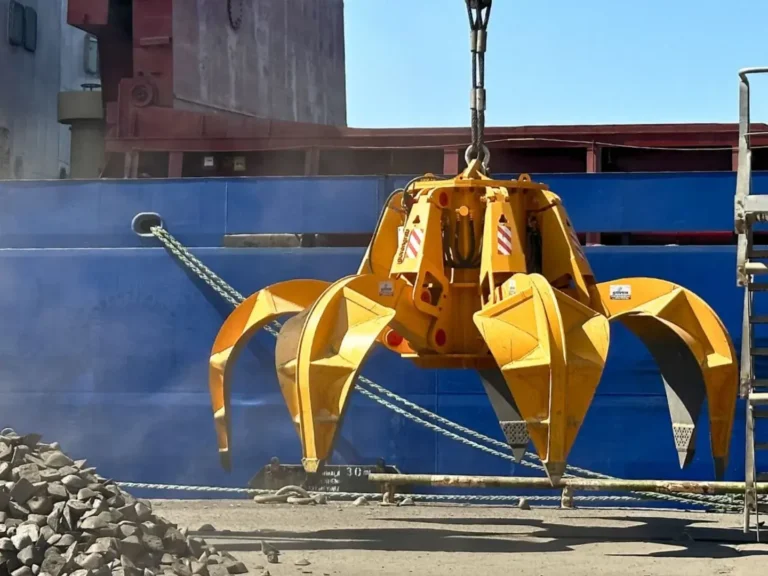
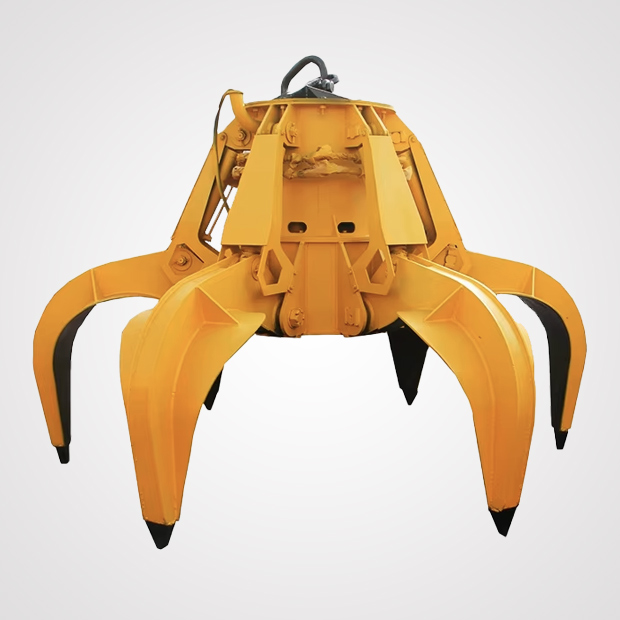
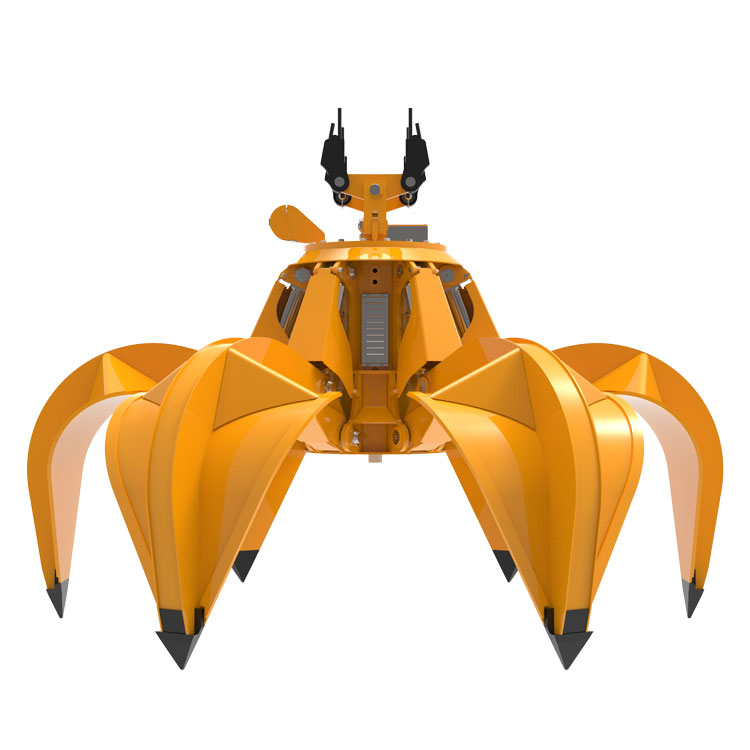
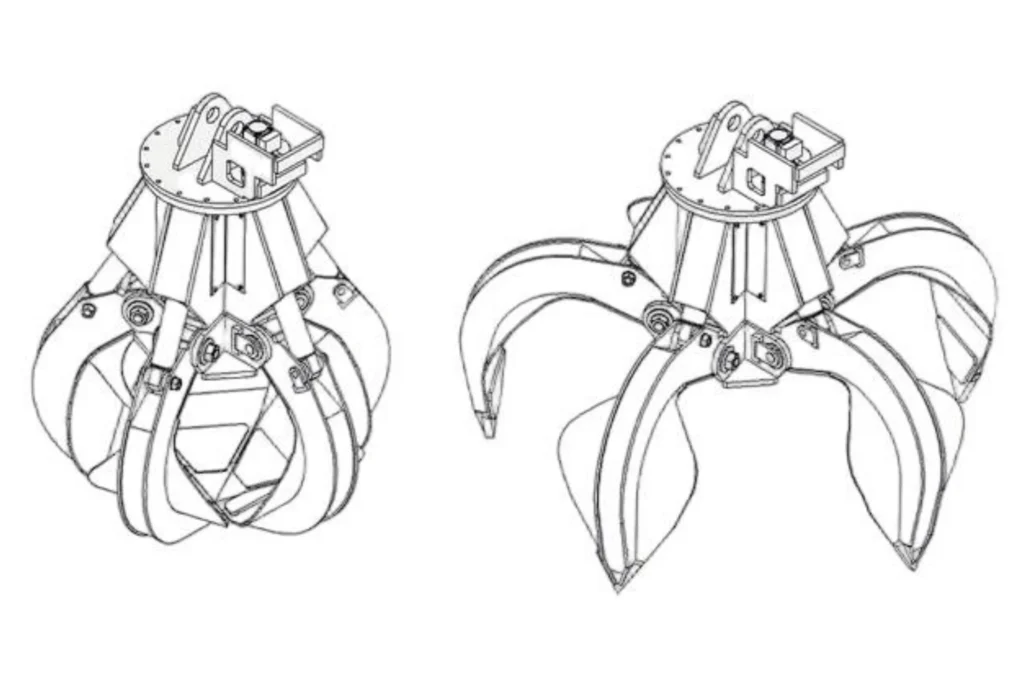
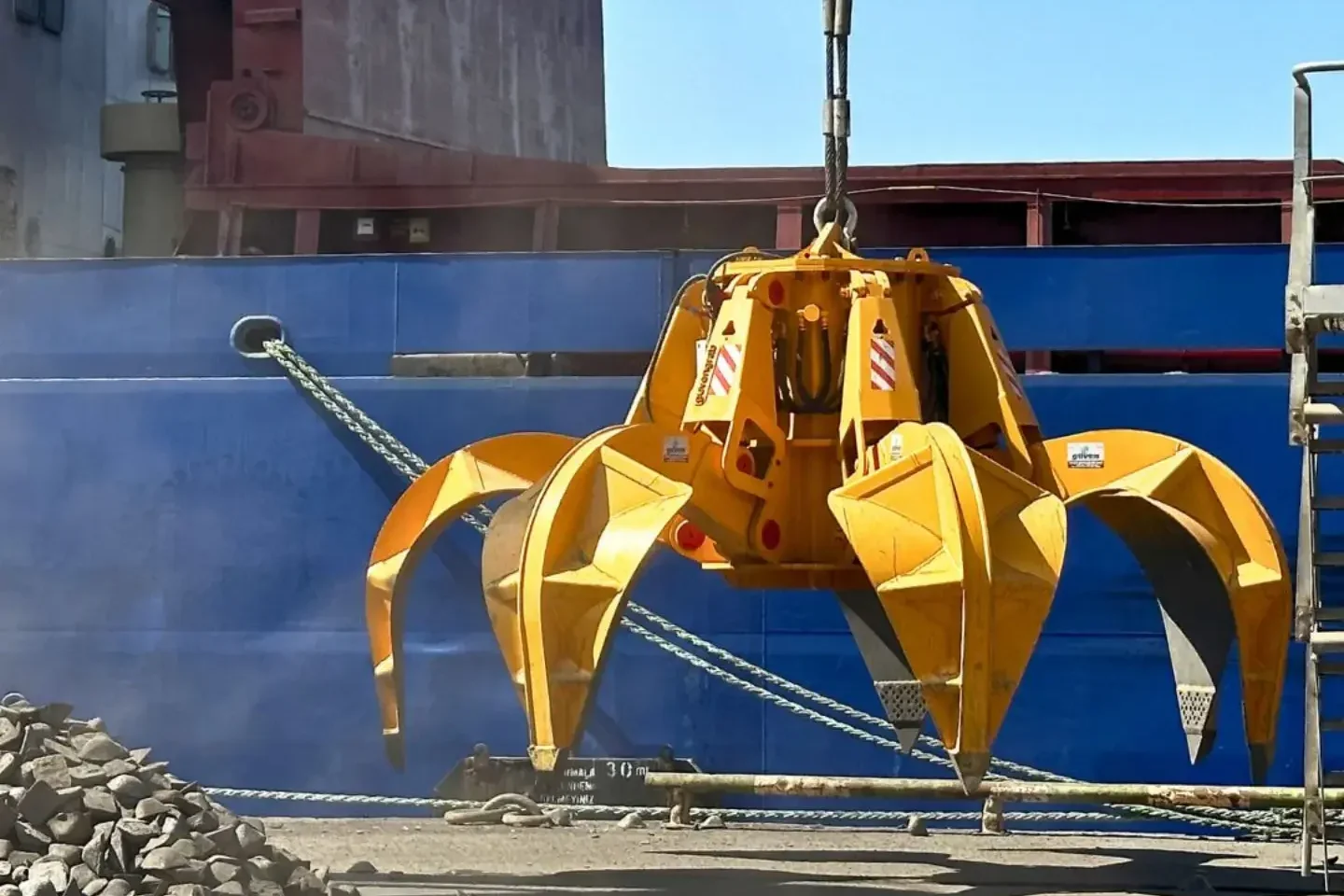
Um orange peel grab uses three, four, five, or six curved jaws arranged radially around a central hub. When open, the jaws spread outward to surround the target material from all sides. When hydraulic cylinders retract, each jaw moves inward and downward simultaneously — gripping irregular, interlocked material from multiple directions at once.
The swivel suspension bearing at the top of the frame allows 360-degree rotation, preventing rope and hose torsional loading during crane travel. Jaw tips are fabricated from hardened wear-resistant steel and are designed as replaceable components to extend structural jaw service life.
The orange peel grab is almost exclusively hydraulic — the multi-jaw geometry does not lend itself to rope-operated designs. Electro-hydraulic configurations with integrated power units are the standard for cranes not originally equipped with hydraulic infrastructure.
Vantagens
- Multi-directional gripping. The radial jaw closure surrounds irregular and interlocked material from all sides simultaneously — capturing loads that two-shell designs cannot reliably grip. This is the fundamental performance advantage of the orange peel design over all alternatives for scrap and irregular material handling.
- Handles irregular materials. Scrap metal, demolition debris, and industrial waste arrive in unpredictable sizes and orientations. The orange peel grab's multi-jaw geometry accommodates this irregularity without requiring material to be positioned or pre-sorted before handling.
- Excellent penetration performance. Jaw tips concentrate closing force at multiple points around the material perimeter, penetrating compacted scrap piles and interlocked loads that resist two-shell compression.
- Strong and consistent grip. Material is held by compressive force from multiple directions, maintaining grip security during hoisting and crane travel even for large, awkwardly shaped loads.
Aplicações
Steel mill scrap handling — charging preparation, yard management, and furnace feeding — is the primary orange peel grab application globally. Metal recycling facilities use them for sorting, shredder feeding, and baler loading. Ports handling scrap metal export cargoes use large-capacity orange peel designs on harbor cranes for vessel loading. Mining and quarrying operations use reinforced designs for rock fragment handling in confined excavation geometries. Waste-to-energy and construction waste facilities use them for heterogeneous waste receiving and transfer.
How to Choose the Right Grab Bucket
Caraterísticas do material
Material type is the primary selection driver. Define the material before any other parameter.
- Free-flowing granular materials — coal, grain, sand, fertilizer, cement clinker — suit rope grab buckets or clamshell grabs. The two-shell sealed closure retains fine particles efficiently, and rope-operated designs provide adequate closing force for these low-resistance materials.
- Dense bulk materials — iron ore, bauxite, limestone — may require hydraulic closing force if compaction or moisture content increases resistance to shell penetration. Two-rope or four-rope clamshell designs are standard for most port ore handling; hydraulic designs suit applications where compaction is a consistent challenge.
- Irregular and interlocked materials — scrap metal, demolition debris, mixed industrial waste — require orange peel grab geometry. Two-shell designs cannot reliably grip these materials; multi-jaw radial closure is the appropriate solution.
- Wet, sticky, or cohesive materials — clay, wet organic waste, compacted municipal solid waste — require specific shell geometry, wider opening angles, and higher closing force to prevent bridging and shell adhesion. Hydraulic control is preferred for these materials to maintain consistent closing force regardless of material resistance variation.
Crane Compatibility
Confirm the crane's rated lifting capacity covers grab dead weight plus maximum material load with a minimum 25% safety margin. Rope grabs connect to standard hoist systems — confirm rope arrangement compatibility with the grab's pulley system. Hydraulic grabs require hydraulic power supply from the crane or an integrated electro-hydraulic unit; confirm power supply specifications before procurement. For all grab types, confirm hook size, structural rating, and hoist rope capacity before ordering.
Operating Environment
Port and coastal environments require corrosion-resistant coatings, sealed bearings, and marine-grade hardware on all grab types. High-temperature environments near steel furnaces affect hydraulic fluid specification and seal material selection — confirm operating temperature range with the grab manufacturer. Dusty environments require sealed electrical and hydraulic components on hydraulic designs. Outdoor operation in cold climates affects hydraulic fluid viscosity — confirm low-temperature fluid specifications for the operating temperature range.
Required Efficiency
High-throughput port operations prioritize cycle time — large-volume rope or hydraulic clamshell grabs with fast rope systems or high-flow hydraulics optimize tonnes per hour. Steel mill scrap handling prioritizes closing force and material capture reliability over raw cycle speed — hydraulic orange peel grabs deliver consistent performance across unpredictable material conditions. Recycling facilities may prioritize versatility — hydraulic grab buckets handling mixed material streams that vary shift by shift.
Grab Bucket Applications by Industry
Portos e Terminais
Port bulk terminals use rope-operated and hydraulic clamshell grabs as the primary attachment for coal, iron ore, grain, fertilizer, and sand unloading. Four-rope designs on large ship unloaders achieve the highest cycle rates and volumes for major bulk cargo operations. Scrap export terminals add orange peel grabs for loading scrap metal cargoes that clamshell designs cannot efficiently handle.
Siderurgias
Steel mills deploy multiple grab bucket types across different facility zones. Ore yard cranes use clamshell grabs for iron ore and coal stockpile management. Scrap yard cranes use orange peel grabs — or hydraulic grab buckets — for scrap handling, sorting, and furnace charging preparation. The intensive, multi-shift operating profile of steel mill applications requires M7 to M8 duty classification for all grab designs in primary production positions.
Recycling Industry
Metal recycling and material recovery facilities use orange peel grabs and hydraulic grab buckets as primary handling attachments. The variable and irregular nature of post-consumer scrap — mixed metals, automotive hulks, structural sections, appliance waste — suits multi-jaw or hydraulic designs better than rope-operated alternatives. Shredder feeding, baler loading, and inter-yard transfer are primary application tasks.
Indústria mineira
Surface mining and quarrying operations use rope grab buckets and clamshell designs for ore and aggregate handling in storage yards and transfer stations. For excavation in confined geometries — deep pits, narrow trenches — orange peel and clamshell grabs mounted on crane barges or rail-mounted cranes provide the vertical access that excavators cannot achieve efficiently. Rock handling applications require reinforced jaw tips and elevated closing force specifications.
Waste Management
Waste-to-energy facilities use orange peel grabs and hydraulic clamshell designs for municipal solid waste receiving and feed management. Construction and demolition waste facilities use orange peel grabs for mixed debris handling. Industrial waste and hazardous material facilities may require specific corrosion-resistant materials, sealed systems, and containment features that must be specified explicitly for the waste stream composition.
How to Select a Reliable Grab Bucket Manufacturer
Experiência em Engenharia
Request documented project references in your specific application category — grab type, material handled, capacity range, and crane configuration. A manufacturer with verified installations in comparable applications brings operational knowledge that reduces specification risk and delivery uncertainty.
Capacidade de fabricação
Genuine grab bucket manufacturers maintain dedicated fabrication facilities with CNC machining, certified welding processes, and assembly and load testing capability. Confirm manufacturing infrastructure through factory visit or third-party inspection before placing significant orders.
Capacidade de personalização
Standard catalogue designs address common requirements. Non-standard capacities, unusual materials, extreme environment specifications, and specific crane integration requirements all demand custom engineering. Confirm that the manufacturer has in-house engineering capability for custom development — not only the ability to modify standard designs within narrow parameters.
Quality Certification
ISO 9001 quality management certification confirms documented production processes. Marcação CE (Machinery Directive 2006/42/EC) is mandatory for EU market grab buckets and widely referenced internationally as a quality indicator. Request load test certificates and material test reports as standard deliverables for every grab procurement.
After-Sales Support and Spare Parts Availability
A grab bucket has a service life of 10 to 20 years in typical industrial applications. Wear parts — jaw tips, cutting edges, pin bushings, hydraulic seals — require regular replacement throughout that period. Confirm spare parts availability, lead times for critical components, and service engineer availability in your region before finalizing supplier selection.
Conclusão
Four grab bucket types serve the full range of industrial bulk material handling requirements — each with a defined performance range where it excels and clear limitations that make other designs more appropriate.
Rope grab buckets deliver mechanical simplicity and reliable performance for free-flowing granular materials in port and storage yard applications. Hydraulic grab buckets provide independent, high-force closing for dense and compacted materials where rope-operated designs fall short. Clamshell grabs maximize volume per cycle for sealed retention of granular bulk cargo across port, dredging, and storage applications. Orange peel grabs provide the multi-directional gripping that irregular, interlocked scrap and demolition materials require.
The right selection depends on one primary question: what is the character of the material being handled? Answer that question accurately, then confirm crane compatibility, operating environment requirements, and duty cycle intensity. With those four inputs defined, the appropriate grab bucket type and configuration follows directly from the engineering requirements — not from the catalogue.
Ready to define your grab bucket specification? Contact our engineering team to discuss your material handling requirements. We supply customized rope grab buckets, hydraulic grab buckets, clamshell grabs, and orange peel grabs across the full capacity range — with full technical support from initial selection through to commissioning and lifecycle maintenance.

Perguntas mais frequentes
Q1: What is the difference between a rope grab bucket and a hydraulic grab bucket?
The fundamental difference is the closing mechanism. A rope grab bucket closes through wire rope tension transmitted via pulley blocks — the closing force depends on the crane hoist rope arrangement and cannot be applied independently of rope position. A hydraulic grab bucket closes through hydraulic cylinders that operate independently of the crane rope — the operator can open or close at any hoist position with adjustable force. Rope grabs are mechanically simpler and require no hydraulic infrastructure; hydraulic grabs provide stronger and more controllable closing force suited to denser or more irregular materials.
Q2: When should I use a clamshell grab?
Use a clamshell grab when handling free-flowing granular or loose bulk materials — coal, sand, grain, ore, fertilizer, or dredged sediment — where high volume per cycle and sealed material retention are the primary performance requirements. The two-shell sealed design captures large volumes of flowing material efficiently and retains fine particles that would fall through multi-jaw designs. Clamshell grabs are not appropriate for irregular, interlocked, or non-uniform materials such as scrap metal — for those applications, orange peel or hydraulic grab bucket designs are more effective.
Q3: What materials can an orange peel grab handle?
Orange peel grabs handle irregular, interlocked, and non-uniform bulk materials where multi-directional gripping is required. Primary materials include scrap metal in all forms — heavy melt, shredded scrap, structural sections, automotive scrap — demolition and construction debris, rock and mineral fragments, timber and logs, and mixed industrial waste. They are not suitable for fine granular materials — sand, grain, coal fines — where particle sizes smaller than the jaw gaps fall through during hoisting. For these materials, clamshell or rope grab bucket designs provide better material retention.
Q4: Which grab bucket is best for scrap metal handling?
Orange peel grabs are the standard choice for scrap metal handling in steel mills, scrap yards, and recycling facilities. Their multi-jaw radial closure penetrates compacted scrap piles and grips irregular, interlocked loads from multiple directions simultaneously — capturing material that two-shell designs cannot reliably retain. Hydraulic grab buckets are also used for scrap handling in applications where the material is more uniform in size. Rope-operated clamshell grabs are not recommended for scrap metal — their two-shell design does not provide the penetration and grip required for irregular, interlocked material.
Q5: Which grab bucket is suitable for port bulk handling?
Rope-operated and hydraulic clamshell grabs are the standard choice for port bulk cargo handling — coal, iron ore, grain, fertilizer, sand, and similar materials. Four-rope clamshell designs on large ship unloaders provide the highest cycle rates and cargo volumes for major bulk terminal operations. Rope grab buckets in two-rope configurations handle medium-duty port applications efficiently. For scrap metal export loading, orange peel grabs are added to the port crane fleet alongside clamshell designs to handle the irregular, interlocked material character of scrap cargoes.
Q6: Can grab buckets be customized for different cranes?
Yes. Leading grab bucket manufacturers offer customization across capacity, shell geometry, jaw configuration, opening width, cutting edge profile, hydraulic system specification, corrosion protection, and control system integration. Rope grab configurations can be adapted to match specific crane hoist rope arrangements. Hydraulic grabs can be designed for specific crane hydraulic supply pressures and flow rates. Electro-hydraulic designs are custom-integrated with specific crane electrical supply and control systems. For non-standard crane configurations, crane specifications and infrastructure should be provided to the grab manufacturer during the specification stage — not after order placement.