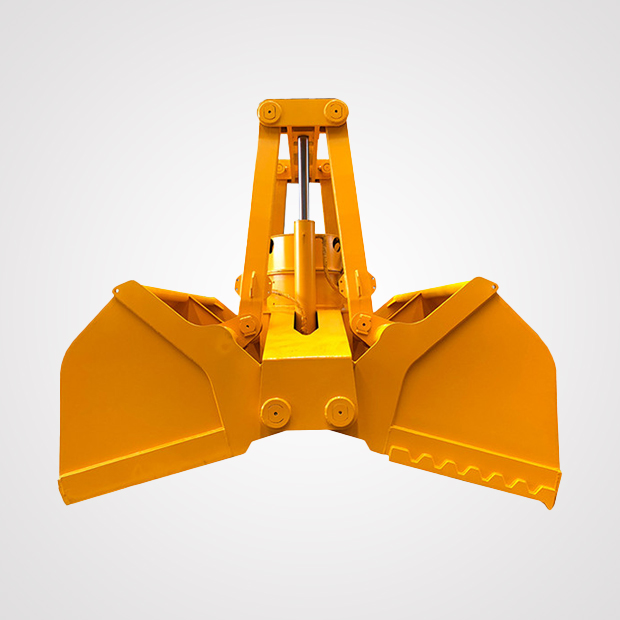







Handling irregular, heavy, and interlocked bulk materials — scrap metal, industrial waste, demolition debris, and rock — presents challenges that standard clamshell grabs and conveyor systems cannot address efficiently. The material resists penetration, shifts unpredictably, and requires gripping force from multiple directions simultaneously.
An orange peel grab is a multi-jaw crane attachment designed specifically for this challenge. It uses three to six curved jaws that close radially around the material, generating gripping force from all sides rather than only two. This multi-directional approach makes the orange peel grab the standard crane attachment for scrap yards, steel mills, recycling facilities, and port terminals handling irregular bulk materials worldwide.
This guide covers how orange peel grabs work, the main types available, industrial applications, selection criteria, maintenance requirements, and safety practices — providing engineers, procurement managers, and terminal operators with the technical grounding to select and specify the right grab solution for their application.
Índice
What Is an Orange Peel Grab
Definição
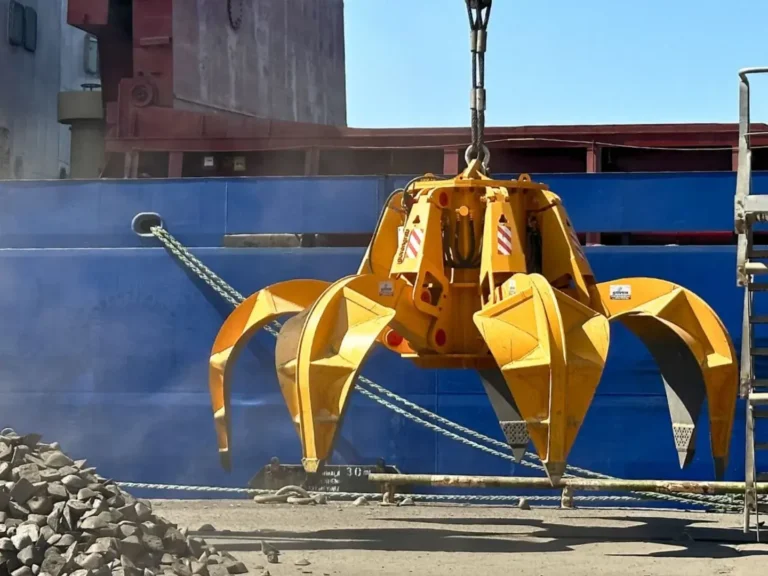
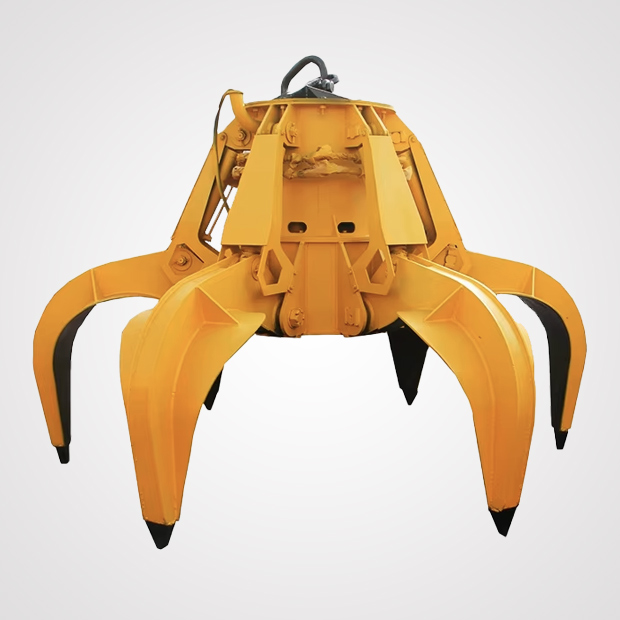
Um orange peel grab is a hydraulic or mechanical crane attachment consisting of multiple curved jaws — typically four to six — arranged radially around a central axis and connected to a common suspension frame. When open, the jaws spread outward. When closed, they converge from all directions to grip and retain irregular, bulky, or interlocked materials that two-jaw designs cannot handle effectively.
Orange peel grabs connect to overhead cranes, gantry cranes, harbor cranes, and scrap handling crane systems. They are the dominant grab attachment type in scrap metal handling and are widely used in steel mills, recycling plants, ports, mining operations, and waste management facilities.
Why It Is Called an Orange Peel Grab
The name derives directly from the visual resemblance to an orange being peeled. When the grab jaws open, each curved jaw section spreads outward in a pattern that mirrors orange peel segments separating from the fruit's center. When closed, the jaws form a rounded, enclosed basket — again resembling the intact orange before peeling. This intuitive visual description has made the name universal across international markets and languages.
Obter um orçamento gratuito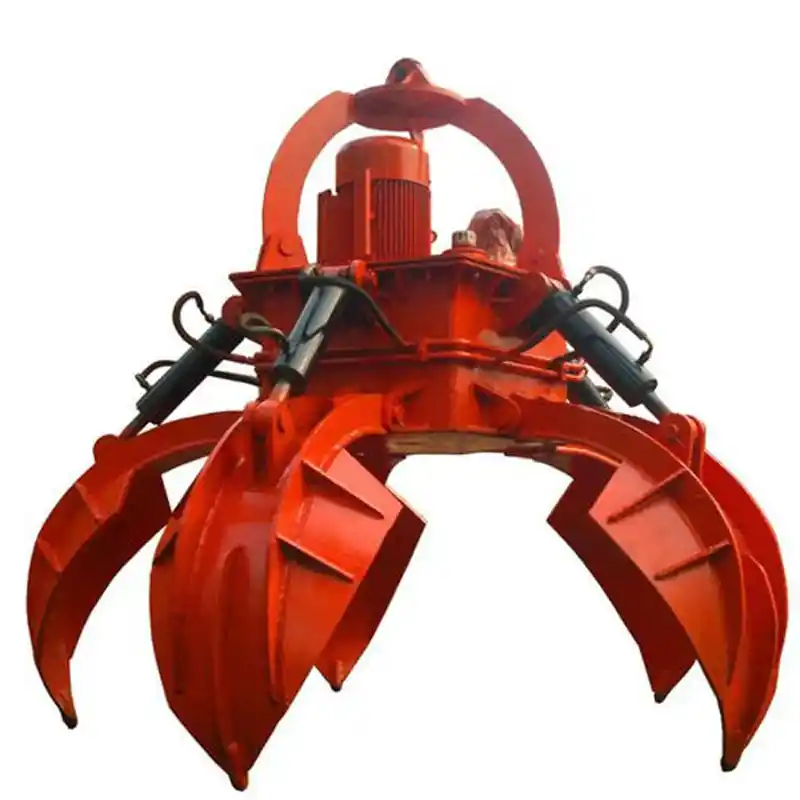
How an Orange Peel Grab Works
Step 1 — Grab Opening
The crane lowers the grab toward the material pile with jaws in the open position. In hydraulic designs, cylinders extend to drive the jaws outward to maximum opening diameter. The open configuration presents the maximum entry profile for penetrating the material surface. Jaw opening angle and maximum open diameter determine how effectively the grab can be positioned over irregular, loose, or piled material.
Step 2 — Material Gripping
As the open jaws contact the material surface, the operator initiates closing. Hydraulic cylinders retract, pulling the jaws inward and downward in a coordinated radial movement. Each jaw engages the material from a different angular direction — surrounding it rather than approaching from only two sides. This multi-directional engagement is particularly effective for scrap metal, where individual pieces are entangled, angular, and resistant to two-jaw penetration.
The closing force generated by the hydraulic system determines how much gripping pressure the jaws apply to the material. High closing force is essential for dense scrap steel and heavy industrial waste. Closing force is a key specification parameter and must be matched to the material being handled.
Step 3 — Lifting Operation
With jaws closed and material gripped, the crane hoist lifts the loaded grab to the required travel height. The suspension frame transfers the combined weight of the grab and retained material to the crane hook. Load distribution across the jaws and through the suspension frame must be considered in structural design — particularly for asymmetric loads where material distribution between jaws is uneven.
Step 4 — Transportation
The crane travels to the discharge position — a furnace charging platform, crusher hopper, vessel hold, or storage pile. Grab stability during travel depends on jaw closure integrity and the rigidity of the suspension frame. Anti-sway control systems on the crane reduce pendulum motion during travel with heavy or asymmetrically loaded grabs.
Step 5 — Material Release
At the discharge point, hydraulic cylinders extend to open the jaws, releasing material by gravity. Controlled opening — at variable speed in sophisticated hydraulic systems — allows operators to place material accurately or release it progressively. After discharge, the empty grab returns to the collection point and the cycle repeats.
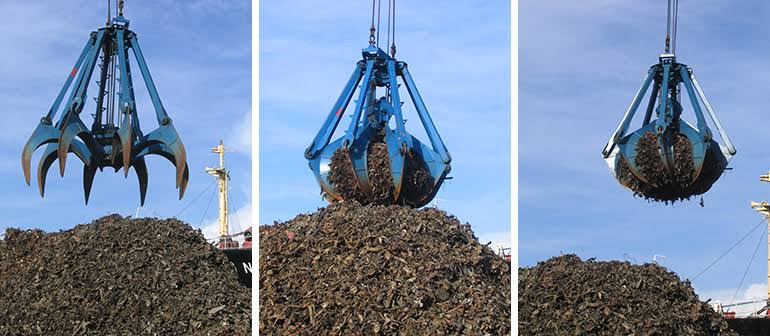
Main Components of an Orange Peel Grab
| Componente | Função |
|---|---|
| Grab jaws (shells) | The primary gripping elements. Curved jaw geometry and jaw count — typically 4 to 6 — determine gripping performance for specific material types. Jaw material is high-strength wear-resistant steel. |
| Hydraulic cylinders | Drive jaw opening and closing. Cylinder bore diameter, stroke, and operating pressure determine the closing force and jaw travel range. |
| Hydraulic power unit | Pump, motor, valves, reservoir, and control manifold supplying hydraulic power to the cylinders. May be mounted on the crane (with hoses to the grab) or integrated into the grab body (electro-hydraulic design). |
| Gear ring | Structural ring connecting the jaw assembly to the suspension frame. Transmits load from the jaws to the crane hook through the frame. |
| Pin shafts | Pivot pins at each jaw hinge point. High-strength alloy steel with hardened bearing surfaces to resist the bending and wear loads imposed during gripping and release cycles. |
| Bearing system | Pivot bearings at jaw hinge points and connecting links. Sealed or grease-nipple-equipped designs extend service intervals in dirty operating environments. |
| Quadro de suspensão | Upper structural assembly connecting to the crane hook. Transmits the full loaded grab weight to the crane while accommodating the rotation and articulation of the jaw assembly below. |
| Wear liners | Replaceable wear plates on jaw inner surfaces protect the structural jaw from abrasion during material contact. Liner material is selected for the specific abrasiveness of the material being handled. |
| Bordas de corte | Hardened steel edges on jaw tips improve penetration into compacted or interlocked material piles. Replaceable designs extend jaw service life without replacing the full jaw assembly. |
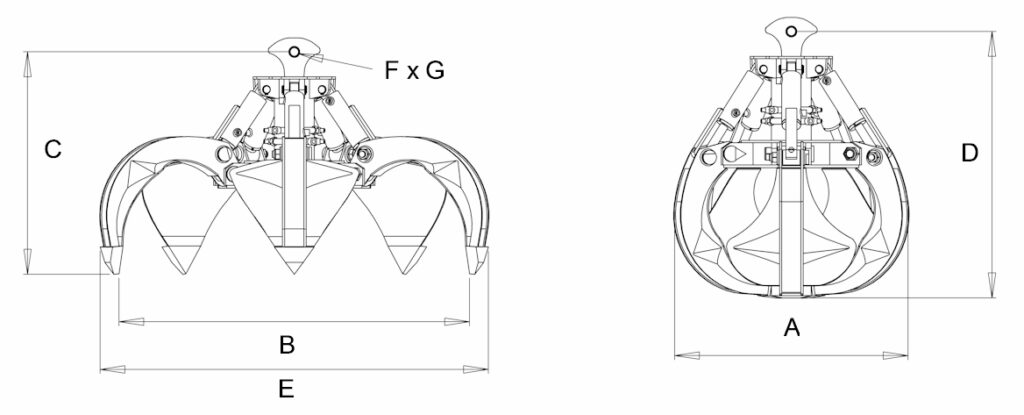
Orange Peel Grab vs Other Grab Bucket Types
| Tipo de agarrar | Melhor aplicativo | Gripping Approach | Limitations |
|---|---|---|---|
| casca de laranja | Scrap metal, industrial waste, rock, irregular materials | Multi-jaw radial closure — surrounds material from all directions | Less efficient for fine, loose, or flowable materials |
| Pegada em forma de concha | Sand, coal, ore, grain, loose bulk materials | Two-jaw opposed closure | Poor performance with interlocked or irregular materials |
| Caçamba hidráulica | Mixed bulk materials, precision discharge | Hydraulic cylinder closure — two or multi-jaw | Higher cost than rope alternatives |
| balde de agarrar corda | General bulk cargo, port operations | Rope tension closure — two jaw | Limited closing force; unsuitable for heavy scrap |
The selection principle is straightforward: match the grab type to the material geometry. Granular, flowable materials that fill and fall out of open shells suit clamshell designs. Irregular, interlocked, or cohesive materials that require multi-directional gripping suit orange peel configurations. When both material types are handled at the same facility, different grab attachments may be specified for different positions or a versatile hydraulic grab bucket with adjustable configuration may be considered.
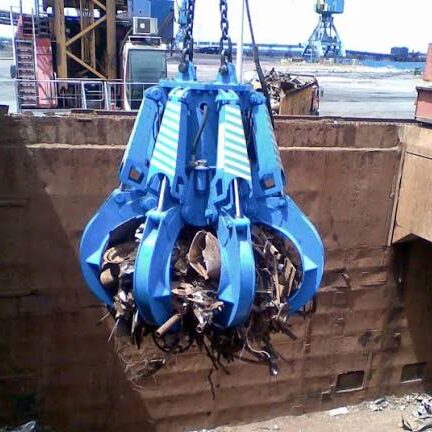
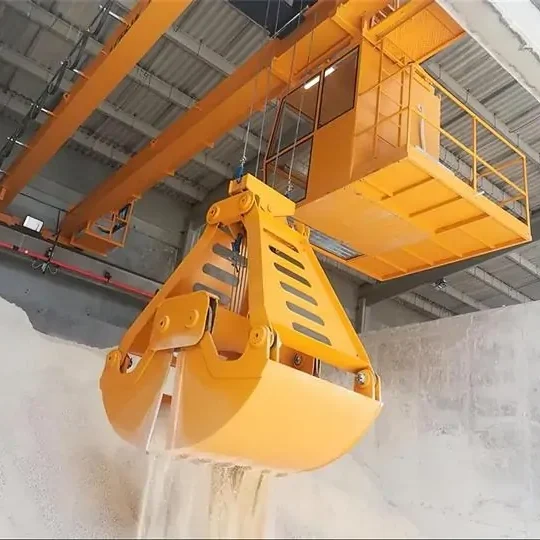
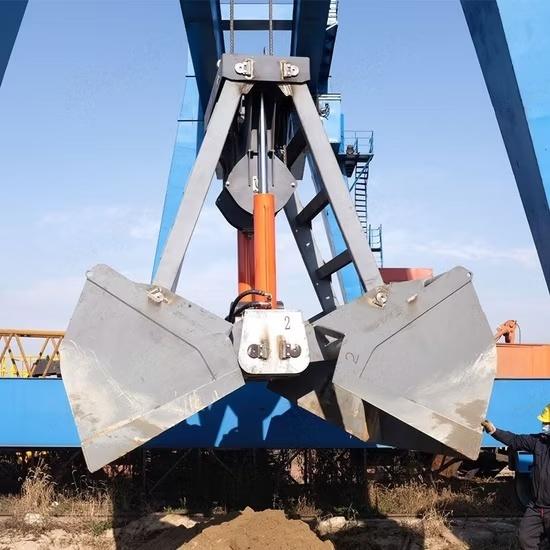
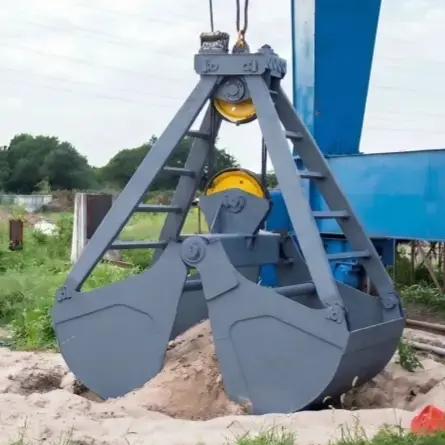
* For a comprehensive comparison of all four grab bucket types — rope, hydraulic, clamshell, and orange peel — see our grab bucket types comparison guide.
Industrial Applications of Orange Peel Grabs
Siderurgias
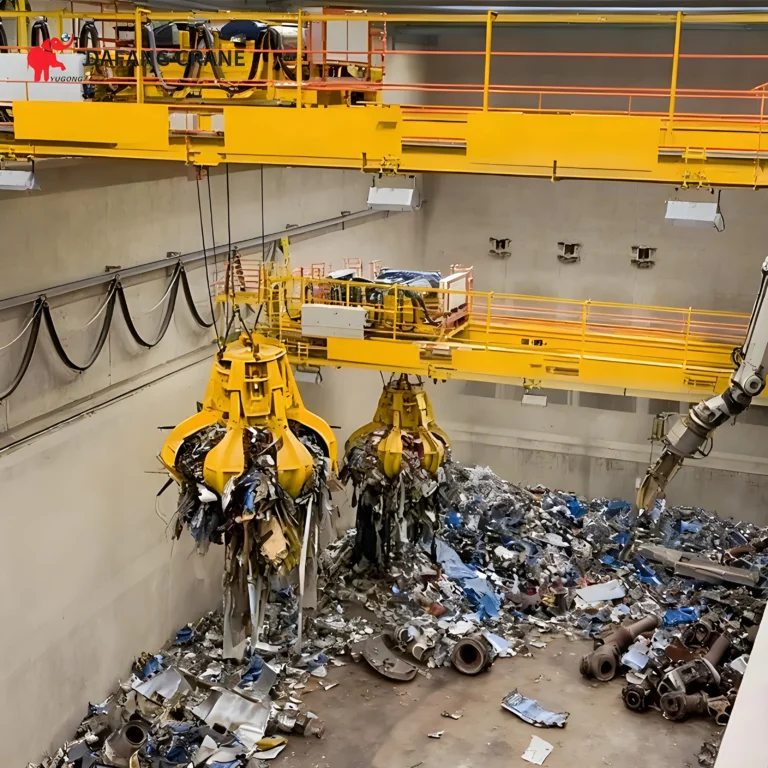
Steel mill scrap yards are the primary application for orange peel grabs globally. Electric arc furnace (EAF) steelmaking uses scrap metal as the primary feedstock — heavy melting scrap, shredded scrap, and pig iron are loaded from scrap bays into charging baskets or directly into the furnace vessel by overhead grab cranes. The interlocked, angular nature of steel scrap requires the multi-jaw radial grip that orange peel designs provide. Grab capacity in steel mill applications typically ranges from 3 to 16 cubic meters, matched to the crane capacity and furnace charging cycle requirements. Duty cycles are intensive — M7 to M8 under ISO 4301 — requiring grabs engineered for continuous heavy-duty operation across multiple shifts.
Recycling Plants
Metal recycling and material recovery facilities use orange peel grabs for sorting, consolidating, and transferring ferrous and non-ferrous scrap. Shredded vehicle bodies, white goods, structural steel offcuts, and mixed metal waste are all materials that benefit from the strong, multi-directional gripping of the orange peel design. In facilities processing mixed waste streams, the ability to grip irregular assemblies without requiring pre-sorting improves operational efficiency significantly.
Portos e Terminais
Port terminals handling scrap metal export cargoes use orange peel grabs on harbor cranes and ship-mounted cranes for vessel loading. Scrap metal — typically compressed bales, loose shredded scrap, or HMS (heavy melting scrap) — is loaded from shore storage into vessel holds. Harbor crane grabs in port applications are sized for high throughput, with grab capacities up to 20 cubic meters and cycle times optimized for vessel turnaround targets.
Indústria mineira
Rock handling in quarrying, open-pit mining, and underground mining uses orange peel grabs where the irregular geometry and high density of the material — blasted rock, ore fragments, waste rock — exceeds the gripping capability of clamshell designs. Grab cranes provide effective vertical access in deep excavations and constrained site geometries where wheeled or tracked machinery cannot operate efficiently.
Waste Management
Waste-to-energy facilities, construction waste processing centers, and municipal solid waste handling operations use orange peel grabs for material reception, handling, and feeding processing equipment. The variable composition of waste material — mixed density, irregular geometry, occasional large items — favors the versatile gripping geometry of the orange peel design over more material-specific grab types.
Advantages of Orange Peel Grabs
- Strong gripping capability. Multi-jaw radial closure generates gripping force from all directions simultaneously, capturing and retaining materials that resist two-jaw approaches. This is the defining performance advantage for scrap metal and irregular bulk material applications.
- Suitable for irregular materials. Scrap metal, demolition debris, and industrial waste are geometrically unpredictable. Orange peel jaws adapt to the local material geometry at the point of contact rather than relying on consistent material surface characteristics.
- High loading efficiency. Large jaw opening diameter and strong closing force allow the grab to capture substantial volumes per cycle in dense scrap applications. High cycle rates — combined with large load per cycle — produce throughput rates that justify the equipment investment at high-volume facilities.
- Reduced manual handling. Grab crane systems replace manual sorting, loading, and transfer operations in environments where worker exposure to heavy, sharp, and unstable material carries significant injury risk. The orange peel grab handles materials that cannot be safely managed by hand.
- Flexible crane compatibility. Hydraulic orange peel grabs operate on overhead cranes, gantry cranes, harbor cranes, and ship cranes. Electro-hydraulic designs extend compatibility to cranes without crane-mounted hydraulic infrastructure.
- Improved workplace safety. Crane-mounted grab handling removes workers from the material handling zone. In scrap yards, recycling facilities, and mining environments, this separation significantly reduces exposure to falling material, pinch point hazards, and unstable pile conditions.
How to Select the Right Orange Peel Grab
Material Type
The material being handled is the primary selection driver. Heavy melting scrap — large, dense, interlocked steel pieces — requires a high-capacity hydraulic orange peel grab with strong closing force and robust jaw geometry. Light industrial scrap, demolition waste, or mixed recycling materials allow lighter configurations with moderate closing force. Rock and mineral materials require wear-resistant jaw materials and cutting edges designed for abrasive contact.
Confirm the bulk density and typical piece size of your material before specifying grab capacity. Dense materials limit the practical grab volume within the crane's safe working load; large irregular pieces determine the minimum jaw opening diameter required to capture them effectively.
Capacidade de agarrar
Grab volumetric capacity is selected based on the crane's lifting capacity, material bulk density, and required throughput. Calculate the maximum material weight the crane can lift — rated capacity minus grab dead weight with a 25% safety margin — then divide by the material bulk density to determine the maximum grab volume. Compare this against the volume per cycle needed to achieve target throughput at the crane's operating cycle frequency.
Hydraulic System Requirements
For hydraulic orange peel grabs, confirm the operating pressure range, hydraulic flow rate, and power supply requirements. The hydraulic power unit must match the grab's cylinder specifications to generate the required closing force at the specified operating speed. Confirm whether the crane's existing hydraulic system can supply the grab, or whether a dedicated power unit is required.
Crane Compatibility
The grab's dead weight, loaded weight, and connection geometry must be compatible with the crane's hook capacity, hoist rope arrangement, and electrical supply capability. For electro-hydraulic grabs, confirm that the crane's electrical supply — voltage, phase, amperage — matches the grab's motor requirements.
Ambiente de trabalho
High-temperature environments near furnaces require heat-resistant seals, hydraulic fluid rated for elevated temperatures, and thermal shielding on sensitive components. Coastal and marine environments require corrosion-resistant coatings and sealed electrical enclosures. Explosive atmosphere locations impose ATEX certification requirements on all electrical components. Define the operating environment completely before specifying grab components.
Conclusion and Next Steps
The orange peel grab is the established solution for bulk material handling applications where material geometry, interlocking, density, or irregularity exceeds the capability of two-jaw clamshell designs. Its multi-jaw radial closure generates gripping force from all directions, capturing and retaining scrap metal, industrial waste, rock, and demolition debris reliably across continuous heavy-duty operating cycles.
Selecting the right orange peel grab requires defining material type and bulk density, calculating grab capacity against crane lifting capacity, matching the hydraulic system to operational requirements, and confirming compatibility with the crane's infrastructure and duty class. Maintenance discipline — daily inspection, scheduled lubrication, hydraulic system monitoring, and proactive wear component replacement — protects the investment and prevents unplanned downtime. Safety compliance, including crane matching, operator training, and personnel exclusion zone management, is non-negotiable in any scrap or industrial waste handling environment.
Ready to specify your orange peel grab solution? Contact our engineering team to discuss your scrap handling, recycling, or bulk material application. We supply customized hydraulic orange peel grabs, electro-hydraulic crane grabs, and complete grab crane systems across the full capacity range — with technical support from initial specification through to commissioning and lifecycle maintenance planning.

Perguntas mais frequentes
Q1: How does an orange peel grab work?
The open grab is lowered to the material pile, with jaws spread to maximum diameter. The operator initiates closing — hydraulic cylinders retract, drawing the jaws inward radially to surround and grip the material. The loaded grab is hoisted to travel height and transported to the discharge position by crane travel. At discharge, cylinders extend to open the jaws, releasing material by gravity. The cycle repeats continuously. Hydraulic orange peel grabs provide independent jaw control at any hoist position; mechanical designs use rope tension from the crane closing line to drive jaw movement.
Q2: What materials can an orange peel grab handle?
Orange peel grabs handle irregular, heavy, and interlocked materials including scrap steel, shredded vehicle bodies, structural steel offcuts, cast iron scrap, industrial waste, demolition debris, blasted rock, mineral ore fragments, and large construction waste. They are less effective for fine, loose, or flowable materials — sand, grain, fine coal — where material passes through jaw gaps rather than being retained. For those materials, clamshell grabs with closely fitting shells are the appropriate choice.
Q3: What is the difference between an orange peel grab and a clamshell grab?
The fundamental difference is gripping geometry. A clamshell grab uses two opposed shells that close from two directions — effective for loose, granular materials that fill the open shell volume. An orange peel grab uses three to six jaws closing radially from all directions simultaneously — effective for irregular, interlocked, and cohesive materials that resist two-jaw penetration. For scrap metal handling, orange peel designs significantly outperform clamshell alternatives. For bulk cargo handling — coal, ore, grain, sand — clamshell designs are more efficient.
Q4: What is a hydraulic orange peel grab?
A hydraulic orange peel grab uses hydraulic cylinders to drive jaw opening and closing, independent of the crane hoist rope system. The hydraulic power unit — mounted on the crane or integrated into the grab body in electro-hydraulic designs — supplies pressurized fluid to the cylinders via hose runs or onboard routing. The operator controls jaw movement through crane cabin controls or radio remote. Hydraulic designs provide higher and more controllable closing force than mechanical alternatives and allow jaw operation at any hoist position — making them the standard for heavy scrap and industrial waste handling applications.
Q5: How much capacity can an orange peel grab handle?
Orange peel grab geometric capacity typically ranges from 0.5 cubic meters for light industrial applications to 20 cubic meters for large port and steel mill cranes. The practical material weight per cycle is limited by the crane's lifting capacity — grab dead weight subtracted from the crane's rated safe working load, with a minimum 25% safety margin, gives the maximum material payload per lift. For heavy scrap steel at approximately 1,000–1,500 kg/m³ bulk density, a 10-cubic-meter grab on a 50-ton crane can typically handle 10 to 15 tons of material per cycle depending on grab dead weight.
Q6: How often should an orange peel grab be maintained?
Daily pre-operation inspection covers jaw condition, hydraulic leakage, hinge pin lubrication, and control function. Formal maintenance including bearing inspection, hydraulic fluid analysis, and structural inspection is typically scheduled at 250 to 500 operating hour intervals depending on duty cycle intensity. Annual third-party structural inspection — including NDT of primary welds — is standard practice in heavy industrial applications. Wear components — jaw liners, cutting edges, hydraulic seals — are replaced on a condition-based schedule rather than fixed time intervals. Document wear rates to plan replacements before they become failures.