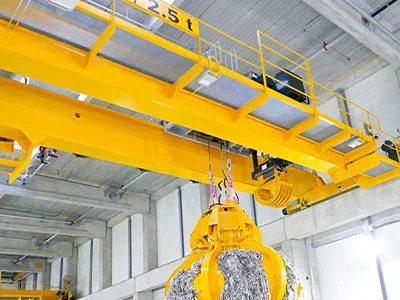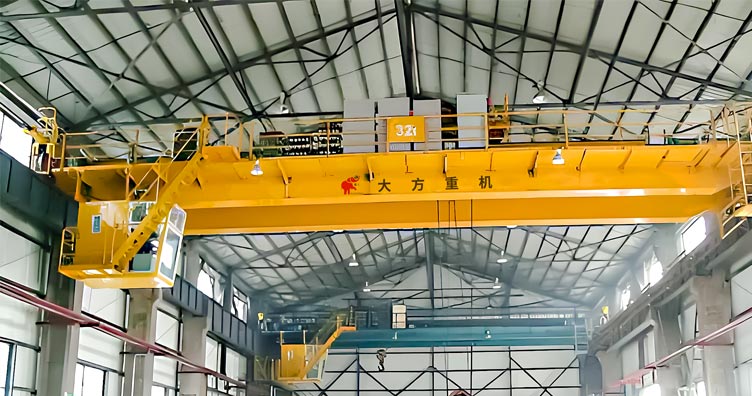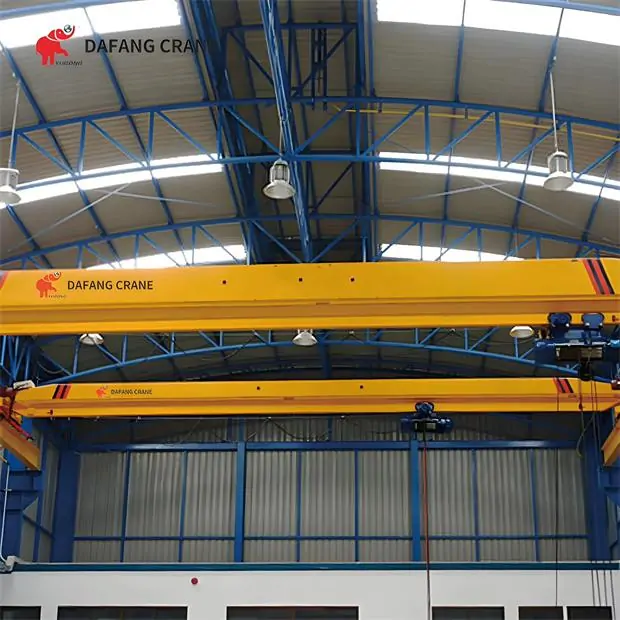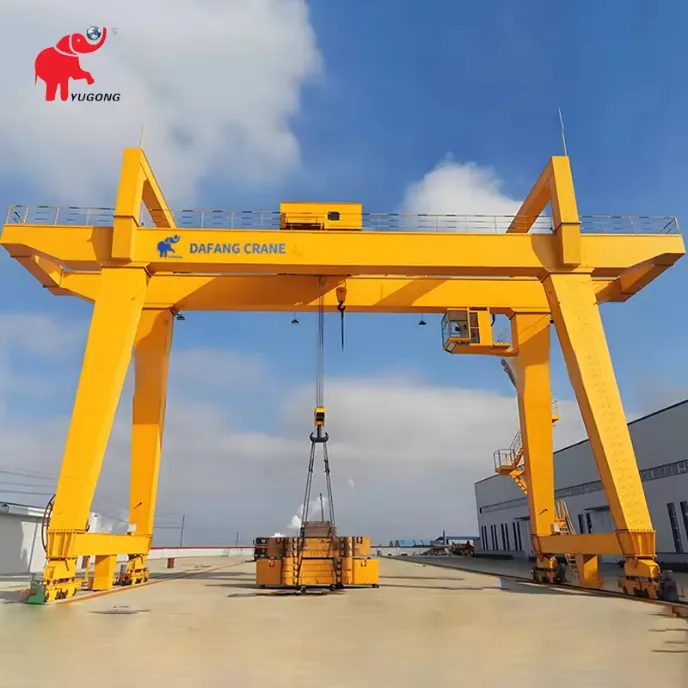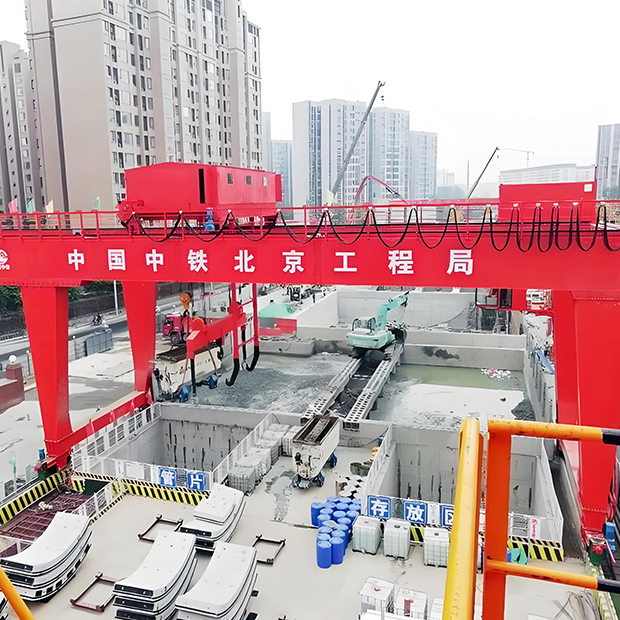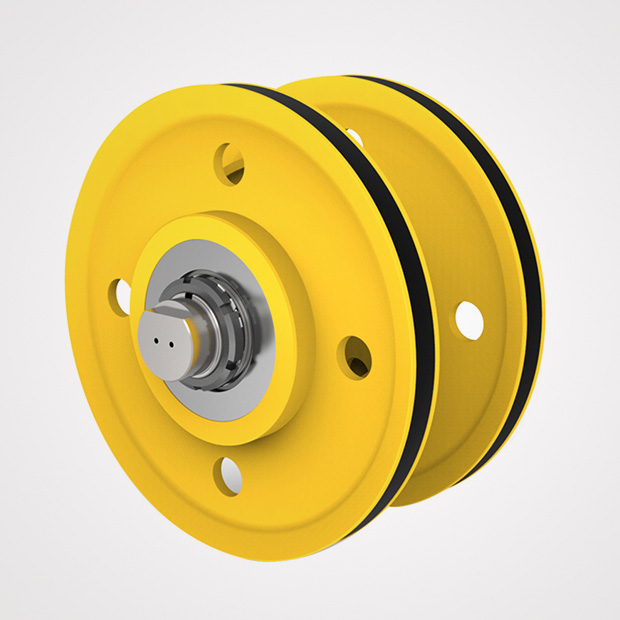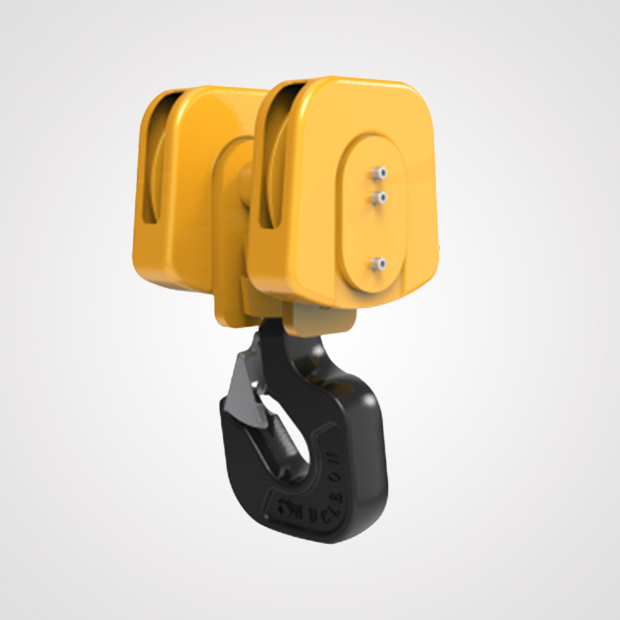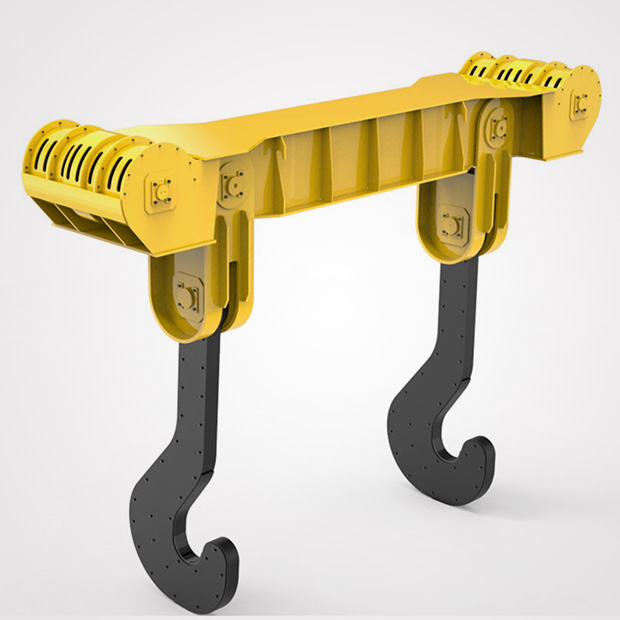







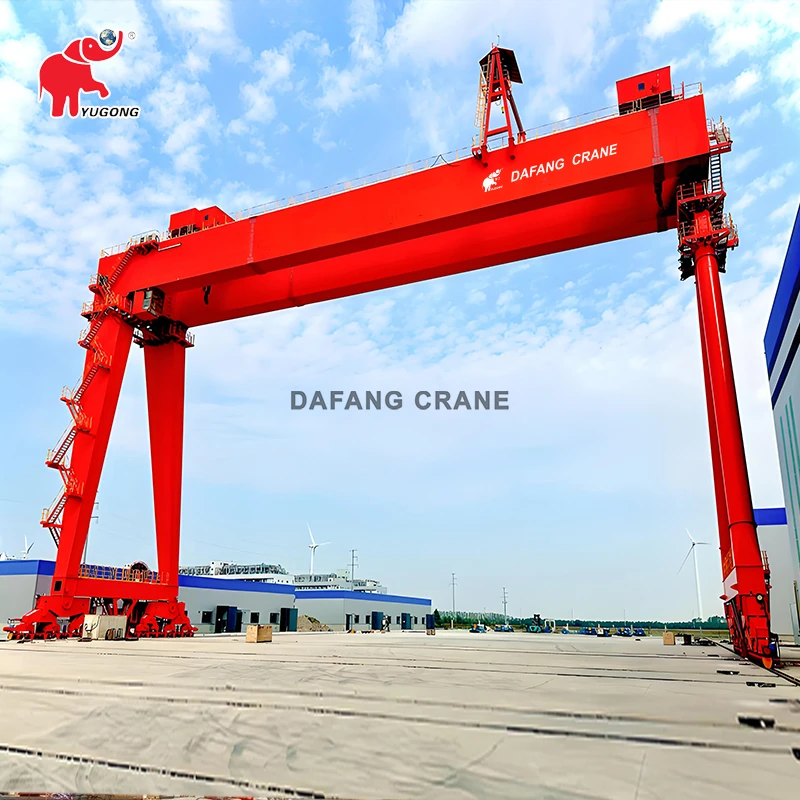
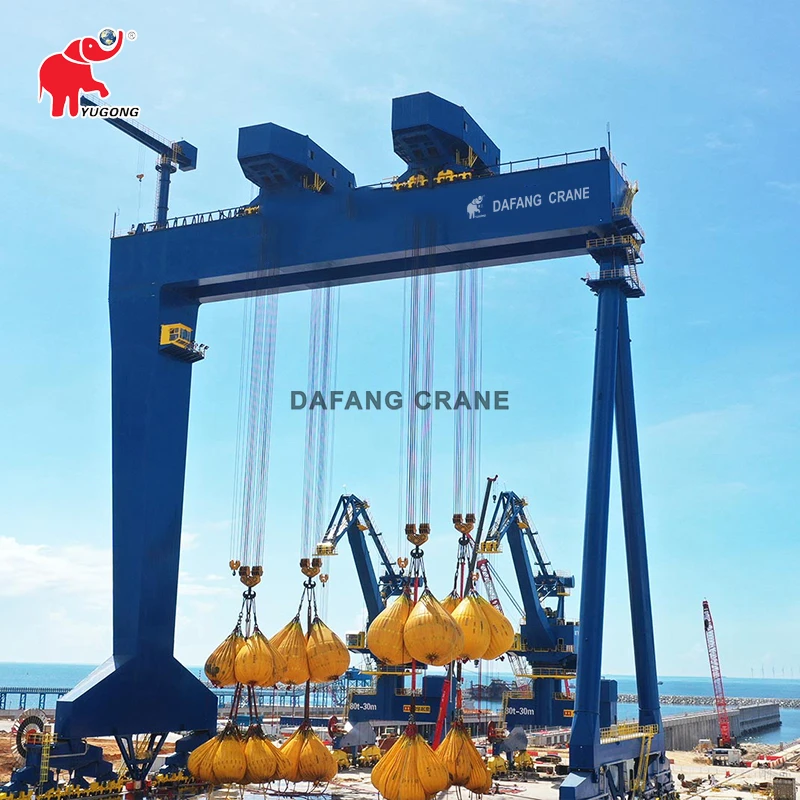
A shipbuilding gantry crane is a rail-mounted portal crane engineered specifically for ship block assembly, hull erection, and drydock operations — and the capacity figures you see in spec sheets are rarely straightforward. Dafang's shipbuilding gantry cranes cover dual-trolley configurations from 2×50+100 t up to 2×400+400 t, with spans from 50 to 185 m and lifting heights from 28 to 76 m, all rated to working grade M7–M8 under ISO 4301.
Most buyers arrive at this product with one question — "what tonnage do I need?" — but that framing misses the real decision. The right question is: what combination of trolley configuration, span, lifting height, and environmental protection class matches your berth geometry, your heaviest block, and your coastal operating conditions?
This guide walks through exactly that: how to read capacity figures correctly, which configuration suits which yard type, what the specs actually mean in operation, and what certifications to verify before signing a contract.
Table of Contents
Quick Configuration Reference
| Yard Type | Typical Configuration | Span | Lifting Height | Duty Class |
|---|---|---|---|---|
| Coastal repair / small commercial | 2×50+100 t or 2×75+100 t | 50–80 m | 28–45 m | M7 |
| Mid-size commercial shipbuilding | 2×100+160 t or 2×150+200 t | 80–130 m | 45–60 m | M8 |
| Large container / tanker / offshore | 2×400+400 t (customized) | 130–185 m | 60–76 m | M8 |
All configurations are customizable. Provide berth span, maximum block weight, and daily operating hours for a site-specific engineering review.
Get Free QuoteHow to Read Shipbuilding Gantry Crane Capacity Figures
The Difference Between Single-Hook Capacity and Dual-Trolley Combined Capacity
A shipbuilding gantry crane's rated capacity is not a single number — it is a configuration. The standard notation "2×150+200 t" means two main-hook trolleys each rated at 150 t, plus one auxiliary hook rated at 200 t: a combined lifting capacity of 500 t when all hooks operate together on one block. Buyers who compare a "500-ton crane" from one supplier with a "200-ton crane" from another may be looking at the same machine described differently.
Dafang's standard configurations run from 2×50+100 t at the entry level to 2×400+400 t for mega-yard applications. The combined figure can reach approximately 1,200 t in that top configuration, and fully customized solutions extend further. The "up to 3,000 t" figure cited in Dafang's product range applies to bespoke engineering projects — not to catalogue units.
Why Trolley Configuration Matters as Much as Rated Tonnage
The choice between a single-trolley and a dual-trolley arrangement is not simply about lifting more weight. It is about how load is distributed across a hull block whose center of gravity shifts during assembly. A single trolley applies load at one point; a dual-trolley spreads the lift across two independently controlled pick points. For blocks with irregular geometry — a stern section with machinery already installed, for example — dual-trolley control prevents induced bending stress that could distort the block before it is welded into place.
The main hook lifting speed on Dafang units runs 0–1 m/min (variable), with the slow-creep mode below 0.1 m/min used for final positioning. The auxiliary hook runs 0–5 m/min for faster repositioning between lifts. That asymmetry is deliberate: the main hook trades speed for precision; the auxiliary hook handles the cycle-time tasks.
Key Technical Specifications and What They Mean in Operation
Span and Lifting Height: The Two Parameters You Must Fix Before Capacity
Span and lifting height are fixed at manufacture and cannot be changed after installation. Getting them wrong costs more than the crane itself. The span must cover the full width of the construction berth plus adequate clearance on both sides for trolley travel and maintenance access; a typical rule of thumb is berth width plus 8–12 m. For Dafang's standard range, this means spans from 50 m for small repair docks to 185 m for the largest building berths.
Lifting height is governed by the deepest point of the drydock plus the height of the tallest structure being lifted plus the sling clearance required above that structure. Dafang's range of 28–76 m above rail covers both shallow coastal repair facilities and deep VLCC-class graving docks. The 10–50 m range cited in the specification table applies to under-hook height measured from the dock floor — a different reference point buyers sometimes confuse with the above-rail figure.
Duty Class M7 vs. M8: What the Classification Actually Requires
ISO 4301 classifies cranes by two parameters: total number of load cycles over the design life, and the proportion of those cycles carried out at or near full rated load (the load spectrum factor). M7 applies to heavy utilisation with a moderate spectrum; M8 applies to very heavy utilisation — over 50% of operating time at or near full load. The classification determines the structural steel section sizes, wire rope minimum breaking load margins, drum and sheave diameter ratios, and brake sizing.
A crane specified at M5 (a common general-industry grade) and operated under shipyard conditions will reach its fatigue limit years ahead of schedule. Structural cracks in box-girder main beams under heavy-cycle shock loading are not a theoretical risk; they are the reason shipyard cranes carry M7–M8 classification as a baseline, not an upgrade.
Coastal Environmental Protection: IP Rating and Anti-Corrosion System
Shipyard environments combine salt spray, condensation, and mechanical abrasion in a way that degrades standard industrial electrical equipment within two to three seasons. Dafang's standard specification for shipbuilding cranes includes IP54 electrical enclosures (IEC 60529) — dust-protected and splash-resistant — with IP55 or IP65 available for particularly exposed installations.
The structural anti-corrosion system is rated to ISO 12944-6 corrosivity category C5-M, the marine environment category. In practice, this means hot-dip galvanised fasteners, a multi-layer epoxy primer and intermediate coat system, and a topcoat rated for continuous salt-atmosphere exposure. Specifying a lower corrosion category (C3 or C4, which are common for inland industrial cranes) on a coastal shipyard installation typically doubles maintenance painting frequency and reduces structural service life.
Matching Configuration to Your Yard Type
Coastal Repair Yards and Small Commercial Shipbuilding
Repair yards and small commercial builders lifting blocks up to approximately 150 t with berths in the 50–80 m span range are best served by the 2×50+100 t or 2×75+100 t configurations. At this scale, a single main trolley with an auxiliary hook covers most repair tasks — engine removals, propeller shaft lifts, and partial hull block replacements — without the additional complexity and foundation loading of a full dual-trolley arrangement.
The M7 duty class is appropriate here provided the yard operates on a single-shift basis with rest periods between heavy lifts. Yards running double shifts or targeting block production rather than repair work should step up to M8 regardless of capacity.
Mid-Size Commercial Shipbuilding: Bulk Carriers and General Cargo
For yards building bulk carriers, general cargo vessels, or medium tankers in the 20,000–80,000 DWT range, the 2×100+160 t and 2×150+200 t configurations cover the majority of block weights encountered during hull erection. Spans in the 80–130 m range accommodate typical building berths at this scale.
At this tier, the PLC tandem synchronisation capability becomes practically important. When two cranes operate together on a single block — a common requirement for hull sections exceeding 200 t — the master-slave control system maintains synchronisation within ±5 mm. Without active synchronisation, differential hoisting speed between two independently operated cranes can introduce torsional loads into the block structure, particularly problematic for thin-plate sections.
Large Shipyards: Container Ships, Tankers, and Offshore Fabrication
The 2×400+400 t configuration and fully customised solutions beyond that serve yards building container vessels above 10,000 TEU, VLCC tankers, LNG carriers, and offshore FPSO topsides modules. At this scale, spans reach 130–185 m, lifting heights approach 76 m, and the M8 duty class is non-negotiable.
Offshore fabrication yards operating 24/7 production schedules present the most demanding duty cycle. Dafang configures these units with dual independent braking per FEM 1.001 and load monitoring systems that log every lift event — a requirement for defence and offshore contractor compliance audits. The storm-lock braking system, rated to 55 m/s per GB/T 3811, is standard on all coastal installations; anemometers trigger automatic operational slow-down at 20 m/s and full stop at 28 m/s during active lifting.
Ready to specify your crane? Provide your berth span, maximum block weight, drydock depth, and daily shift hours — Dafang's engineering team will return a site-specific configuration proposal.

Certification and Compliance Checklist for Buyers
What Certifications to Require
For most export markets and international shipyard projects, buyers should verify the following before accepting a quotation:
CE Declaration of Conformity under Machinery Directive 2006/42/EC covers the essential health and safety requirements for crane design and manufacture. ISO 9001:2015 certification confirms the quality management system under which the crane is built — request the certificate number and verify it against the issuing body's registry. ISO 4301 working grade classification (M7 or M8 as specified) should appear in the structural calculation report, not only on the nameplate. ISO 3834-2 welding quality certification confirms that fusion welding of structural members meets comprehensive quality requirements — weld records traceable to each joint are part of this standard.
For marine corrosion protection, ask for the ISO 12944-6 corrosivity category specified in the paint system datasheet, and confirm it matches the C5-M marine category rather than a lower inland rating.
Why This Matters for Clearing Customs and Insurance
CE marking is a legal requirement for cranes placed on the European market and is increasingly required by port authorities and insurance underwriters in other regions as a proxy for design compliance. An ISO 9001 certificate from an accredited certifier (not a self-declaration) supports cargo insurance claims and third-party inspection sign-off. Load test certificates — typically a 125% proof load test witnessed by a third-party inspector — are required by most port authority operating licenses before a crane enters service.
How to Verify Before Shipment
Request the full documentation package at contract stage, not at delivery: EC Declaration of Conformity, proof load test report with inspector's stamp, ISO 9001 certificate with validity dates, weld records per ISO 3834-2, and the O&M manual in the contract language. Dafang ships all of these as standard with each unit.
Contact Dafang for a Site-Specific Engineering Proposal
Dafang has supplied shipbuilding gantry cranes to commercial shipyards, offshore fabrication yards, and naval facilities in more than 30 countries since 2006. Engineering design, structural fabrication, electrical assembly, and site commissioning all operate from the integrated 850,000 m² Henan production base.
Full-scope project delivery covers civil foundation design, rail engineering, crane manufacture, sea freight, site installation, proof load testing, and operator training under a single contract.
FAQ
Q1:What is the actual lifting capacity of a shipbuilding gantry crane — is it a single number?
No — shipbuilding crane capacity is expressed as a configuration. The notation "2×150+200 t" means two main trolleys at 150 t each plus a 200 t auxiliary hook, for a combined capacity of 500 t. Always clarify whether a supplier's quoted tonnage refers to a single hook, a single trolley, or the full dual-trolley combined figure before comparing quotations.
Q2:What is the difference between M7 and M8 duty class, and which do I need?
ISO 4301 M7 suits heavy-utilisation yards operating one shift with moderate load cycles; M8 applies to yards running two or more shifts, or where the crane is under near-full load for more than half its operating time. For active shipbuilding (block erection, hull closing), M8 is the correct specification. M7 is acceptable for light repair-yard use.
Q3:Can one shipbuilding gantry crane handle both block pre-assembly and hull erection?
Yes, if configured with a dual-trolley system and sufficient capacity. A dual-trolley arrangement allows a single crane to balance a long or irregularly shaped block across two independent pick points, handling both pre-assembly staging and final hull erection without a separate crane for each task. The required capacity depends on the heaviest block in your production schedule, plus a 20–30% safety margin.
Q4:What certifications should I require from a shipbuilding gantry crane supplier?
At minimum: CE Declaration of Conformity (Machinery Directive 2006/42/EC), ISO 9001:2015 quality management certificate, ISO 4301 working grade documentation in the structural calculation report, ISO 3834-2 welding records, and a 125% proof load test certificate from a third-party inspector. For marine environments, also confirm ISO 12944-6 C5-M corrosion category in the paint system specification.
Q5:How much does a shipbuilding gantry crane cost, and what drives the price?
Publicly available pricing benchmarks for heavy shipbuilding cranes are limited, and costs vary significantly by configuration. The primary price drivers are: total combined lifting capacity, span and lifting height (which determine the volume of structural steel), trolley configuration (single vs. dual vs. main+aux hook), electrical components brand tier (Siemens/ABB vs. domestic alternatives), corrosion protection specification, and the scope of project delivery services included. For a credible budget figure, submit your berth dimensions, required capacity configuration, and working shift schedule to Dafang's engineering team for a site-specific proposal.