
Which overhead crane standards apply depends on where the crane will be installed, not where it is built. For the EU that means CE marking with EN 15011 as the design reference; for Russia and other Eurasian Economic Union markets, EAC conformity; for the United States, OSHA and ASME B30.2 on site, with CMAA specifications as the design benchmark. FEM and ISO 4301 sit underneath all of them as duty-class systems.
Buyers get stuck because these names are used as if they were interchangeable. A supplier writes "CE, FEM, ISO" on a quotation, and it is unclear whether that means a legal declaration, a design basis or just a duty class. The difference decides whether the crane clears customs, satisfies an insurer and passes a mill audit.
This guide separates the standards into three layers, maps them to the markets that ask for them, and lists the documents to request from any overhead crane supplier before you pay a deposit.
Quick comparison: which standard does what
| Standard or scheme | Type | Main market | What it covers | Ask the supplier for |
|---|---|---|---|---|
| CE marking (Directive 2006/42/EC; Regulation (EU) 2023/1230 from 20 Jan 2027) | Legal market access | EU / EEA | Conformity with machinery safety requirements | EC Declaration of Conformity |
| EN 15011 | Design and safety standard | EU, used with CE | Bridge and gantry cranes | Edition used (e.g. EN 15011:2020) |
| FEM / ISO 4301 | Duty classification | International | Class by load spectrum and operating time | Written duty class plus the operating profile behind it |
| CMAA 70 / 74 | Design specification | North America | 70: top-running multiple-girder bridge and gantry cranes; 74: single-girder cranes with under-running trolley hoist | Stated CMAA service class |
| OSHA 29 CFR 1910.179 / ASME B30.2 | Rules for cranes in service | United States | Overhead and gantry cranes in use | Project engineer's acceptance criteria |
| EAC (TR CU 010/2011) | Legal market access | Russia, Belarus, Armenia, Kazakhstan | Machinery safety conformity | EAC certificate or declaration |
Confirm current editions with your standards body or compliance adviser before you finalise a specification.
Not sure which rows apply to your project? Send your destination country, span and duty profile to our engineers and we will point you to the right documents.
Get Free QuoteOverhead Crane Standards Explained: Three Layers, Three Jobs

Market-access schemes: CE and EAC
CE and EAC decide whether a crane may legally be sold in a market; they do not tell you how well it is built. With CE, the manufacturer declares conformity with the EU machinery rules and issues a written declaration. EAC works in a similar spirit in the Eurasian Economic Union: conformity is attested either as a certificate or as a declaration under technical regulations such as TR CU 010/2011 on machinery safety. Depending on the product, regulations on low-voltage equipment and electromagnetic compatibility may also come into play, so ask your certification body which ones apply.
Design standards: EN 15011 and CMAA 70/74
EN 15011 is a design standard; CE marking is the legal route to the EU market. The 2020 edition covers bridge and gantry cranes that travel on rails, runways or roadway surfaces, and it supersedes EN 15011:2011+A1:2014. It is described as a harmonised standard supporting the Machinery Directive, and it excludes light crane systems, cranes for lifting persons and the specific hazards of explosive atmospheres. In North America the counterparts are CMAA 70, for top-running multiple-girder bridge and gantry cranes, and CMAA 74, for single-girder cranes with an under-running trolley hoist.
Duty classification: FEM, ISO 4301 and CMAA classes
FEM, ISO 4301 and CMAA classes describe how hard a crane will work, not how well it is made. CMAA runs from Class A (standby service) to Class F (continuous severe service). FEM groups run from 1Dm/1Cm up to 5m and are derived from load spectrum and operating time, while ISO 4301 expresses the same idea as classes A1 to A8. There is no official one-to-one conversion: distributor comparison tables we reviewed disagree, and one publishes two tables that map the same CMAA class to different FEM groups.
In practice, give the supplier your operating profile (lifts per hour, average load as a percentage of rated capacity, operating hours per year) and ask them to state the class under the standard your specification names. Our overhead crane for steel mill guide shows how that check works in a high-duty bay.
Which Overhead Crane Standards Your Target Market Requires
European Union and EEA: CE, EN 15011 and the 2027 change
For the EU, expect CE marking with EN 15011 as the design reference, plus a change in the underlying law in January 2027. Regulation (EU) 2023/1230 replaces Directive 2006/42/EC and, according to EU-OSHA, applies from 20 January 2027, with some provisions, such as those on notified bodies, applying earlier. If your crane will be placed on the market around that date, ask the supplier in writing which legal instrument the declaration cites and which edition of EN 15011 was used. Transition arrangements are a question for the supplier and your compliance adviser.
Eurasian Economic Union: EAC conformity
Cranes sold into Russia, Belarus, Armenia or Kazakhstan need EAC conformity, issued as a certificate or a declaration. Which form applies depends on the product and the applicable regulation lists, so confirm it with a certification body at quotation stage. Leaving it to the end of the project is a common mistake, because the paperwork has to exist before the crane can be placed on the market.
United States: OSHA, ASME B30.2 and CMAA
US sites are governed by OSHA and ASME B30.2 in use, with CMAA specifications as the usual design benchmark. OSHA's 29 CFR 1910.179 deals with overhead and gantry cranes, and ASME B30.2 covers the same crane family. Whether a crane designed to FEM or EN 15011 meets a particular US project specification is a decision for the project engineer and the inspecting authority; do not assume equivalence from a duty-class table. If the specification calls for a CMAA service class, put it in the RFQ in those exact words.
Other regions. Tenders elsewhere may name CE, ISO 9001 or FEM-based design. Copy the exact wording from your own specification into the RFQ instead of paraphrasing it.
Get a tailored quote from our engineers. Tell us your destination, capacity, span and duty profile through the inquiry form or on WhatsApp at +86 13603732637.
Get Free QuoteCertification and Compliance: What to Ask Before You Buy
Why compliance papers matter beyond the paperwork
Missing compliance papers can hold a crane at customs, complicate insurance and fail a site audit. Customs authorities in many markets ask for a conformity declaration before release, insurers and inspectors ask for test and conformity records when they review lifting equipment, and group-level mill audits request the same documents. The real cost of a gap is rarely the paperwork itself; it is a finished crane waiting in a yard while a certificate is reissued.
Documents to request, and the red flags to watch for
Ask in writing for the documents that match your market before you pay a deposit. A typical request list:
- EC Declaration of Conformity for the EU, naming the legal instrument and the standards used
- EAC certificate or declaration for EAEU markets
- Overload test report for the actual crane, with a factory acceptance test written into the contract
- ISO 9001 certificate for the supplier, including the issuing body
- A written duty-class statement based on your operating profile
- Explosion-protection documents for any crane used in a classified area
Red flags
- A standard cited without a number or edition
- "CE" claimed without a signed declaration
- A duty class quoted without asking for your operating profile
- One certificate presented as covering every model in the catalogue
Certification scope is one factor in the crane price
Certification scope is one factor that shapes the quote, alongside capacity, span, duty class and control package. A crane documented for the EU or EAEU needs more engineering and paperwork than one supplied against a basic domestic specification, so state your destination in the first RFQ and ask each supplier to list the documents included. Only compare quotes when that documentation scope matches. Dafang quotes per project, because two cranes with the same tonnage can differ widely once duty class, controls and compliance scope are added.
Where Dafang Models Fit in the Standards Conversation
Dafang's product pages give duty classes for four double-girder models and a design reference for one. The certificates and declarations that apply to a given order are confirmed per project and should be listed in the quotation.
QDXX: the European-type model
QDXX is Dafang's European-type double-girder crane, and its product page states it is designed to European FEM standards. It lists 3–100 t capacity, 4.5–31.5 m span and A5–A8 work duty, with a −20 °C to 40 °C operating range, and its FAQ describes a load test at 1.25 times rated load before handover. For a comparison with the general-purpose QD, see our double girder overhead crane buyer's guide.
QD and LH/NLH: general-service and lighter-duty options
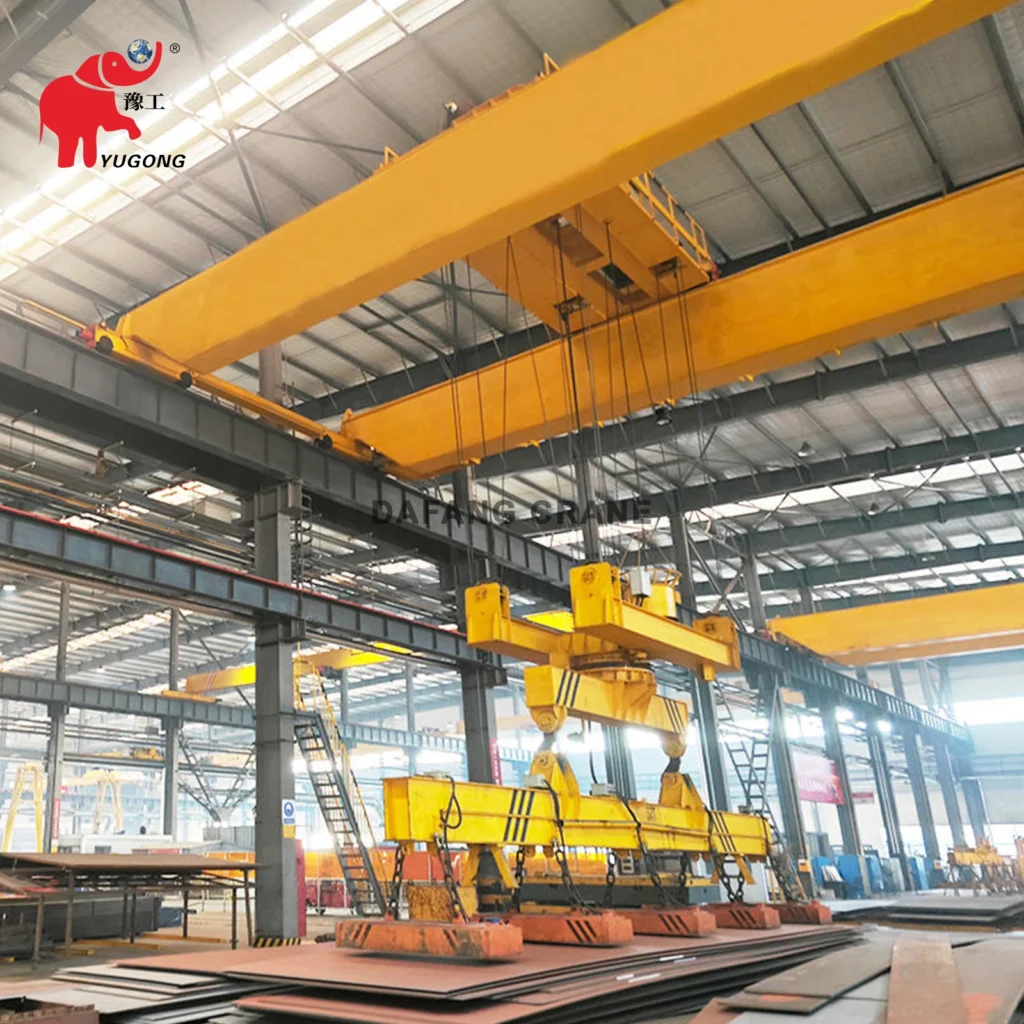
QD (A5–A6) and LH/NLH (A3–A4) suit general and lighter duty, so state the duty class you need in the RFQ. The QD double girder crane covers 5–450 t with 10.5–31.5 m spans and ground, remote or cabin control. The LH/NLH electric hoist double girder crane covers 5–32 t with 6–12 m lifting height and an option of a European-type hoist trolley. Its A3–A4 class is not meant for continuous high-cycle work.
QB: explosion protection is a separate compliance track
QB explosion-proof cranes need explosion-protection documents on top of the standards above. EN 15011 excludes the specific hazards of explosive atmospheres, so a CE declaration to that standard alone does not cover them. Dafang's QB page describes 5–100 t, A4 duty, gas groups up to IIB or IIC and temperature groups T1–T4. Ask which explosion-protection regime applies at your site (ATEX in the EU, for example) and request the matching documents.
Specifying overhead crane standards for a new project? Send your destination country, capacity, span and duty profile, and our engineers will list the documents and configuration that fit.
Contact Stella, Account Manager, Henan Dafang Heavy Machine Co., Ltd Phone: 86 0373 2157333 | WhatsApp: +86 13603732637

Final equipment selection should be confirmed with a Dafang engineer and must comply with local lifting-equipment regulations.
FAQ
Q1:What standards apply to overhead cranes?
Standards follow the destination market: CE and EN 15011 for the EU, EAC for the EAEU, OSHA for US sites. In North America, CMAA 70 and 74 are the usual design benchmarks, and FEM or ISO 4301 classify duty. Check your own tender specification for the exact standards and editions it names.
Q2:Is EN 15011 the same as CE marking?
No. EN 15011 is a design standard; CE marking is the legal route to the EU market. EN 15011:2020 supports conformity with the machinery rules, but CE also requires the manufacturer's declaration of conformity and supporting documentation. Ask the supplier for the declaration and the edition of the standard used.
Q3:Are FEM, ISO 4301 and CMAA classes equivalent?
Not exactly; no official one-to-one table exists, and published comparison tables differ. All three classify how hard a crane works, using load spectrum, operating time or lift frequency. Give your supplier the operating profile and ask for the class under the standard named in your specification.
Q4:Do I need EAC to ship an overhead crane to Russia?
Generally yes; industrial machinery in EAEU markets needs EAC conformity as a certificate or declaration. The form depends on the product and the applicable regulation lists. Confirm it with a certification body at quotation stage, because the documents have to exist before the crane can be placed on the market.
Q5:Does certification affect the price of an overhead crane?
Yes, certification scope is one factor in the quote, alongside capacity, span and duty class. A crane documented for the EU or EAEU needs more engineering and paperwork than a basic domestic one. State your destination in the first RFQ and compare quotes only when the documentation scope matches.