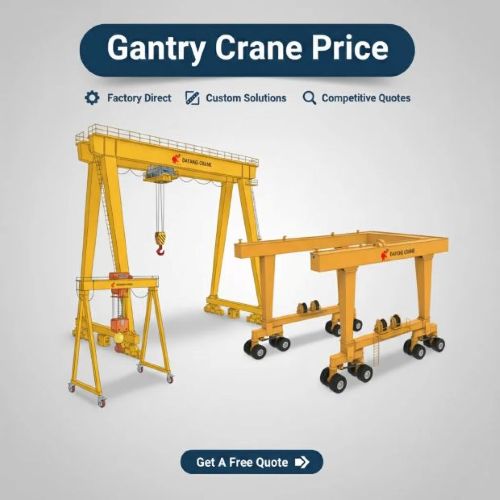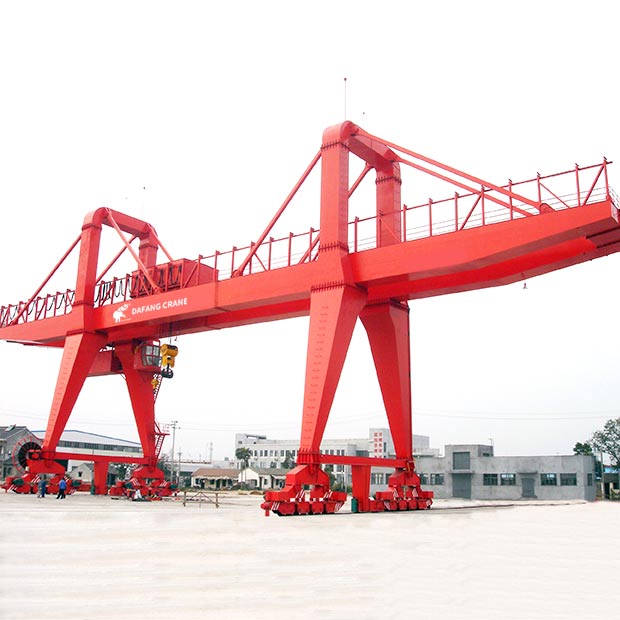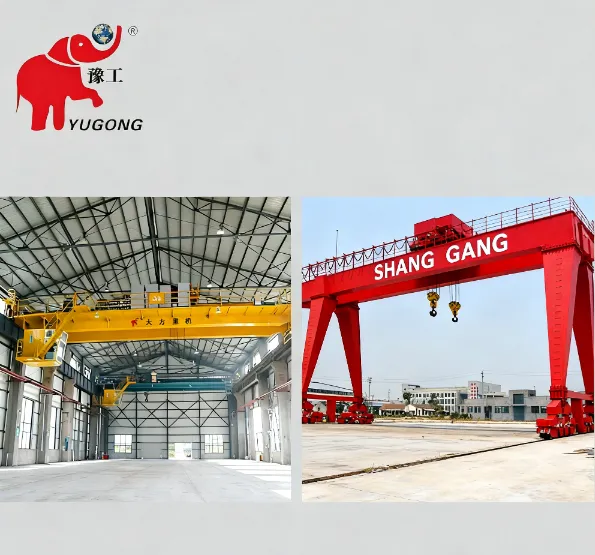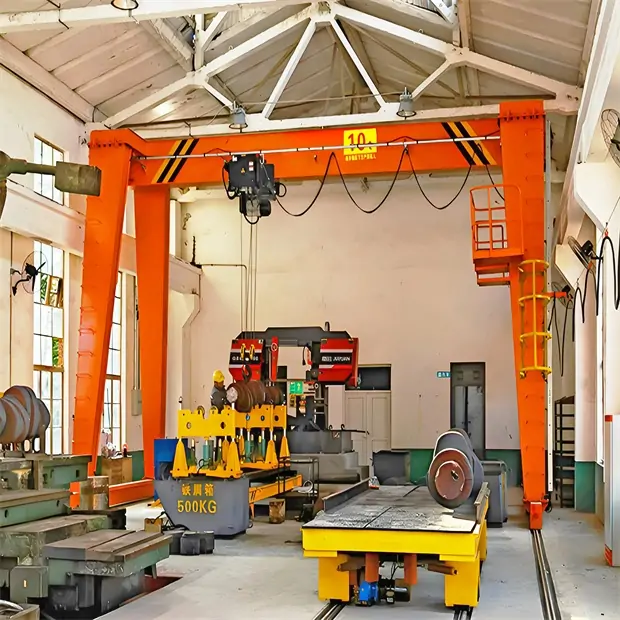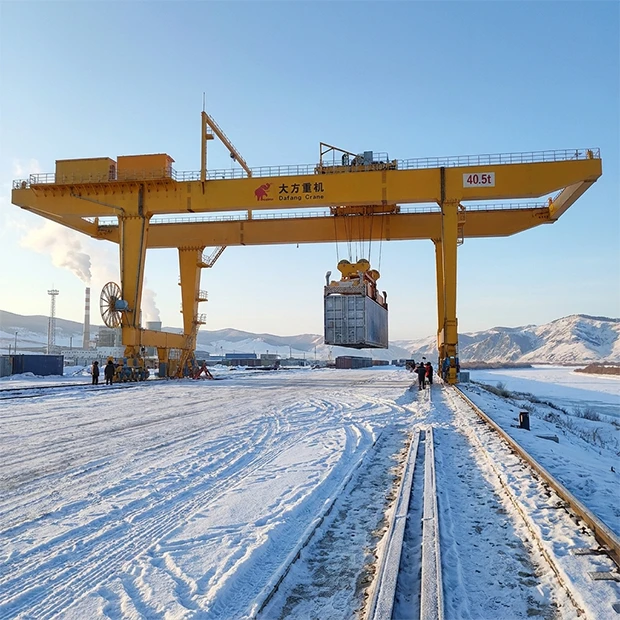







A gantry crane is a type of crane built on a freestanding frame — supported by two or more legs that travel on rails or wheels — that carries a hoist and trolley along an elevated bridge girder. Unlike overhead cranes, which depend on a building's structural framework for runway support, gantry cranes are self-supporting and can be installed indoors or outdoors without dedicated runway beams built into the facility structure.
Gantry cranes are used for lifting, moving, and positioning heavy loads across manufacturing facilities, warehouses, shipyards, ports, construction sites, and steel plants. They are among the most versatile lifting systems in industrial operations, serving applications from small workshop assemblies handled by portable gantry cranes to container handling at major port terminals managed by rubber-tyred or rail-mounted gantry crane systems rated at hundreds of tons.
This guide covers everything engineers, plant managers, procurement teams, and industrial buyers need to know about gantry cranes — including how they work, what they are used for, the main types available, safety requirements, inspection procedures, maintenance practices, and how to evaluate manufacturers.
What Is a Gantry Crane?
Defining a Gantry Crane
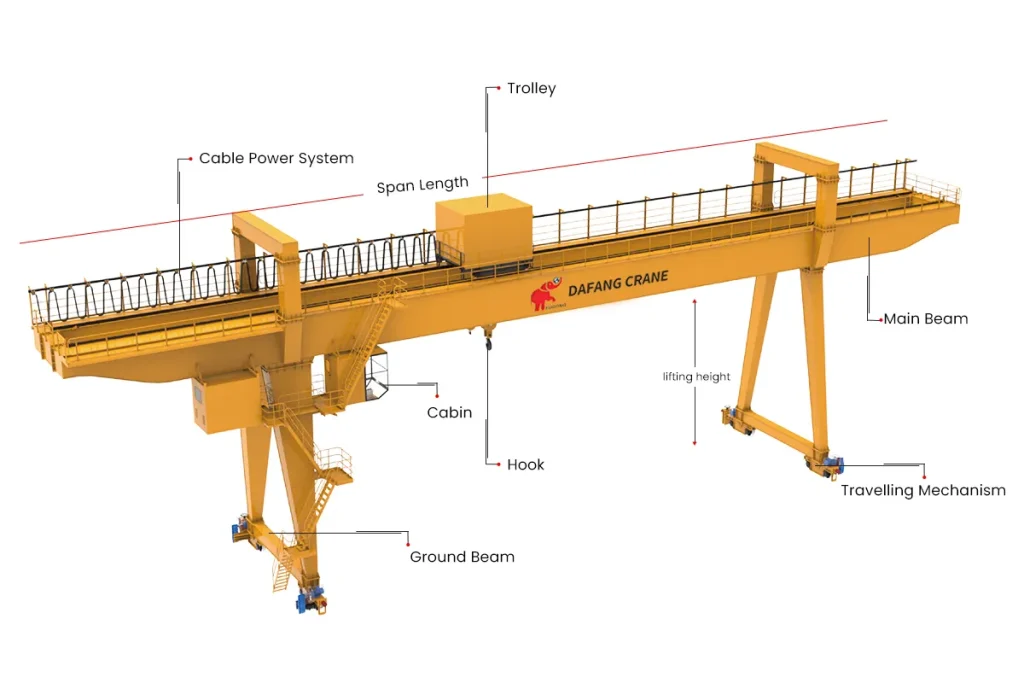
A gantry crane is a crane whose bridge girder is supported at each end by a structural leg assembly, with each leg traveling along a ground-level rail track or on rubber-tyred bogies. The bridge spans the working area between the legs, and a hoist trolley traverses the bridge to provide horizontal load positioning across the full span. The combination of bridge travel (longitudinal) and trolley travel (lateral) gives the crane two horizontal axes of movement, while the hoist provides the vertical lifting axis.
Gantry cranes are available in capacities from under 1 ton for portable workshop models to over 1,000 tons for heavy industrial shipyard and port applications. They operate in temperature extremes from arctic installations to steel plant environments, in saltwater coastal conditions, and in dust-laden processing facilities.

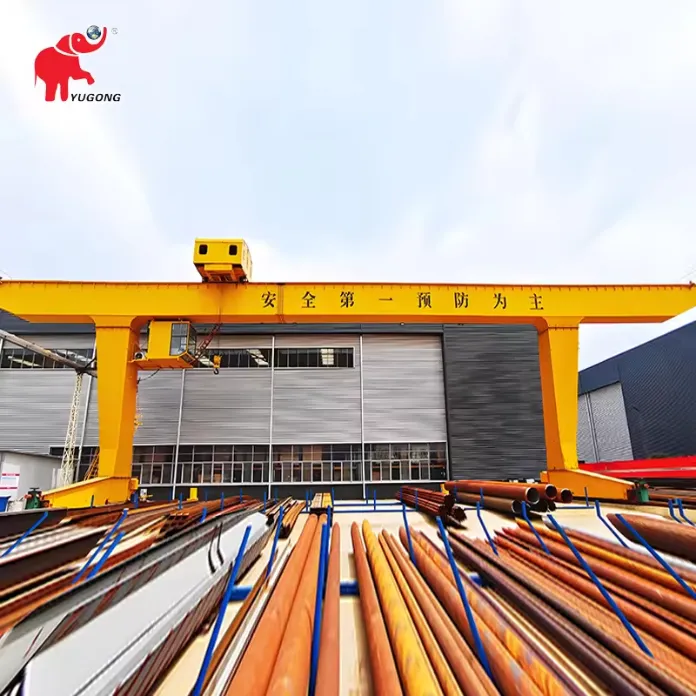
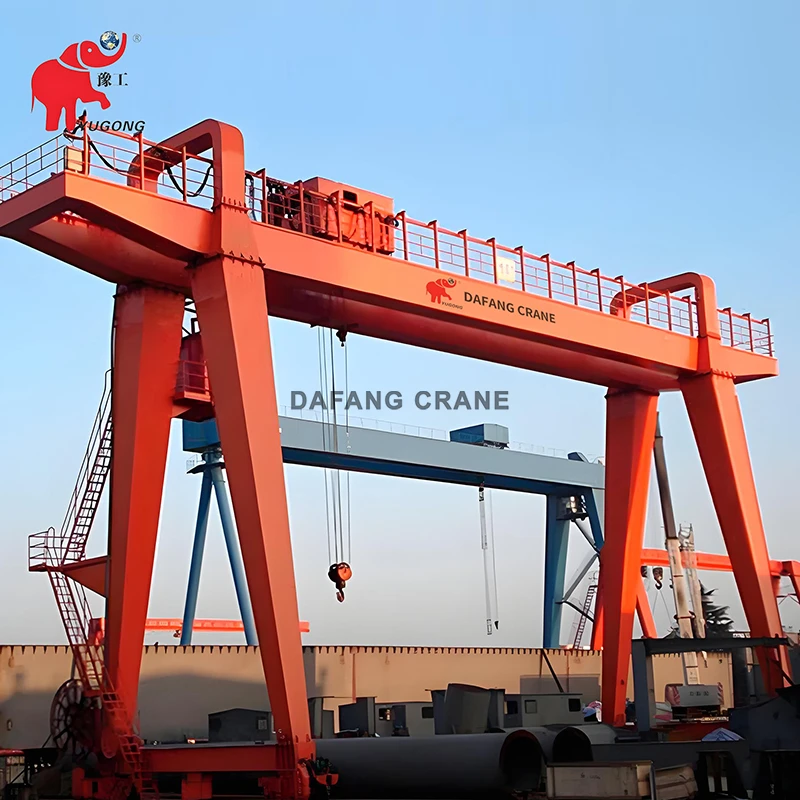

How Does a Gantry Crane Work?
A gantry crane lifts and moves loads through the coordinated operation of several interconnected systems.
Hoist System
The hoist is the component that performs the vertical lifting. An electric motor drives a gearbox that rotates a rope drum, winding or unwinding wire rope (or lifting chain in lighter configurations) to raise or lower the hook block. The hoist is rated at the crane's lifting capacity and must be selected for the duty class appropriate to the operating frequency of the application.
Trolley Movement
The hoist is mounted on a trolley that travels horizontally along rails on the top or bottom flange of the bridge girder, depending on whether the configuration is a top-running or underhung design. The trolley provides the lateral (cross-travel) axis of movement, allowing the operator to position the hook across the full width of the crane's span.
Bridge Girder
The bridge girder spans between the two gantry legs. In single girder configurations, one main beam carries the trolley. In double girder configurations, two parallel main beams provide greater structural rigidity, support heavier loads, and enable higher hook heights relative to the top of the crane structure.
Gantry Legs
The legs transfer all structural loads — the crane's self-weight plus the lifted load — to the travel wheels or bogies at the base. Leg geometry varies: full gantry configurations have two legs, one at each end of the bridge. Semi-gantry configurations have one leg on the ground rail and one end of the bridge supported on an elevated runway beam.
Travel Mechanism
The gantry travels longitudinally along the rail or surface by drive motors mounted on the end trucks at the base of each leg. Drive systems may use a single motor driving both rails through a mechanical coupling, or independent motors on each end truck with electronic synchronization to prevent skewing.
Control System
The operator controls bridge travel, trolley travel, and hoist motions through a pendant control station, radio remote control, or a cab mounted on the crane structure. Modern gantry crane control systems use variable frequency drives (VFDs) on all motions for smooth acceleration and deceleration, precise speed control, and energy efficiency. Safety interlocks, limit switches, overload protection, and emergency stop systems are integrated into the control architecture.
Operating sequence for a typical lift: The operator positions the trolley over the load using cross-travel. The hoist lowers the hook to the load. Rigging is attached. The hoist raises the load to the required travel height. The operator travels the bridge longitudinally and/or moves the trolley laterally to the destination position. The hoist lowers the load to the target location. Rigging is detached.

What Is a Gantry Crane Used For?
Gantry cranes are deployed across a broad range of industrial sectors and applications. Their structural independence, available in configurations for both indoor and outdoor use, and the wide capacity range available make them applicable wherever loads need to be lifted and moved in a defined working area.
Manufacturing Facilities
In production environments, gantry cranes handle heavy machinery during installation and relocation, support assembly operations on large fabricated components, service production line equipment, and move dies, molds, and tooling between storage and production areas. Double girder industrial gantry cranes are common in heavy equipment manufacturing, turbine assembly, and large fabrication operations.
Warehouses and Logistics Centers
Logistics facilities use gantry cranes for heavy cargo movement, loading and unloading trucks or rail cars, managing oversized items that exceed forklift capacity, and supporting pallet handling operations in areas where floor-level equipment cannot access. Semi-gantry configurations are effective in warehouses where one wall can serve as the runway for one side of the crane.
Construction Projects
Precast concrete element installation — bridge beams, tunnel segments, wall panels, and structural frames — relies on gantry cranes to lift and position heavy components with precision. Steel structure installation, particularly at locations where mobile cranes cannot be positioned, uses gantry cranes running on temporary rail systems along the construction corridor.
Ports and Container Terminals
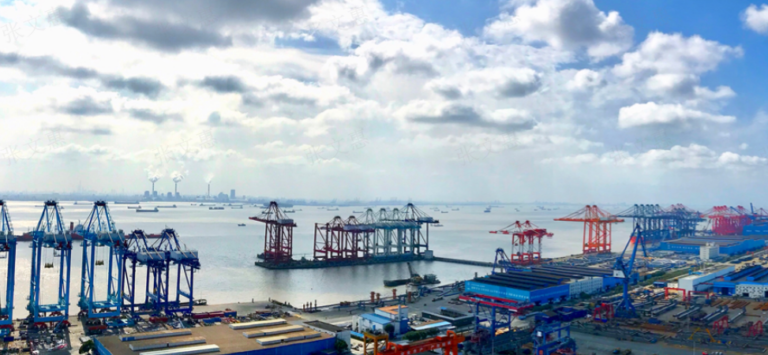
Container handling at marine and inland terminals uses rubber-tyred gantry (RTG) cranes and rail-mounted gantry (RMG) cranes to stack containers in the yard, interface with truck chassis, and transfer containers to and from rail. These specialized port gantry cranes handle capacities from 35 to 65 tons per container lift and operate in high-duty-cycle continuous terminal operations.
Shipyards
Shipyard gantry cranes handle ship blocks during hull assembly — lifting and positioning prefabricated sections of hundreds to thousands of tons during vessel construction. Maintenance gantry cranes service propulsion systems, rudders, and underwater equipment during dry-docking. The combination of outdoor exposure, high capacity, and long spans makes the shipyard gantry crane one of the most demanding applications in the category.
Steel Plants
Steel production facilities use gantry cranes in outdoor stockyards for coil and slab storage management, in service areas for heavy equipment maintenance, and in materials handling operations between production stages. Outdoor steel plant gantry cranes operate in high-temperature, dusty environments that require specific structural protection and component specifications.
Main Types of Gantry Cranes
Single Girder Gantry Crane
A single girder gantry crane uses one main bridge beam, with the hoist trolley running on the lower flange of the beam in an underhung configuration. Single girder designs are lighter in self-weight, impose lower loads on the rail foundation, and are lower in cost than double girder alternatives at the same capacity.
Typical capacity range is 1 to 20 tons, with spans up to approximately 30 meters. They are well-suited to light to medium industrial applications — workshop fabrication, parts storage, maintenance bays, and logistics operations — where the load requirements fall within this range.
Get Free Quote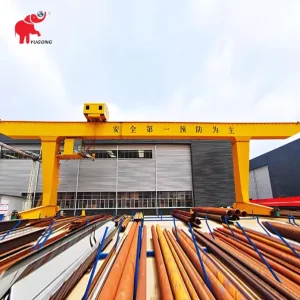
Double Girder Gantry Crane
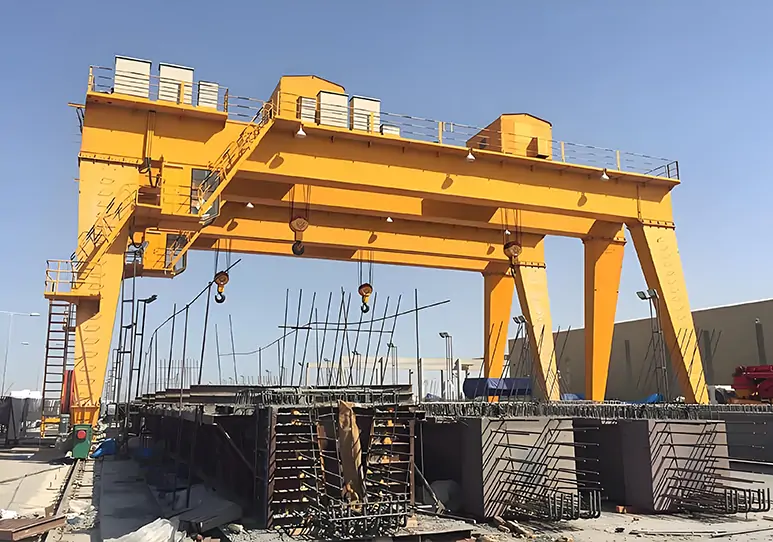
A double girder gantry crane uses two parallel main bridge beams, with the hoist trolley running on top-mounted rails between the girders. The double girder configuration provides greater structural rigidity, enables higher capacities (from 10 tons to over 500 tons), accommodates longer spans, and allows the hoist hook to reach a lower position relative to the top of the crane rail.
Double girder gantry cranes are the standard choice for heavy industrial applications — steel plants, heavy fabrication workshops, shipyards, and outdoor material handling operations where single girder capacity or duty ratings are insufficient.
Get Free Quote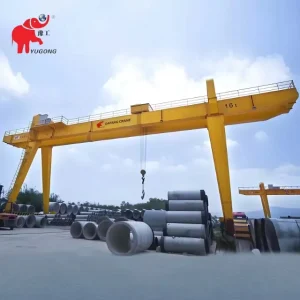
Semi Gantry Crane
A semi gantry crane has one end of the bridge supported by a leg traveling on a ground-level rail, and the other end supported on an elevated runway beam mounted on a wall or column. This configuration is useful in facilities where the floor area on one side is constrained but an elevated runway can be provided on the other, or where a building column line can serve as one support for the crane while the other side requires ground-level travel.
Semi gantry cranes make efficient use of buildings with asymmetric geometry and are commonly used in warehouses, covered yards, and facilities where a conventional full gantry or overhead crane is structurally or spatially impractical.
Get Free Quote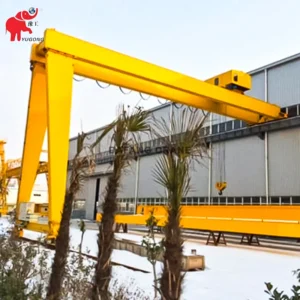
Portable Gantry Crane
Portable gantry cranes are lightweight, manually adjustable lifting frames on casters or rubber wheels, designed for workshop use where occasional lifting of moderate loads is required without permanent crane infrastructure. They are typically rated from 0.5 to 5 tons, easily moved by hand between locations, and adjusted in height to suit different load dimensions.
Portable gantry cranes are widely used in maintenance workshops, small fabrication operations, and facilities where a permanent crane system is not justified by the lifting frequency or capital budget.
Get Free Quote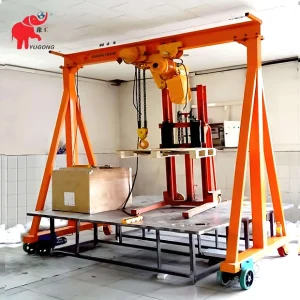
Rubber Tyred Gantry Crane (RTG)
The rubber-tyred gantry crane is a specialized container handling machine used in port and logistics terminal yards. It travels on rubber tyres across the yard surface — without fixed rails — providing the flexibility to change lanes and serve different container rows. RTG cranes typically span six to ten container rows plus a truck lane, stack containers four to five high, and operate in high-frequency terminal duty cycles.
RTG cranes are being progressively electrified and in many terminals semi-automated, with remote operation stations replacing crane cabs as terminal operators seek to reduce labor costs and improve safety.
Get Free Quote
Rail Mounted Gantry Crane (RMG)
The rail-mounted gantry crane is a fixed-rail container handling machine used in automated container terminals and intermodal rail yards. Unlike RTG cranes, RMG cranes travel on fixed rails embedded in the yard surface, providing more consistent positioning, lower rolling resistance, and better compatibility with fully automated operation.
RMG cranes are the preferred choice for fully automated container terminals where their fixed travel path enables precise position feedback and integration with automated stacking algorithms and terminal operating systems.
Get Free Quote
Gantry Crane vs Overhead Crane
| Feature | Gantry Crane | Overhead Crane |
|---|---|---|
| Support Structure | Self-supporting legs on ground rails or wheels | Runway beams on building columns or dedicated structure |
| Building Structure Required | No — suitable for buildings without crane runways | Yes — runway beams must be part of building design |
| Installation Cost | Higher rail/foundation cost; lower building modification | Lower if building is crane-ready; higher if building modification needed |
| Outdoor Use | Well-suited — independent of building structure | Possible but requires dedicated outdoor runway structure |
| Indoor Use | Suitable — typically used where overhead runway is impractical | Standard choice for indoor industrial facilities |
| Mobility | Can be designed for relocation (portable types) | Generally fixed installation |
| Span Range | Very wide — from small workshop to large outdoor yards | Wide — constrained by building bay width |
| Typical Applications | Yards, shipyards, ports, outdoor storage, mixed use | Factories, workshops, manufacturing bays |
The practical choice between a gantry crane and an overhead crane depends primarily on whether the building structure can support a crane runway, whether outdoor capability is needed, and whether the crane may need to be relocated. When a building is designed from the outset with crane runway beams, an overhead crane is typically the more cost-effective indoor solution. When no suitable building structure exists, or when outdoor or semi-outdoor operation is required, a gantry crane is the appropriate choice.
Gantry Crane Safety Requirements
Load Capacity Compliance
Every gantry crane has a rated capacity — also called the Safe Working Load (SWL) — that represents the maximum load the crane is designed to lift under normal operating conditions. The SWL must be clearly marked on the crane structure and must never be exceeded in operation. The SWL applies to the load including all rigging hardware; the weight of slings, chains, lifting beams, and other attachments must be deducted from the SWL to determine the maximum net load that can be lifted.
Operators must verify the weight of every load before lifting. Loads of unknown weight must be weighed or estimated conservatively before being attached to the hook.
Operator Training
Gantry crane operators must be trained in safe operating procedures, load assessment, rigging practice, pre-operational inspection, and emergency response. Most jurisdictions with regulated workplaces require operators to hold a formal qualification or certification for the class of equipment they operate. Refresher training should be provided when operating conditions change, when new equipment is commissioned, or following any incident.
Safety Devices
Modern gantry cranes incorporate multiple safety devices that protect against the most common hazard scenarios:
Overload protection prevents the hoist from lifting loads above the rated SWL. Mechanical torque limiters or electronic load cells detect overload conditions and interrupt the lifting motion before structural damage can occur.
Emergency stop systems provide immediate cessation of all crane motions from the operator's control position and from additional accessible locations around the crane. Emergency stop devices must be clearly identified and easily accessible.
Limit switches on the hoist prevent the hook block from being raised above the safe upper travel limit or lowered below the minimum rope length on the drum. End travel limits on the bridge and trolley prevent overtravel beyond the physical limits of the runway or bridge.
Anti-collision systems on cranes operating in shared aisles or adjacent to other cranes use proximity sensors or laser distance measurement to detect approach conditions and slow or stop crane travel before contact.
Workplace Safety Procedures
Safe gantry crane operation requires defined procedures for the workplace as a whole, not just for the crane operator. Established lifting zones beneath the crane's working area should be marked, and personnel not involved in the lift should be excluded from the zone while loads are suspended. Clear communication protocols between the operator and rigging crew must be established and followed consistently. Suspended load travel over personnel or occupied areas must be avoided through route planning and physical barriers where necessary.
Gantry Crane Inspection Checklist
Regular inspection is a legal requirement in most jurisdictions and is the primary means of identifying developing faults before they result in equipment failure or safety incidents.
Daily Inspection
Before each operating shift, the operator should inspect and functionally test the following items:
| Inspection Item | What to Check |
|---|---|
| Hook | Visible cracks, deformation, twist, latch function |
| Wire rope / chain | Broken wires, kinks, corrosion, lubrication, proper reeving |
| Hoist brakes | Functional test under no-load conditions |
| Limit switches | Upper and lower travel limits function correctly |
| Controls | All motions respond correctly; emergency stop functions |
| Runway rails | No visible debris, damage, or displacement |
| Warning devices | Horn or warning light operational |
| Structural visible items | No visible cracks, deformation, or loose fasteners |
Any defect identified during daily inspection must be reported and the crane taken out of service until the defect is corrected.
Monthly Inspection
In addition to daily checks, monthly inspections should cover:
| Inspection Item | What to Check |
|---|---|
| Electrical systems | Conductor bar or festoon condition, motor connections, control panel |
| Trolley mechanism | Wheel wear, rail engagement, lubrication of wheels and axles |
| Travel wheels | Flange wear, tread wear, bearing condition |
| Drive system | Coupling condition, gearbox oil level, motor mounting |
| Brakes | Brake pad wear, adjustment, release mechanism |
| Runway alignment | Rail gauge, level, joint condition |
Annual Inspection
Annual inspections involve a more thorough examination of the complete crane system, typically conducted by a competent person with specific crane inspection qualifications:
- Structural evaluation including all welds, connections, and structural members for cracks, corrosion, deformation, and fatigue damage
- Proof load test at the applicable percentage of SWL per the relevant standard (typically 110–125%)
- Full electrical system inspection including insulation resistance testing
- Review of all safety devices for correct function and calibration
- Review of maintenance records and operating history
- Certification or inspection documentation updated and maintained
Inspection Documentation
All inspection results must be documented in a maintenance log that records the date, inspector identity, items inspected, findings, and corrective actions taken. Inspection records must be retained for a period defined by the applicable regulatory standard — typically a minimum of five years. Documentation supports regulatory compliance, insurance requirements, and the crane's operational history for future maintenance decisions.
Gantry Crane Maintenance Guide
Preventive Maintenance
Preventive maintenance — scheduled servicing performed before failures occur — is the most cost-effective approach to gantry crane maintenance. A preventive maintenance program should be based on the manufacturer's recommendations, the crane's duty class, and the operating environment, and should cover all mechanical, electrical, and structural elements of the machine.
Lubrication is the single most important preventive maintenance task. Wire rope, open gear drives, wheel flanges, slewing rings (where fitted), and trolley wheel bearings all require lubrication at intervals specified by the manufacturer. Using the correct lubricant type and applying it at the correct frequency prevents premature wear on high-cost mechanical components.
Scheduled servicing intervals should be defined in hours of operation, number of lift cycles, or calendar time — whichever is most appropriate for the crane's duty pattern.
Mechanical Maintenance
Gears and drives: Gearbox oil level should be checked regularly and oil changed at the manufacturer's specified interval. Gear tooth condition should be inspected for pitting, scoring, or abnormal wear patterns.
Wheels and rails: Travel wheel flange wear is a progressive process that, if unmonitored, leads to derailment risk. Wheel and rail wear measurements should be recorded at inspection intervals to track the rate of wear and predict replacement timing.
Bearings: Wheel bearings, trolley bearings, and rope drum bearings require lubrication and periodic replacement. Abnormal bearing noise during operation is an early warning sign that should trigger investigation rather than continued operation.
Electrical Maintenance
Motors: Motor operating temperature, insulation condition, and brush wear (on DC motors) should be checked periodically. Thermographic inspection of motor windings during operation can identify developing insulation problems before they cause failure.
Control panels: Contactor contacts, relay condition, and terminal connection tightness should be inspected at annual maintenance intervals. VFD parameter settings should be recorded and verified.
Power supply systems: Conductor bars and festoon cables should be inspected for wear, damage, and secure mounting. Insulation condition on conductor bars is particularly important in wet or corrosive environments.
Wire Rope and Hook Maintenance
Wire rope should be lubricated regularly and inspected for broken wires, wear, kinks, and corrosion. Rope replacement criteria — typically defined as a specific number of broken wires per rope lay length, or visible corrosion reducing the rope's effective diameter — should be defined in the maintenance program and followed rigorously. A damaged wire rope that fails during a lift can cause a catastrophic load drop.
Hooks should be inspected for deformation, twist, cracks, and latch mechanism function at daily inspection. Hooks that show any dimensional change from the original dimensions — measured using a hook gauge — should be replaced. Hooks must never be repaired by welding or heat treatment.
Common Maintenance Mistakes
Delayed servicing: Deferring scheduled maintenance to maintain production availability is one of the most common and costly maintenance errors. Deferred lubrication, worn brake pads that are not replaced, and accumulated rope wear all create failure modes that result in much longer unplanned downtime than the scheduled maintenance would have required.
Poor lubrication practice: Applying the wrong lubricant type, using excessive quantities that attract dirt and contamination, or lubricating at incorrect intervals — too frequently or too infrequently — are all common errors that reduce rather than extend component life.
Ignoring warning signs: Abnormal noise during operation, uneven braking, intermittent electrical faults, and visible structural changes are warning signs that should trigger immediate investigation. Operating a crane with known defects until it fails creates safety risk and typically results in more extensive damage than addressing the problem when first identified.
Common Problems and Troubleshooting
| Problem | Possible Cause | Recommended Action |
|---|---|---|
| Hoist not lifting | Overload condition; brake not releasing; motor fault; power supply interruption | Check load weight against SWL; inspect brake mechanism; check motor and power supply; review fault codes on VFD |
| Abnormal noise during operation | Bearing wear; gear damage; loose fasteners; rail joint condition | Identify source of noise; inspect bearings, gears, and fasteners; check rail joints; engage maintenance |
| Travel misalignment / skewing | Drive speed imbalance; rail gauge variation; worn wheel flanges; drive coupling fault | Check rail gauge; inspect wheel flanges; verify drive synchronization; check couplings |
| Electrical faults / tripping | Motor overtemperature; overload; insulation failure; VFD fault | Check motor temperature; review VFD fault codes; test insulation resistance; inspect electrical connections |
| Excessive vibration | Wheel out-of-round; loose rail fasteners; structural looseness; drive imbalance | Inspect wheels for flat spots or uneven wear; check rail fastenings; inspect structural connections; balance check drive |
| Hoist limit switch not functioning | Switch position misadjusted; switch damaged; wiring fault | Test switch function; check adjustment; inspect wiring continuity; replace if defective |
How to Choose a Gantry Crane Manufacturer
Engineering Capability
The manufacturer's engineering depth determines their ability to design a gantry crane suited to the specific requirements of the application — not just to provide a catalog product. Evaluate whether the manufacturer performs structural analysis using recognized design standards (FEM, ISO, CMAA), whether they can customize span, capacity, duty class, and configuration to match project requirements, and whether they provide engineering documentation adequate to support the project's civil and electrical design.
Manufacturing Facilities
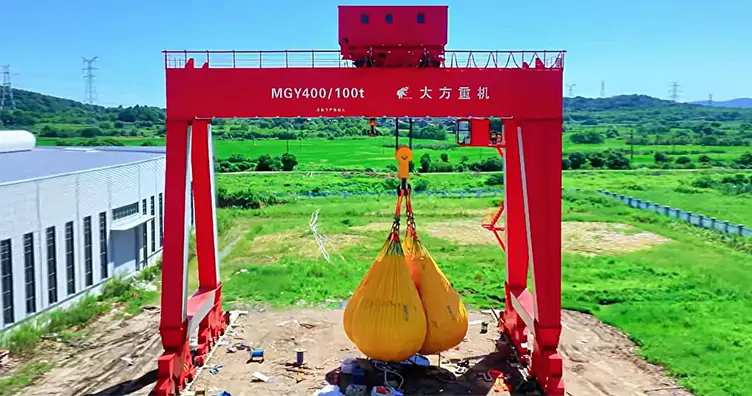
Visit or request documentation on the manufacturer's production facility. Key indicators of manufacturing quality include: CNC fabrication equipment for precision cutting and drilling; qualified welding procedures and certified welders for structural weld quality; dimensional control systems during fabrication; and organized assembly areas that support quality management. Factory load testing before shipment — confirming that every crane is tested at rated capacity before delivery — is a baseline requirement.
Quality Certifications
| Certification | What It Confirms |
|---|---|
| ISO 9001 | Documented quality management system governing all production processes |
| CE Marking | Conformity with EU Machinery Directive; required for European market supply |
| FEM Standards | Crane design to European crane duty classification methodology |
| ISO 14001 | Environmental management system |
| ISO 45001 | Occupational health and safety management system |
Project Experience
Request references for projects comparable to your application in terms of capacity, duty class, operating environment, and industry sector. Contact reference customers directly to discuss equipment performance in service, reliability, and their experience with the manufacturer's technical and commercial support.
After-Sales Service
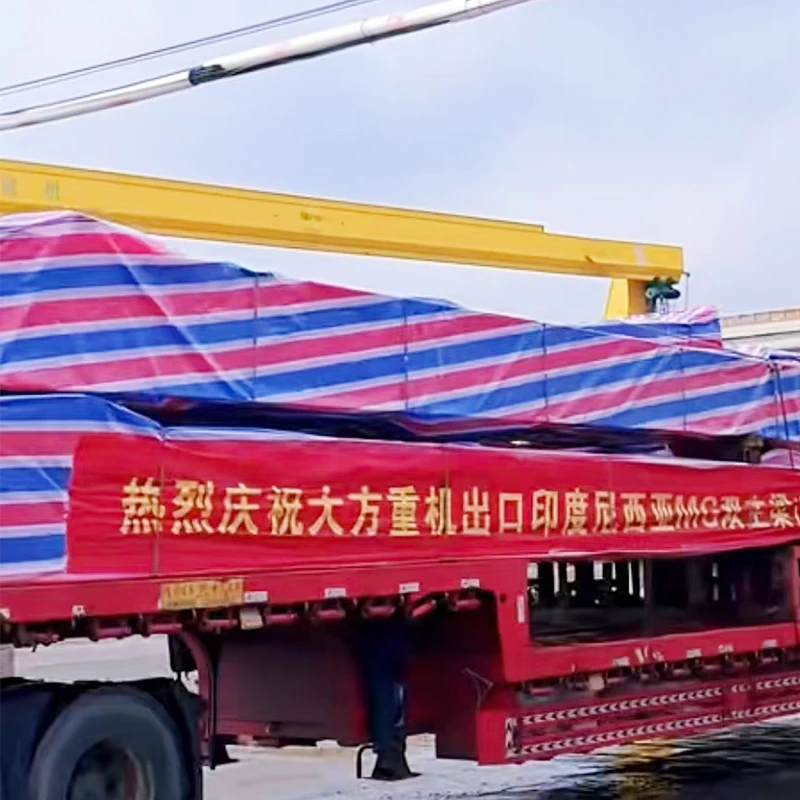
The quality of after-sales service — spare parts availability, technical response time, field service capability, and the availability of remote diagnostics — directly affects operational uptime over the crane's working life. Manufacturers with established service networks in the project region, local spare parts inventory, and clear service response commitments provide better long-term value than those whose support capability does not extend credibly to the installation location.
Conclusion
Gantry cranes are among the most versatile and widely applied lifting systems in industrial operations. Their structural independence from building frameworks, compatibility with both indoor and outdoor environments, and availability across an exceptional range of capacities and configurations make them the preferred solution for a wide range of material handling applications — from portable workshop cranes to large-scale shipyard and port terminal equipment.
Safety, inspection, and maintenance are not optional supplements to gantry crane ownership — they are fundamental requirements for reliable, compliant, and safe operation throughout the equipment's working life. Daily inspections, scheduled preventive maintenance, and annual comprehensive examinations protect both personnel and production continuity.
Selecting the right manufacturer — one with genuine engineering depth, quality manufacturing facilities, relevant project experience, and credible after-sales support — is as important as the initial equipment specification. A gantry crane is a 20-to-30-year investment in operational capability, and the quality of the manufacturer relationship affects the performance of that investment throughout its life.
Contact our engineering team for lifting system consultation and specification support.
Discuss your project requirements with our crane experts — we will help you identify the right configuration and manufacturer for your application.

Frequently Asked Questions
Q: How often should a gantry crane be inspected?
Gantry cranes should be inspected before each operating shift (daily inspection), monthly for more detailed mechanical and electrical checks, and annually for a comprehensive structural and load testing examination by a qualified inspector. The specific inspection frequency and scope required may also be defined by the applicable regulatory standard in the jurisdiction where the crane operates.
Q: What maintenance does a gantry crane require?
Gantry crane maintenance includes regular lubrication of wire ropes, gears, wheels, and bearings; scheduled replacement of wear items including brake pads, wire rope, and travel wheels; electrical system inspection covering motors, controls, and power supply; and structural inspection for cracks, corrosion, and fastener condition. Maintenance frequency should follow the manufacturer's schedule adjusted for the duty class and operating environment of the specific installation.
Q: How long does a gantry crane last?
A gantry crane designed to the applicable duty class, manufactured to recognized standards, and properly maintained will typically achieve a structural design life of 20 to 25 years. Mechanical and electrical components have shorter service lives and require scheduled replacement during the crane's life. Cranes operating within their duty class rating and receiving consistent preventive maintenance frequently remain in productive service beyond their nominal design life.
Q: How do I choose a gantry crane manufacturer?
Evaluate manufacturers on engineering capability (structural analysis, custom design), manufacturing facility quality (fabrication equipment, welding procedures, factory testing), certifications (ISO 9001, CE, FEM/CMAA as applicable), project experience (references in comparable applications), and after-sales support (spare parts availability, service response, technical assistance). Total lifecycle cost — not purchase price alone — is the appropriate basis for manufacturer comparison.
Q: What industries use gantry cranes?
Gantry cranes are used across manufacturing, steel production, shipbuilding, port and container terminal operations, construction, warehousing and logistics, mining, renewable energy, and maintenance facilities. The RTG and RMG variants are specific to container terminal operations. Heavy-duty gantry cranes serve shipyards and steel plants. Portable and light-duty gantry cranes serve workshops and maintenance applications.