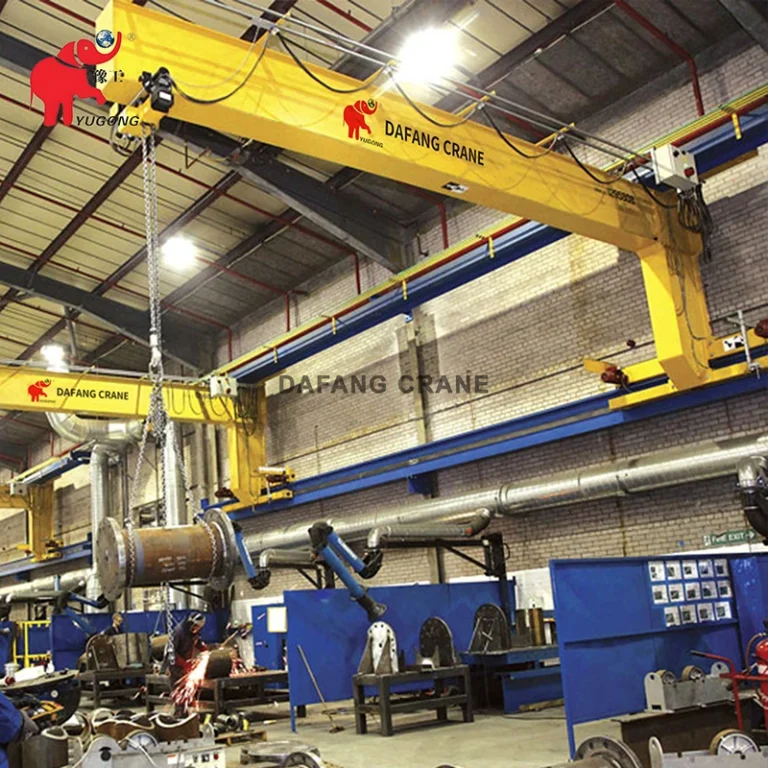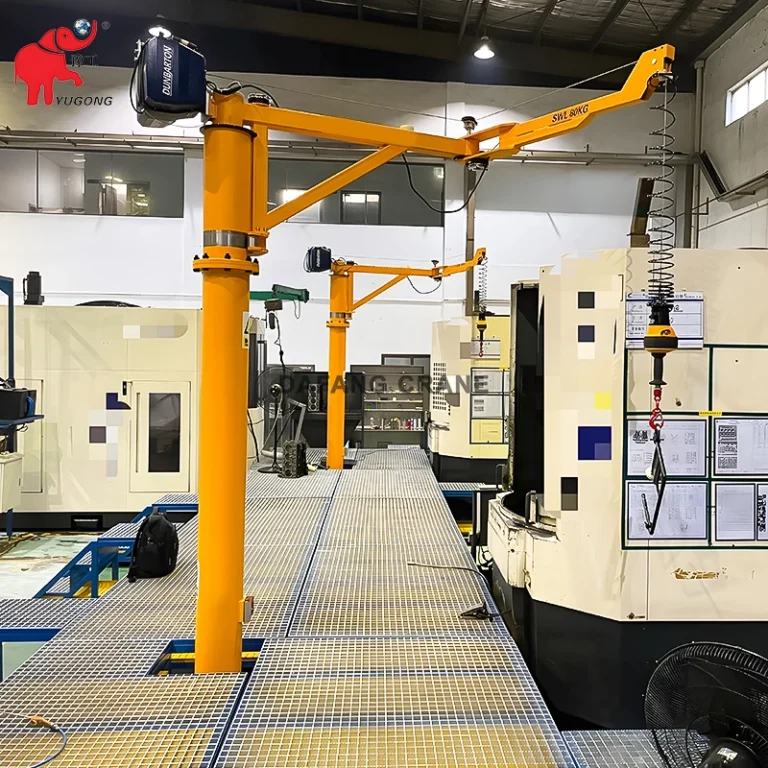







Jib cranes are among the most widely deployed material handling systems in modern manufacturing, warehousing, and maintenance environments. Their ability to provide localized lifting capability at a specific workstation or work zone — without the infrastructure cost of a full overhead crane system — makes them one of the most cost-effective solutions for improving material flow, reducing manual handling, and increasing workplace safety across a broad range of industrial applications.
As facilities modernize and ergonomic standards evolve, the demand for efficient workstation lifting solutions continues to grow. Jib cranes answer that demand with a range of configurations suited to different installation conditions, coverage requirements, and operational contexts. Selecting the right type is a decision that affects both the immediate usability of the equipment and its long-term return on investment.
Table of Contents
What Is a Jib Crane?
A jib crane is a lifting device consisting of a horizontal boom arm (the jib) mounted to a supporting structure — a floor-anchored pillar, a building column, a wall, or a mobile base — that carries a hoist for lifting and moving materials within a defined working area. The jib arm rotates around the mounting point to provide angular coverage, and a trolley on the boom allows the hoist to travel along the arm's length for horizontal positioning. Together, these motions give the crane two horizontal axes and one vertical axis of load movement within its working zone.
This article explains how jib cranes work, the benefits they provide, and the five most common types used in industrial settings — with practical guidance on selecting the right configuration for specific applications.
Get Free Quote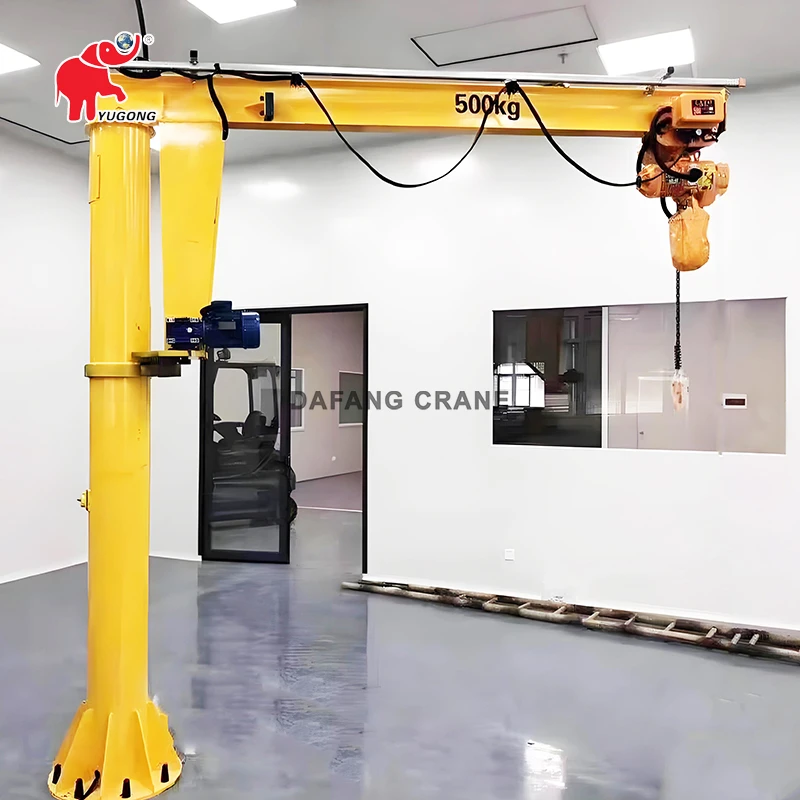
How Does a Jib Crane Work?
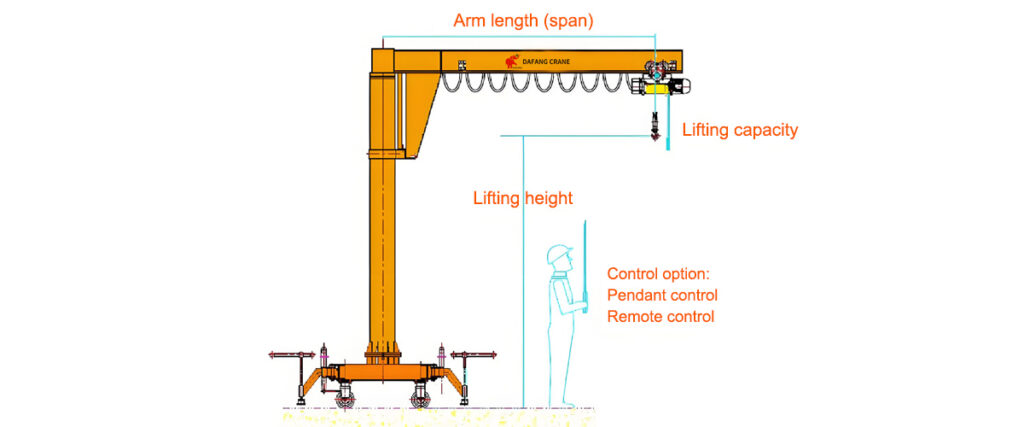
Jib cranes operate through the coordinated action of three primary motion systems, each contributing to the crane's ability to position loads within the working zone.
Jib Arm
The jib arm is the horizontal structural member that extends outward from the mounting point. It defines the crane's reach — the radius within which loads can be lifted and positioned. The arm is fabricated from structural steel, typically an I-beam or box section, sized for the rated capacity and the required arm length. Longer arms and higher capacities require heavier sections to maintain acceptable deflection under load.
Hoist
The hoist performs the vertical lifting function. Electric chain hoists are the most common choice for jib crane applications, offering compact dimensions, adequate capacity for most workstation lifting tasks, and simple installation on the trolley. Electric wire rope hoists are used where greater capacity, higher lifting height, or finer load control is required.
Trolley
The trolley carries the hoist along the jib arm, providing horizontal load movement along the arm's length. Push-type trolleys rely on the operator to manually position the load along the arm. Motorized trolleys provide powered travel for faster or more controlled positioning, particularly on longer arms or with heavier loads.
Rotation Mechanism
The rotation mechanism allows the jib arm to swing through its working arc around the mounting point. Manual rotation — the operator physically swings the arm — is standard for most workstation jib cranes. Motorized rotation is available for heavier cranes or applications where powered slewing is operationally justified.
Supporting Structure
The supporting structure is the mounting interface between the crane and the facility. It determines the structural type of the crane — floor-mounted pillar, wall bracket, mobile base, or wall-mounted rail — and transfers the crane's loads into the floor, building structure, or travel rail accordingly.
Operating Sequence
A typical lift begins with the operator rotating the jib arm to position the hoist over the load. The trolley is moved along the arm to align the hook above the load's center of gravity. The hoist lowers the hook, rigging is attached, and the hoist lifts the load. The operator then rotates the arm and adjusts the trolley position to move the load to the target location, where the hoist lowers it into position.
Benefits of Using Jib Cranes
Improved Workplace Efficiency
A jib crane positioned at the point of use eliminates travel time and intermediate handling steps. Components can be lifted, repositioned, and placed without leaving the work zone, reducing cycle time and allowing operators to focus on value-added tasks rather than material movement.
Reduced Manual Handling
Mechanical lifting replaces repetitive manual effort, reducing the physical strain on operators and lowering the risk of musculoskeletal injuries associated with lifting, carrying, and positioning heavy components. In high-frequency assembly operations, this reduction in physical demand has measurable effects on operator productivity and long-term health outcomes.
Lower Installation Costs
Compared to overhead crane systems, jib cranes require minimal structural investment. A floor-mounted jib crane needs a concrete foundation and anchor bolts; a wall-mounted type requires anchor points on an existing wall or column. Neither requires runway beams, end trucks, or the structural provisions that a full overhead crane system demands.
Better Space Utilization
Jib cranes are compact and localized. They serve a defined zone without consuming floor space for columns or infrastructure, and multiple jib cranes can serve adjacent workstations without interfering with each other. In tight production layouts, this spatial efficiency is a meaningful operational advantage.
Increased Operator Safety
By removing the need for manual lifting of loads above a defined weight threshold, jib cranes reduce injury risk associated with repetitive or heavy manual handling. Controlled mechanical movement reduces the risk of dropped loads and unexpected load shifts during positioning.
Type 1 — Floor Mounted Jib Crane
What Is a Floor Mounted Jib Crane?
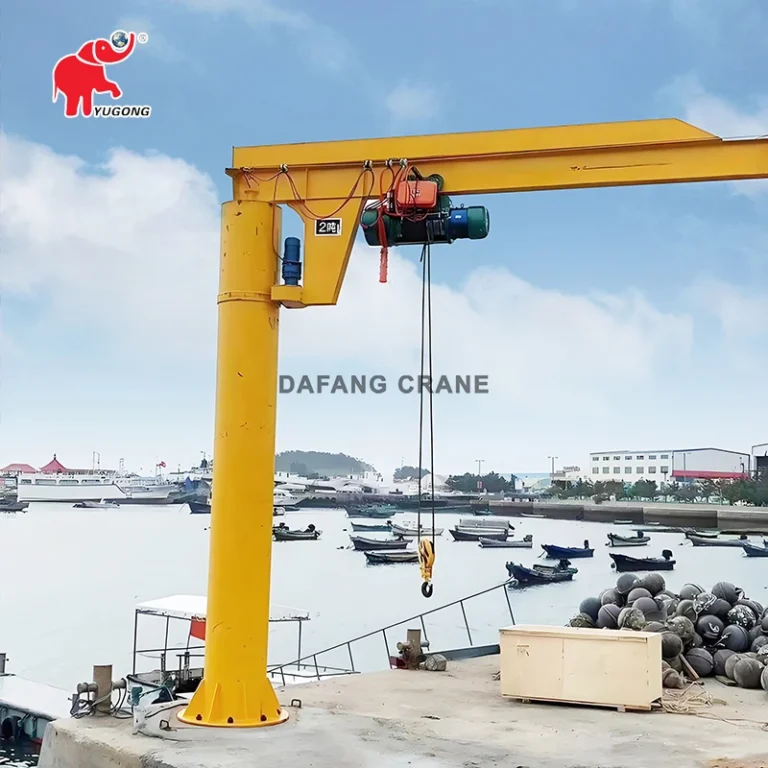
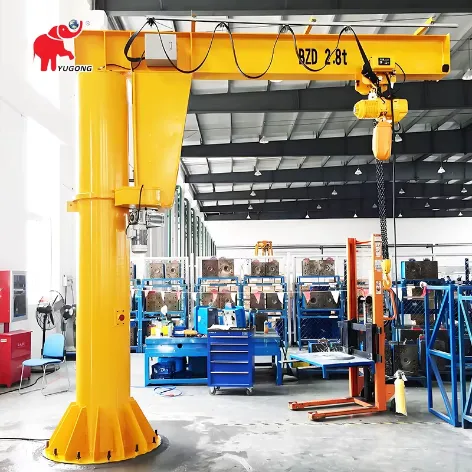
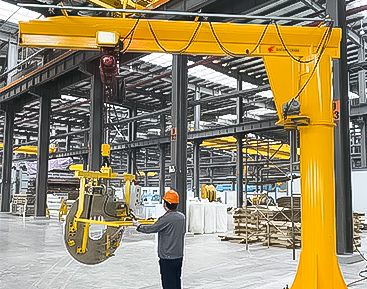
A floor mounted jib crane is a freestanding jib crane whose central pillar is anchored directly to a reinforced concrete floor foundation. It is structurally independent — it does not rely on any wall, column, or overhead structure for support. This independence allows it to be positioned anywhere in a facility where a suitable foundation can be installed, and it transfers all crane loads through the pillar directly to the foundation.
Key Features
The defining capability of the floor mounted jib crane is its rotation range. Because the pillar is freestanding and not constrained by an adjacent wall, the jib arm can rotate through a full 360 degrees around the pillar — providing complete circular coverage within the arm's reach radius. Capacities typically range from 0.25 tons to 5 tons for standard industrial configurations, with custom designs available at higher capacities. Arm lengths from 2 to 8 meters are common, creating working zones of substantial area around the crane position.
Get Free Quote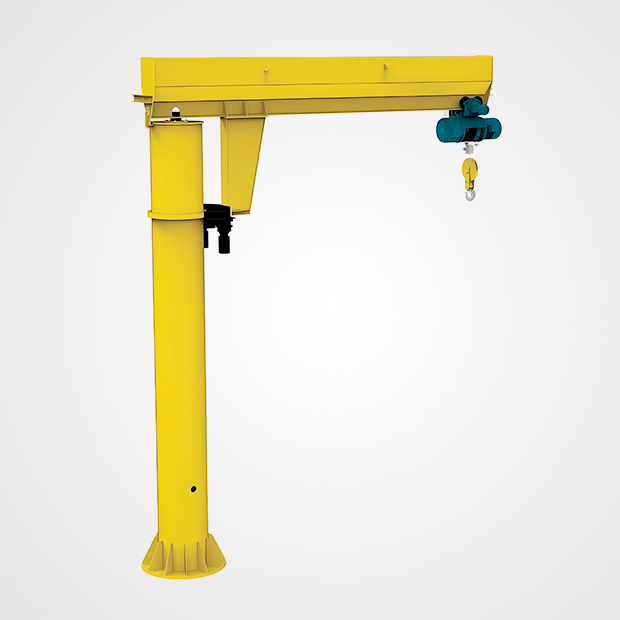
Typical Applications
Floor mounted jib cranes are deployed at standalone workstations in manufacturing plants, at machine tool positions in metalworking workshops, at assembly stations on production floors, and in machinery maintenance areas. Their full rotation capability makes them effective at serving a circular work zone — for example, loading a lathe or machining center from multiple approach directions, or supplying components from a storage area to an assembly fixture at any angle.
Advantages and Limitations
| Factor | Details |
|---|---|
| Rotation Range | Full 360° — complete circular coverage |
| Structural Dependency | None — fully independent of building structure |
| Floor Space | Requires foundation footprint at pillar base |
| Installation | Foundation engineering and anchor bolt work required |
| Capacity Range | Typically 0.25 – 5 tons standard; higher on request |
| Relocation | Difficult — foundation is permanent |
| Best Suited For | Isolated workstations, machine positions, open floor areas |
The primary limitation of the floor mounted jib crane is that its pillar and foundation occupy floor space that may be needed for production or access. In facilities with tight floor layouts, the footprint of the pillar and the area required to maintain safe clearance around the working radius must be carefully accounted for in the layout plan.
Type 2 — Slewing Mobile Jib Crane
What Is a Slewing Mobile Jib Crane?
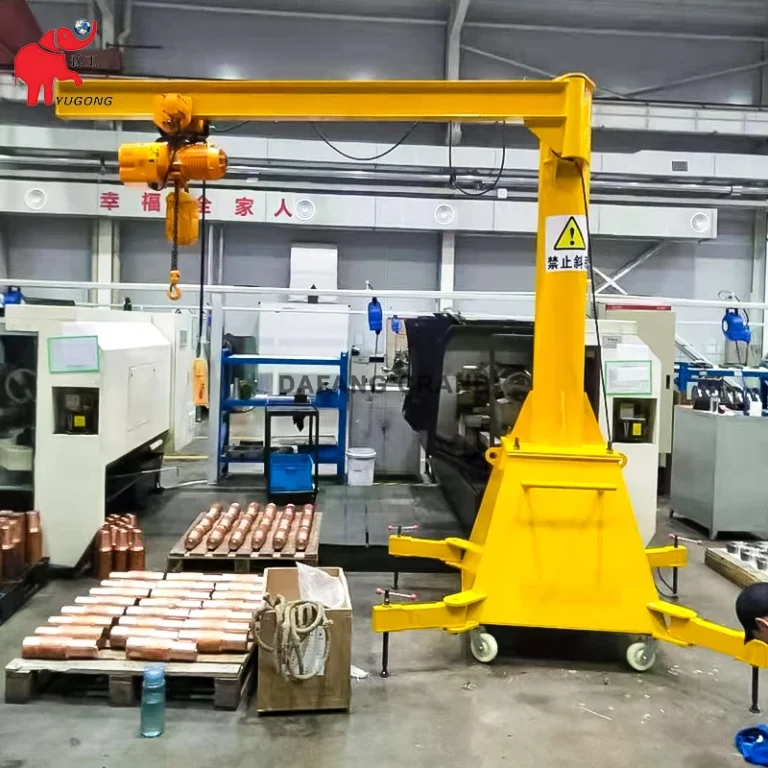
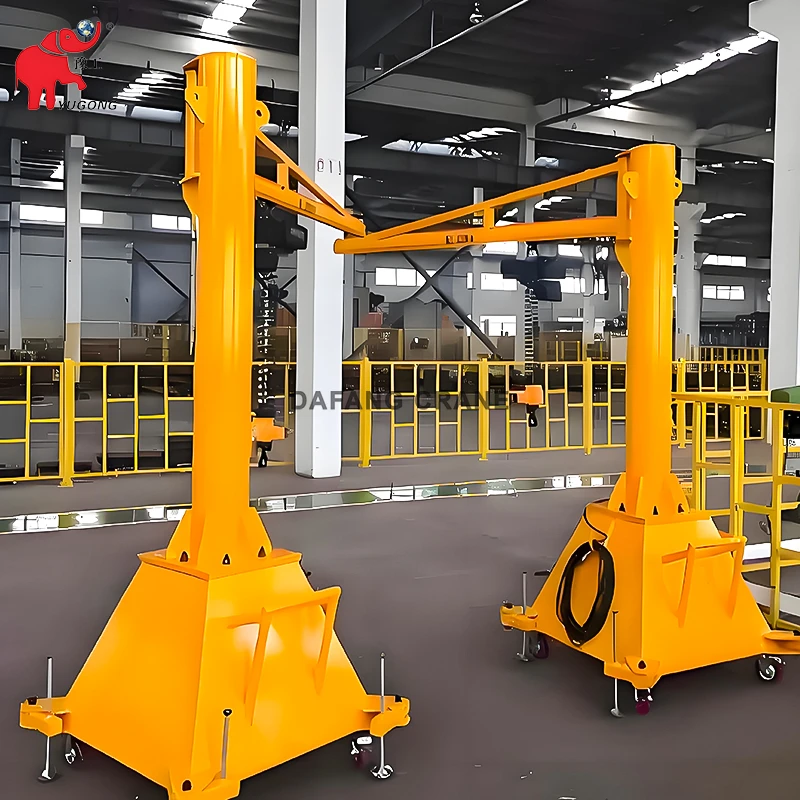
A slewing mobile jib crane is a self-contained, freestanding jib crane mounted on a wheeled or castored base that can be moved manually to different locations within a facility. The jib arm rotates around the central mast, and the entire unit can be repositioned without tools or structural modification.
Key Features
Mobility is the defining characteristic of the slewing mobile jib crane. The unit can be moved between workstations, positioned temporarily for a specific task, and relocated as production requirements change. Capacities typically range from 0.125 tons to 3ton, reflecting the load limits appropriate for a manually mobile structure. The base may incorporate stabilizing outriggers or counterweights to maintain stability during lifting operations. Arm lengths are generally shorter than floor-mounted types to maintain manageable overall dimensions and stability.
Get Free Quote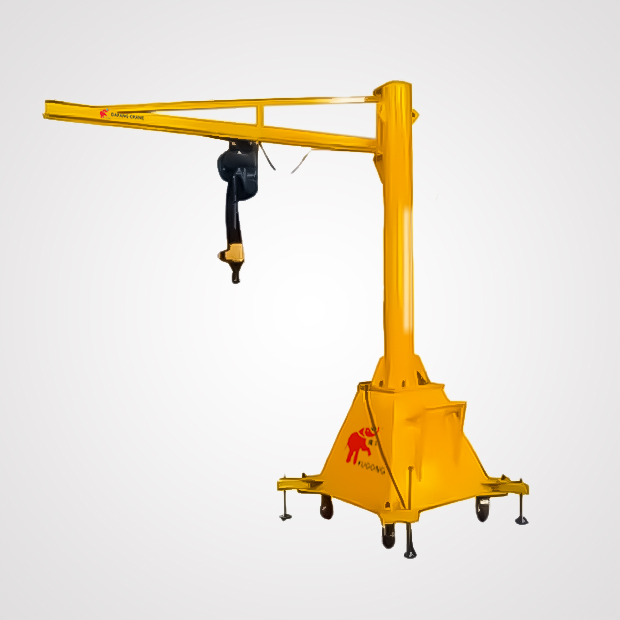
Typical Applications
Slewing mobile jib cranes are used in maintenance workshops for occasional lifting tasks at different positions, in warehouses for loading and unloading operations at varying dock or shelf positions, in production support areas where lifting requirements move with the work, and in facilities where permanent crane installation is not justified by the frequency or consistency of lifting tasks.
Advantages and Limitations
The mobile jib crane's principal advantage — flexibility — is also the source of its limitations. A mobile unit carries lower rated capacities than fixed installations, is less stable under dynamic loading, and requires stable, level floor surfaces for safe operation. It is not suitable as the primary lifting solution for high-frequency operations or heavy loads, but it fills a genuine gap for occasional, versatile, low-to-medium capacity lifting needs.
| Factor | Details |
|---|---|
| Rotation Range | Typically 270° – 360° depending on model |
| Mobility | Fully mobile — no installation required |
| Capacity Range | 0.125 – 1 ton typical |
| Stability | Requires level surface; outriggers may be needed |
| Relocation | Immediate — no tools or structural work required |
| Best Suited For | Occasional lifts, maintenance areas, varied task locations |
Type 3 — Column Articulating Jib Crane
What Is a Column Articulating Jib Crane?
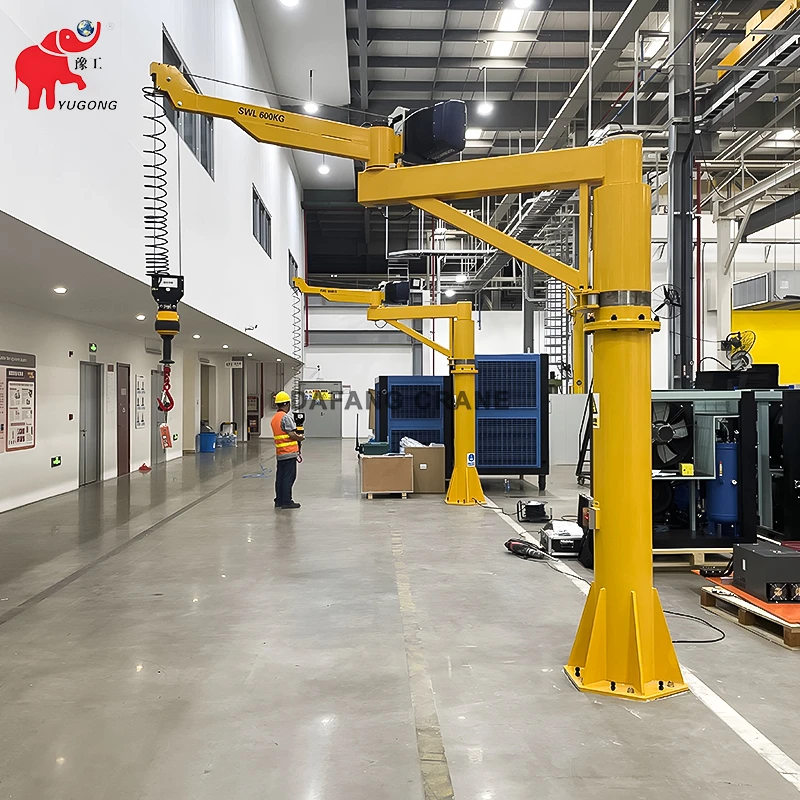
A column articulating jib crane — also called an articulated jib crane — is a floor or column-mounted jib crane with two arm segments connected by a pivot joint at the midpoint of the total reach. The inner arm extends from the mast, and the outer arm extends from the pivot point on the inner arm. Both arms can rotate independently, giving the crane the ability to position loads within a complex, non-circular working zone and to navigate around obstacles that a simple rotating single arm could not avoid.
Key Features
The articulated configuration gives the crane access to positions that are not reachable by a single-arm jib. The outer arm can fold back toward the mast, reducing the effective reach and allowing the load to be positioned close to the crane column. The two-arm geometry also enables the crane to reach around equipment, fixtures, or structural elements within the working zone that would block a conventional jib arm. Capacities from 0.1 tons to 2 tons are typical for standard column articulating configurations.
Get Free Quote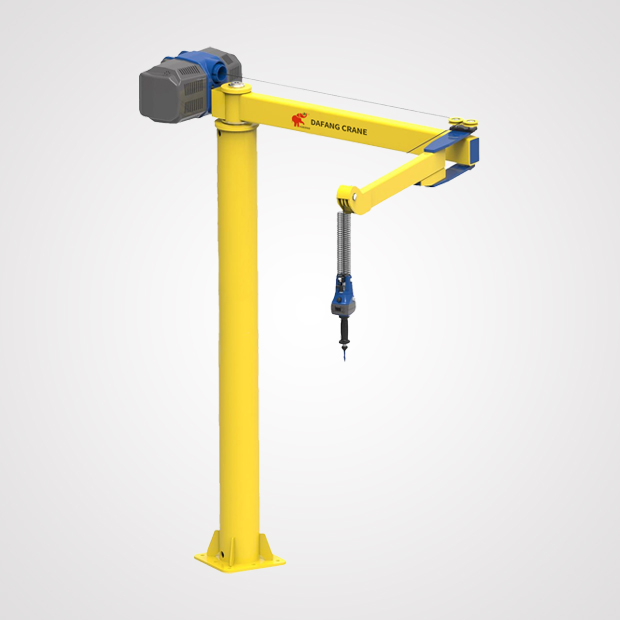
Typical Applications
Column articulating jib cranes are particularly well-suited to CNC machining centers, where the crane must position components through the machine door opening and onto the worktable while avoiding machine structure and tooling. Welding stations with fixtures and positioners that create obstacles within the work zone benefit from the articulated arm's ability to reach around those obstacles. Assembly cells with complex fixture arrangements are another common application. The articulated jib crane is the preferred choice wherever the work zone contains obstacles that a standard single-arm jib cannot navigate.
Advantages and Limitations
| Factor | Details |
|---|---|
| Rotation Range | Inner arm: 360° typical; outer arm: full articulation range |
| Coverage Shape | Non-circular — can reach around obstacles |
| Capacity Range | 0.1 – 2 tons typical |
| Positioning Precision | High — dual-arm geometry enables fine positioning |
| Installation | Floor foundation or column mounting |
| Best Suited For | Machine tool cells, assembly stations with obstacles, complex work zones |
The articulating crane's additional pivot point adds mechanical complexity compared to a single-arm jib. The bearing and pivot joint at the arm connection require periodic inspection and lubrication. Operators require some familiarization with the two-arm movement pattern before achieving smooth, efficient operation.
Type 4 — BX Type Wall Mounted Jib Crane
What Is a BX Type Wall Mounted Jib Crane?
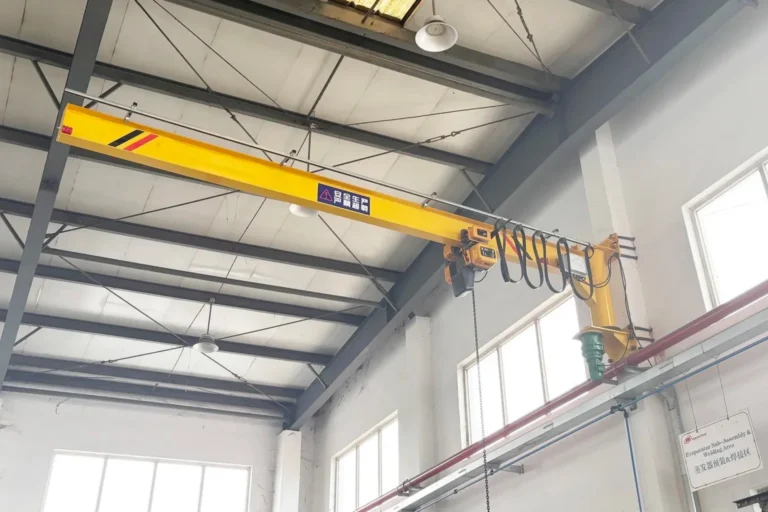
A BX type wall mounted jib crane — also called a wall bracket jib crane — is a jib crane attached directly to a building wall, structural column, or reinforced concrete structure by a bracket assembly, with no floor-level support pillar. The bracket transfers the crane's load through two attachment points at different heights on the wall, creating a moment couple that supports the cantilever load of the arm and its lifted load.
Key Features
The defining advantage of the BX wall mounted jib crane is that it requires no floor space for a support pillar or foundation. This makes it ideal for facilities where floor space is at a premium and every square meter is needed for production, storage, or traffic flow. The jib arm typically rotates through 180 degrees along the wall face, covering a semicircular working zone in front of the mounting wall. Capacities from 0.1 tons to 5 tons are available in standard configurations, with arm lengths from 1.5 to 6 meters.
Get Free Quote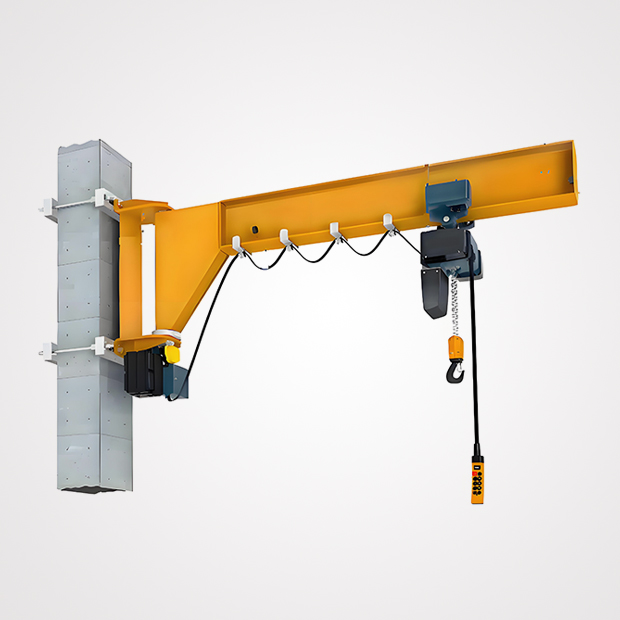
Typical Applications
Wall mounted jib cranes are widely used along production lines to provide individual workstation lifting capability at each machine position. Warehouse loading and unloading zones mounted at the dock wall allow goods to be lifted between dock level and vehicle beds efficiently. Machining areas with equipment positioned against a wall benefit from a wall-mounted crane that serves multiple machines within the 180-degree arc. The BX type is also common in maintenance bays where equipment is typically serviced against one wall of the facility.
Advantages and Limitations
| Factor | Details |
|---|---|
| Rotation Range | Typically 180° along wall face |
| Floor Space Required | None — mounts to existing wall or column |
| Structural Requirement | Wall or column must carry crane loads — engineering assessment required |
| Installation | Wall anchor work; no foundation required |
| Capacity Range | 0.1 – 5 tons standard |
| Best Suited For | Production lines along walls, warehouse docks, machine bays |
The primary constraint of the wall mounted jib crane is that the mounting wall or column must be structurally capable of carrying the crane's loads. An engineering assessment of the existing structure is required before installation. Unreinforced masonry, lightweight partition walls, and deteriorated concrete are not suitable mounting substrates without significant reinforcement.
Type 5 — Wall Travelling Jib Crane
What Is a Wall Travelling Jib Crane?
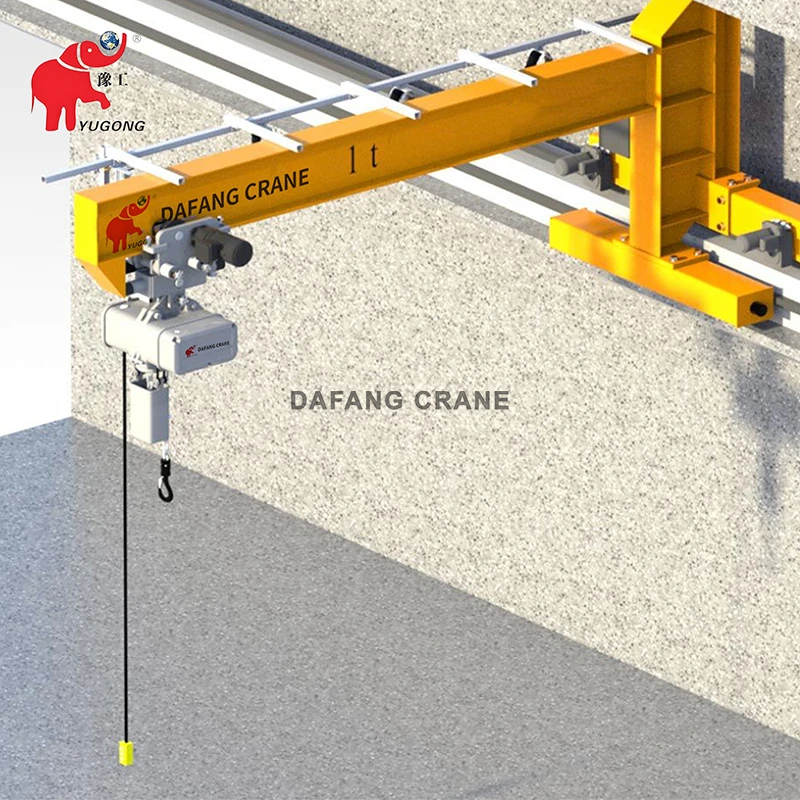
A wall travelling jib crane is a jib crane mounted on a carriage that travels along rails fixed to the wall, enabling the crane to move longitudinally along the full length of the wall-mounted track system. Unlike a fixed wall-mounted jib crane that covers only the semicircular zone in front of its fixed mounting point, a wall travelling jib crane can serve any workstation along the length of the travel rail.
Key Features
The wall travelling jib crane combines the space efficiency of a wall-mounted configuration with the extended coverage of a travelling crane system. A single crane can serve an entire production line or multiple workstations along a wall run, moving to the position where it is needed and providing lifting capability across the full rail length. Travel rail lengths from 10 meters to over 50 meters are practical, with the jib arm rotating through approximately 180 degrees at each position along the rail. Capacities from 0.25 tons to 3 tons are typical.
Get Free Quote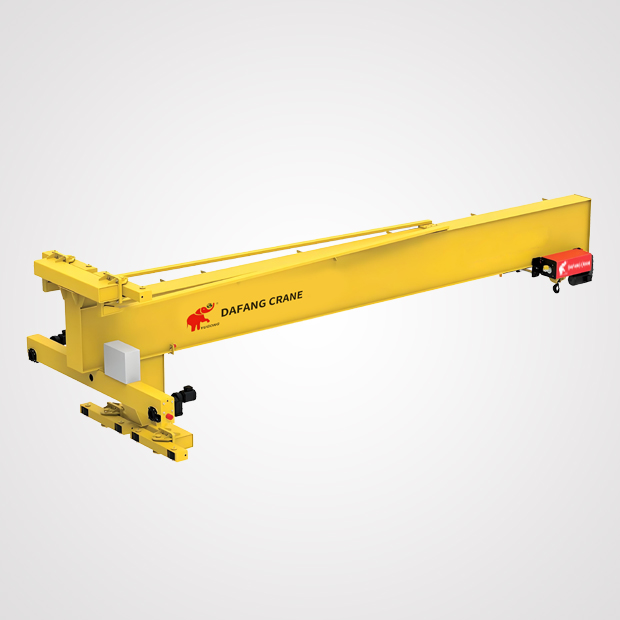
Typical Applications
Wall travelling jib cranes are particularly effective in production workshops with multiple workstations arranged in a line parallel to one wall — a common factory layout. A single crane serves all workstations along the line without requiring a separate jib crane at each position. Assembly facilities producing large components along a progressive assembly line, manufacturing lines where the same crane must support operations at different stages along the process, and workshops where occasional lifting requirements exist at many positions along a wall are all well-suited to the wall travelling configuration.
Advantages and Limitations
| Factor | Details |
|---|---|
| Travel Range | Full rail length — serves all positions along the wall |
| Rotation Range | Typically 180° at each position |
| Floor Space Required | None — wall and rail mounted |
| Coverage | Linear — all workstations along rail length |
| Installation | Rail mounting to wall; wall must carry travel rail loads |
| Capacity Range | 0.25 – 3 tons typical |
| Best Suited For | Linear production lines, multi-station assembly, progressive manufacturing |
The wall travelling configuration is a more complex installation than a fixed wall-mounted jib, requiring the travel rail to be level, aligned, and structurally supported along its full length. The carriage travel mechanism requires periodic maintenance in addition to the standard jib crane maintenance requirements.
Comparison of the 5 Common Jib Crane Types
| Jib Crane Type | Rotation Range | Mobility | Coverage Area | Typical Capacity | Best Application |
|---|---|---|---|---|---|
| Floor Mounted | 360° | Fixed — permanent installation | Full circle around pillar | 0.25 – 5 tons | Standalone workstations, machine positions, open floor areas |
| Slewing Mobile | 270° – 360° | Fully mobile — can be repositioned | Circle around current position | 0.125 – 3 ton | Maintenance areas, occasional lifts, variable task locations |
| Column Articulating | Dual-arm articulation | Fixed — floor or column mount | Non-circular — obstacle avoidance | 0.1 – 2tons | CNC cells, welding stations, complex work zones |
| BX Wall Mounted | 180° along wall | Fixed — wall mounted | Semicircle in front of wall | 0.1 – 5 tons | Production lines, warehouse docks, machine bays along walls |
| Wall Travelling | 180° at each position | Travels along wall rail | Linear — full rail length | 0.25 – 3 tons | Multi-station lines, progressive assembly, wall-parallel layouts |
How to Choose the Right Jib Crane
Load Capacity Requirements
Identify the maximum load the crane must lift, including all lifting attachments. Apply a minimum 25 percent safety margin above the maximum load to establish the minimum rated capacity. For high-frequency applications, consider a larger margin. Never specify to the average load — always specify to the maximum.
Available Installation Space
Assess the space available for the crane's supporting structure. If floor space is constrained, wall-mounted or wall-travelling configurations eliminate the need for a pillar footprint. If no suitable wall or column is available, a floor-mounted configuration is required. For maximum flexibility without any permanent installation, a mobile crane is the only option.
Frequency of Use
High-frequency lifting operations — multiple lifts per hour throughout a shift — require a crane with appropriate hoist duty ratings, motorized trolley travel for faster cycling, and a maintenance program matched to the operating intensity. Low-frequency occasional lifting can be adequately served by simpler manual configurations.
Coverage Area
Define the complete working zone the crane must reach — all load pickup and placement positions. A circular zone around a central point suits a floor-mounted pillar crane. A zone along a wall suits a wall-mounted or wall-travelling configuration. A zone with obstacles or irregular geometry suits an articulating configuration. A zone that moves with production requirements suits a mobile crane.
Mobility Requirements
If the crane must serve different positions in the facility over time, a mobile unit is the only type that can accommodate this without additional infrastructure. If the crane's position is fixed for the foreseeable future, a permanent installation delivers better capacity, duty rating, and long-term value.
Budget Considerations
Mobile and wall-mounted cranes typically have the lowest installation costs. Floor-mounted cranes require foundation work that adds to the total project cost. Articulating cranes carry a premium over simple single-arm configurations. Wall travelling cranes involve rail installation costs in addition to the crane itself. Evaluate total installed cost — including civil work — not just equipment price.
Common Industries Using Jib Cranes
Manufacturing Plants
General manufacturing facilities use all five jib crane types depending on the specific workstation configuration and production layout. Floor-mounted cranes serve machine positions in open floor areas; wall-mounted types serve production lines along facility walls.
Automotive Industry
Automotive assembly operations use jib cranes extensively at individual assembly stations for part loading, subassembly positioning, and component transfer. Articulating jib cranes are common in tight assembly cells where conventional arms cannot navigate around fixtures and body panels.
Steel Fabrication Workshops
Steel fabrication shops use jib cranes for positioning plate, section, and assembly components at welding and cutting stations. Heavy-duty floor-mounted configurations handle the higher capacities typical of structural steel fabrication.
Warehouses
Warehouse applications use wall-mounted and mobile jib cranes at receiving and dispatch docks, in picking and packing areas, and at storage systems where mechanical assistance is needed for goods above manual handling weight limits.
Maintenance Facilities
Maintenance workshops benefit from mobile jib cranes for flexible lifting at different service positions, and from floor-mounted or wall-mounted cranes at permanent service bays for regular equipment maintenance tasks.
Logistics Centers
Logistics operations use jib cranes for ergonomic handling of heavy parcels, pallet component handling, and goods preparation at packing stations where consistent load weights require mechanical assistance for operator safety.
Jib Crane Safety Best Practices
Operator Training
All jib crane operators should receive training covering the specific crane type in use, safe load capacity limits, rigging procedures, pre-operational inspection requirements, and emergency response procedures. Training should be documented and repeated when equipment or personnel change.
Load Capacity Compliance
The rated capacity of the jib crane — marked on the crane arm — must never be exceeded. Operators must verify the weight of loads before lifting. Rigging hardware weight must be included in the total load calculation. Loads of uncertain weight must not be lifted until weight is confirmed.
Daily Inspection
Before each operating shift, the operator should inspect the hook (for deformation and latch function), wire rope or chain (for wear, damage, and lubrication), hoist controls (for correct function), rotation bearing (for smooth operation and abnormal noise), and visible structural condition (for cracks, deformation, or loose fasteners).
Safe Load Handling
Loads must be lifted vertically — side loading of the jib arm (pulling the hoist laterally with a load on the hook) is prohibited as it imposes lateral forces the arm is not designed to carry. Loads must be secured against rotation and sway before the jib arm is rotated. Personnel must not stand under suspended loads.
Emergency Procedures
All operators must be familiar with the emergency stop function of the hoist and control system, the procedure for safely lowering a load in the event of a power failure, and the reporting procedure for equipment defects or incidents.
Jib Crane Maintenance Checklist
| Maintenance Item | Frequency | What to Check |
|---|---|---|
| Hook condition | Daily | Deformation, twist, cracks, safety latch function |
| Wire rope / chain | Daily | Broken wires, wear, kinks, lubrication, proper reeving |
| Hoist controls | Daily | All motions respond correctly; emergency stop functions |
| Rotation bearing | Daily | Smooth operation, no abnormal noise |
| Structural visible condition | Daily | No cracks, deformation, loose fasteners |
| Trolley wheels | Monthly | Wear, correct rail engagement, lubrication |
| Rotation bearing lubrication | Monthly | Apply correct lubricant per manufacturer schedule |
| Hoist gearbox oil | Monthly | Level check; change at manufacturer interval |
| Electrical connections | Monthly | Terminal tightness, wiring condition |
| Structural bolts and connections | Monthly | Torque verification at all mounting fasteners |
| Wall bracket / foundation anchors | Annual | Condition, corrosion, movement, torque verification |
| Jib arm structural integrity | Annual | Complete inspection for fatigue cracks at welds and connections |
| Load test | Annual | Proof load test at applicable percentage of rated capacity |
| Certification review | Annual | Confirm applicable inspection and certification currency |
How to Choose a Jib Crane Manufacturer
Engineering Capability
A competent jib crane manufacturer can design for project-specific requirements — non-standard arm lengths, unusual capacity and rotation combinations, special mounting conditions, and harsh environmental specifications — rather than being limited to catalog configurations. Request engineering documentation on previous custom projects to assess this capability.
Manufacturing Experience
Years of production experience and the breadth of the installed product base indicate accumulated design refinement and process knowledge. Ask how long the manufacturer has been producing jib cranes and what types and capacities are in regular production.
Quality Certifications
| Certification | Relevance to Jib Cranes |
|---|---|
| ISO 9001 | Quality management system governing design and production processes |
| CE Marking | Required for European market; confirms Machinery Directive compliance |
| FEM Standards | Crane duty class methodology for component design life |
Project References
Request references for projects in comparable industries and at comparable capacities. Contact reference customers to discuss equipment performance, reliability, and their experience with the manufacturer's technical and commercial support.
After-Sales Support
Spare parts availability, technical response time, and service capability in the installation region directly affect operational uptime over the crane's working life. Confirm spare parts lead times and service coverage before committing to a supplier.
Customization Capability
Standard catalog jib cranes do not suit every application. Manufacturers who can accommodate non-standard arm lengths, special finishes for corrosive or food-grade environments, custom rotation stops, and integration with specific hoist brands provide better long-term value for applications outside standard parameters.
Conclusion
The five common types of jib cranes — floor mounted, slewing mobile, column articulating, BX type wall mounted, and wall travelling — each offer a distinct combination of coverage area, installation requirements, capacity range, and operational characteristics. Understanding these differences is the foundation for selecting the right solution for a specific workstation, facility layout, and operational requirement.
Floor mounted jib cranes deliver full 360-degree coverage from a freestanding pillar. Mobile slewing cranes provide maximum flexibility for variable task locations. Articulating jib cranes navigate complex work zones with obstacles. Wall mounted BX cranes eliminate floor space requirements along building walls. Wall travelling cranes extend a single crane's coverage across the full length of a production line.
Safety, inspection, and preventive maintenance are not optional aspects of jib crane ownership — they are the operational requirements that keep these machines performing reliably and safely throughout their service lives. Selecting a manufacturer with genuine engineering depth, quality manufacturing processes, and credible after-sales support protects the long-term value of the investment.
Contact our engineering team for workstation lifting consultation and application guidance.
Discuss your material handling requirements with our crane experts — we will help you identify the right jib crane type and specification for your application.

Frequently Asked Questions
Q: What is a jib crane used for?
A jib crane is used to lift, move, and position materials at a specific workstation or work zone within a manufacturing, warehouse, maintenance, or assembly environment. Common applications include machine loading and unloading, component assembly, parts transfer between workstations, maintenance lifting, and ergonomic material handling at positions where loads exceed safe manual handling limits.
Q: Which type of jib crane is best for a workshop?
The best type depends on the workshop layout and application. For a standalone machine position in an open floor area, a floor-mounted jib crane with 360-degree rotation is typically the most effective choice. For positions along a wall, a wall-mounted BX type crane eliminates the floor footprint. For CNC cells with obstacles inside the work zone, an articulating jib crane provides the required maneuverability. For occasional lifting at multiple locations, a mobile slewing jib crane offers maximum flexibility.
Q: What is the difference between a wall-mounted and floor-mounted jib crane?
A floor-mounted jib crane is anchored to a concrete floor foundation through a central pillar and rotates through 360 degrees, providing full circular coverage. It requires floor space for the pillar. A wall-mounted jib crane attaches to an existing wall or column via a bracket assembly, requires no floor space, and typically rotates through 180 degrees along the wall face. The wall-mounted type has lower installation cost in facilities with suitable walls, but the wall must be structurally capable of carrying the crane loads.
Q: How much weight can a jib crane lift?
Standard industrial jib cranes are available from 0.1 tons (100 kg) to 5 tons for most catalog configurations. Custom designs can exceed this range for specific applications. The appropriate capacity for a given application is determined by the maximum load to be lifted — including all rigging hardware — with a minimum 25 percent safety margin applied to establish the rated capacity.
Q: What maintenance does a jib crane require?
Jib crane maintenance includes daily pre-shift inspection of the hook, hoist rope or chain, controls, and visible structural condition; monthly lubrication of the rotation bearing and trolley wheels; periodic gearbox oil changes; annual structural inspection for fatigue cracks; and annual load testing at the applicable proof load percentage. Specific maintenance intervals should follow the manufacturer's schedule adjusted for the crane's operating duty and environment.