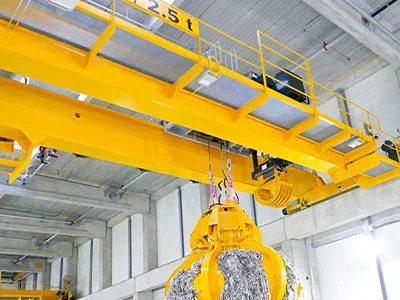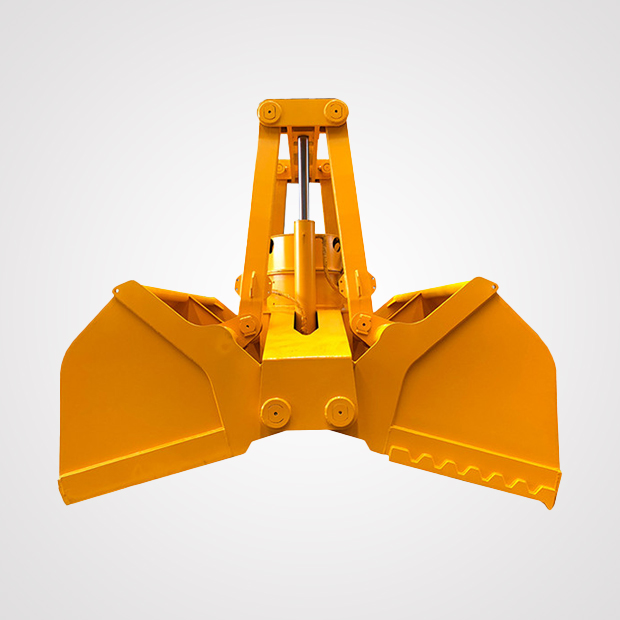







A clamshell grab is a crane attachment consisting of two hinged shells that open and close to capture, lift, transport, and discharge bulk materials. It handles sand, coal, ore, grain, scrap metal, waste, and similar loose materials efficiently across a wide range of industrial environments. Clamshell grabs are used with overhead cranes, gantry cranes, harbor cranes, and ship cranes worldwide.
For port terminals, steel mills, mining operations, and waste handling facilities, the clamshell grab is one of the most practical and widely deployed crane attachments available. It reduces manual handling, increases loading and unloading speed, and integrates directly with existing crane infrastructure.
This guide covers everything procurement managers, terminal operators, and plant engineers need to understand: how clamshell grabs work, which types suit which applications, how to select the right configuration, and what maintenance and safety practices keep them operating reliably.
Table of Contents
What Is a Clamshell Grab
Definition
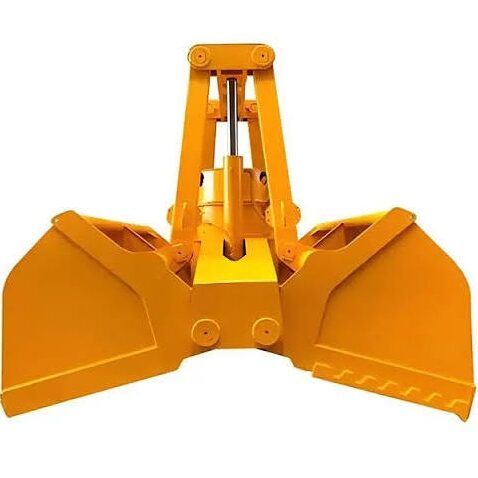
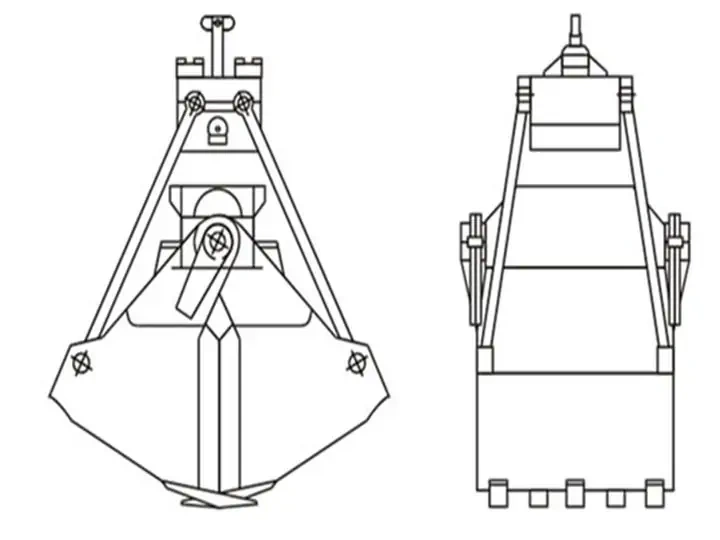
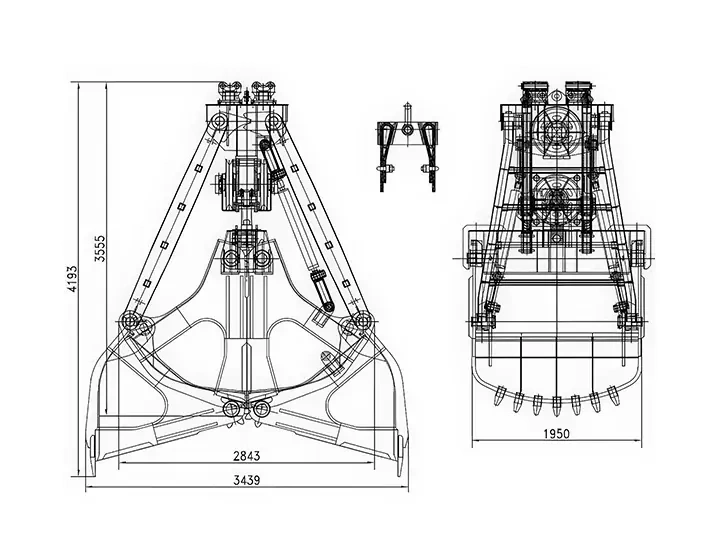
A clamshell grab — also called a clamshell bucket or grab bucket — is a mechanical or hydraulic crane attachment designed for bulk material handling. It consists of two symmetrical bucket shells hinged together at the top. When the shells open, they penetrate the material surface. When they close, they capture a volume of material that is then lifted, transported, and discharged at the target location.
Main Functions
Clamshell grabs perform four core functions in bulk material handling operations:
- Excavation and scooping: Penetrating the material pile or seabed and capturing a defined volume
- Lifting and transport: Holding the closed load securely during crane travel
- Precise discharge: Releasing material accurately at the target position
- Repeated cycling: Handling continuous high-frequency loading and unloading operations reliably
How a Clamshell Grab Works
The operating cycle of a clamshell grab follows a consistent sequence. Understanding each stage helps operators optimize crane coordination and handle different material types effectively.
- Step 1 Lowering the Grab
- The crane lowers the open clamshell grab toward the material pile or cargo hold. For rope-operated grabs, the closing rope slackens to allow the shells to open under gravity. For hydraulic grabs, the cylinders extend to open the shells during descent.
- Step 2 Opening the Shells
- Shells open to their maximum width as the grab descends. Opening width determines how large an area the grab can engage in a single cycle. Wider opening improves penetration in loose, low-density materials.
- Step 3 Closing Around the Material
- Contact with the material surface triggers the closing action. In rope-operated designs, the closing rope is tensioned by the crane hoist, pulling the shells together through the pulley block system. In hydraulic designs, cylinders retract to drive the shells closed. The closing force determines how effectively the grab penetrates and retains the material.
- Step 4 Hoisting the Load
- With the shells closed and the load secured, the crane hoists the grab to the required travel height. Load distribution between the two shells is governed by the closing mechanism geometry. A well-designed grab maintains consistent closing pressure throughout the lift.
- Step 5 Traveling to the Discharge Point
- The crane traverses to the discharge position — a hopper, vessel hold, storage pile, or conveyor. Travel speed and anti-sway control affect the stability of the loaded grab during this phase, particularly for heavy or asymmetric loads.
- Step 6 Opening and Releasing the Material
- At the discharge point, the shells open and the material falls by gravity. For rope grabs, the closing rope slackens and the shells open under their own weight. For hydraulic grabs, cylinders extend to open the shells at a controlled rate. After discharge, the grab returns to the collection point and the cycle repeats.
Main Components of a Clamshell Grab
| Component | Function |
|---|---|
| Grab shells | The two hinged bucket halves that capture and retain material. Shell geometry, cutting edge profile, and wear plate specification determine penetration performance and service life. |
| Hinge pins | The central pivot points around which the shells rotate. High-strength alloy steel pins with hardened surfaces resist the bending and wear loads imposed during closing. |
| Closing mechanism | The rope pulley system or hydraulic cylinder arrangement that drives shell closure. Mechanism design determines closing force, speed, and energy efficiency. |
| Pulley blocks | In rope-operated designs, pulley blocks multiply the closing rope force to generate the shell closing load required for the material being handled. |
| Wire rope / hydraulic cylinders | The energy transmission elements. Wire rope carries closing load in rope grabs; hydraulic cylinders provide closing force in hydraulic and electro-hydraulic designs. |
| Suspension frame | The upper structural frame connecting the grab to the crane hook. Frame design must accommodate both the static load of the grab and the dynamic forces during opening, closing, and travel. |
| Bearings | Pivot bearings at hinge points and pulley blocks allow rotation under load. Sealed or grease-nipple-equipped bearings extend service intervals in dirty operating environments. |
| Cutting edges | Hardened steel edges on the shell lower lips that penetrate and cut through the material surface. Replaceable cutting edges extend shell service life significantly. |
| Wear plates | Replaceable liner plates on the inner shell surfaces protect the structural shell from abrasion. Wear plate material is selected for the specific abrasiveness of the material being handled. |
Clamshell Grab vs Other Grab Bucket Types
| Grab Type | Best Material | Power Source | Typical Application |
|---|---|---|---|
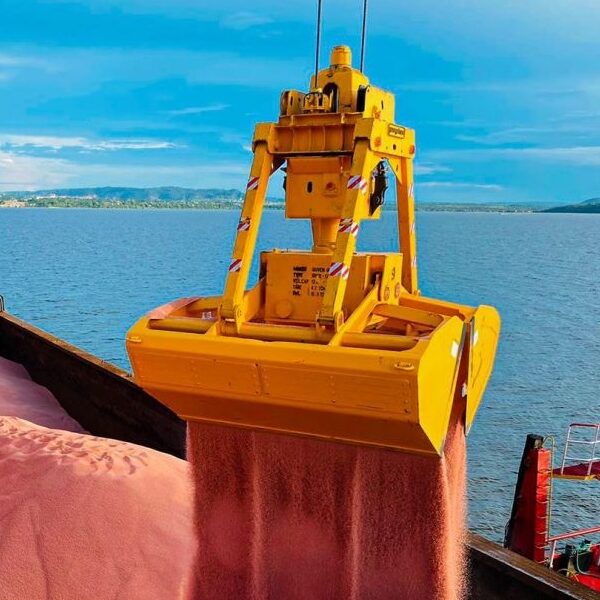
| Clamshell grab | Sand, coal, ore, grain, waste | Rope or hydraulic | Ports, steel mills, power plants, dredging |
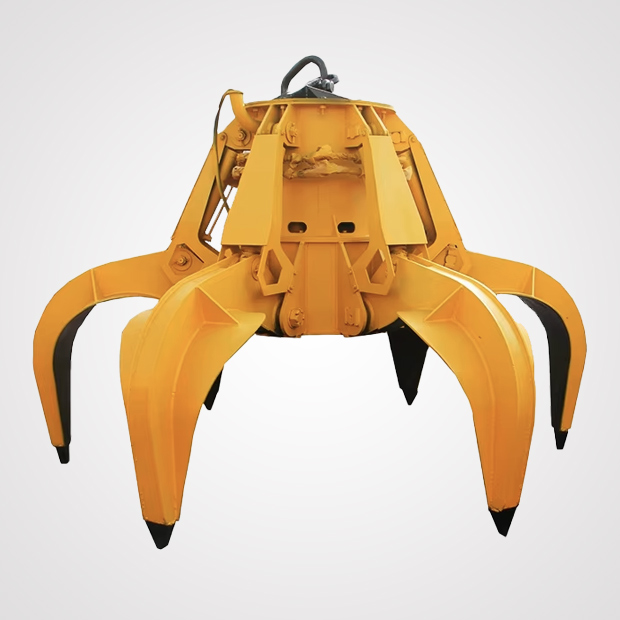
| Orange peel grab | Scrap metal, demolition waste, logs | Hydraulic | Scrap yards, recycling facilities, steel mills |
| Hydraulic grab bucket | Mixed bulk materials, precise discharge | Hydraulic | High-precision applications, waste handling |
| Rope grab bucket | Loose bulk materials, high-cycle port operations | Wire rope | Harbor cranes, ship unloaders, storage yards |
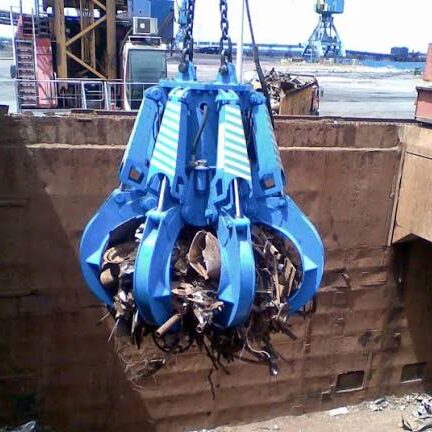
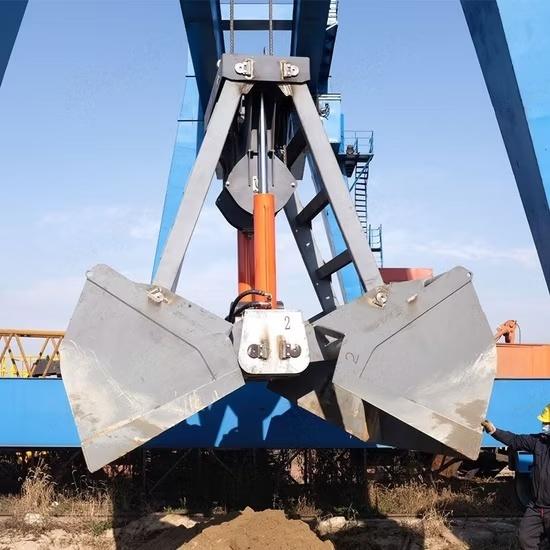
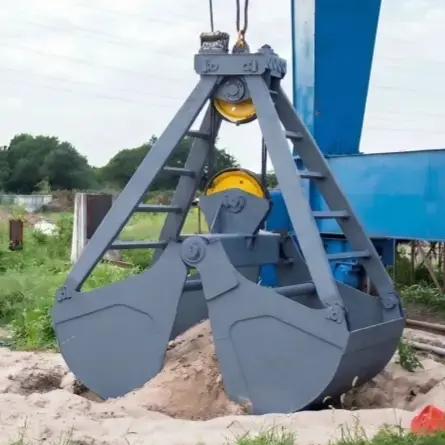
The primary distinction between a clamshell grab and an orange peel grab is shell geometry. Orange peel grabs use three or more curved shells arranged radially — better suited to irregular, interlocked materials like scrap metal that require the shells to penetrate from multiple directions simultaneously. Clamshell designs with their two opposed shells are more efficient for loose, granular, or flowable bulk materials.
Industrial Applications of Clamshell Grabs
Ports and Terminals
Port terminals use clamshell grabs extensively for bulk cargo unloading from vessels and loading onto conveyors, hoppers, or storage piles. Coal, iron ore, grain, fertilizer, and cement clinker are among the most common materials handled. Ship unloaders and harbor gantry cranes typically use four-rope or electro-hydraulic grabs rated for high cycle frequencies and large grab capacities — often 10 to 30 cubic meters per grab — to achieve the throughput rates that port operations require.
Mining Industry
Surface mining operations use clamshell grabs for ore and waste rock handling in situations where the excavation geometry — deep, narrow pits or confined quarry faces — makes other equipment less practical. Grab cranes provide vertical access to depths that excavators cannot reach efficiently, and their cycle time in repetitive dig-and-dump operations is competitive with alternative equipment for the right site conditions.
Steel Plants
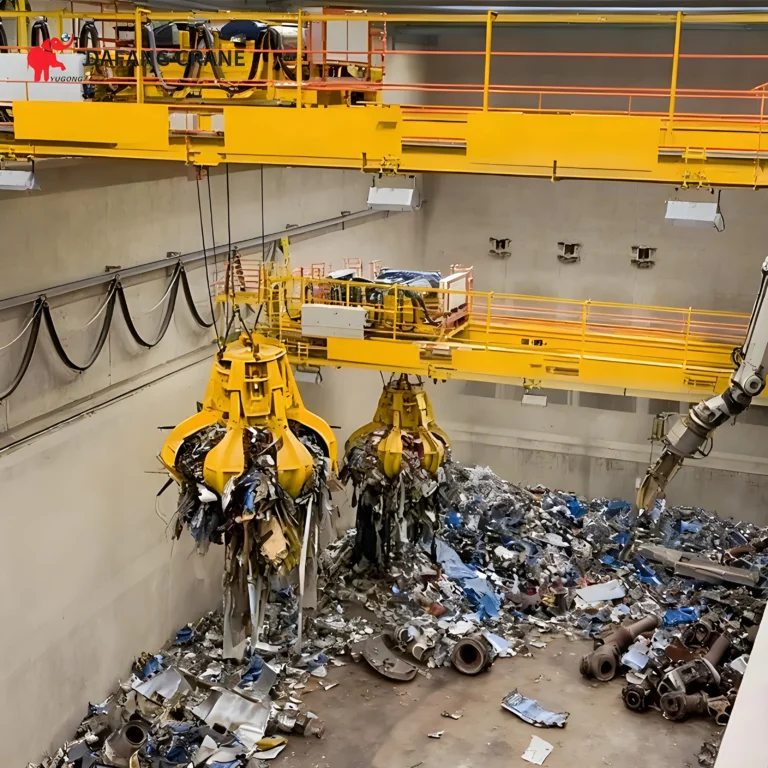
Steel mills use clamshell grabs for scrap metal charging, raw material handling in ore yards, and slag and waste removal. Scrap yard overhead cranes typically use orange peel grabs for irregular scrap, while coal and ore storage yard cranes use clamshell configurations for granular bulk materials. Duty cycles in steel plant applications are intensive — M7 to M8 classification — requiring grab designs engineered for continuous heavy-duty operation.
Waste-to-Energy Plants
Waste-to-energy facilities use clamshell and orange peel grabs to handle municipal solid waste in the receiving hall — mixing, homogenizing, and feeding the combustion chamber. These applications require grabs resistant to the highly abrasive, corrosive, and chemically variable nature of waste material. Sealed bearings, corrosion-resistant coatings, and wear-resistant shell liners are standard requirements.
Recycling Facilities
Material recovery facilities and recycling plants use grab buckets for sorting, consolidating, and transferring recyclable materials — metals, glass, paper, and mixed waste streams. The variable and often irregular nature of recyclable materials makes hydraulic grabs with adjustable closing force preferable for precise, controlled handling.
Dredging Projects
Marine dredging operations use clamshell grabs mounted on crane barges or pontoons to excavate harbor channels, river beds, and offshore sediment. Dredging grabs are designed for operation in saturated, submerged conditions and must maintain watertight closure during the hoist phase to prevent material loss. Stainless steel fittings and marine-grade coatings are standard specifications for saltwater dredging applications.
Sand and Gravel Plants
Sand and gravel quarries and processing plants use rope-operated clamshell grabs for stockpile management and feeding processing lines. The consistent, free-flowing nature of these materials suits standard two-rope or four-rope designs, and the relatively low abrasiveness extends cutting edge and wear plate service life compared to harder mineral applications.
Grain Handling
Grain terminals and storage facilities use clamshell grabs for ship unloading and inter-silo transfer. Grain handling grabs require smooth, sealed interior surfaces to minimize product retention and contamination risk, and stainless steel or food-grade coated components for facilities with hygiene requirements. Gentle closing action — avoiding excessive impact that could damage grain — is a specification consideration for high-value grain cargoes.
How to Choose the Right Clamshell Grab
Material Characteristics
The physical properties of the material being handled drive most selection decisions. Particle size, flowability, moisture content, density, abrasiveness, and corrosiveness all affect shell geometry, cutting edge design, wear plate specification, and material selection. Free-flowing dry materials suit standard shell geometries; wet, sticky materials may require wider opening angles and smoother shell surfaces to prevent bridging and retention.
Bulk Density
Bulk density determines the weight of material captured per cycle for a given grab volume. High-density materials — iron ore at 2,000–2,500 kg/m³, for example — limit the practical grab volume to remain within the crane's safe working load. Confirm that the loaded grab weight — grab dead weight plus material weight — falls within the crane's rated capacity with the required safety margin.
Grab Capacity
Grab geometric capacity (volume) is selected based on the crane's lifting capacity, material bulk density, and cycle time requirements. Larger grabs complete fewer cycles per hour at higher loads per cycle; smaller grabs cycle faster at lower loads. Optimize grab capacity against crane speed and throughput target rather than simply maximizing volume.
Crane Lifting Capacity
The crane must lift the loaded grab — material plus grab dead weight — within its rated safe working load with a minimum 25% safety margin. For rope grabs, confirm that the crane hoist rope arrangement is compatible with the grab's rope system requirements.
Working Environment
Offshore, coastal, and humid environments require corrosion protection specifications beyond standard industrial coatings. High-temperature environments — near furnaces or in steel plants — affect lubrication selection and seal material choices. Explosive atmosphere requirements (ATEX) impose specific electrical component specifications for electro-hydraulic designs.
Duty Cycle
High-frequency, continuous operation demands grabs engineered to ISO 4301 heavy duty classifications. Structural fatigue life, bearing service intervals, wear plate thickness, and cutting edge replacement frequency must all be matched to the actual operating cycle frequency — not an estimated average.
Opening Width and Shell Design
Opening width determines the plan area the grab engages per cycle. Wider-opening grabs perform better in loose, low-resistance materials; narrower designs concentrate closing force for penetrating compacted or cohesive materials. Shell curvature and cutting edge angle affect penetration efficiency for the specific material being handled.
Advantages of Clamshell Grabs
Clamshell grabs deliver several operational advantages that make them the preferred bulk handling attachment across a wide range of industrial applications:
- High handling efficiency. A well-matched clamshell grab completes full loading and unloading cycles faster than manual or conveyor-only alternatives in many bulk cargo scenarios.
- Reduced labor requirements. Crane and grab handling replaces manual shoveling, excavation, or loader operation — reducing labor cost and removing workers from hazardous material exposure.
- Large material capacity per cycle. Modern port-grade clamshell grabs handle 10 to 30 cubic meters per cycle, enabling high throughput rates with a single crane system.
- Versatility across material types. With appropriate shell geometry and cutting edge selection, clamshell grabs handle materials ranging from fine grain through coarse ore to demolition debris.
- Reliable mechanical operation. The fundamental rope-and-pulley or hydraulic cylinder closing mechanism is mechanically straightforward and has demonstrated durability over decades of heavy industrial use.
- Easy crane integration. Rope-operated grabs connect to standard crane hoist systems without additional infrastructure. Electro-hydraulic grabs require only electrical power supply from the crane.
Safety Considerations
Safe operating procedures. Establish and enforce written procedures for grab attachment, detachment, and operation. No personnel should be positioned beneath a loaded or open grab at any time.
Overload prevention. Confirm that the loaded grab weight — at maximum material fill — does not exceed the crane's rated safe working load. Install crane overload protection systems and confirm that grab weight is included in the lift plan calculation.
Proper crane matching. Verify that the grab's rope system, weight, and closing force requirements are compatible with the crane's hoist capacity, rope arrangement, and structural rating before commissioning. Mismatched equipment is a primary source of grab and crane damage.
Operator training. Grab crane operators require specific training covering grab operation, material behavior, load estimation, and emergency procedures. Competency should be assessed and documented before operators work independently.
Routine inspection compliance. Enforce daily pre-operation inspections and document results. Remove equipment from service immediately when inspection reveals conditions that meet discard criteria. Do not defer safety-related maintenance.
Emergency stop procedures. All grab crane systems should have clearly identified and tested emergency stop functions accessible to the operator and — where possible — to a ground-based observer. Emergency stop activation procedures should be part of operator training.
Conclusion
The clamshell grab is one of the most versatile and widely deployed crane attachments in bulk material handling. Its two-shell design efficiently captures, lifts, transports, and discharges a broad range of granular and loose bulk materials across port, mining, steel, waste, and dredging applications. Selecting the right configuration — rope-operated, hydraulic, or electro-hydraulic — depends on the material being handled, the crane system available, the precision required during discharge, and the duty cycle intensity of the operation.
Correct specification requires defining material characteristics, bulk density, required grab capacity, crane lifting capacity, operating environment, and duty cycle before approaching a supplier. A grab that is matched to the actual operational conditions — not simply the nearest standard catalogue size — delivers better throughput, lower maintenance cost, and longer service life.
Contact our engineering team to discuss your bulk material handling requirements.
We supply customized clamshell grabs, hydraulic grab buckets, and rope grab systems across the full capacity range — with technical support from initial selection through to commissioning and lifecycle maintenance planning.

Frequently Asked Questions
Q1: What materials can a clamshell grab handle?
Clamshell grabs handle a wide range of bulk materials including coal, iron ore, bauxite, limestone, sand, gravel, grain, fertilizer, cement clinker, municipal solid waste, recycled materials, and dredged sediment. Material selection affects shell geometry, cutting edge profile, wear plate specification, and closing force requirement. Free-flowing granular materials suit standard designs; wet, sticky, or cohesive materials require specific shell geometries and higher closing forces to prevent bridging and shell adherence.
Q2: What is the difference between a clamshell grab and an orange peel grab?
The primary difference is shell configuration and the materials each handles best. A clamshell grab uses two opposed shells hinged at the top — well suited to loose, granular bulk materials that flow freely into the open shells. An orange peel grab uses three or more curved shells arranged radially around a central axis — better suited to irregular, interlocked materials such as scrap metal, demolition debris, and timber that require multi-directional penetration. For bulk cargo handling in ports and industrial facilities, clamshell designs dominate; for scrap yards and recycling operations, orange peel designs are more common.
Q3: What is a hydraulic grab bucket?
A hydraulic grab bucket is a grab crane attachment that uses hydraulic cylinders — rather than rope tension — to open and close the shells. The hydraulic system provides independent shell control: the operator can open or close at any hoist position, adjust closing force for different materials, and discharge material with precise control. Hydraulic grabs are heavier and more expensive than rope equivalents but offer superior operational precision. Electro-hydraulic designs integrate the complete hydraulic power unit — motor, pump, and valves — directly into the grab body, requiring only electrical power from the crane.
Q4: Which cranes use clamshell grabs?
Clamshell grabs are compatible with overhead bridge cranes, gantry cranes, harbor cranes, ship unloaders, floating cranes, and crane barges. The crane must have sufficient hoist capacity to lift the loaded grab — material weight plus grab dead weight — within its rated safe working load with an appropriate safety margin. Rope-operated grabs connect to standard crane hoist systems; hydraulic grabs require hydraulic or electrical power supply from the crane to the grab. Confirm compatibility between the grab's system requirements and the crane's hoist arrangement before procurement.
Q5: Can a clamshell grab be customized?
Yes. Leading grab bucket manufacturers offer customization across all major parameters: capacity and shell volume, opening width and shell geometry, cutting edge profile and material for the specific bulk material being handled, wear plate specification and thickness, corrosion protection systems for marine or chemical environments, hydraulic system configuration and control integration, and structural reinforcement for high-duty-cycle heavy industrial applications. Customization ensures the grab is optimized for the specific material, crane, and operating environment — rather than adapted from a standard design that may not match actual requirements.