






Every vessel, regardless of size or purpose, periodically needs to leave the water. Bottom inspections, antifouling treatment, propeller and shaft maintenance, hull repairs, and seasonal storage all require the vessel to be lifted clear of the waterline and supported on land. For the vast majority of marinas, yacht service centers, and commercial shipyards, the marine travel lift is the equipment that makes this possible.
Marine travel lifts are the most widely used vessel handling solution in professional marina and shipyard operations worldwide. Their combination of high lifting capacity, operational mobility, and compatibility with a wide range of vessel types has made them the standard tool for vessel haul-out and launch operations across the full spectrum of the marine industry — from small recreational boat marinas to naval shipyards handling vessels of several hundred tons.
This article provides a comprehensive explanation of what marine travel lifts are, how they work, the types available, their applications across industry sectors, and the factors that influence equipment selection.
Table des matières
Qu'est-ce qu'un élévateur de voyage marin ?
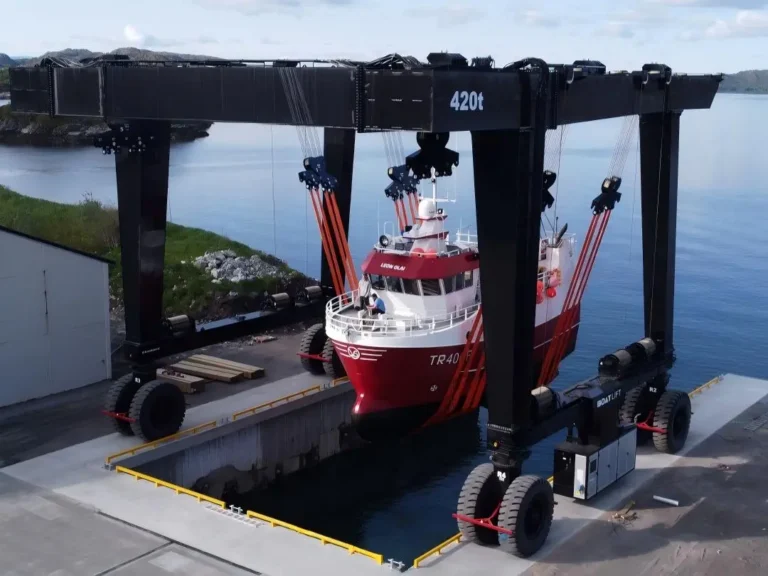
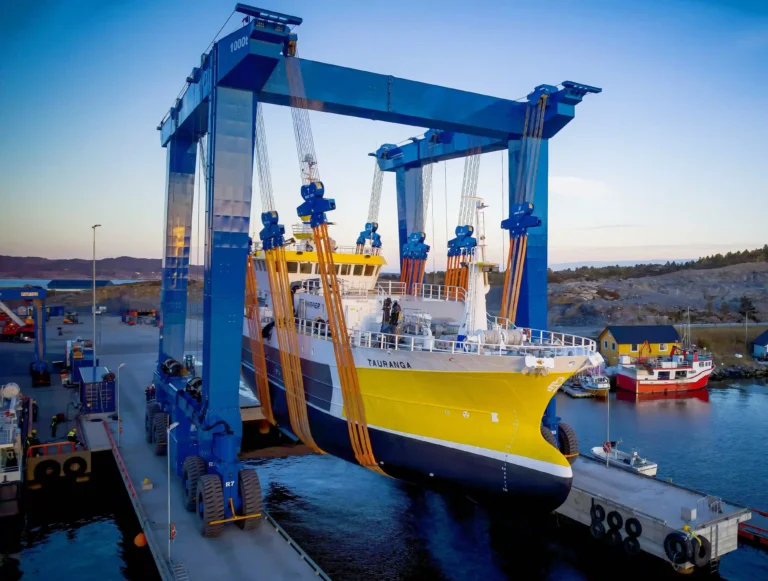
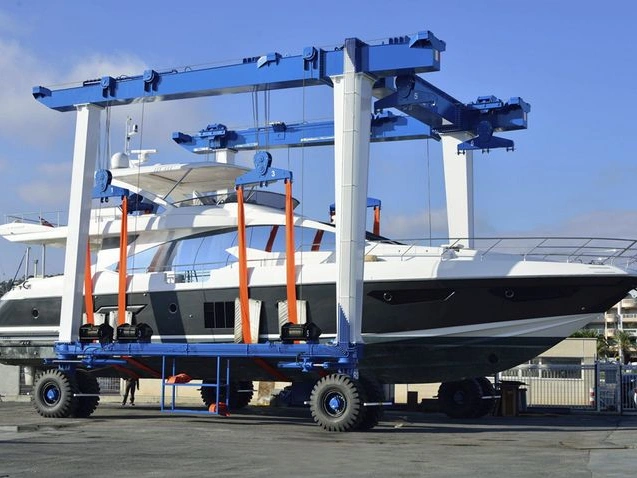
A ascenseur marin is a self-propelled, rubber-tyred gantry crane purpose-designed for lifting vessels from the water, transporting them across a yard surface, and positioning them for storage, maintenance, or re-launching. The machine straddles the vessel in the water at a dedicated haul-out slip, engages the hull using adjustable fabric sling beams, and lifts the vessel clear of the water using a synchronized hydraulic system.
Unlike conventional industrial cranes, which are designed for general cargo lifting at fixed or limited positions, a marine travel lift is engineered specifically for the geometry, load distribution requirements, and environmental conditions of vessel handling. The machine travels freely throughout the yard on its rubber-tyred bogies, positioning vessels precisely in storage rows or at maintenance stations without requiring fixed lifting infrastructure at each point.
Obtenir un devis gratuit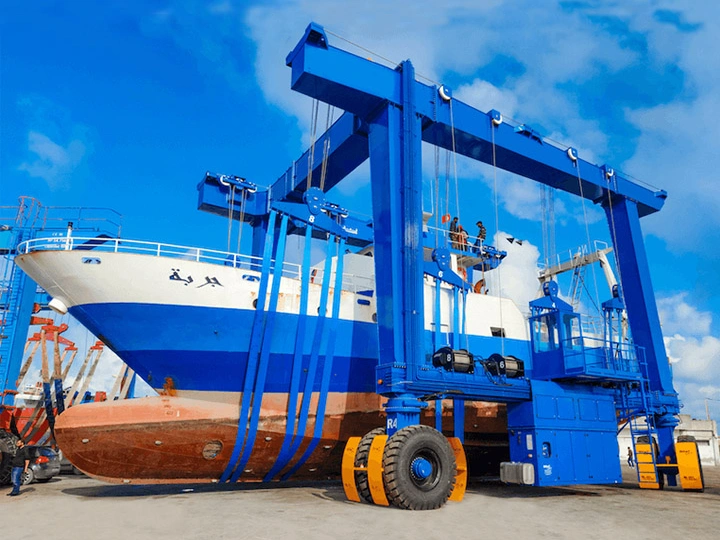
Main Functions
The marine travel lift performs four primary operational functions:
- Lifting vessels from the water: The machine positions over the vessel at the haul-out slip, lowers sling beams under the hull, and hydraulically lifts the vessel clear of the water surface.
- Transporting vessels on land: Once lifted, the machine carries the vessel across the yard surface to the designated storage or service location under full control of the operator.
- Supporting maintenance operations: Vessels can be held suspended in the travel lift slings during specific maintenance tasks, or lowered precisely onto support cradles or keel blocks for extended maintenance periods.
- Launching vessels: The process reverses to return the vessel to the water, with precise hydraulic control ensuring a smooth, controlled re-entry.
How Does a Marine Travel Lift Work?
The operating sequence of a marine travel lift follows a defined process that ensures vessel safety throughout the haul-out or launch operation.
Step 1: Positioning Over the Vessel
The travel lift operator drives the machine to the haul-out slip and positions the gantry frame directly over the vessel in the water. The machine's steering system — which may include all-wheel and crab steering — provides the precise lateral and longitudinal positioning needed to align the sling beams with the vessel's designed lift points.
Step 2: Sling Placement
With the machine positioned, the sling beams are lowered into the water and the fabric slings are guided under the hull at the specified lift point locations. Sling positioning is critical: incorrect placement can cause uneven load distribution, hull stress, or damage to underwater appendages. The sling beam width is adjusted to match the vessel's beam, ensuring the slings engage the hull at appropriate angles.
Step 3: Hydraulic Lifting
The hydraulic lifting system raises all sling beams simultaneously under synchronized control. The synchronization system continuously monitors the rate of rise at each lift point and adjusts hydraulic flow to keep the vessel level throughout the lift. As the vessel leaves the water, the operator confirms stable suspension before proceeding.
Step 4: Vessel Transportation
With the vessel lifted to the required transit height, the operator drives the travel lift across the yard surface to the destination location. Travel speed is controlled to ensure smooth, stable transport of the suspended vessel. Anti-sway measures — either passive through sling geometry or active through control system inputs — minimize vessel movement during transit.
Step 5: Maintenance or Storage Positioning
At the destination, the vessel is lowered onto pre-positioned support cradles or keel blocks. The operator controls the lowering rate and final position with precision, ensuring the vessel is correctly seated on the supports before releasing the sling load.
Step 6: Launching Back Into Water
For the launch operation, the sequence is reversed. The travel lift positions over the vessel on its cradles, slings are re-attached, the vessel is raised, transported to the haul-out slip, and lowered into the water under controlled hydraulic descent until floating freely.
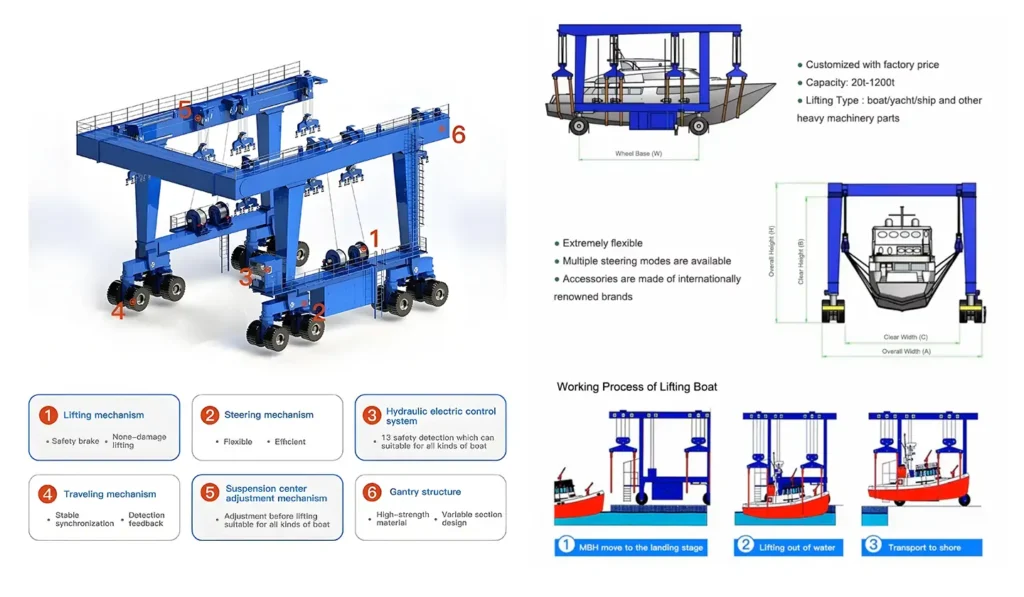
Main Components of a Marine Travel Lift
Main Steel Structure
The main steel gantry frame is the primary load-bearing element of the travel lift. It consists of two vertical leg assemblies connected by horizontal cross-girders at the top, forming a portal structure that straddles the vessel. The frame is designed to carry the full rated lifting load, plus the dynamic loads generated during travel with a suspended vessel, while maintaining structural integrity over decades of cyclic loading.
Gantry frames are fabricated from structural steel — typically S355 or equivalent high-strength grade — using welded construction with extensive quality control of weld joints. Frame geometry determines the machine's inside clear width (the maximum vessel beam that can be accommodated) and the lifting height available above the dock surface.
Système de levage hydraulique
The hydraulic lifting system generates the force required to raise and lower the vessel. It consists of hydraulic cylinders mounted on each sling beam carriage, a hydraulic power unit (pump, reservoir, and control valves), and a synchronization system that coordinates cylinder movement.
Synchronization ensures that all lifting cylinders rise and lower at equal rates, keeping the vessel horizontal throughout the operation regardless of uneven load distribution between lift points. Modern systems use electronic proportional valve control with position feedback to achieve synchronization accuracy within millimeters.
Système d'élingue
The sling system is the interface between the machine and the vessel hull. Marine-grade woven polyester webbing slings are the standard material, combining high tensile strength with flexibility and hull-friendly contact characteristics. Slings are fitted to adjustable sling beams that can be repositioned along the cross-girders to match the vessel's required lift point spacing.
Sling beam width is adjustable to suit different vessel beam dimensions. The number of sling beams — typically two to four depending on machine capacity and vessel length — is selected to distribute the load safely across the hull.
Slings are classified as consumables with a defined service life and must be inspected before each use and replaced when wear, damage, or UV degradation exceeds manufacturer limits. Sling condition is one of the most safety-critical factors in travel lift operations.
Steering System
Travel lift steering systems control the direction of travel and enable the precise positioning required at haul-out slips and in congested yard areas.
- Front-wheel steering is the basic configuration, with steering applied to the front axle pair. It provides adequate maneuverability for straightforward yard layouts.
- All-wheel steering applies steering control to all axles, enabling tighter turning radii and more precise positioning. All-wheel steering is standard on larger-capacity machines and recommended for facilities with constrained yard geometry.
- Crab steering allows all wheels to turn in the same direction simultaneously, moving the entire machine laterally without rotation. This capability is essential for lateral positioning at haul-out slips and for maneuvering in tight storage rows.
Système d'entraînement
The drive system propels the travel lift across the yard surface and powers the steering and hydraulic systems.
- Diesel-hydraulic systems use a diesel engine to drive a hydraulic pump that powers travel, steering, and lifting functions from a single power source. This configuration is self-contained and operationally independent of grid power, making it suitable for facilities without reliable electrical supply.
- Electric-hydraulic systems connect to the grid via trailing cable or festoon system, using electric motors to drive the hydraulic and travel functions. Electric systems eliminate fuel costs and engine maintenance, produce no direct emissions during operation, and are increasingly preferred in marinas and harbors where emission regulations are tightening.
- Systèmes hybrides combine battery storage with electric drive and a diesel generator for extended range operations. They offer lower emissions than pure diesel systems and operational independence from grid power.
Système de contrôle
The control system governs all machine functions and safety interlocks. Modern travel lift control systems are built around programmable logic controllers (PLCs) with operator interface panels that display machine status, load readings, and diagnostic information.
Operator control may be via a fixed cab on the machine, a trailing pendant station, or a wireless remote control unit that allows the operator to move freely around the machine during sling placement and vessel positioning — improving visibility and operational safety.
Advanced control systems incorporate load monitoring with real-time display of individual sling beam loads, overload alarms, emergency stop systems, and increasingly, IoT connectivity for remote diagnostics and operational data logging.
Types of Marine Travel Lifts
Small Marine Travel Lifts
Small travel lifts in the 10-to-50-ton capacity range serve recreational boat marinas, boat clubs, inland waterway facilities, and smaller yacht havens. They are compact, relatively simple in construction, and designed for the lighter and shorter vessel types typical of recreational boating. These machines typically use front-wheel or basic all-wheel steering and diesel-hydraulic or compact electric drive systems.
Medium-Duty Travel Lifts
Medium-duty travel lifts covering the 50-to-200-ton range are the most widely deployed capacity class in professional marina and yacht service operations. They serve the broad range of sailing yachts, motor yachts, and fishing vessels that make up the majority of the global managed boat fleet. This capacity class is most likely to incorporate all-wheel steering, adjustable span, and a choice of diesel or electric drive.
Heavy-Duty Travel Lifts
Heavy-duty travel lifts in the 200-to-500-ton range serve large motor yachts, commercial workboats, ferries, and offshore support vessels. These machines require more substantial civil infrastructure, wider haul-out slips, and heavier pavement sections. Engineering complexity increases significantly at this capacity level, with more sophisticated hydraulic systems, larger structural sections, and more complex multi-axle drive and steering configurations.
Ultra-Heavy Marine Travel Lifts
Ultra-heavy travel lifts rated from 500 to 1,200 tons and above are purpose-engineered for specific project requirements. They serve naval shipyards, mega-yacht service facilities, and specialized commercial marine operations. These machines are custom-engineered projects involving detailed site-specific structural analysis, custom hydraulic and drive system design, and in many cases classification society approval. Lead times for ultra-heavy travel lifts are typically longer than standard production machines.
Common Applications of Marine Travel Lifts
Ports de plaisance
Marinas are the single largest market for marine travel lifts. Seasonal haul-out programs — lifting hundreds of vessels in autumn for winter storage and returning them to the water in spring — require efficient, reliable vessel handling capability. Marine travel lifts enable marina operators to handle a diverse fleet of monohulls, catamarans, and motor vessels efficiently with a single machine, supporting both storage programs and ongoing maintenance throughout the season.
Chantiers navals
Commercial repair shipyards use travel lifts to haul vessels for hull inspection, bottom painting, antifouling treatment, propeller and shaft work, thruster servicing, and general below-waterline maintenance. Shipyard operations typically involve heavier vessels and higher operating frequency than marina environments, requiring machines with higher duty ratings and more robust component specifications.
ports de pêche commerciale
Fishing vessels require regular maintenance access for hull treatment, gear overhaul, and mechanical servicing. Travel lifts at fishing ports enable rapid haul-out and return-to-service, minimizing the time fishing vessels spend out of the water. Operational efficiency directly affects the economics of fishing operations, making reliable and fast vessel handling a priority.
Yacht Service Facilities
Premium yacht service facilities handling high-value motor yachts and sailing superyachts require vessel handling equipment that combines high capacity with precise load control and zero hull damage risk. Travel lifts at these facilities are typically configured with wider sling beams, finer hydraulic control, and advanced load monitoring to meet the standards expected in the luxury yacht market.
Government and Naval Facilities
Government-operated marine facilities handle a range of vessel types from small patrol RIBs to larger patrol vessels and offshore support craft. Naval procurement typically imposes more stringent certification requirements — classification society approval, compliance with military specifications, and documented quality management processes. Travel lifts in government and naval service may also need to accommodate specialized hull forms and underwater equipment configurations not encountered in commercial marina operations.
Benefits of Marine Travel Lifts
Exceptional Mobility
The defining advantage of the marine travel lift is its ability to move freely throughout the yard. A single machine can serve multiple haul-out slips, storage areas, and service stations within the facility, eliminating the need for fixed lifting infrastructure at each position. As the facility evolves and storage layouts change, the travel lift adapts without infrastructure modification.
Reduced Infrastructure Requirements
Compared with fixed dry docks, synchrolifts, or slipway railway systems, a marine travel lift requires substantially less civil construction. A paved yard surface, a suitable haul-out slip, and utility connections for the machine are the primary infrastructure requirements. This makes travel lifts the most accessible high-capacity vessel handling solution for new marina and shipyard developments.
Amélioration de la sécurité des navires
Synchronized hydraulic lifting ensures that the vessel remains level throughout the haul-out and launch operation, distributing loads evenly across the hull at engineered lift points. Modern load monitoring systems provide real-time feedback to the operator on sling tensions, enabling immediate identification and correction of load imbalances before they cause hull stress or damage.
Faster Maintenance Turnaround
Travel lifts reduce the time between a vessel's arrival at the facility and the start of maintenance work. The haul-out, yard transit, and placement on stands can typically be completed within 30 to 60 minutes for standard-sized vessels by experienced operators. Faster turnaround increases throughput capacity and reduces the number of lay days charged to vessel owners.
Better Yard Space Utilization
The ability to position vessels precisely in the yard — and to reposition them as storage requirements evolve — allows marina and shipyard operators to achieve higher vessel density per square meter of yard area than fixed-infrastructure systems permit. Travel lifts can service vessels stored in close-stacked rows that would be inaccessible to fixed lifting systems.
Cost-Effective Operations
Over a 25-to-30-year service life, a well-specified and maintained marine travel lift delivers a lower cost per lift than most alternative vessel handling systems. Capital cost is spread over a high number of lift cycles, operating costs are predictable, and the machine's versatility means it can continue to serve a changing vessel mix as the facility's business evolves.
Marine Travel Lift vs Marine Boat Hoist
| Fonctionnalité | Élévateur de voyage maritime | Treuil pour bateau marin |
|---|---|---|
| Mobilité | Fully mobile, self-propelled throughout yard | Fixed to fully mobile depending on type |
| Gamme de capacités | 10 tons to 1,200+ tons | de 10 tonnes à plus de 500 tonnes |
| Applications | Diverse vessel mix, high throughput, multi-point operations | Defined vessel types, single or limited lift points |
| Flexibilité | High — serves multiple dock and storage positions | Lower for fixed types; comparable for mobile configurations |
| Infrastructure Requirements | Paved yard surface, haul-out slip, power supply | Lower for fixed installations; similar for mobile types |
| Sling Beam Adjustment | Adjustable within machine range | Dépendant du type |
Marine travel lifts are the preferred solution when operational flexibility, a wide vessel beam accommodation range, and high annual throughput are required. Fixed boat hoists are appropriate for single-point lifting installations with lower throughput requirements and more constrained capital budgets. For most professional marina and yacht service operations, the marine travel lift provides superior long-term operational value.
Marine Travel Lift vs Floating Dry Dock
| Facteur | Élévateur de voyage maritime | Floating Dry Dock |
|---|---|---|
| Investissement initial | Moderate to high depending on capacity | Very high — major marine civil engineering project |
| Flexibilité | High — mobile, serves full yard | Low — fixed position, vessels must be brought to dock |
| Space Requirements | Yard surface plus haul-out slip | Significant water area and mooring infrastructure |
| Capacité | Up to 1,200+ tons for standard designs | Potentially unlimited with sufficient dock size |
| Utilisateurs types | Marinas, yacht service centers, mid-size shipyards | Large commercial shipyards, naval facilities, heavy repair yards |
| Operational Complexity | Moderate — trained operator with single machine | High — requires dock flooding, ballasting, and positioning operations |
| Infrastructure Dependency | Lower — adaptable to existing yard | High — requires dedicated water berth and utility connections |
Floating dry docks are appropriate for large commercial shipyards handling vessels too large for travel lifts, where the economics of high-volume repair throughput justify the capital investment. For the vast majority of marina and yacht service operations — and for many mid-size commercial shipyards — the marine travel lift offers comparable functionality at a fraction of the infrastructure cost and operational complexity.
Important Factors When Selecting a Marine Travel Lift
Vessel Weight
The maximum vessel displacement — at full operational load, not light ship — is the primary capacity driver. Always apply a minimum 20 percent margin above the heaviest vessel currently in the fleet to accommodate future vessel growth and occasional overweight conditions.
Longueur du navire
Length determines the required sling beam spacing range and influences the yard transit turning envelope. Confirm that the machine's sling beam adjustment range covers the longest vessels to be handled.
Vessel Beam
The maximum vessel beam — including any multi-hull vessels — determines the minimum inside clear width required. Confirm that the machine's span accommodates the widest vessel in the fleet with adequate clearance for sling placement on each side.
Plan de la marina
The available haul-out slip dimensions, yard surface area, travel corridor widths, and overhead clearances all constrain machine selection. A site survey should precede equipment specification to confirm that the proposed machine can operate effectively within the facility's physical constraints.
Operating Frequency
Higher annual lift frequency requires a machine with a higher duty classification rating, more robust hydraulic and drive systems, and more intensive maintenance scheduling. Specify based on projected peak-period lift frequency, not annual average.
Conditions environnementales
Coastal salt-air environments, tropical climates, and high-humidity locations impose greater corrosion demands on structural, electrical, and hydraulic components. Machines specified for harsh environments should incorporate enhanced corrosion protection as a primary requirement, not an option.
Future Expansion Plans
Vessel size trends and marina growth trajectories should inform the capacity specification. The incremental cost of additional capacity at initial procurement is consistently lower than the cost of supplementing or replacing undersized equipment within the facility's planning horizon.
Safety Features of Modern Marine Travel Lifts
Modern marine travel lifts incorporate multiple layers of safety systems designed to protect the vessel, the operator, and ground personnel.
- Protection contre les surcharges prevents the machine from lifting loads above the rated safe working load through hydraulic pressure limiting systems that block further lifting if the total sling load exceeds the design threshold.
- Hydraulic safety valves maintain load in the event of hydraulic line failure, preventing uncontrolled lowering of the suspended vessel.
- Load monitoring systems display real-time sling beam loads to the operator, providing immediate feedback on load distribution and warning of imbalances before they reach critical levels.
- Systèmes d'arrêt d'urgence provide immediate cessation of all machine functions from multiple control points, including the operator pendant, cab controls, and in some installations remote emergency stops accessible to ground personnel.
- Anti-collision systems on machines operating in automated or semi-automated environments use proximity sensors to detect obstacles in the travel path and prevent collisions with stored vessels, yard infrastructure, or personnel.
- Remote diagnostics allow manufacturer technical support teams to monitor machine condition and diagnose faults remotely, reducing the time required to identify and resolve technical issues.
Conclusion
Marine travel lifts are the cornerstone vessel handling technology in modern marinas, yacht service facilities, and commercial shipyards worldwide. Their combination of high lifting capacity, full yard mobility, adaptability to diverse vessel types, and relatively low infrastructure requirement makes them the most versatile and cost-effective vessel handling solution across the majority of marine industry applications.
Available in capacities from 10 tons to over 1,200 tons, and configurable with diesel, electric, or hybrid drive systems and varying levels of automation and monitoring technology, marine travel lifts can be specified to meet the requirements of facilities ranging from small recreational marinas to major commercial shipyards.
As the marine industry moves toward lower-emission operations, smarter asset management, and more sustainable infrastructure, marine travel lift technology is evolving in parallel — with electric drive systems, IoT monitoring platforms, and predictive maintenance capabilities becoming increasingly standard features in new equipment specifications.
For any facility where vessels must be regularly lifted, transported, and maintained, the marine travel lift remains one of the most proven and reliable solutions available.
Contact our engineering team for marine equipment consultation and project planning support.

Questions fréquemment posées
Q: What is the difference between a travel lift and a boat hoist?
A marine travel lift is a specific type of mobile boat hoist — the self-propelled, rubber-tyred gantry configuration that is the most widely used vessel handling equipment in professional marinas and shipyards. "Boat hoist" is a broader category that includes travel lifts as well as fixed-installation hoists, rail-mounted systems, and other vessel lifting configurations. When the terms are used interchangeably in the industry, they are most often referring to mobile travel lift-type equipment.
Q: How much weight can a marine travel lift lift?
Marine travel lifts are available in capacities ranging from approximately 10 tons for small recreational marina machines up to 1,200 tons or more for specialized heavy-duty shipyard configurations. The appropriate capacity for a given facility is determined by the maximum operational displacement of the heaviest vessel to be handled, with a minimum 20 percent margin above that figure.
Q: What size travel lift do I need?
Size selection depends on four primary parameters: the maximum vessel displacement at full load, the maximum vessel beam, the required sling beam spacing for the longest vessels, and the available yard and haul-out slip geometry. A complete sizing assessment should also account for the facility's growth trajectory over the equipment's service life. Consult the manufacturer with full vessel fleet data and site dimensions for a specific recommendation.
Q: Are travel lifts suitable for yachts?
Yes — marine travel lifts are widely used for both sailing and motor yachts across all size categories. Smaller travel lifts in the 30-to-75-ton range handle the majority of the global sailing and motor yacht fleet. Larger machines serve the superyacht segment. Sling systems can be configured for both monohull and multi-hull yacht types with appropriate rigging arrangements.
Q : Quelle est la durée de vie d'un élévateur de transport marin ?
Well-designed and properly maintained marine travel lifts have operational service lives of 25 to 30 years. Structural components typically outlast hydraulic and electrical systems, which require scheduled replacement during the machine's life. The quality of initial specification, manufacturing, corrosion protection, and ongoing maintenance determines how the machine ages in service.
Q: What industries use marine travel lifts?
Marine travel lifts are used across a range of marine industry sectors including recreational boat marinas, yacht service and repair centers, commercial fishing ports, commercial shipyards, naval and government marine facilities, ferry operators, and offshore vessel maintenance facilities. The equipment's versatility across vessel types and operating environments makes it applicable wherever vessels need to be regularly removed from the water for maintenance or storage.
Q: What certifications should a marine travel lift have?
Relevant certifications depend on the target market and application. For European facilities, CE marking under the Machinery Directive is required. ISO 9001 quality management certification for the manufacturer is a baseline expectation. FEM crane design classification confirms that the machine is designed for the appropriate duty cycle. For naval or government procurement, classification society approval from bodies such as DNV, Bureau Veritas, or Lloyd's Register may be required. North American facilities should confirm ASME B30 compliance.
Q: Can a marine travel lift handle catamarans?
Yes, with appropriate configuration. The machine's inside clear width must be sufficient to straddle the full beam of the catamaran, and sling rigging must be configured to engage each hull independently with appropriate load distribution. For facilities serving a significant multi-hull vessel population, the required span and sling configuration should be specified explicitly at equipment procurement rather than assumed from standard monohull configurations.