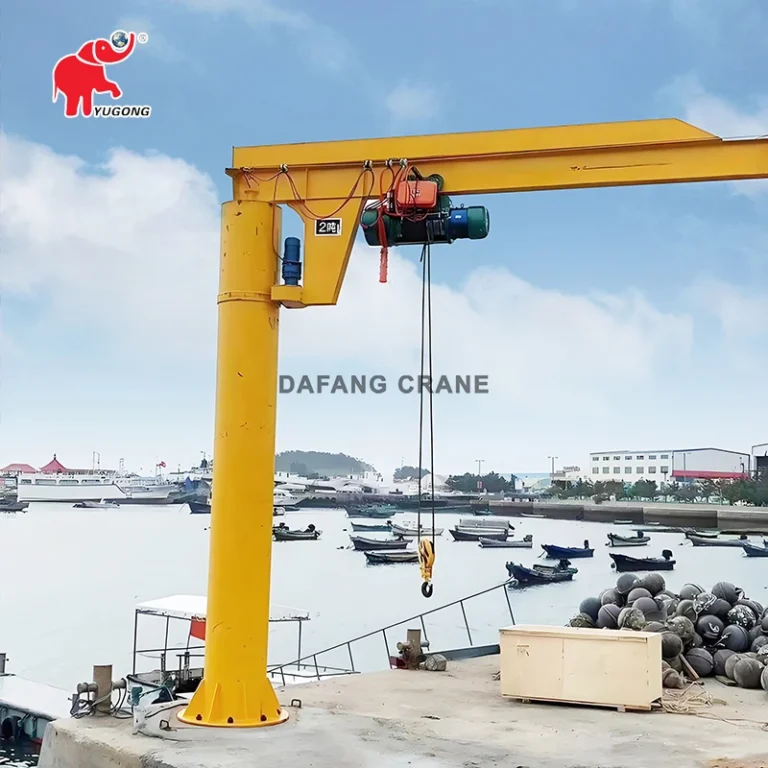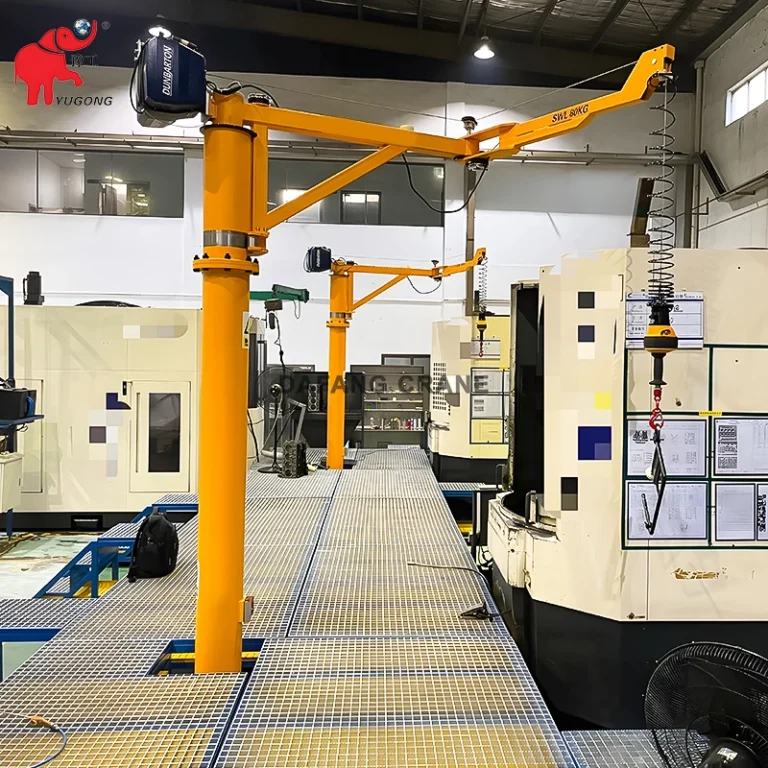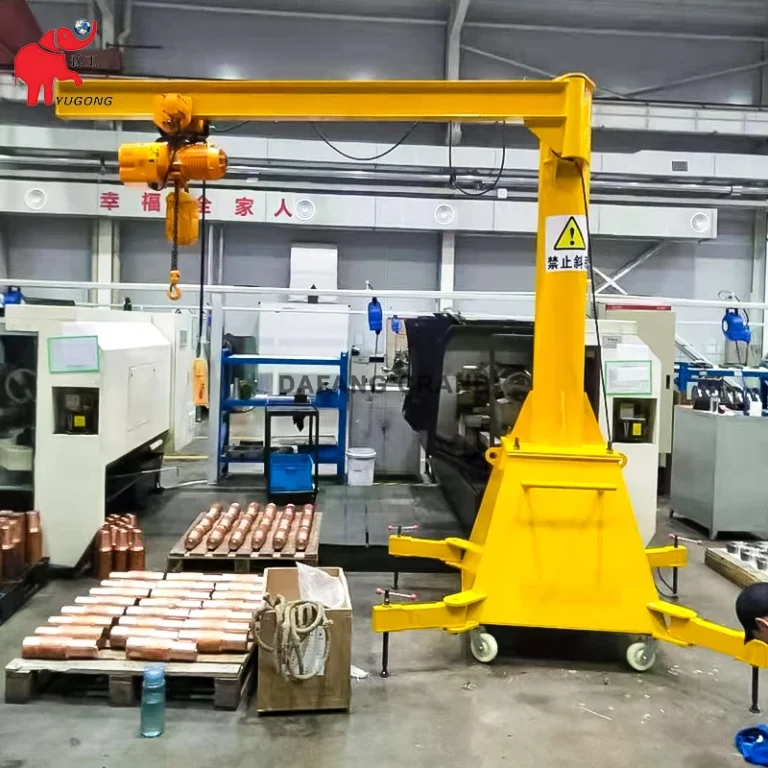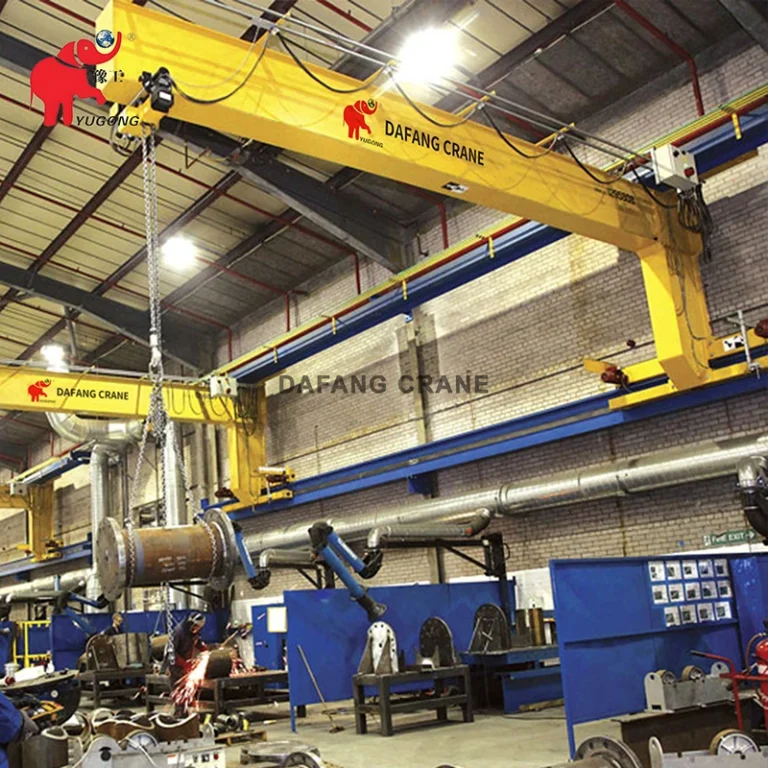







When selecting a jib crane, one of the first decisions a buyer must make is the mounting configuration. Floor mounted jib cranes are freestanding systems installed on a concrete foundation, providing full 360-degree rotation and structural independence from the building. Wall mounted jib cranes attach directly to a building column or wall, eliminating the floor footprint and reducing installation cost, but are limited to approximately 180 degrees of rotation and depend on the building structure for support. The correct choice depends on the available floor and wall space, the required load capacity, the rotation needed to serve all work positions, and the structural characteristics of the facility.
This guide explains both configurations in detail, compares their structural differences, applications, costs, and installation requirements, and provides a structured framework for selecting the right solution.
Tabla de Contenidos
¿Qué es una grúa de pluma montada en el suelo?
Definición
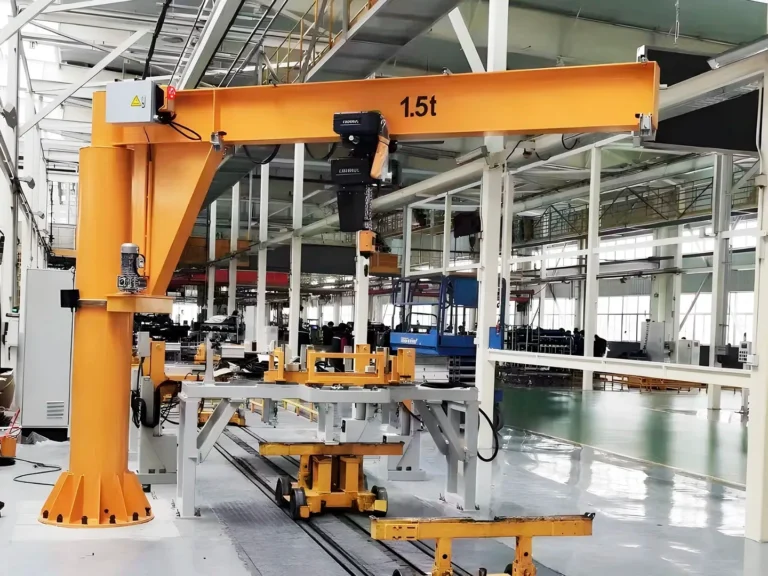
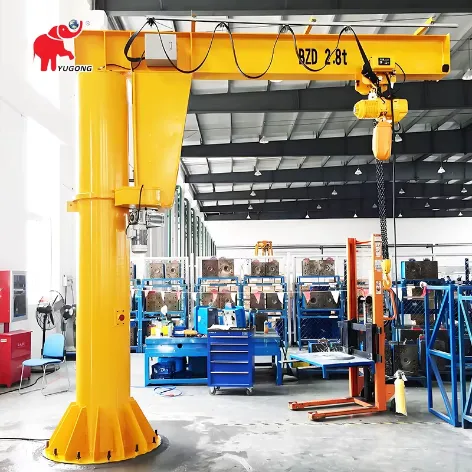
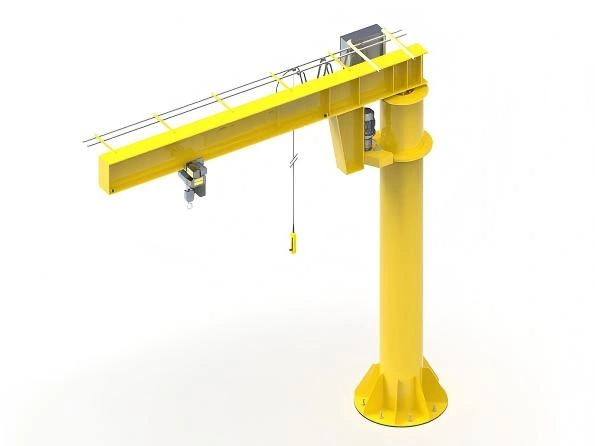
A grúa de pluma montada en el suelo — also referred to as a freestanding jib crane or pillar jib crane — is a jib crane whose central mast is anchored directly to a reinforced concrete floor foundation. The crane is structurally independent, requiring no attachment to any wall, column, or overhead structure for support. All crane loads are transferred through the mast to the foundation and into the floor slab.
Diseño estructural
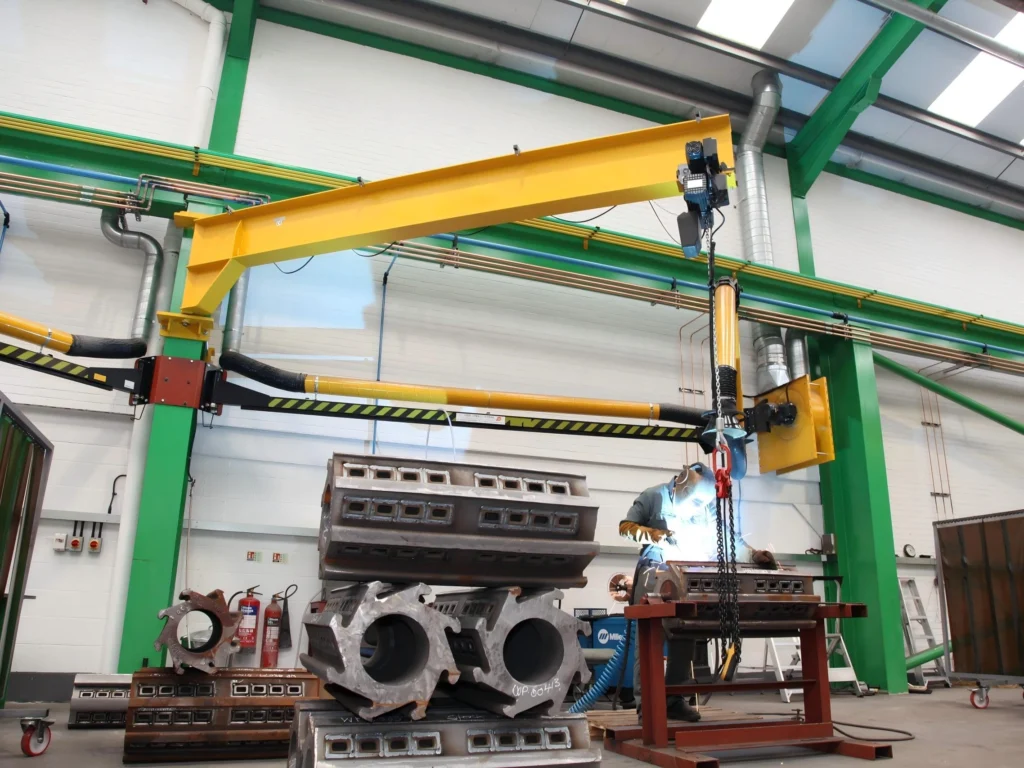
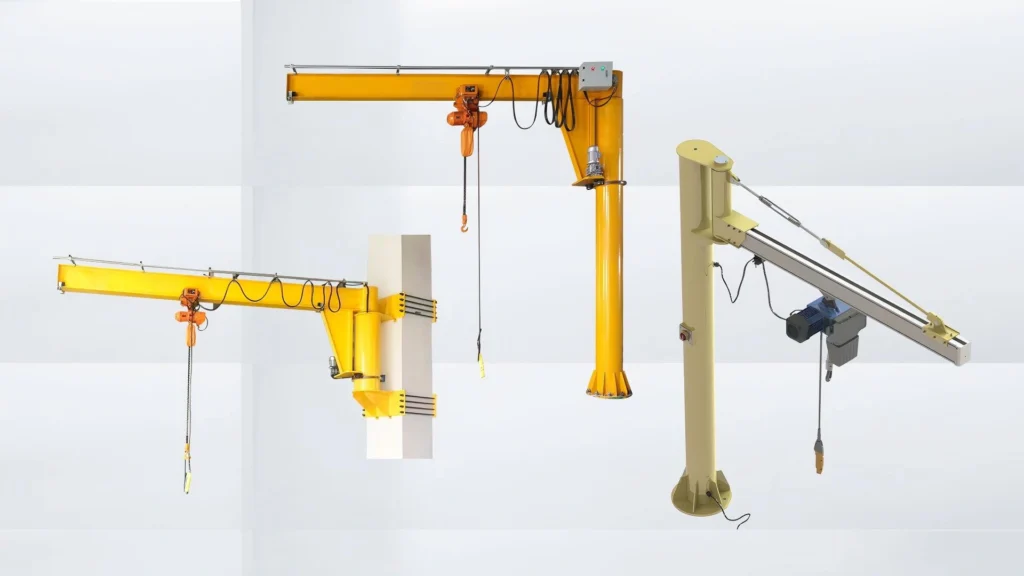
The floor mounted jib crane consists of a vertical steel mast anchored to the floor by a bolt pattern embedded in a purpose-designed reinforced concrete foundation. The jib boom extends horizontally from the top of the mast through an upper trunnion bearing, with a lower tie-rod or brace connecting the outer end of the boom back to the lower section of the mast. This geometry creates a triangulated structure that efficiently resists the bending moment created by the cantilevered load.
The foundation is engineered to the crane's rated capacity and the geotechnical conditions of the site. Foundation design must account for the vertical load (crane weight plus lifted load), the horizontal overturning moment at the base, and the dynamic loads generated by acceleration and deceleration during crane operation.
Main Components
- Mast/column: The vertical structural member anchored to the foundation. Mast height determines the lifting height available beneath the boom and the clearance for the hoist and load during rotation.
- Boom arm: The horizontal cantilever extending from the mast. Boom length defines the crane's working radius. Standard boom lengths range from 2 to 8 meters; longer booms require heavier structural sections and larger foundations.
- Izar: The electric chain hoist or wire rope hoist mounted on the trolley, providing vertical lifting motion.
- Carrito: The carriage that travels along the boom, providing horizontal positioning of the hoist along the boom's length.
- Rotation mechanism: The upper and lower bearings on the mast that allow the boom to rotate. Standard floor mounted jib cranes rotate through 270 to 360 degrees around the mast.
What Is a Wall Mounted Jib Crane?
Definición
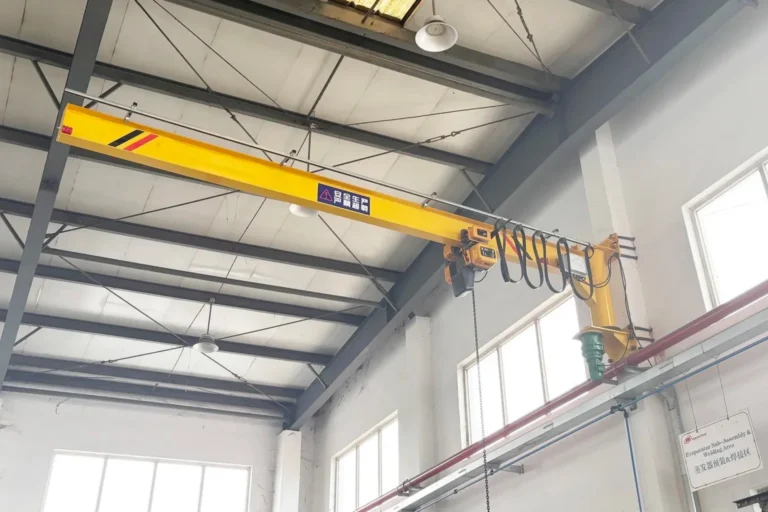
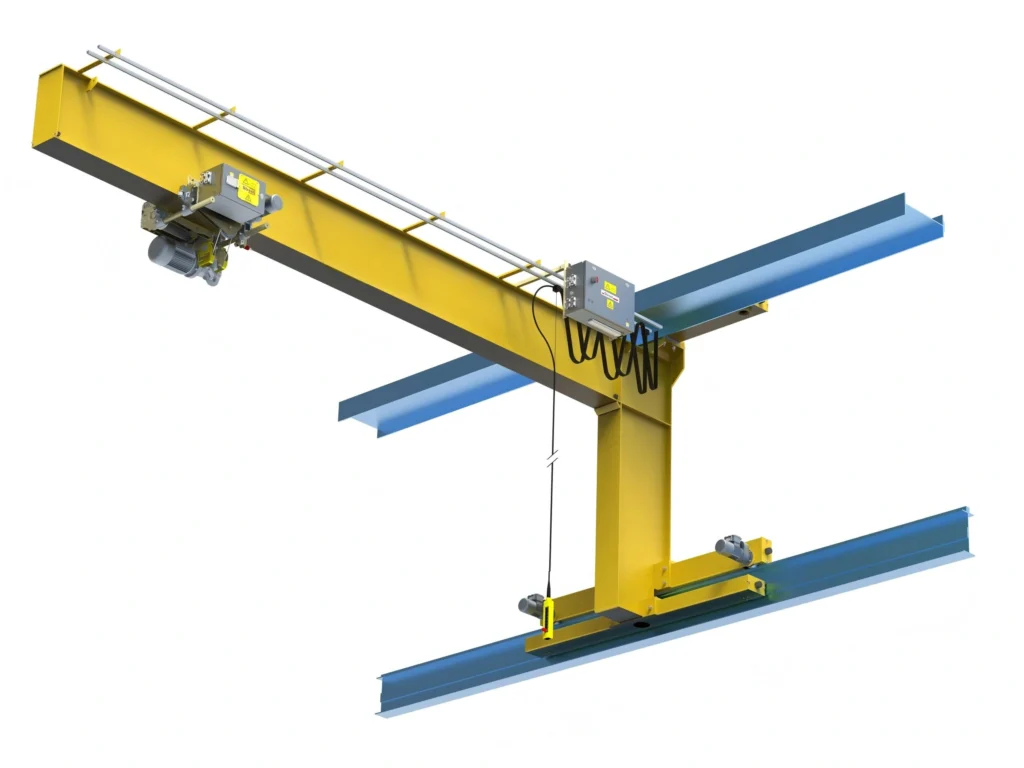
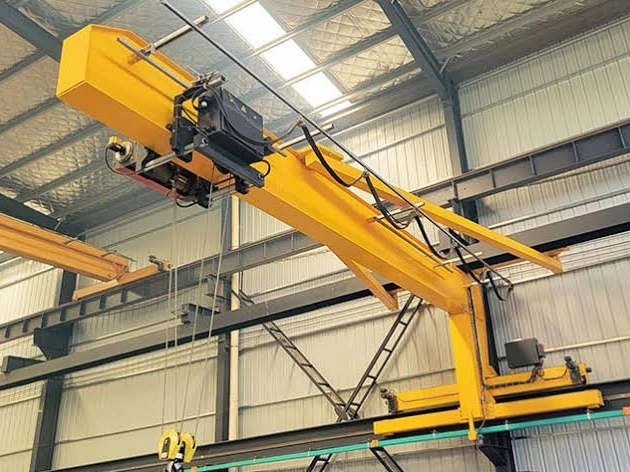
A grúa de pluma montada en la pared is a jib crane attached to an existing building wall, structural steel column, or reinforced concrete column by a bracket assembly, with no floor-level support column or foundation. The building structure carries all crane loads through the wall bracket attachment points.
Diseño estructural
The wall mounted jib crane bracket consists of an upper tie-rod or trunnion and a lower pivot bearing, both anchored to the wall or column at vertically separated attachment points. The vertical spacing between these two attachment points creates a moment couple that supports the cantilevered boom and its load. The boom pivots at the lower attachment and is stabilized by the upper attachment, allowing rotation within the available arc along the wall face.
Main Components
The wall mounted jib crane shares the same boom, hoist, trolley, and rotation mechanism as the floor mounted type. The distinguishing element is the wall bracket assembly — the upper and lower mounting hardware that connects the crane to the building structure and transfers loads into the wall or column.
Installation Requirements
The mounting wall or column must be assessed by a structural engineer to confirm adequate capacity for the vertical load, horizontal pull-out force, and bending moment imposed by the crane at its rated capacity. Anchor bolt specification, embedment depth, and edge distance from the wall face are critical to achieving the required load ratings. Inadequate anchor installation is a primary cause of wall mounted jib crane failures in service.
Wall mounted jib cranes typically rotate through 180 degrees along the wall face. In some configurations, up to 270 degrees of rotation is achievable depending on bracket design and the absence of wall obstructions within the extended arc.
Floor Mounted vs Wall Mounted Jib Crane: Structural Differences
| Característica | Grúa pluma montada en el suelo | Grúa giratoria mural |
|---|---|---|
| Estructura de soporte | Freestanding mast on concrete foundation | Bracket mounted to building wall or column |
| Foundation Requirement | Dedicated reinforced concrete foundation required | No floor foundation — anchors into existing wall |
| Rango de rotación | 270° – 360° standard | Typically 180°; up to 270° in some configurations |
| Complejidad de la instalación | Moderate — foundation excavation and concrete work | Lower — bracket installation on existing structure |
| Rango de capacidad | 0.25 – 10 tons standard; custom above | 0,1 – 5 toneladas estándar |
| Área de cobertura | Full circle or near-circle around mast | Semicircle along wall face |
| Building Dependence | None — structurally independent | Depends on wall/column structural capacity |
| Superficie del piso | Requires mast footprint and clearance zone | No floor space consumed |
| Capacidad al aire libre | Well suited — fully independent | Requires suitable outdoor wall or column |
| Reubicación | Difícil: la base es permanente. | Easier — brackets can be removed and reinstalled |

The structural independence of the floor mounted crane is its defining advantage. It can be positioned anywhere in a facility where a foundation can be installed, regardless of the building's wall or column arrangement. The wall mounted crane's defining advantage is the complete elimination of floor space consumption, at the cost of dependence on the building structure and a reduced rotation range.
Working Principle Comparison
Both crane types perform the same fundamental material handling functions through the same motion axes. The mechanics of each motion are identical — the difference lies in how and where the crane is anchored.
Hoisting Motion
In both configurations, the electric hoist raises and lowers the load vertically. The hoist capacity, speed, and duty class should be selected based on the maximum load weight and the operating frequency — these decisions are the same regardless of mounting configuration.
Trolley Travel
The trolley travels horizontally along the boom in both types, providing the radial axis of load movement within the crane's working zone. Push trolleys require manual positioning; motorized trolleys provide powered travel for faster or more controlled operation. Trolley selection is independent of mounting configuration.
Boom Rotation
Both crane types rotate the boom around the vertical axis of the mast or bracket pivot. The floor mounted crane's full 360-degree rotation creates a complete circular working zone. The wall mounted crane's 180-degree arc creates a semicircular zone in front of the wall. For applications where all load pickup and placement positions fall within a 180-degree arc, the wall mounted crane's rotation range is fully adequate. For applications requiring coverage behind the crane's mounting line, a floor mounted crane with greater rotation range is necessary.
Operator Control
Both types use the same pendant control or radio remote control systems. Control selection — pendant vs remote, variable speed vs fixed speed — is determined by the application requirements, not by the mounting configuration.
Advantages of Floor Mounted Jib Cranes
360-Degree Rotation Capability
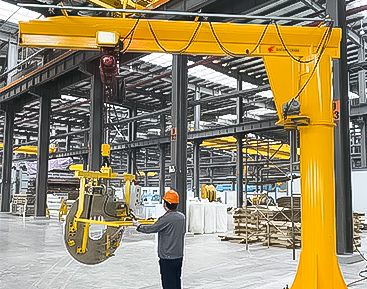
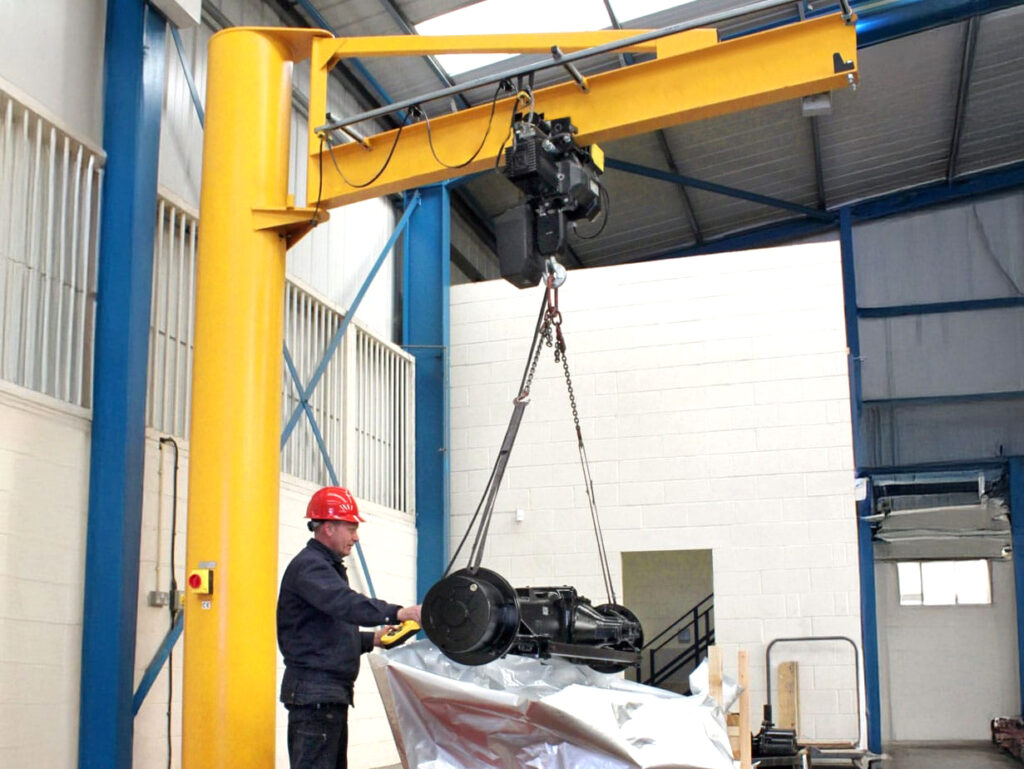
Full circular rotation allows the operator to serve load positions at any angle around the crane mast — directly in front, behind, or to either side. This is essential when load pickup and placement positions are distributed around the crane rather than all concentrated within a forward arc. Machine loading, where the crane must access a machine tool from multiple approach directions, is a typical application where 360-degree rotation provides genuine operational advantage.
Higher Load Capacities
Floor mounted cranes are available in higher standard capacities than wall mounted types, reflecting the greater structural rigidity and load path efficiency of a mast anchored directly to the ground. Custom designs for capacities above 10 tons are feasible with appropriate foundation engineering. This makes floor mounted cranes the appropriate choice for heavy fabrication, large component handling, and applications where loads regularly approach or exceed 5 tons.
Independent Installation
No dependency on the building structure means the floor mounted crane can be installed in any facility, including those with walls and columns that are not structurally adequate for wall-mounted crane loads. It can also be installed outdoors, in temporary structures, or in locations where no building exists.
Flexible Positioning
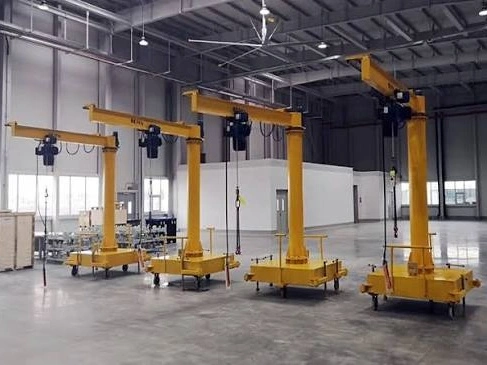
Within any facility, a floor mounted crane can be positioned wherever a foundation is practical — at the center of an open floor area, between rows of equipment, or along a production line. This flexibility is not available with wall-mounted types, which are constrained to locations adjacent to suitable walls or columns.
Suitable for Outdoor Applications
Because the floor mounted crane is self-supporting, it is the natural choice for outdoor material handling — equipment yards, maintenance pads, receiving areas, and outdoor fabrication zones. Wall mounted cranes require an outdoor wall or column of adequate structural capacity, which limits their outdoor applicability.
Advantages of Wall Mounted Jib Cranes
Saves Valuable Floor Space
The complete absence of a floor-level mast or foundation is the most significant practical advantage of the wall mounted jib crane. In production facilities where every square meter of floor area is occupied by equipment, personnel, or traffic routes, eliminating the crane's floor footprint preserves usable space that a floor mounted crane would occupy. In dense production layouts, this is not a marginal benefit — it can determine whether a workstation can be equipped with a crane at all.
Menores costos de instalación
Wall mounted jib crane installation requires anchor bolt work into the existing wall or column structure — a scope that is significantly less extensive than the foundation excavation, reinforcement placement, concrete pouring, and curing time required for a floor mounted crane foundation. Total installed cost for a wall mounted jib crane is generally lower than for a floor mounted crane of equivalent boom length, even when accounting for the structural assessment of the mounting location.
Ideal for Workstations
Production workstations, machine tool cells, and assembly positions located along the wall of a facility are naturally served by wall mounted jib cranes. The 180-degree rotation arc covers all positions in front of the workstation, which in a wall-adjacent layout is all that is operationally needed. Multiple wall mounted cranes at adjacent workstations can serve an entire production line with individual lifting capability at each station.
Efficient Material Flow
A wall mounted crane positioned directly at each workstation enables parts delivery and finished product removal without travel to a central crane or floor-level handling. This localized lifting reduces cycle time and improves material flow efficiency along the production line.
Easy Integration with Overhead Cranes
Wall mounted jib cranes are frequently installed in facilities that also have overhead bridge cranes covering the main bay. The two systems complement each other: the overhead crane handles long-distance material movement across the facility, while wall mounted jib cranes serve individual workstations along the bay walls. The absence of a floor-level mast means the wall mounted jib crane does not interfere with overhead crane travel or floor-level access routes.
Common Applications of Floor Mounted Jib Cranes
Plantas de fabricación
Open floor area manufacturing facilities use floor mounted jib cranes at standalone machine positions — lathes, machining centers, presses, and fabrication fixtures — positioned in the center of the floor away from any wall suitable for crane mounting.
Talleres de fabricación de acero
Heavy steel fabrication requires jib cranes capable of handling plate, structural section, and welded assembly weights that exceed the standard capacity of wall mounted types. Floor mounted cranes with capacities from 2 to 10 tons are common at welding bays and assembly stations in steel fabrication workshops.
Machinery Maintenance Areas
Maintenance workshops require lifting capability at equipment service bays that may not be adjacent to structurally suitable walls. Floor mounted cranes serve these positions with the full rotation needed to approach equipment from any direction during component removal and installation.
Montaje de maquinaria pesada
Assembly stations for large machines, industrial equipment, and structural fabrications require both high capacity and the ability to position loads at any angle around the assembly fixture. Floor mounted cranes with full rotation coverage are the appropriate choice.
Outdoor Material Handling
Equipment storage yards, receiving pads, and outdoor maintenance areas use floor mounted jib cranes because no building structure is available for wall mounting, and the crane must be self-supporting against wind loading and outdoor environmental conditions.
Common Applications of Wall Mounted Jib Cranes
Líneas de producción
Manufacturing production lines arranged parallel to facility walls are the canonical application for wall mounted jib cranes. Individual cranes at each workstation position along the line provide lifting capability exactly where and when it is needed, without mutual interference between adjacent crane zones.
CNC Machining Centers
CNC machining centers positioned against a facility wall use wall mounted jib cranes for workpiece loading and unloading. The crane serves the machine from directly above, providing precise positioning through the machine's access opening without a floor-mounted mast interfering with pallet truck or AGV access to the machine's front face.
Warehouse Picking Stations
Warehouse operations handling goods above comfortable manual lifting weight use wall mounted jib cranes at picking and packing stations to assist operators in moving totes, cartons, and components between shelving, conveyors, and workbenches.
Assembly Workstations
Component assembly stations where sub-assemblies are built up from individual parts use wall mounted jib cranes to handle the heavier components in the assembly sequence, reducing operator fatigue in high-cycle assembly operations.
Packaging Areas
Packaging lines handling heavy products, drums, or bulk containers use wall mounted jib cranes at the packaging station to assist with container positioning, lid placement, and pallet loading operations.
Capacity and Coverage Comparison
| Factor | Grúa pluma montada en el suelo | Grúa giratoria mural |
|---|---|---|
| Typical Standard Capacity | 0.25 – 10 tons | 0,1 – 5 toneladas |
| Rango de rotación | 270° – 360° | 180° standard; up to 270° possible |
| Standard Boom Length | 2 – 8 m | 1.5 – 6 m |
| Forma de cobertura | Full circle or near-circle | Semicircle along wall face |
| Espacio en el suelo requerido | Mast footprint + foundation zone | Ninguno |
| Outdoor Suitability | Full — independent of building | Limited to locations with suitable outdoor walls |
Cost Comparison
- Initial Equipment Cost
- For equivalent boom length and capacity, floor mounted and wall mounted jib cranes have comparable equipment costs. At the lower capacity end (below 2 tons), wall mounted types may be marginally less expensive due to the lighter bracket assembly versus the floor mounted mast. At higher capacities, floor mounted cranes require heavier structural sections that increase equipment cost.
- Costo de instalación
- Wall mounted jib crane installation cost is generally lower than floor mounted installation cost when a structurally suitable wall or column is available. The foundation work for a floor mounted crane — excavation, concrete, reinforcement, and curing time — adds meaningful cost and schedule to the project. The structural assessment required for wall mounting is a relatively modest cost compared to foundation construction.
- Coste de mantenimiento
- Ongoing maintenance costs for both types are comparable. Annual inspection, lubrication, and hoist maintenance requirements are essentially the same. The primary maintenance cost difference is the foundation inspection for floor mounted cranes versus the anchor and wall condition check for wall mounted types — both modest costs.
- Lifecycle Cost and Return on Investment
- Over a 20-year service life, the total lifecycle cost of a wall mounted crane in a facility with a suitable mounting structure is generally lower than that of a floor mounted crane at the same capacity, primarily due to lower installation cost. The floor mounted crane's higher initial cost is offset in applications where its additional capabilities — full rotation, higher capacity, outdoor capability, or independence from building structure — provide operational value that the wall mounted type cannot deliver.
Installation Requirements
Floor Mounted Installation
Foundation design is the critical element of floor mounted jib crane installation. The foundation must carry the vertical load (crane self-weight plus rated capacity), the horizontal overturning moment at the base (proportional to boom length and capacity), and dynamic loads from crane operation. Foundation geometry — depth, diameter or plan area, and reinforcement arrangement — is determined by structural analysis based on the crane's load data and the site's soil conditions.
Installation sequence involves excavation to the required foundation depth, formwork preparation, reinforcement cage placement, anchor bolt template positioning, concrete pouring, and a curing period before crane erection can proceed. Total installation time from excavation to crane commissioning is typically 2 to 4 weeks depending on foundation size and concrete cure time.
Wall Mounted Installation
Wall mounted installation centers on the structural assessment and anchor work. A structural engineer must confirm that the mounting wall or column can carry the crane's loads at the proposed attachment heights. The engineer specifies the anchor bolt type, size, embedment depth, and layout based on the crane manufacturer's load data.
Installation involves drilling or cast-in anchor holes at the specified positions, installing anchor bolts or chemical anchors, and mounting the upper and lower bracket assemblies. Electrical supply for the hoist is connected from the nearest appropriate circuit. Total installation time is typically 1 to 3 days for a standard wall mounted jib crane on a structurally adequate wall.
Floor Mounted or Wall Mounted Jib Crane: Which One Is Right for You?
| Escenario de aplicación | Solución recomendada | Reason |
|---|---|---|
| Heavy loads above 3 tons | Montaje en el suelo | Higher standard capacity; more robust structural design |
| Limited floor space along a wall | Wall Mounted | Eliminates floor footprint; no mast clearance required |
| Workstation on production line | Wall Mounted | Space-efficient; serves forward arc at each station |
| Outdoor material handling | Montaje en el suelo | Structurally independent; no outdoor wall required |
| Flexible facility layout | Wall Mounted | Easier to relocate; lower installation cost |
| Machine tools requiring 360° access | Montaje en el suelo | Full rotation serves all approach angles |
| Multiple adjacent workstations | Wall Mounted | Individual cranes at each station along production wall |
| No suitable wall or column available | Montaje en el suelo | The only fixed installation option in this case |
| Lower total installed cost | Wall Mounted (if wall is suitable) | Foundation cost eliminated |
| High capacity with full rotation | Montaje en el suelo | Combines high capacity with maximum coverage |
For a complete overview of all five jib crane types — floor mounted, wall mounted, wall travelling, column articulating, and slewing mobile — see our full jib crane types guide.
Conclusión
In many facilities, both types coexist — wall mounted cranes serving production line workstations along the bay walls, and floor mounted cranes serving isolated machine positions or heavy assembly operations in the open floor area. Understanding the structural and operational differences between the two configurations is the foundation for making the right specification decision for each position.
Contacta con nosotros engineering team for workstation lifting consultation and specification support.
Discuss your material handling requirements with our crane experts — we will help you select the right configuration for your application.

Preguntas frecuentes
Q: What is the difference between a floor mounted and wall mounted jib crane?
A floor mounted jib crane is anchored to a concrete floor foundation through a freestanding mast and rotates through up to 360 degrees. A wall mounted jib crane attaches to a building wall or column via a bracket assembly, requires no floor space, and typically rotates through 180 degrees. The floor mounted crane is structurally independent; the wall mounted crane depends on the building structure for support.
Q: Do floor mounted jib cranes require foundations?
Yes. A floor mounted jib crane must be anchored to a purpose-designed reinforced concrete foundation engineered for the crane's load data and the site's soil conditions. The foundation carries the full vertical and horizontal loads from the crane and its lifted load. Foundation design should be performed by a structural engineer using the load data provided by the crane manufacturer.
Q: Which jib crane is best for workshops?
The best choice depends on the workshop layout. For positions along a wall with suitable structural capacity, a wall mounted jib crane eliminates the floor footprint and is typically the more economical installation. For positions in the center of an open floor area, or where loads exceed 5 tons, a floor mounted crane is required. For tight workstation layouts along production walls, wall mounted cranes are generally preferred.
Q: Are wall mounted jib cranes suitable for heavy lifting?
Wall mounted jib cranes are available up to 5 tons in standard configurations and can handle loads in this range provided the mounting wall or column is structurally adequate. For consistently heavy loads above 3 tons, a floor mounted crane provides greater structural robustness and higher available capacity. For loads approaching or exceeding 5 tons, a floor mounted configuration is recommended.
Q: How do I choose the right jib crane?
Determine the maximum load capacity required, identify all pickup and placement positions in the work zone and map the rotation arc needed to serve them, assess whether suitable wall or column mounting exists at the required location, and evaluate the floor space available for a mast footprint if wall mounting is not practical. If all work positions fall within 180 degrees and a suitable wall exists, the wall mounted crane is typically the more economical and space-efficient choice. If full rotation is needed, loads are heavy, or no suitable wall is available, the floor mounted crane is the appropriate solution.