




If you have already decided on a double girder design and are now choosing the right model and supplier, this guide is written for you. Dafang's puente grúa birriel line covers general-purpose workshop models, European-standard designs, and a range of process-specific cranes for metallurgy, electromagnetic handling, grab operations, and hazardous environments — with lifting capacities from 3 tons up to 450 tons and spans from 4.5 m to 31.5 m.
The most common sticking point at this stage is not "single vs. double girder" — it is "which double girder model fits my specific process." A general-purpose QD-type crane and a QDY metallurgy crane share the same structural concept but are engineered for completely different environments. Choosing the wrong category means either over-specifying (paying for heat resistance you do not need) or under-specifying (running a standard hoist in a high-temperature foundry, where components degrade rapidly and safety margins erode).
This article walks through Dafang's double girder lineup by application scenario, summarises the key specs for each model group, compares QD-type versus European-standard designs, and covers what certifications to check before signing a purchase order.
Tabla de Contenidos
Quick Model Selector
| Your primary requirement | Recommended model | Duty class | Capacity range |
|---|---|---|---|
| General heavy lifting, workshop / warehouse | QD | A5–A6 | 5–450 t |
| Lower wheel load, space-limited facility | LH / NLH (electric hoist) | A3–A5 | 5–80 t |
| FEM / CE standard, high-cycle production | QDXX (European) | A5–A8 | 3–100 t |
| Steel mill, molten metal, extreme heat | QDY | A7–A8 | 5–75 t |
| Scrap / billet / steel plate (magnetic) | QC | A5–A6 | 5-50 t |
| Long steel products (beam spreader) | QCL | A5–A6 | custom |
| Bulk material (coal, sand, grain) | QZ grab | A5–A6 | custom |
| Explosive / flammable environments | QB | A3–A5 | 5–75 t |
| Electrolysis / non-ferrous smelting | QY (insulated) | A5–A6 | 5-50 t |
| Steel slab handling | YB slab clamp | custom | custom |
| Metallurgy, high-temp general process | YZ steel mill | A6–A8 | custom |
Obtener presupuesto gratuito
Dafang's Double Girder Overhead Crane Models by Application


General-Purpose Workshop Cranes: QD and LH / NLH
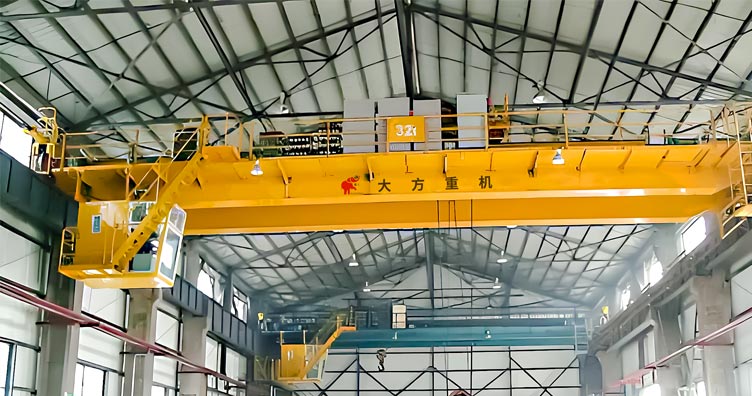
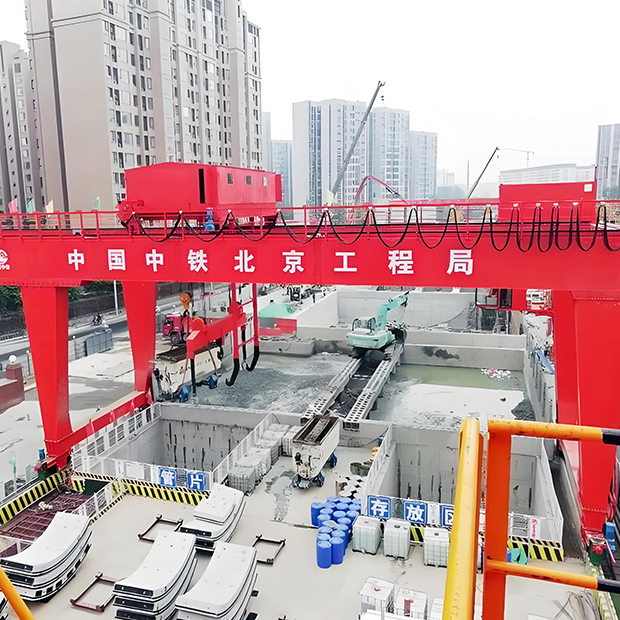
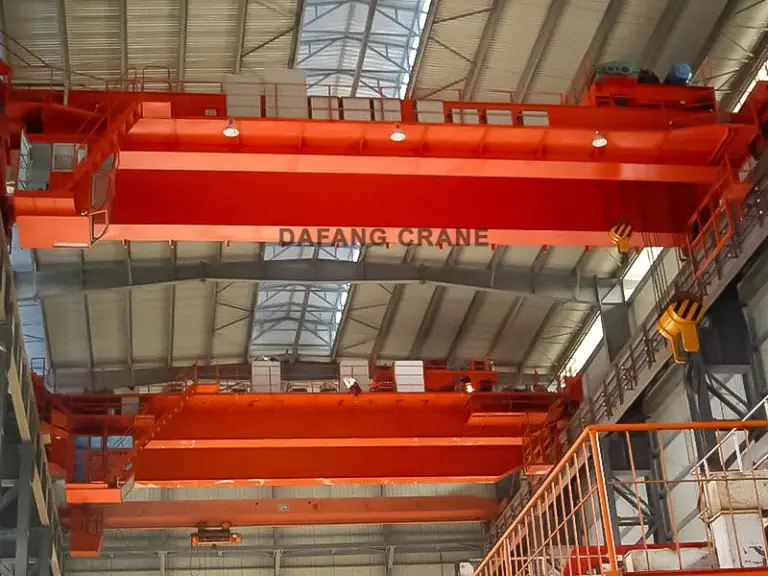
The QD type is the most widely deployed double girder overhead traveling crane in Dafang's line — a workhorse for factories, warehouses, steel service centres, mechanical processing plants, and port terminals. Its two box-section main girders and open-winch trolley deliver the structural rigidity and high hook approach distance that heavier loads demand. With a working class of A5–A6, it handles frequent, sustained lifting cycles throughout a standard production shift.
- Lifting capacity: 5–450 t
- Span: 10.5–31.5 m
- Lifting height: 16–24 m
- Control options: pendant push-button, wireless remote, or enclosed operator cab
The LH and NLH models use the same double-girder bridge but replace the open-winch trolley with a compact electric wire rope hoist. The result is a meaningfully lower overall installation height and reduced wheel load on the runway — a practical advantage when retrofitting an existing building that cannot accommodate the full girder-plus-open-winch stack. The NLH variant adds variable-frequency drives on all motions for smoother start-stop and finer positioning accuracy. If your facility has headroom constraints or you need a solution for loads up to 80 t at moderate duty, LH / NLH warrants a direct comparison against the QD in your quotation request.
European-Standard Design: QDXX Double Girder European Crane
The QDXX (Double Girder European Overhead Traveling Crane) is designed and built to FEM 9.511 rules and targets applications where duty class, energy efficiency, and building load matter as much as raw capacity. It is the right conversation to have when any of the following apply: your project specifies CE 2006/42/EC compliance, your runway structure has fixed wheel-load limits, or your operation runs three shifts at high cycle rates.
- Lifting capacity: 3–100 t
- Span: 4.5–31.5 m (customisable)
- Lifting height: 3–30 m
- Work duty: A5–A8 (FEM M5–M8 equivalent)
- Space utilisation: up to 90% (greater hook approach vs. standard designs)
- Designed operational life: 30+ years at rated duty
- Wheel pressure: 10–50 kN (allows lighter runway structure)
Variable-frequency drives are standard across hoist, cross-travel, and long-travel motions. The PLC-based electrical control system integrates precision sensors for consistent load positioning — relevant when lifting turbine components, generator stators, or press tooling where repeatable placement matters.
QD vs. European Style: Which Standard Fits Your Project?
This is the question most buyers need resolved before issuing a purchase order, and the answer is more contractual than technical.
The QD-type crane is built to Chinese GB standards (GB/T 14405, GB 3811), which are well established and widely accepted in markets across Southeast Asia, the Middle East, Central Asia, and Africa. Standard configurations have shorter lead times, and spare parts are readily available globally. For facilities running A5–A6 duty cycles with no specific European compliance requirement, QD is the cost-efficient default.
The QDXX European model is specified when your buyer, insurer, or regulator requires FEM / EN 13001 compliance — common in EU-destination projects and in international EPC contracts awarded to European engineering firms. The compact hoist trolley also reduces the minimum hook height loss compared to an open-winch trolley, which matters when ceiling clearance is fixed in a retrofit. The trade-off is a higher initial investment and longer custom lead time for non-standard spans.
If your project is ambiguous on this point, ask Dafang's engineering team to quote both configurations against your span and duty class — the practical differences in dimensions and lead time will clarify the decision faster than any general comparison.
Process-Specific Models: When a Standard Hook Crane Is Not Enough


QDY Metallurgy Crane — Steel Mills and Foundries
The QDY is purpose-built for environments where ambient temperatures exceed 60 °C and the load itself may be molten or near-molten. Thermal insulation is applied to the bridge frame and wire rope drum. High-temperature-rated wire rope, IP54/55/65 motor protection class, and redundant dual braking are standard. A7–A8 duty class reflects near-continuous cycling — consistent with converter bay operations in steelmaking or ladle transfer in a foundry.
- Capacidad: 5–75 t
- Span: 10.5–31.5 m
- Work class: A7–A8
- Temperature rating: –20 °C to +60 °C
- Power supply: AC 3-phase, 220–440 V / 50–60 Hz
The QDY is sometimes confused with the YZ steel mill crane. The practical distinction: QDY is Dafang's standard metallurgy model with a conventional hook for ladle and high-temperature material transfer; YZ covers broader steel plant process applications, including billet and ingot handling, and is typically specified alongside dedicated process equipment.
QC Electromagnetic Overhead Crane — Scrap, Billet, and Steel Plate
When handling ferrous materials at high cycle rates — scrap yards, steel service centres, billet warehouses — a hook-type crane requires operators to rig every load, adding time and personnel exposure. The QC replaces the hook with a removable electromagnetic chuck, powered through the crane's onboard rectifier and backed by stored energy for safe load retention during a power interruption. Magnetic holding time is 10–30 minutes.
- Main hook capacity: 32–50 t; auxiliary hook: 5–10 t
- Span: 10.5–31.5 m
- Lifting height: 12–28 m
- Work class: A5–A6
- Proceso de dar un título: CE / ISO
The QCL electromagnetic beam crane extends this concept to long steel products — bars, angles, billets — where a single-point magnet cannot maintain stable load geometry. A spreader beam carries multiple electromagnetic chucks at fixed centres, distributing the magnetic grip evenly across the product's length, preventing bending stress during transfer.

QZ Grab Bucket Crane — Bulk Materials
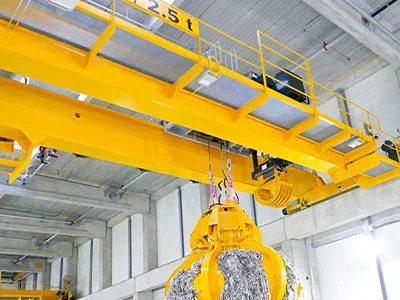
Bulk handling of coal, sand, grain, ore, and demolition waste requires a crane that can open and close a grab bucket without interrupting the hoist cycle. The QZ runs a dual-hoist configuration: the closing rope hoist operates the grab jaw while the support rope hoist controls elevation independently. This avoids the cycle-time penalty of single-hoist grab operation and is the industry-standard arrangement for stockyard and power-plant fuel-handling bays.
QB Explosion-Proof Bridge Crane — Hazardous Environments
Facilities handling flammable solvents, chemical vapours, or combustible dust — petrochemical plants, paint manufacturing, LNG facilities, chemical warehouses — require cranes where every component capable of generating a spark is enclosed, grounded, or replaced with non-sparking materials. The QB is built to explosion-proof classification ExdIIBT4 / ExdIICT4, with motor protection class IP54–IP65. All wiring runs in conduit; control panels carry the corresponding Ex rating.
- Capacidad: 5–75 t
- Span: 10.5–31.5 m
- Work class: A3–A5
If your facility handles both standard and hazardous zones, the QB's classification boundaries need to be confirmed against your ATEX zone map or local equivalent before procurement.


QY Insulated Overhead Crane — Electrolysis and Non-Ferrous Smelting
Electrolytic aluminium, zinc, and lead production operates large DC bus systems with energised electrode arrays at floor level. A standard crane creates a conductive path from hook to runway and from runway to building structure — enough to disrupt the electrolytic process and create an electrocution risk. The QY breaks this path using insulated hooks and electrically isolated trolley mechanisms, protecting both process integrity and operator safety.
- Capacidad: 5-50 t
- Span: 10.5–31.5 m
- Work class: A5–A6
Certifications and Compliance: What to Verify Before Ordering
Certifications affect customs clearance, insurance underwriting, and verification audits by your end customer's EPC contractor. Three documents matter most for most markets.
CE Declaration of Conformity (2006/42/EC, Machinery Directive): Required for EU markets and frequently specified in international EPC contracts regardless of destination. Request the full EC Declaration — not just a CE mark on the nameplate — and confirm it was issued by the crane manufacturer, not a re-labelling agent.
ISO 9001 quality certificate: Confirms that Dafang's manufacturing quality management system is third-party certified. Check the certificate validity date and the scope of certification to ensure it covers the specific product category you are buying.
ISO 4301 / FEM duty class documentation: Verifies that the crane's structural and mechanism classification was calculated against your actual cycle frequency, not a generic assumption. Ask which edition of the standard the design references and request the duty class calculation record for the specific configuration.
Overload test report (1.25× SWL): Mandatory before handover in most markets. Request that the static load test be witnessed by an independent inspector and that the report includes photographic evidence and a calibration certificate for the test weights.
EAC conformity mark: Required for Russia, Kazakhstan, Belarus, and other CIS member states. If your destination is in the Eurasian Economic Union, confirm EAC status before issuing a purchase order.
Dafang does not make compliance claims on behalf of buyers — local regulatory interpretation varies. Confirm documentation requirements with your destination country's lifting-equipment authority before finalising the order.
Preguntas frecuentes
Q1:What is the difference between a QD crane and a European-style double girder overhead crane?
The QD crane is built to Chinese GB standards and suits A5–A6 duty; the European QDXX model conforms to FEM / EN 13001 and supports A5–A8 duty with CE Machinery Directive compliance. For EU-destination projects or EPC contracts with European compliance requirements, the QDXX is the correct specification. For standard industrial lifting in markets without European compliance obligations, the QD offers a shorter lead time and lower upfront cost at equivalent structural performance.
Q2:Which double girder model is correct for a steel mill or foundry?
Steel mill and foundry applications require the QDY metallurgy crane — A7–A8 duty class, thermal insulation, high-temperature wire rope — or the YZ steel mill crane for broader process handling. Standard QD-type cranes are not rated for environments above 40 °C or for handling near-molten material. Using a standard model in a foundry bay accelerates component degradation and compromises load safety.
Q3:How do I choose between an electromagnetic crane and a grab crane?
Use the QC electromagnetic crane when the material is ferrous and relatively uniform in shape — plates, billets, scrap — and the operation benefits from no-rig loading. Use the QZ grab crane when the material is loose, granular, or non-ferrous — coal, sand, grain, demolition waste — where a magnet cannot achieve reliable grip. The decision is driven by material type, not cycle time preference.
Q4:What certifications should I request from a double girder crane supplier before purchase?
At minimum: CE Declaration of Conformity (2006/42/EC), ISO 9001 certificate with current validity dates, static overload test report at 1.25× SWL from an independent inspector, and ISO 4301 or FEM duty class documentation for the specific configuration. For Russia and CIS markets, also request EAC certification. Request originals or certified copies and verify certificate numbers against the issuing body's registry where possible.
Q5:Can Dafang's double girder cranes be customised for non-standard spans or special environments?
Yes — span, lifting height, capacity, and duty class are all configurable within the structural limits of each model. Process-specific requirements such as explosion-proof wiring, insulated hooks, high-temperature materials, or dual-trolley configurations can be engineered for most models. Provide your span, capacity, lifting height, duty cycle, and environmental conditions when submitting an inquiry, and Dafang's engineering team will confirm what is achievable within your project timeline.