






Industrial workshops face a recurring lifting decision that appears straightforward but has real operational consequences: when a heavy component needs to move, which lifting system serves the application best? For many facilities, the practical choice comes down to two widely used options — the mobile gantry crane and the jib crane. Both are common in manufacturing, maintenance, and assembly environments. Both handle loads that manual handling cannot safely manage. But they are engineered for fundamentally different operational models.
A mobile gantry crane is a portable lifting system designed to move between different working areas, while a jib crane is a fixed or semi-fixed lifting system designed for precise lifting operations within a specific workspace. Understanding where each system performs well — and where the other is the better engineering choice — is the foundation of a sound lifting equipment decision.
The selection depends on required mobility, working radius, load capacity, installation conditions, and operation frequency. This guide covers each factor with the practical detail that procurement decisions require.
جدول المحتويات
What Is a Mobile Gantry Crane
تعريف
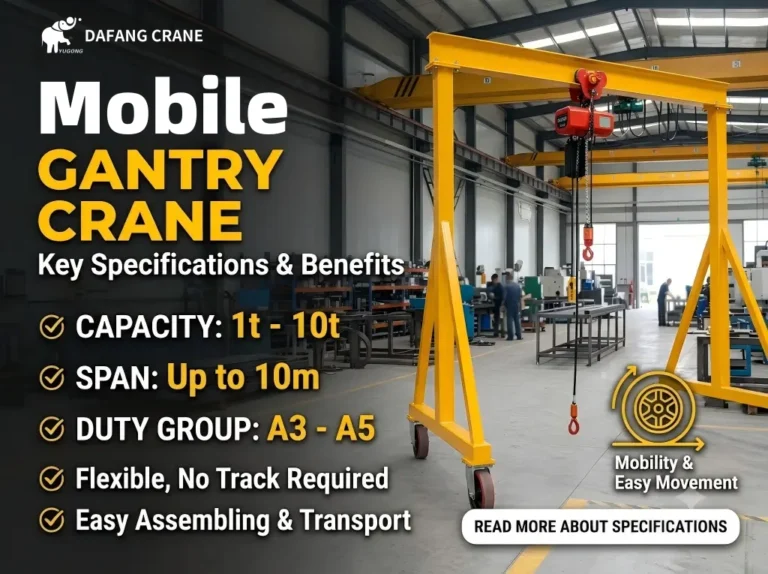
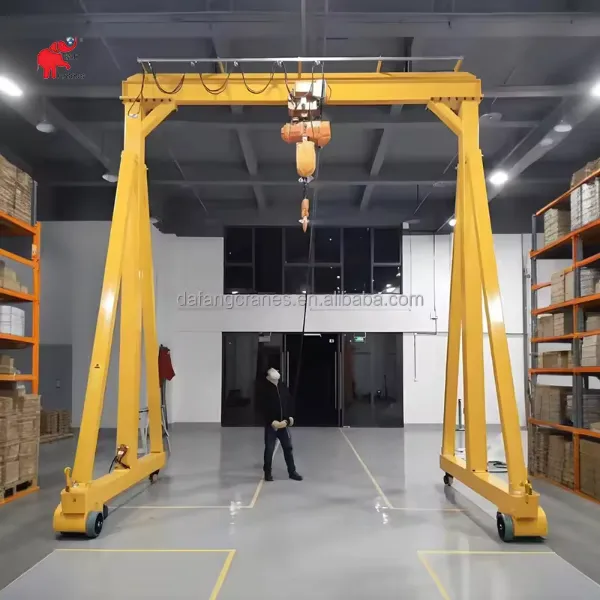
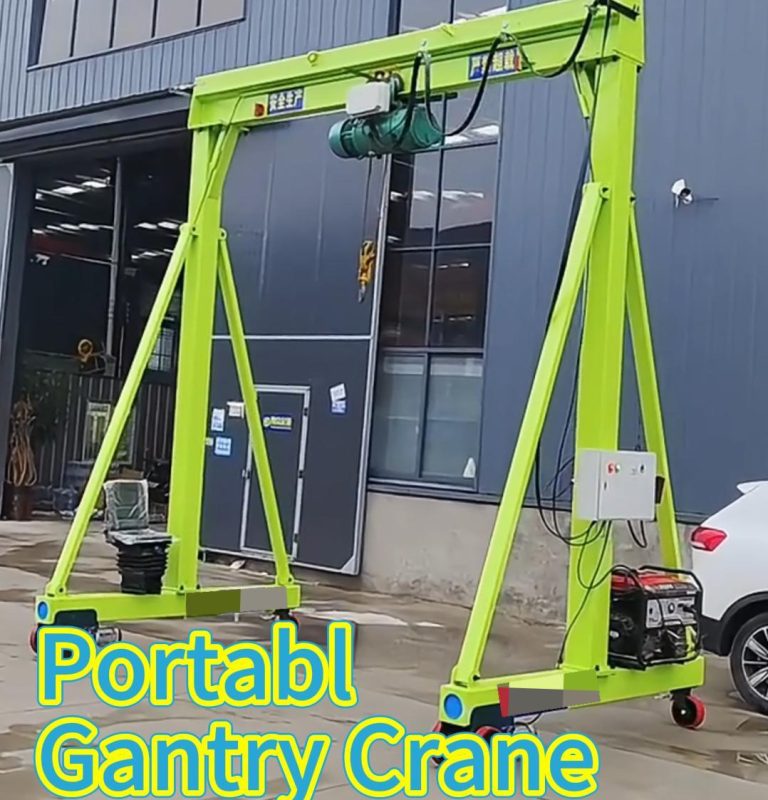
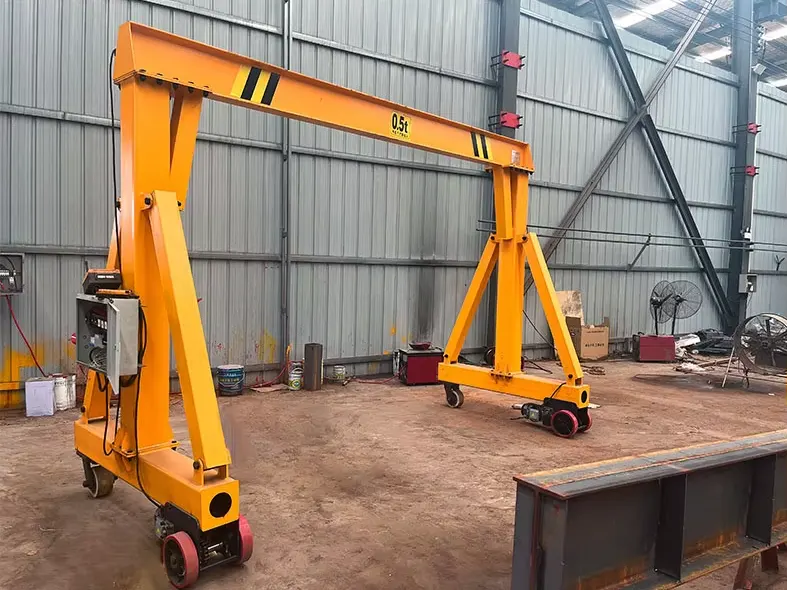
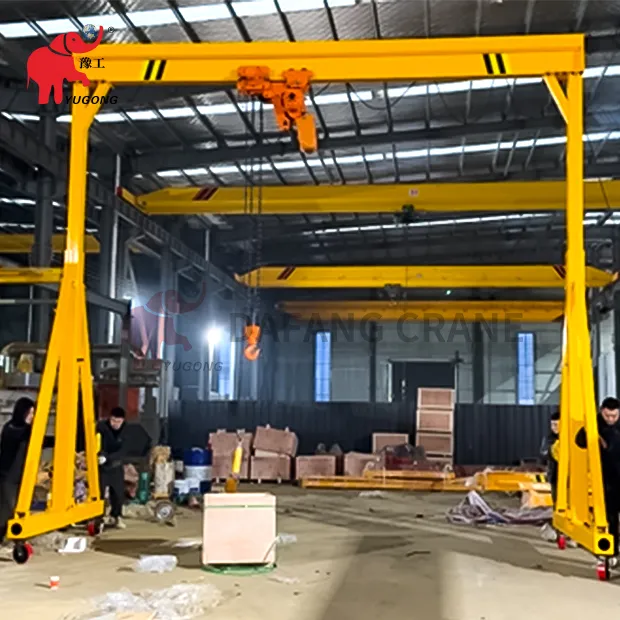
A mobile gantry crane is a freestanding lifting structure equipped with wheels or casters that allow the entire crane to be repositioned across flat floor surfaces without permanent installation. The structure supports itself on its own legs — no attachment to the building structure is required. A hoisting device mounted on the main beam performs the vertical lifting function.
The crane's key characteristic is that it goes to the work. When a maintenance job moves to a different area of the workshop, the crane moves with it. When a new machine is installed at a previously uncovered location, the mobile gantry crane is positioned there without runway modification or building work.
احصل على عرض أسعار مجاني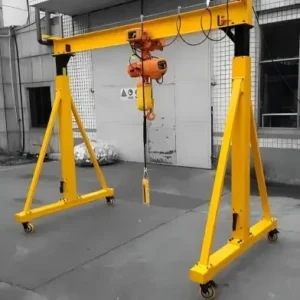
المكونات الرئيسية
- Main girder. The horizontal beam spanning between the two supporting legs. Girder span — the distance between the inner faces of the legs — determines the maximum width of the area the crane can straddle. The hoist trolley travels along the bottom flange of the girder.
- Supporting legs. Vertical structural members connecting the girder to the wheel assemblies. Fixed-height legs provide maximum rigidity. Adjustable-height legs — with pin-adjustable telescoping sections — allow the crane to be configured for different working heights at different positions.
- Wheels and travel system. Swivel casters on all four leg positions allow movement in any direction. All casters must be locked before lifting. Motorized travel systems enable powered repositioning for heavier cranes.
- نظام الرفع. Electric wire rope hoists suit capacities above 500 kg and frequent-use production environments. Electric chain hoists are compact, cost-effective options for light to medium loads. Manual chain hoists serve occasional lifting where electrical supply is unavailable.
- نظام التحكم. Pendant control or radio remote on electric hoists. Emergency stop, end-of-travel limit switches, and overload protection are standard safety systems.
Advantages of Mobile Gantry Cranes
- قدرة عالية على الحركة. The crane moves to wherever the lifting task is — across the workshop, to a different production bay, or to a location that a fixed crane cannot reach. No fixed runway limits the working zone.
- Easy installation. No foundation, no runway beams, no structural attachment. The crane is assembled on-site and immediately operational. Deployment time is hours, not weeks.
- Flexible application. One mobile gantry crane can serve maintenance lifting, machine installation, warehouse loading dock operations, and any other lifting task within the facility — sequentially or as required.
- Lower infrastructure investment. Elimination of runway structure and building modification reduces total cost compared to fixed crane alternatives serving equivalent applications.
What Is a Jib Crane
تعريف
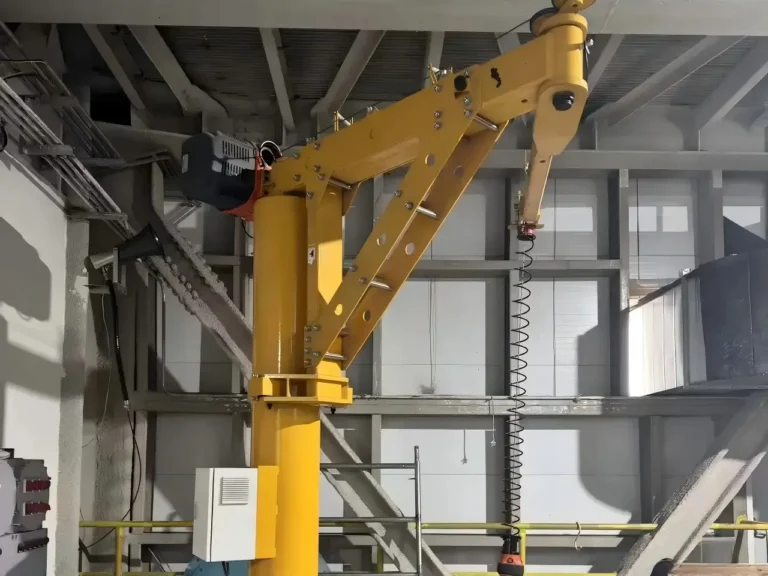
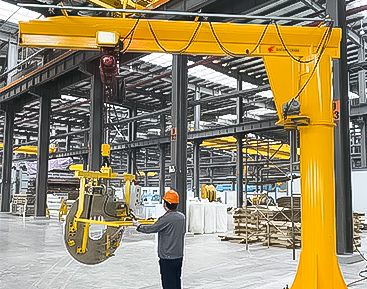
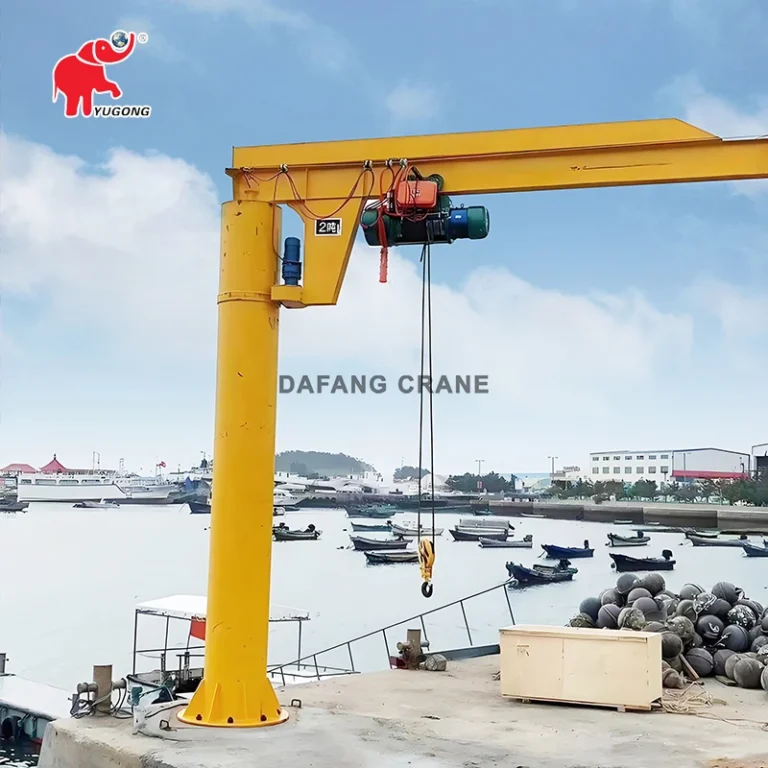
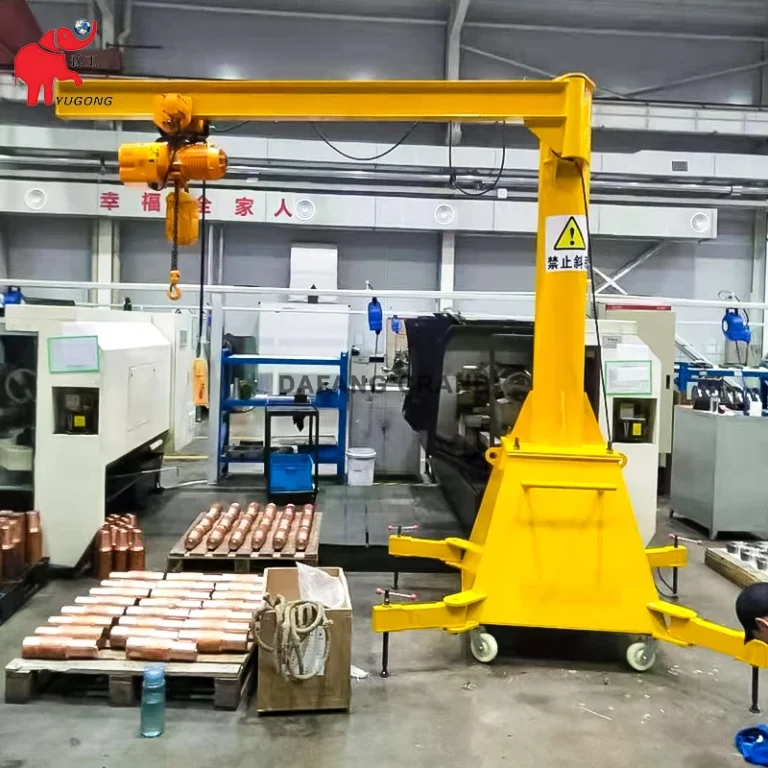
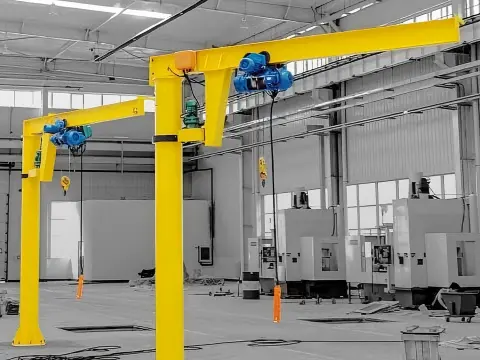
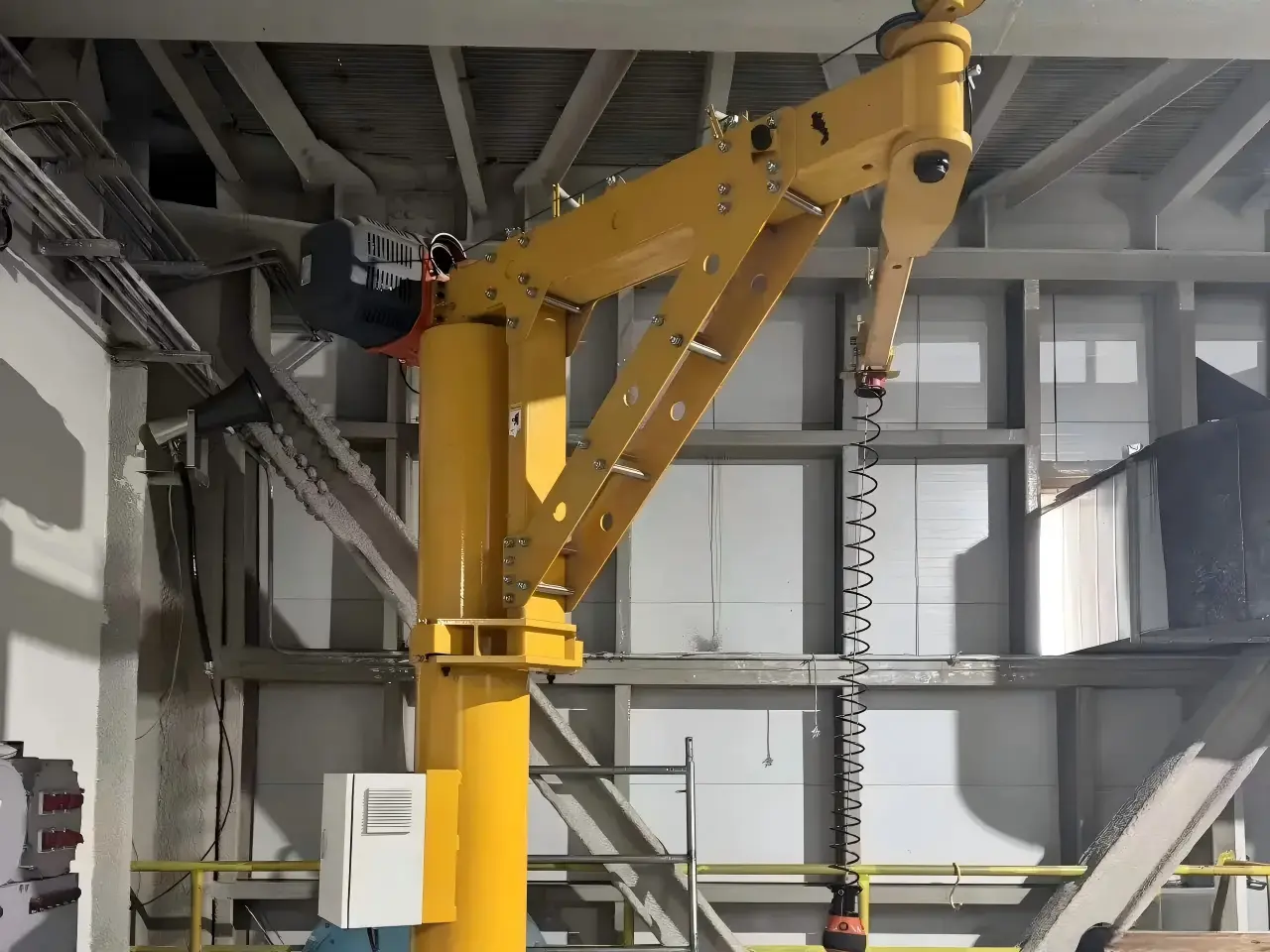
A رافعة ذراع is a lifting device consisting of a vertical support structure — a floor-mounted column or wall-mounted bracket — a horizontal or angled rotating arm (the jib), and a hoisting mechanism mounted on the jib. The crane lifts and positions loads within a defined arc around the pivot point. It does not move between locations — it serves the work area within its rotation radius from a fixed mounting position.
The jib crane's defining characteristic is that it serves one workstation or one zone, very efficiently and repeatedly. For machine loading, assembly station support, and localized maintenance lifting, a jib crane provides faster, more ergonomic, and more precise load handling than any system that must first be repositioned to the work area.
احصل على عرض أسعار مجاني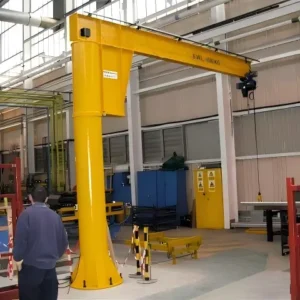
Types of Jib Cranes
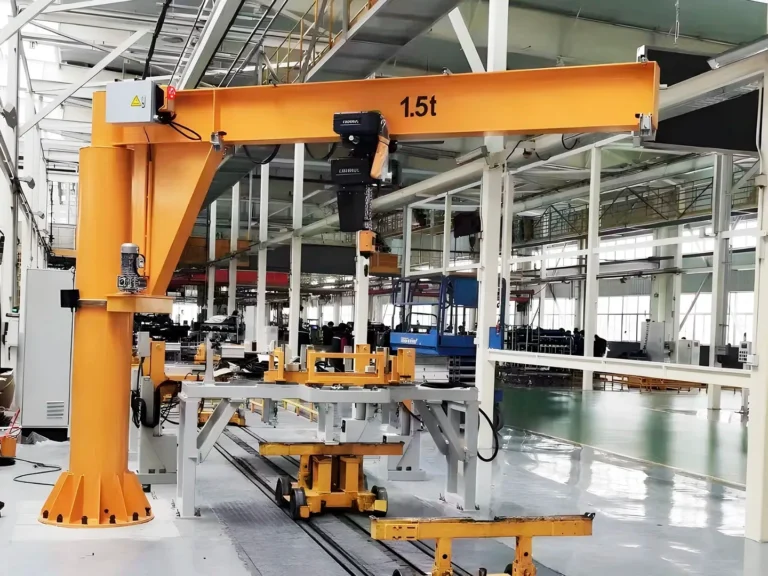
Floor mounted jib crane. A steel column anchored to a concrete foundation carries the jib arm. The column is freestanding — not attached to the building structure — within its defined installation zone. Floor mounted jib cranes handle capacities from 0.25 ton to several tons and provide full 360-degree rotation in some designs, or up to 270 degrees depending on the mounting configuration. They suit heavy-duty workstations, manufacturing production positions, and maintenance areas where the floor structure can accept the column foundation loads.
Wall mounted jib crane. The jib arm brackets directly to a structural wall or building column rather than to a floor-mounted column. No floor foundation is required, and the wall mounting preserves floor area at the installation position. Wall mounted jib cranes typically rotate to 180 degrees — limited by the wall on one side. They suit individual machine positions where the wall provides adequate structural support and floor space preservation is important.
Articulating jib crane. Uses two hinged arm sections — an inner arm and an outer arm — that pivot independently. The articulated geometry allows the operator to maneuver the hoist to positions that a single rigid arm cannot reach — around obstacles, into confined spaces, or along complex positioning paths. Articulating jib cranes are used in precision assembly, automotive manufacturing, and applications where load positioning accuracy and reach flexibility are priorities.
Advantages of Jib Cranes
- Precise positioning. The rotating jib arm and traversing hoist trolley give the operator fine control over hook position within the working radius. For machine loading, component insertion into fixtures, and assembly work where placement accuracy matters, jib crane control is superior to the more approximate positioning of a manually pushed mobile gantry crane.
- Space efficiency. A jib crane's footprint at the workstation is the column base or wall bracket — both are compact. The crane does not occupy floor area outside its immediate mounting zone. In workshops where floor space is at a premium and every workstation must be fully accessible, jib cranes preserve operational space more effectively than gantry alternatives.
- Efficient repetitive handling. Machine loading cycles — pick from incoming pallet, load into machine, unload finished part, place on outgoing pallet — repeat throughout the shift. A jib crane positioned at the machine performs each cycle quickly and with minimal operator effort. The operator does not push a crane to position or engage wheel brakes — the jib swings and the trolley traverses. Cycle time per lift is significantly lower than with a repositioned mobile gantry crane.
- Immediate availability. The jib crane is permanently in position at the workstation. No setup, no repositioning, no brake engagement. The operator approaches, attaches the load, and lifts. This immediate availability is operationally significant in production environments where lifting frequency is high.
Mobile Gantry Crane vs Jib Crane: Key Differences
| ميزة | Mobile Gantry Crane | رافعة ذراع الرافعة |
|---|---|---|
| التنقل | Fully portable — moves anywhere on flat floor | Fixed at installation position — does not relocate |
| التركيب | No foundation required — freestanding on wheels | Foundation (floor mount) or structural wall (wall mount) required |
| منطقة العمل | Repositioned to serve any location in facility | Fixed rotation radius from mounting point — typically 2 to 6 meters |
| Rotation capability | None — crane travels directionally | Full rotation arc (up to 360° floor mount; up to 180° wall mount) |
| سعة الحمولة | 0.5 to 20 tons typical | 0.25 ton to several tons — capacity is radius-dependent |
| ارتفاع الرفع | Good — girder elevation determines hook height | Good — limited by jib arm clearance below building structure |
| المرونة | High — serves multiple locations and tasks | Low — optimized for one workstation or zone |
| Cycle time per lift | Higher — repositioning and brake engagement required | Lower — immediate availability at workstation; swing and traverse |
| Space requirement | Requires clear floor area around working zone | Compact footprint at mounting point only |
| Investment | Lower equipment cost; no civil works | Lower equipment cost; foundation or wall structural work required |
| Best application | Flexible, intermittent, multi-location lifting | Repetitive, localized, precision workstation lifting |
The table differences reflect fundamentally different design philosophies. The mobile gantry crane is optimized for coverage flexibility — it sacrifices cycle speed and positioning precision for the ability to serve any location in the facility. The jib crane is optimized for workstation efficiency — it sacrifices coverage range for speed, precision, and immediate availability at the point of use.
This design difference means the two cranes are rarely direct competitors for the same application. More often, they complement each other within the same facility: jib cranes at individual machine positions and assembly stations, a mobile gantry crane for maintenance and intermittent lifting needs elsewhere.
Application Comparison
Mobile Gantry Crane Applications
- Manufacturing workshops — equipment assembly and machine installation. When a new machine is installed or a large fabricated assembly is positioned, the mobile gantry crane serves the specific location without requiring permanent crane coverage overhead. After the installation is complete, the crane is redeployed to the next task.
- Maintenance facilities — motor replacement and equipment repair. Maintenance lifting requirements move with the equipment being serviced. A mobile gantry crane follows the maintenance crew, positioning at each piece of equipment that requires component removal or replacement across the facility.
- Warehouses — heavy package handling and dock operations. Loading dock lifting and heavy storage handling that falls outside the coverage of permanent overhead crane systems is served by a mobile gantry crane positioned at the dock or storage position as needed.
- Machinery production — large component movement. Moving large machined castings, fabricated frames, or assembled sub-units between production stages — particularly in facilities where the production sequence spans multiple areas — uses mobile gantry cranes to follow the material through the process without fixed infrastructure constraints.
Jib Crane Applications
- Production workstations — material feeding and assembly support. At assembly stations where operators repeatedly position components onto assemblies, a jib crane positioned within the operator's reach arc allows immediate, one-handed load control. The operator swings the jib, positions the trolley, and lowers the component into position — a cycle measured in seconds rather than the minutes required to position and engage a mobile gantry crane.
- CNC machine operations — loading and unloading parts. A wall mounted or floor mounted jib crane at a CNC machining center allows the machine operator to load and unload workpieces independently, without waiting for a shared crane. Machine utilization improves because idle time between operations is reduced.
- Automotive and glass manufacturing — precision repetitive handling. Automotive component assembly, windshield installation, and similar operations involving heavy, fragile, or awkward components benefit from the articulating jib crane's ability to maneuver loads along complex paths with fine position control.
- Maintenance stations — local equipment servicing. Fixed maintenance positions — where the same equipment type is serviced repeatedly at the same location — benefit from a jib crane that is always in position and immediately available for each service cycle.
Which Crane Should You Choose
Choose a Mobile Gantry Crane When
Multiple lifting locations are required. If lifting tasks are distributed across different areas of the facility — some scheduled, some unpredictable — a single mobile gantry crane can serve all of them sequentially. A jib crane at each position would require multiple installations and more total investment.
Lifting requirements change with production layout. Facilities that reconfigure their production layouts periodically, add new equipment, or change their product mix benefit from the mobile gantry crane's ability to follow the new layout without infrastructure modification.
No permanent crane structure exists. In buildings without overhead crane runways, independent runway structure, or adequate wall mounting points for jib cranes, the mobile gantry crane's freestanding design may be the only practical lifting option.
Loads are occasional and varied. Maintenance lifts, machine installation, and project-based heavy lifting — tasks that happen infrequently at varying locations — are well served by a mobile gantry crane. The lower cycle time efficiency compared to jib cranes is not a significant concern when lift frequency is low.
Choose a Jib Crane When
Lifting is concentrated at a fixed workstation. If the majority of lifting happens at one machine, one assembly station, or one maintenance position, a jib crane at that position provides faster, more ergonomic service than any shared or repositioned alternative.
Cycle time per lift matters. In production environments where the lifting cycle is part of the production rate — machine loading, assembly component insertion, packaging line support — the jib crane's immediate availability and fast swing-and-traverse positioning directly affects throughput. Even a 30-second improvement per cycle adds up across hundreds of lifts per shift.
Positioning accuracy is required. Inserting components into precision fixtures, loading parts into CNC machine chucks, and positioning assemblies onto jigs all require more accurate load control than manual pushing of a mobile gantry crane provides. The jib crane's smooth rotation and precise trolley traverse deliver the control accuracy these applications need.
Floor space must remain clear. If the production layout cannot accommodate the floor footprint of a mobile gantry crane during lifting operations — because adjacent machinery, material flow paths, or personnel movement create space conflicts — a wall mounted jib crane that preserves floor space is the practical solution.
Capacity and Specification Comparison
سعة التحميل
Mobile gantry cranes are available in standard capacities of 0.5 ton, 1 ton, 2 ton, 3 ton, 5 ton, and 10 ton, with custom designs available to 20 tons and beyond. The practical upper limit for manual-travel models is approximately 5 tons — above this, manual pushing under load becomes physically demanding and the risk of uncontrolled movement increases. Electric travel systems extend the practical capacity range.
رافعات ذراع الرفع typically range from 0.25 ton to 5 tons for standard configurations, with heavy-duty floor mounted designs reaching 10 tons or more. Critically, jib crane capacity is radius-dependent — the rated capacity at maximum radius is lower than at minimum radius due to the bending moment imposed on the jib arm. Always confirm the crane's capacity at the specific working radius your application requires, not just at the rated maximum.
Working Coverage
Mobile gantry cranes cover whatever floor area they can be moved to. In a facility with smooth concrete floors throughout, one crane can theoretically serve the entire facility area — limited only by doorway clearances, floor load capacity, and the time required for repositioning.
رافعات ذراع الرفع cover a defined rotation arc at a fixed radius from the mounting point. A jib crane with a 4-meter arm covers a semicircle of approximately 25 square meters (wall mount) or a full circle of approximately 50 square meters (floor mount). Lifting requirements outside this arc require a different crane or repositioning the work to within the arc.
متطلبات التركيب
Mobile gantry cranes require only a smooth, level, hard floor surface with adequate load-bearing capacity for the concentrated wheel loads of the loaded crane. No civil works, no structural engineering, no building modification.
رافعات ذراع الرفع require structural engineering confirmation of the mounting point. Floor mounted jib cranes need a concrete foundation designed for the column base bending moment — typically a reinforced concrete pad of 800mm to 1,500mm depth depending on soil conditions and crane capacity. Wall mounted jib cranes require structural confirmation that the wall or column can carry the bracket loads without failure.
اعتبارات التكلفة
Mobile Gantry Crane Cost Factors
Equipment cost is determined by lifting capacity, girder span, leg configuration (fixed or adjustable), travel system (manual casters or electric drive), and hoist type (wire rope, chain, or manual). No civil works cost applies. For facilities needing immediate lifting capability without infrastructure investment, the mobile gantry crane's all-in project cost is lower than fixed alternatives serving equivalent intermittent lifting requirements.
Jib Crane Cost Factors
Equipment cost is determined by jib arm length, rotation arc, mounting type (floor or wall), and hoist selection. Civil works cost — foundation design, excavation, concrete, and curing time — adds to the total project cost for floor mounted designs. Wall mounted designs avoid foundation costs but require structural wall confirmation. For high-frequency workstation lifting, the jib crane's lower cycle time per lift translates to productivity improvement that offsets its total installed cost relatively quickly.
Investment Framework
Neither system is inherently more cost-effective — the right comparison is total cost relative to the operational value delivered. A mobile gantry crane serving one maintenance lift per week is a reasonable investment. A mobile gantry crane attempting to serve a CNC machine loading cycle that repeats 200 times per shift will have a negative impact on production throughput that its purchase cost cannot offset. Conversely, a jib crane at a location where lifts occur twice per month is an overcapitalized solution compared to a shared mobile gantry crane.
Define the lifting frequency, the importance of cycle time, and the distribution of lifting tasks across the facility before comparing equipment costs.
Mobile Gantry Crane and Jib Crane Solutions by Dafang Crane
Dafang Crane provides customized industrial lifting solutions including mobile gantry cranes and jib cranes for factories, workshops, warehouses, and manufacturing facilities worldwide.
Mobile gantry crane solutions. Capacities from 0.5 ton to 20 tons, spans from 2 to 8 meters, fixed or adjustable height legs, manual or electric travel, wire rope or chain hoist. Custom configurations for non-standard spans, limited headroom environments, or specific hoist interface requirements are developed through in-house engineering.
Jib crane solutions. Floor mounted jib cranes with column foundation design, wall mounted jib cranes for space-limited machine positions, and articulating jib cranes for complex positioning requirements. Capacities from 0.25 ton to 10 tons. Hoist selection — electric wire rope hoist, electric chain hoist, or manual — matched to the duty cycle and capacity requirement of each workstation.
Customized engineering support. Dafang Crane's engineering team reviews application requirements — lifting tasks, facility layout, capacity, duty cycle, and installation constraints — to specify the most appropriate crane type and configuration. Both mobile gantry cranes and jib cranes are available with FEM-classified electric hoists carrying documented duty group compliance for projects requiring CE certification.
الخاتمة
Mobile gantry cranes and jib cranes solve different versions of the same problem — how to lift heavy loads safely and efficiently in industrial environments. The mobile gantry crane solves the problem of variable and distributed lifting requirements across a facility with one portable system. The jib crane solves the problem of high-frequency, precision, and ergonomic lifting at a fixed workstation with a permanently installed system.
The facilities that make the best crane investment decisions are those that evaluate their actual lifting patterns — where lifts happen, how often, at what capacity, and with what positioning precision — before choosing equipment. Most production facilities benefit from a combination: jib cranes at the highest-frequency production positions, a mobile gantry crane for maintenance, installation, and intermittent lifting needs elsewhere.
Ready to discuss your workshop lifting requirements? Contact Dafang Crane's engineering team with your facility layout, lifting task descriptions, and production requirements. We provide customized mobile gantry crane and jib crane solutions — individually or in combination — with engineering support from specification through delivery and commissioning.
الأسئلة الشائعة
Q1: What is the main difference between a mobile gantry crane and a jib crane?
The fundamental difference is mobility versus workstation efficiency. A mobile gantry crane is portable — it moves between locations to serve lifting tasks wherever they occur. A jib crane is fixed at one position — it serves lifting tasks within its rotation arc repeatedly and quickly. Mobile gantry cranes offer flexibility across the facility. Jib cranes offer speed, precision, and ergonomic efficiency at the specific workstation where they are installed.
Q2: Which crane is better for a small workshop?
It depends on the lifting pattern. If lifting requirements are spread across different areas of the workshop — maintenance at various machines, installation of different equipment, handling in multiple zones — a mobile gantry crane serves all positions with one investment. If the primary lifting requirement is at one specific machine or workstation — loading a CNC lathe, supporting an assembly bench — a jib crane at that position is more efficient and immediately available. Many small workshops benefit from one mobile gantry crane for general and occasional lifting, plus one or two jib cranes at the highest-frequency lifting positions.
Q3: Can a mobile gantry crane replace a jib crane?
In terms of coverage, yes — a mobile gantry crane can physically perform the same lift that a jib crane would perform. In terms of operational efficiency for high-frequency workstation lifting, no. A mobile gantry crane requires positioning, brake engagement, and repositioning after each use. A jib crane is immediately available at the workstation for every lift. For machine loading cycles that repeat 50 to 200 times per shift, the time difference per cycle multiplied by the cycle count represents a meaningful production rate impact. The mobile gantry crane is not a direct substitute for a jib crane in high-frequency production lifting applications.
Q4: Which crane provides better flexibility?
The mobile gantry crane provides better flexibility across the facility — it can serve any location on a flat floor surface. The jib crane provides better operational flexibility at the workstation level — its rotation arc, trolley traverse, and articulating options (on articulating designs) give the operator fine control over hook position within the working radius. These are different types of flexibility serving different operational needs.
Q5: Why choose Dafang Crane for industrial lifting solutions?
Dafang Crane provides 20+ years of manufacturing experience in both mobile gantry cranes and jib cranes, in-house engineering for customized configurations, ISO 9001 and CE-certified production, and factory-direct supply without intermediary costs. Engineering consultation at the specification stage reviews your specific lifting tasks and recommends the appropriate crane type — not just the nearest catalogue product. After-sales spare parts supply and technical support extend the supplier relationship beyond equipment delivery. International project experience covers export documentation, marine packing, and installation support at overseas project sites.