
Application
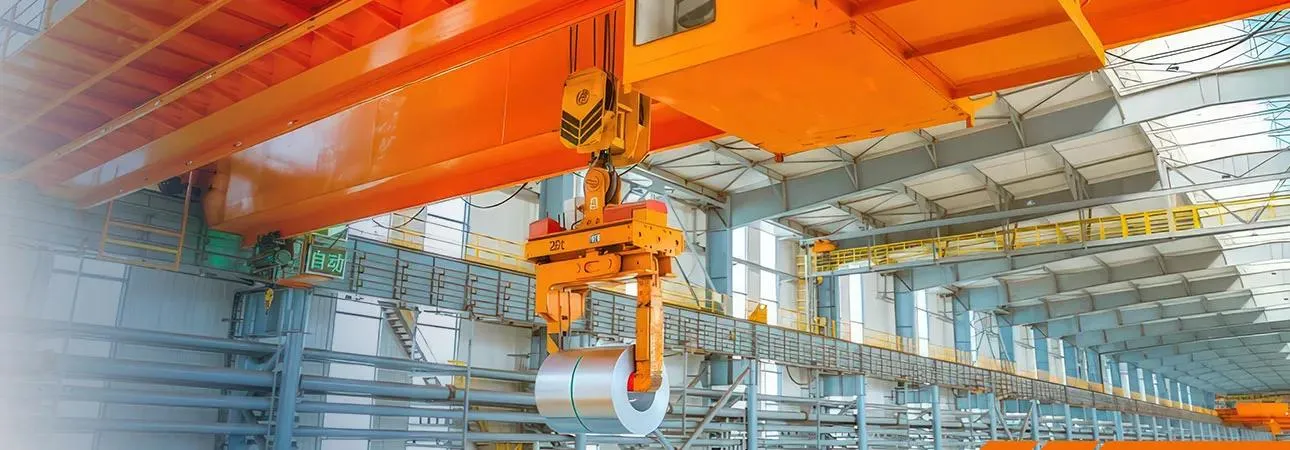
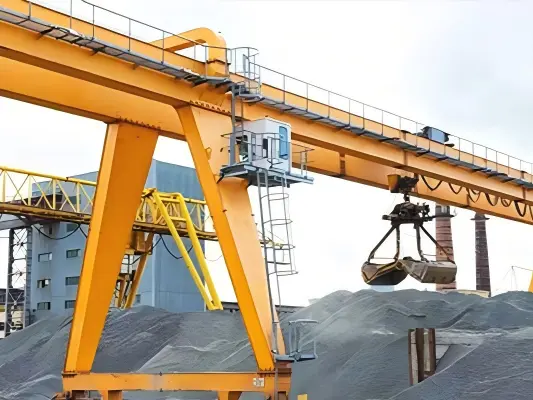
Mining operations place heavier demands on lifting equipment than almost any other industrial application. Continuous production schedules, abrasive bulk materials, extreme dust levels, outdoor exposure, and the sheer weight of mining machinery combine to create an operating environment where undersized or incorrectly specified cranes fail early — and the consequences reach the entire production operation.
This page covers the crane systems used across the mining industry — from underground maintenance hoists and grab overhead cranes for ore and coal handling through outdoor gantry cranes for stockyard management and intelligent transfer systems for heavy module movement. Each section explains why a specific crane type is used for a specific mining application, what capacity and duty class is appropriate, and what selection factors matter most for reliable long-term performance.
Before examining specific crane types, it is worth being direct about what separates mining crane applications from general industrial lifting.
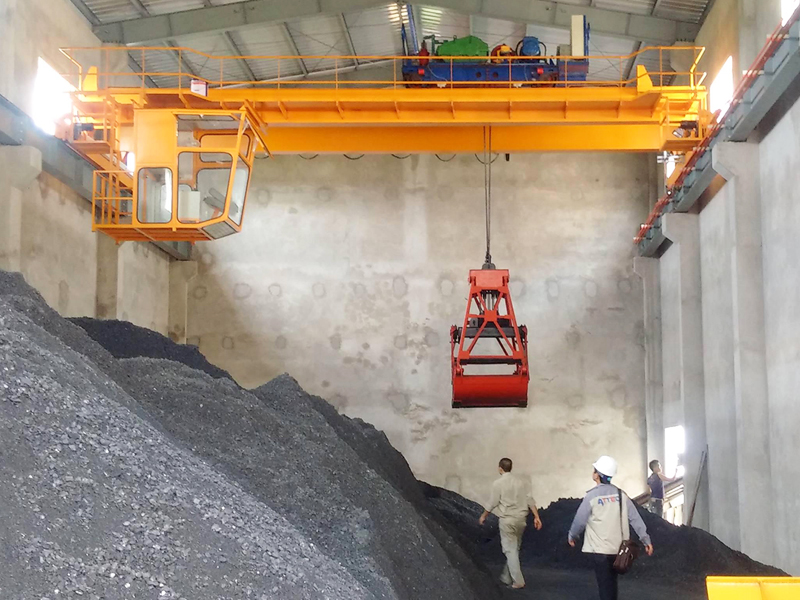
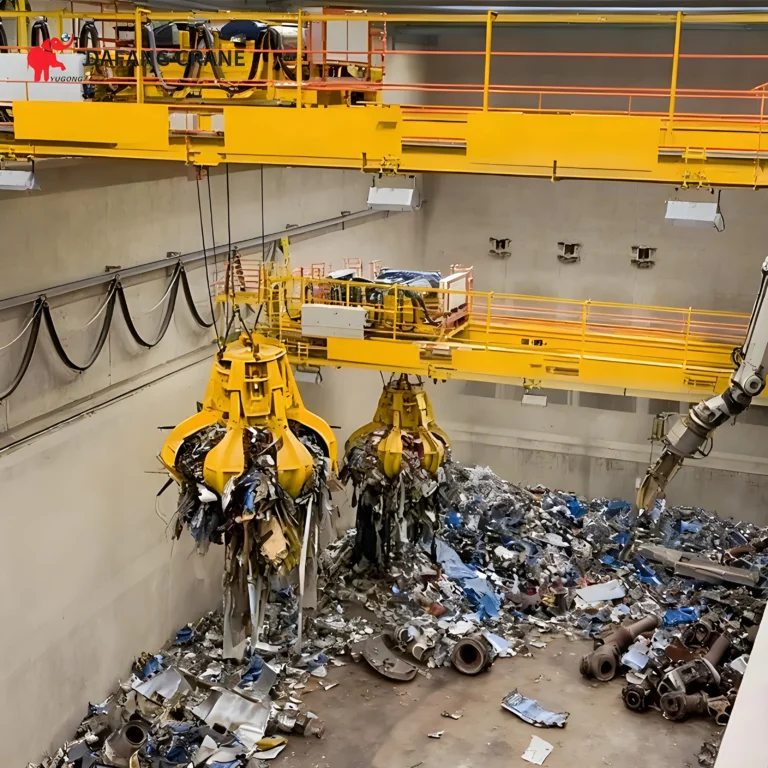
The QZ grab overhead crane uses a double-drum, four-rope grab bucket system. Two independent rope drums on the hoist — a supporting drum and a closing drum — control the opening and closing of the grab bucket independently. The supporting drum maintains the grab's elevation while the closing drum controls shell closure. This four-rope architecture provides stable, controllable grab operation with higher closing force than two-rope alternatives.
The grab bucket opens as it descends into the material pile, closes around the bulk material when the closing drum tensions, and holds the loaded grab securely during the hoist and travel phases. Standard clamshell grab configurations handle loose bulk materials. Toothed grab buckets are specified for harder, more compacted materials that require penetration force for effective capture.
The QZ grab overhead crane is the most widely deployed crane in mining bulk material handling. Indoor coal bunkers, ore storage bays, limestone silos, coke handling facilities, and slag processing areas all use QZ grab cranes as the primary material management tool. The crane stacks incoming material, manages inventory within the storage bay, and reclaims material to feed downstream processing equipment.
Capacity: 5 to 32 tons, matched to grab bucket volume and material bulk density
Duty Class: A6 to A7 under FEM/ISO classification — reflecting the high-cycle, high-frequency operating profile of continuous bulk material handling
Typical Materials: Iron ore, coal, limestone, coke, sand and gravel, mineral slag, mineral powder, bauxite
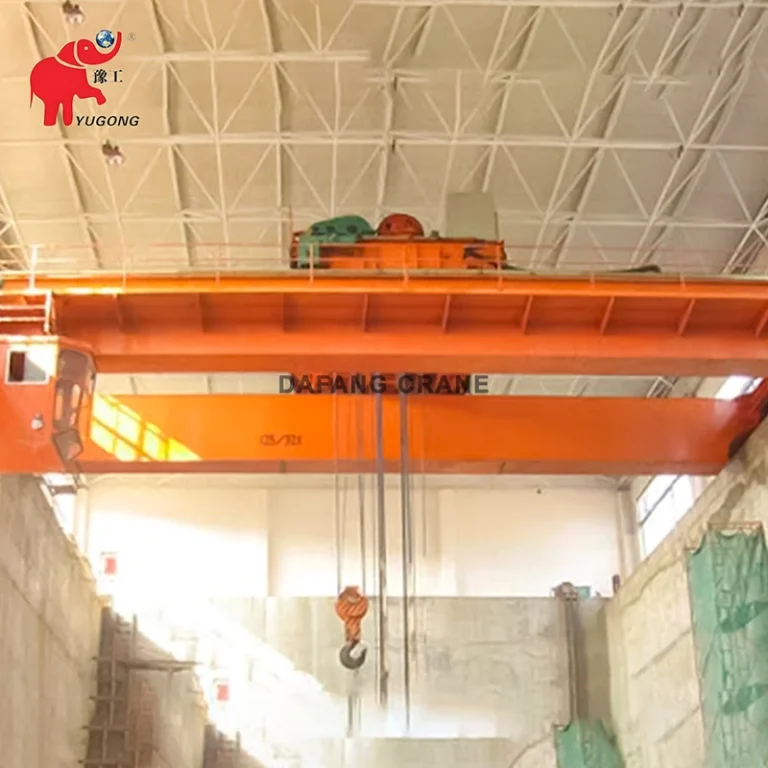
The QD double girder overhead crane is a standard-configuration heavy-duty overhead bridge crane using two parallel main girders with a top-running wire rope hoist trolley. It operates with hook, electromagnetic lifting device, clamp attachments, or custom below-hook tooling depending on the maintenance task. The double girder structure provides the rigidity, hook height, and capacity range required for heavy mining equipment maintenance positions.
Crusher stations require cranes capable of lifting crusher mantles, concaves, and eccentric assemblies — components that may weigh 5 to 30 tons and require precise positioning into the crusher frame. Ball mill maintenance needs hook cranes for mill shell lifts, liner replacement operations, and motor and gearbox removal at grinding workshops. Motor installation, pump maintenance, and large gearbox replacement across mineral processing plants are all QD crane applications.
Electromagnetic lifting devices on QD cranes handle steel plate, billet, and structural material in workshops and storage areas without requiring manual rigging attachment for each lift.
Capacity: 5 to 500 tons — defined by the heaviest single component lift required at the crane position, with a 25–30% operational buffer
Duty Class: A5 for maintenance cranes with moderate cycle frequency; A6 to A7 for production-critical positions with high daily utilization
Typical Applications: Crusher maintenance, ball mill overhaul, motor and gearbox replacement, mining equipment assembly, conveyor head pulley replacement
Single girder overhead cranes use one main bridge beam with an under-hung wire rope or chain hoist trolley. The under-hung configuration reduces the hook-to-beam dimension compared to top-running designs, making single girder cranes practical in buildings with limited headroom.
Spare parts warehouses: Parts storage and retrieval in mining spare parts facilities — motors, pumps, gearboxes, electrical panels — typically fall within the 1 to 10 ton range that single girder cranes handle efficiently.
Underground maintenance: In underground mine workshops and maintenance bays where space is constrained and heavy lifts are infrequent, single girder cranes provide adequate capability at lower cost and lighter runway loading than double girder alternatives.
Ancillary workshops: Electrical workshops, instrument maintenance areas, and light fabrication shops in mining facilities use single girder cranes for infrequent maintenance lifting without requiring the structural investment of heavier crane systems.
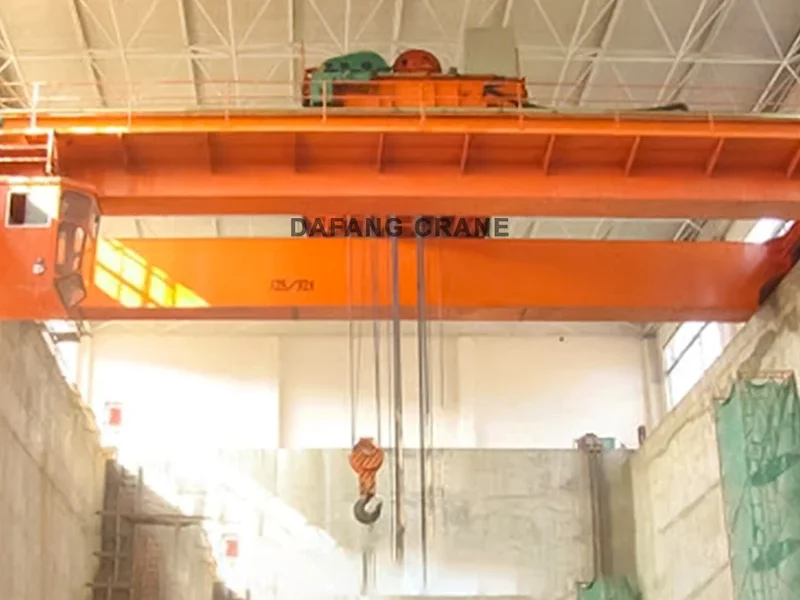
Double girder overhead cranes use two parallel bridge beams with a top-running trolley, providing greater structural rigidity, higher rated capacity, larger span capability, and greater hook height than single girder designs. They are the standard configuration for mining positions where loads exceed 20 tons, spans exceed 20 meters, or continuous multi-shift operation imposes duty cycle demands that single girder structures cannot sustain.
Heavy mining equipment workshops assembling and overhauling large machinery — dragline components, SAG mill shells, mining truck powertrains — require double girder cranes with capacities from 50 to 500 tons and spans of 20 to 35 meters or more. The double girder structure handles these loads with adequate rigidity to maintain positioning accuracy under dynamic load conditions.
Continuous production positions in ore processing plants — where the crane handles material or performs maintenance tasks across multiple shifts daily — require double girder structures rated for the higher duty classifications that intensive operation demands.
Recommended Capacity: 10 to 500 tons
Duty Class: A5 to A8 depending on application intensity
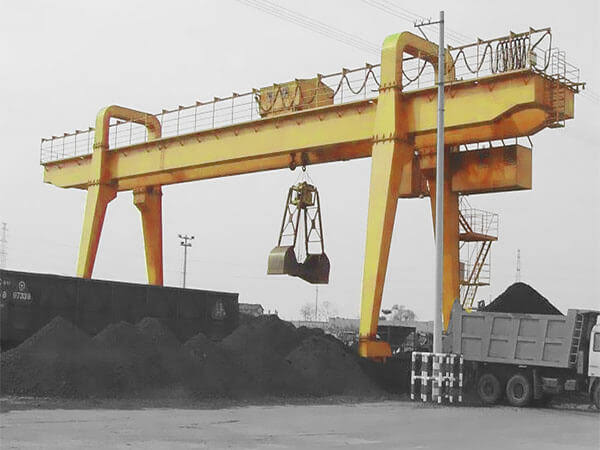
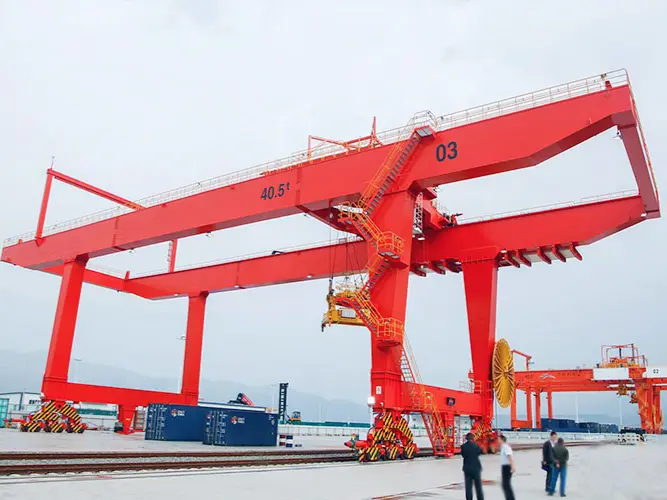
The MZ double girder grab gantry crane operates on ground-level rails spanning an outdoor stockyard, with the gantry structure carrying a four-rope grab bucket hoist system identical in operating principle to the QZ indoor grab overhead crane. The difference is the structural configuration: the gantry's self-supporting legs eliminate the need for a building structure to support the crane runway, allowing operation in open outdoor stockyards of any scale.
Coal preparation plant surface yards, iron ore stockpiles at surface mining operations, limestone storage for cement raw material facilities, and aggregate stockyards at quarry operations all use MZ grab gantry cranes as the primary material management system. The crane stacks incoming material from conveyors or trucks, manages inventory within the stockyard, and reclaims material to feed processing or loading systems.
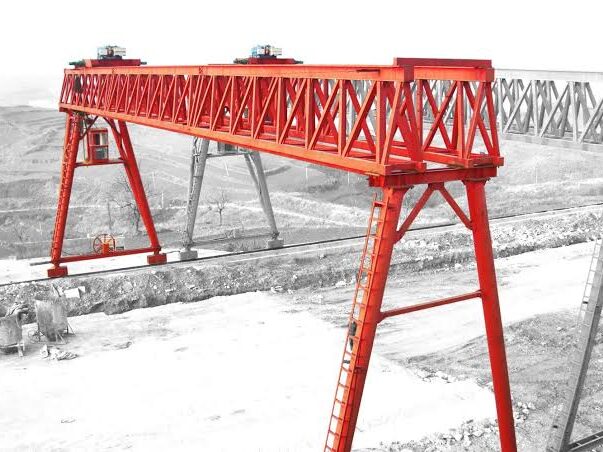
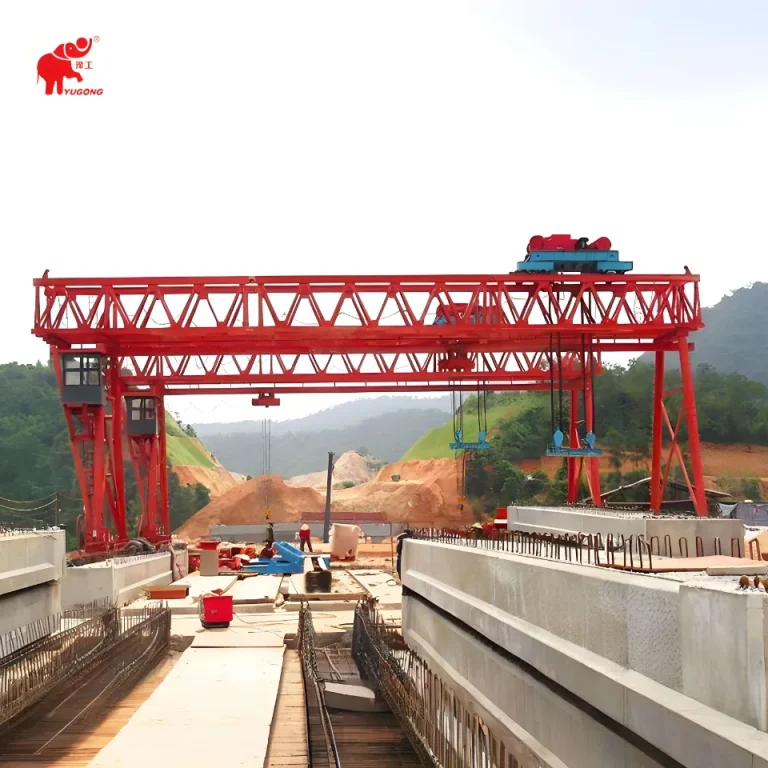
Truss gantry cranes use an open lattice (truss) structure for the main bridge beam and leg members rather than solid box girder or I-beam construction. The open truss geometry reduces wind-induced forces on the structure by allowing air to pass through rather than presenting a solid surface to wind pressure. This wind resistance advantage makes truss gantry cranes the preferred structural choice for exposed open pit mining environments and high-elevation surface installations where wind loading is a primary design constraint.
Open pit mine surface operations — ore stockpiles, waste rock storage, mining equipment assembly areas — in locations exposed to high prevailing winds or located at altitude where design wind speeds are elevated use truss gantry cranes to achieve adequate structural performance at lower steel weight than equivalent box girder designs.
Recommended Capacity: 5 to 100 tons
Suitable Environment: Exposed outdoor locations, high-wind regions, elevated mining sites
Duty Class: A5 to A7 depending on operational intensity
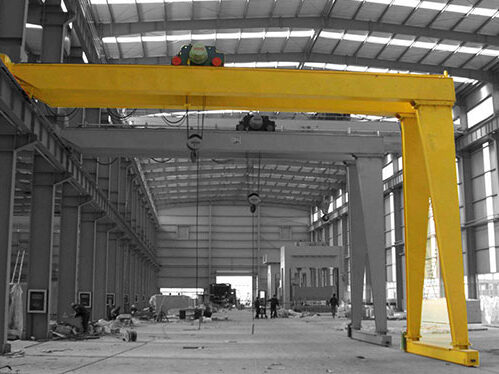
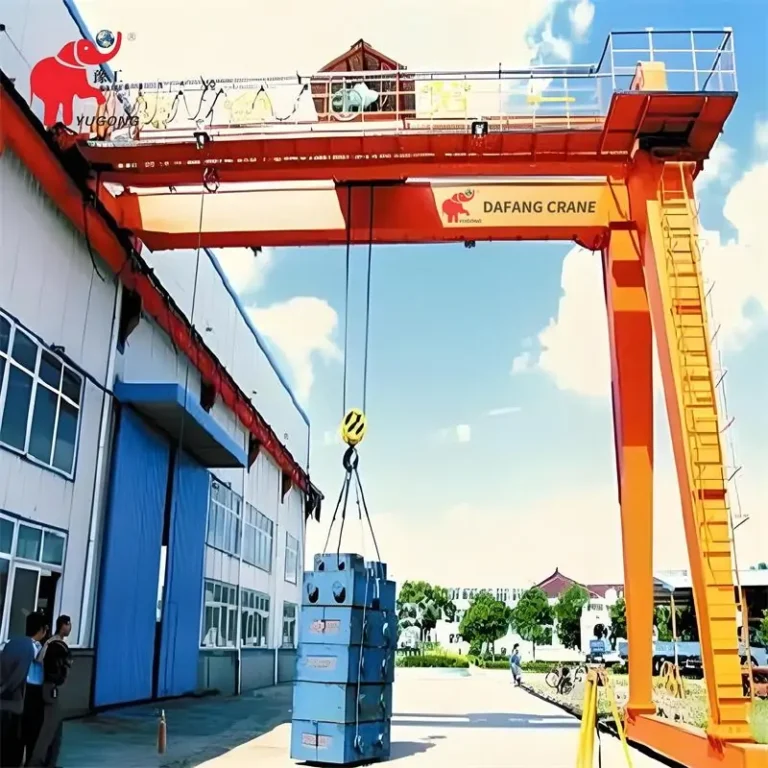
A semi gantry crane uses one elevated runway beam attached to the building structure on one side and a ground-level rail on the other. This hybrid configuration is ideal for maintenance areas that extend beyond the main building footprint — where one side of the crane's working area is covered and the other is in a semi-outdoor or open extension.
Mining workshop extensions where the main workshop building cannot cover the full maintenance area, conveyor maintenance zones adjacent to enclosed buildings, and surface equipment maintenance areas with partial roofing use semi gantry cranes to provide crane coverage across both the covered and uncovered zones without requiring two separate crane systems.
Underground mine maintenance workshops operate in confined spaces with low headroom, high humidity, and continuous ventilation requirements. Single girder overhead cranes with compact hoist designs recover maximum hook height in low-clearance development and maintenance openings. Equipment maintenance — drill jumbos, LHD loaders, underground trucks — requires cranes in the 5 to 32 ton range depending on the mining equipment fleet. Electrical systems must meet underground enclosure and, where required, explosion-proof specifications for the mine's hazardous atmosphere classification.
Open pit surface operations use outdoor gantry cranes — truss or box girder construction — for equipment maintenance areas and component storage yards. Large mining equipment — shovels, excavators, haul trucks — require crane capacities of 50 to 500 tons for major component removal and replacement. Wind load is the primary structural design driver for exposed surface installations. Equipment maintenance workshops at open pit operations may use QD double girder overhead cranes for indoor maintenance positions alongside outdoor gantry cranes for heavy outdoor lifting.
Coal handling facilities require QZ grab overhead cranes or MZ grab gantry cranes rated A6 to A7 for high-cycle indoor or outdoor bulk material management. Electrical systems must be specified for coal dust environments — IP54 minimum enclosure rating, with ATEX certification where applicable. Stacker-reclaimer combinations at large surface coal facilities may complement grab crane systems for high-throughput stockyard management. Underground coal mine maintenance workshops follow the general underground crane specification with additional explosion-proof electrical requirements.
Ore processing plants combine bulk handling cranes for ore feed management with maintenance cranes for process equipment service. Crusher stations require 20 to 50 ton overhead cranes for primary and secondary crusher maintenance. Grinding workshops need 32 to 200 ton overhead cranes for ball mill and SAG mill maintenance. Flotation plants use 5 to 20 ton cranes for flotation cell maintenance and equipment installation. The complete ore processing plant crane fleet covers a wide capacity and duty class range — from A4 maintenance cranes in ancillary areas to A6 to A7 grab cranes in ore storage and reclaim positions.
Conveyor systems — the primary bulk material transport infrastructure in mining operations — require regular maintenance of head and tail pulleys, idler frames, belt tensioning systems, and drive units. Semi gantry cranes or standard overhead cranes positioned above conveyor maintenance points handle the component weights and access requirements of conveyor overhaul work. Crane coverage must extend the full length of the conveyor section within the maintenance zone, and hook height must accommodate the lift-out clearance for the heaviest component at the highest maintenance position.
Outdoor ore and coal stockyards at surface mining operations use MZ double girder grab gantry cranes or MDZ single girder grab gantry cranes as the primary material management equipment. Crane selection depends on material bulk density, required throughput rate, stockyard span, and operational shift intensity. High-throughput stockyards handling iron ore at full production rates require A7 rated double girder grab gantry cranes with robust structural design for continuous outdoor operation. Lower-throughput aggregate and sand stockyards may be adequately served by MDZ single girder designs at A5 to A6 classification.
Mining procurement teams consistently face a specific set of challenges when specifying crane equipment. Understanding how crane design addresses these challenges directly informs better specification decisions.
Continuous production and downtime risk. Mining cranes at production-critical positions — bulk material handling, ore feed management — cannot fail without production impact. Correct duty class specification, quality component selection, and availability of replacement parts determine how long a crane runs before requiring unplanned intervention. A crane specified at A6 for an application that demands A7 will reach its design life in a fraction of the expected time.
Dust and corrosion. Mining environments generate mineral dust that penetrates standard electrical enclosures and bearing arrangements. IP54 minimum enclosure rating for electrical components, sealed bearing designs, and regular lubrication at defined intervals are baseline specifications for mining environments. In aggressive environments — high humidity, chemical exposure in processing plants — IP65 or higher enclosure ratings and enhanced corrosion protection systems are required.
Heavy and oversized loads. Mining machinery frequently exceeds the capacity of general industrial cranes. Crusher mainframes, SAG mill shells, and large mining truck components require cranes engineered specifically for their weight and dimensional characteristics — not general-purpose cranes adapted to the task. Below-hook equipment — custom spreader beams, specialized lifting attachments — must be designed for the specific load geometry.
Wind in outdoor environments. Open pit and surface mining operations in exposed locations require structural wind resistance analysis specific to the installation site. Standard structural calculations using generic wind speed assumptions may be inadequate for elevated or coastal mining locations where design wind speeds exceed standard assumptions.
Port cargo handling refers to the processes and equipment used to load, unload, transfer, store, and manage cargo in marine terminals.
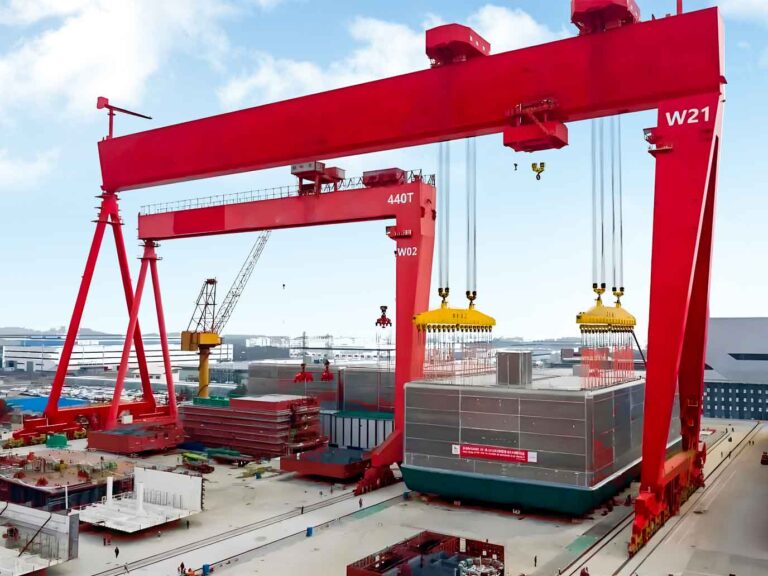
A Shipbuilding Gantry Crane is a heavy-duty lifting system designed for shipyards to transport and assemble large ship blocks.
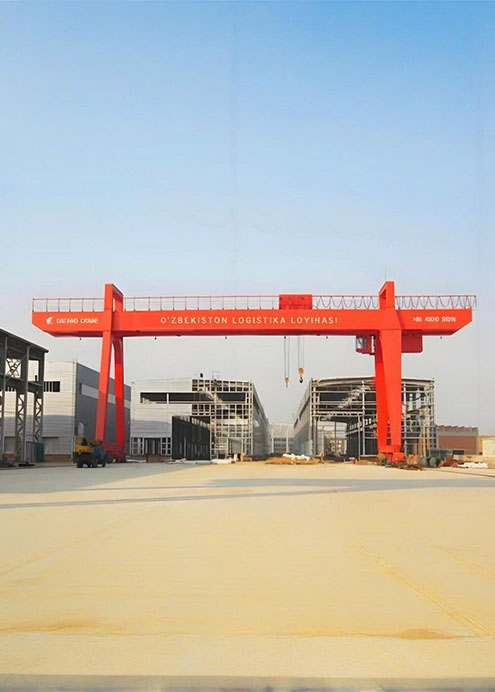
On the construction site of large-scale construction project