
A jib crane — also called a cantilever crane or slewing jib crane — typically costs anywhere from under $1,000 to over $50,000, depending on type, capacity, boom length, mounting method, and whether installation is included. That wide range is not a supplier problem; it reflects genuine engineering differences between a simple wall-mounted unit for occasional light lifting and a floor-mounted, motorized, heavy-duty system running multiple shifts a day.
Most buyers arrive at the pricing question already knowing their lifting requirement — but uncertain about which configuration actually fits their facility, and whether the quotes they receive are covering the same scope. The cheapest quote is not always the lowest-cost solution if it omits foundation work, a suitable hoist, or the certification documentation you need for customs clearance.
This guide breaks down jib crane pricing by type and capacity, then works through the five engineering variables that drive cost differences between quotes — so you can build a realistic budget and compare suppliers on equal terms.
Jib Crane Price at a Glance
| Tipo | Capacidade típica | Equipment Price Range (EXW) | Key Cost Driver |
|---|---|---|---|
| Grua fixa de parede | 0.25–2 t | $950–$3,500 | Wall/column structural capacity |
| Grua de lança montada no chão | 0.5–5 t | $8,000–$20,000+ | Boom length, foundation |
| Guindaste de braço articulado | 0.125–2 t | $1,500–$4,200 | Dual-arm mechanism |
| Mobile / Portable Jib Crane | 0.25–1 t | $2,000–$6,000 | Ballasted base, mobility |
| Grua móvel de parede | 1–3 t | $4,100–$22,000+ | Rail system, travel distance |
Prices are EXW factory estimates for standard configurations. Total installed cost typically runs 20–50% higher once freight, foundation work, electrical connection, and load testing are included.
→ Ready to compare your requirements? Send your lifting capacity, boom length, and mounting conditions to Dafang's engineering team for a tailored quotation
Obter um orçamento gratuitoDafang's Jib Crane Range: Which Type Maps to Which Application
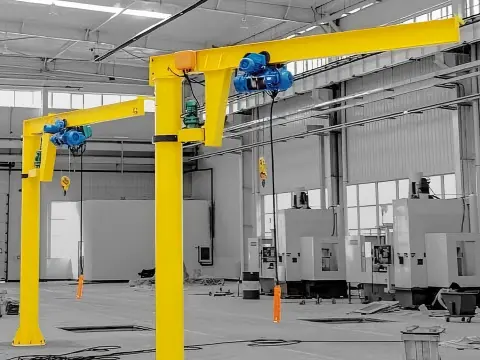
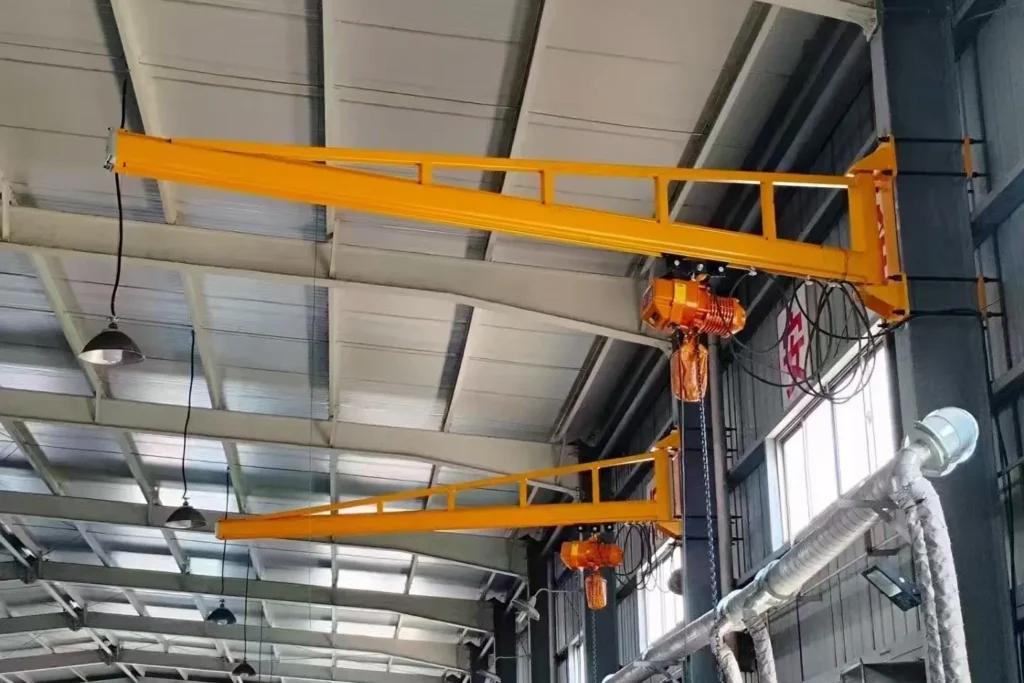
Dafang cantilever crane range covers five configurations, each suited to a different combination of space constraint, duty cycle, and lifting requirement.
Floor Mounted Jib Crane (BZ Type) — 0.5–5 t, working radius 4–6 m
The BZ floor-mounted crane anchors directly to a reinforced concrete floor via a steel base plate and anchor bolts, rotating up to 360°. It is the most common choice for machining workshops, fabrication bays, and loading docks where the floor can bear the load and full coverage around a fixed workstation is required. The column transfers the entire cantilever moment into the foundation, so slab thickness and concrete specification matter more here than for wall-mounted types.
Working class A3, lifting height 4–10 m, hoisting speed 0.8–8 m/min. Because it needs no building structure involvement, it is also the most straightforward type to install in a leased facility or a new building under construction.
Wall Mounted Jib Crane (BX Type) — 0.25–1 t, radius 4–5 m
The BX bolts to an existing structural wall or column, eliminating the need for a floor foundation entirely. It is the lowest-entry-cost configuration, with slewing to 180°. The trade-off is that the building wall or column must be evaluated for the crane's cantilever moment and repeated loading — the wall is not "free support." In narrow workshops, maintenance areas, or production lines where a column is already in place, the BX often delivers the lowest total installed cost of any type.
Wall Travelling Jib Crane — 1–3 t
Where a single fixed rotation point is not enough coverage, the wall travelling crane adds a rail system along the workshop wall, allowing the whole jib unit to traverse horizontally as well as rotate. This effectively gives a crane that covers the full length of a bay without requiring a bridge crane runway. The rail system and end stops add significant cost compared to a fixed wall-mounted unit, but it can replace an overhead crane in narrow workshops where beam height is insufficient.
Slewing Mobile Jib Crane — 0.25–1 t
The mobile jib requires no fixed installation: a counterweighted ballast base allows it to be repositioned freely around the facility. It is typically chosen for maintenance operations, multi-location assembly, and facilities where a permanent lifting point is not yet fixed. The ballast system limits capacity and working radius compared to floor-mounted types, and the unit is not suitable for high-cycle production use.
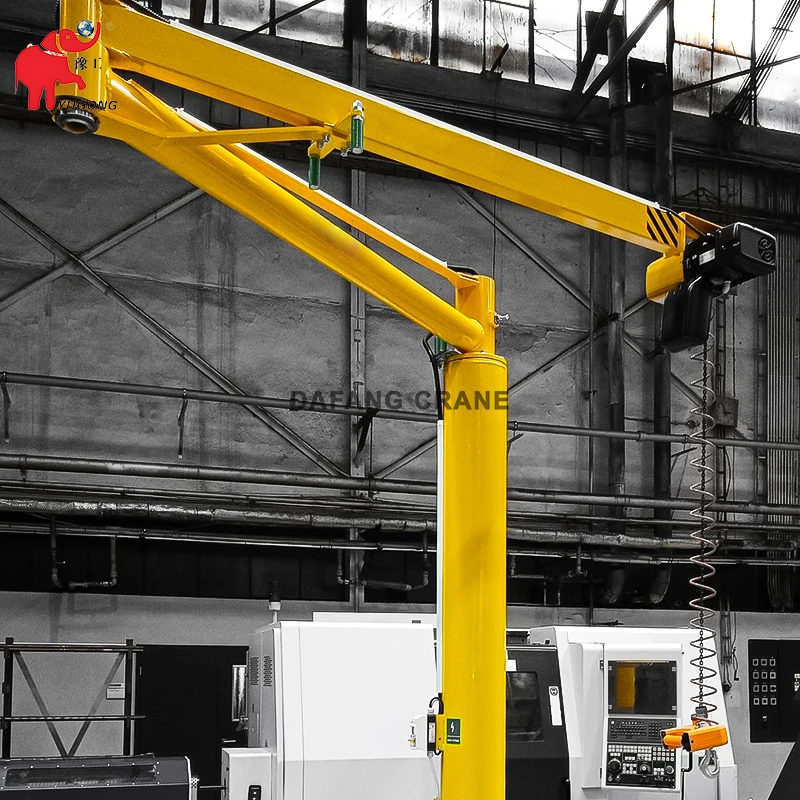
Column Articulating Jib Crane — 0.125–2 t
The articulating design adds a second pivot at the end of the jib arm, allowing the outer section to fold and reach into spaces that a straight boom cannot access — around machine guards, between workbenches, or into storage rack openings. The dual-arm mechanism adds mechanical complexity and cost relative to a straight-boom design of the same capacity, but it is often the only practical solution for confined cell environments.
Five Variables That Explain Why Two Quotes for "the Same Crane" Differ
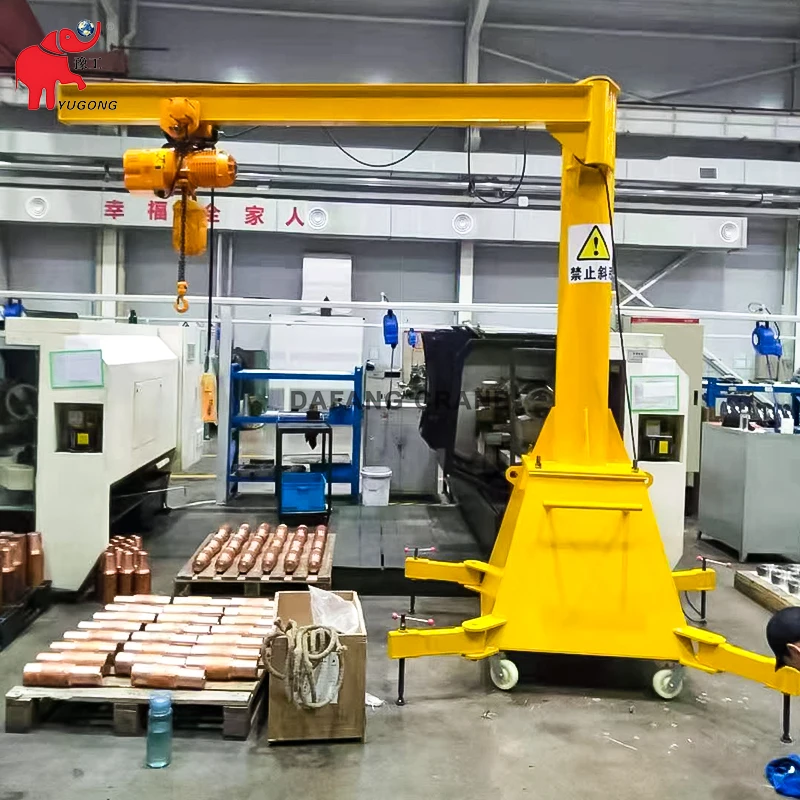
Boom length and working radius
Boom length is the single most underestimated cost variable in jib crane procurement. For the same rated load, increasing the boom from 3 m to 6 m roughly doubles the bending moment at the mast — which then requires a heavier column section, a larger base plate, stronger anchor bolts, and in many cases a thicker or reinforced concrete foundation. A 6 m boom can add 20–40% to the structural cost of a floor-mounted crane compared to a 3 m standard configuration, even with identical capacity.
The practical implication: specify the boom length from your actual pick-up and drop-off points, not from a round number. Oversizing the boom by 1–2 m "just in case" can substantially increase the structural package without adding useful coverage.
Rotation angle and slewing mechanism
Floor-mounted and mobile jib cranes typically offer 180°, 270°, or 360° slewing. Wall-mounted types are generally limited to 180° by the wall itself. The mechanical cost difference between 180° and 360° is modest on the crane itself — but 360° rotation combined with electric drive adds a cable management system (typically a festoon or cable reel arrangement) that prevents the power cable winding around the mast. For a manually rotated crane used infrequently, this addition may be unnecessary. For a motorized unit making dozens of slewing cycles per shift, it is essential.
Manual slewing is more economical upfront and sufficient for occasional or low-frequency lifting. Motorized slewing adds $500–$2,000 to the equipment cost depending on drive size, but reduces operator effort on long-boom or heavy configurations. Specify from your actual cycle frequency, not from what sounds more capable.
Mounting type and foundation scope
Wall-mounted types save foundation cost but require a structural assessment of the wall or column. Floor-mounted types require no building structure involvement but need a concrete foundation — typically 150–300 mm reinforced slab for light to medium duty, or a dedicated isolated footing for heavier configurations. The foundation is frequently the largest hidden cost in a jib crane project.
In a retrofit where the existing floor slab is marginal, the civil engineering and downtime can exceed the crane hardware cost. Foundationless designs — using a wider baseplate to distribute load across an existing slab — are available for some models and can avoid new concrete pours, but the slab still requires verification. Always confirm foundation scope in the supplier quotation before comparing equipment prices.
Hoist type and duty class
The hoist is not just an accessory — it is a primary cost and reliability variable. Two hoists rated at the same capacity can differ significantly in lifting speed, duty class, headroom requirement, and service life. An electric chain hoist is compact and economical for light-to-medium duty. A wire rope hoist offers higher lifting speeds and is better matched to high-cycle or heavy-duty applications.
More consequentially: a hoist with an under-rated duty class will fail prematurely in production use. A crane quoted with a light-duty hoist that is then used for 50+ lifts per shift will incur maintenance and replacement costs that far exceed the initial saving. Ask for the hoist duty classification (A3, A5, etc.) explicitly in any quotation, not just the capacity.
Equipment cost vs total installed cost
This distinction causes more budget surprises than any other. Equipment cost covers the crane structure, hoist, rotation mechanism, and standard controls. Total installed cost adds: freight (typically $300–$1,500 depending on destination), foundation or structural reinforcement ($1,000–$5,000), electrical connection ($300–$1,000), installation labour ($800–$3,000), and load testing ($300–$800). In most projects, installed cost runs 20–50% above equipment price. A $6,000 equipment quotation should be budgeted at $8,500–$12,000 as a realistic project figure before detailed site assessment.
Certifications and Compliance: What Export Buyers Need to Check
For overseas buyers importing jib cranes into regulated markets, compliance documentation is part of the purchase cost — not an afterthought at customs.
The relevant framework typically includes CE marking (Machinery Directive 2006/42/EC) for the European market, ISO 9001 quality management certification at the manufacturing level, and FEM duty group classification where European standards apply. For markets in the Eurasian Economic Union (Russia, Kazakhstan, Belarus), EAC certification is required. For North American projects, ASME B30.22 and OSHA 1910.179 provide the compliance baseline.
Ask any supplier for the EC Declaration of Conformity specific to the serial number being shipped — not a generic company-level document. Request the current ISO 9001 certificate with validity date, and for higher-capacity or high-cycle units, the factory acceptance test report showing proof load results. Dafang holds CE, ISO 9001, and FEM standard certifications, verifiable on request.
Certification costs — including any third-party inspection arranged before shipment — should be included in the budget, particularly for first-time imports to regulated markets.
How to Compare Jib Crane Quotes Without Getting Misled
Two quotes can show a 40% price difference and be covering entirely different scopes. Before comparing numbers, verify that each quote specifies:
On the crane itself: rated capacity (in kg or tonnes), boom length, working radius, slewing angle and mechanism (manual or motorized), working class/duty class, hoist type and model, and protection grade (IP rating).
On installation scope: whether freight is included and to which port or destination, whether foundation design is included or requires separate civil works, whether electrical connection and commissioning are included, and whether load testing to local standard is included in the price.
On compliance: which certifications are supplied with the unit, whether the EC Declaration of Conformity is model- and serial-specific, and what documentation accompanies the shipment.
A supplier who cannot specify these line items is asking you to compare a partial quotation to a complete one. The lower number is not always the better deal.
Have your lifting requirement, boom length, and installation conditions ready?
Dafang's engineering team reviews application requirements and provides tailored quotations covering equipment, hoist configuration, and export documentation. Account Manager Stella coordinates the quotation process.

FAQ
Q1: How much does a jib crane cost in 2026?
A standard jib crane typically ranges from $950 for a basic wall-mounted unit to $20,000+ for a heavy-duty floor-mounted configuration with a long boom and motorized slewing. Total installed cost — including freight, foundation, electrical connection, and load testing — generally runs 20–50% above the equipment price. The right budget figure depends on type, capacity, boom length, hoist selection, and your facility's structural conditions.
Q2: Why are two quotes for a "1-ton jib crane" so different in price?
Capacity alone does not define a jib crane's cost. Two 1-ton cranes can differ substantially depending on boom length (which determines structural loads and foundation requirements), rotation type (manual vs motorized), mounting method (wall vs floor), hoist duty class, and what installation work is included in the quotation. A detailed comparison of scope — not just the headline number — is the only reliable way to evaluate competing quotes.
Q3: Does a floor-mounted jib crane always need a new concrete foundation?
Not always. Some foundationless designs anchor to a suitable existing reinforced concrete slab without a new pour, provided the slab meets the crane's specified thickness, reinforcement, and strength requirements. Standard floor-mounted cranes typically require a 150–300 mm reinforced slab or a dedicated isolated footing. Confirm the foundation requirement for the specific model before excluding civil cost from the project budget.
Q4: What certifications should I request from a Chinese jib crane manufacturer?
For most export markets, request: CE marking with model- and serial-specific EC Declaration of Conformity, current ISO 9001 certificate with validity date, FEM duty classification documentation, and — for Eurasian markets — EAC certification. For high-cycle applications, also request the factory acceptance test (proof load) report. A reputable manufacturer can supply all of these for a specific shipped unit.
Q5: Which jib crane type has the lowest total installed cost?
For loads under 1 ton with a suitable structural wall or column available, a wall-mounted jib crane generally has the lowest total installed cost — no floor foundation is required, and the equipment price range starts around $950. However, if the wall or column requires reinforcement to carry the crane load, the civil cost can erode that advantage. For applications needing higher capacity or full 360° coverage, a floor-mounted jib crane with a well-planned foundation is often more cost-effective over the long term despite a higher initial investment.