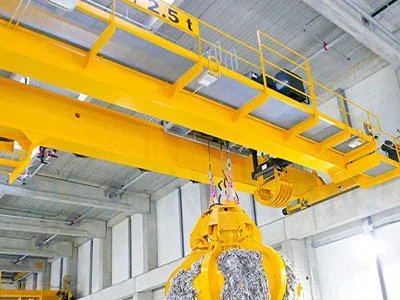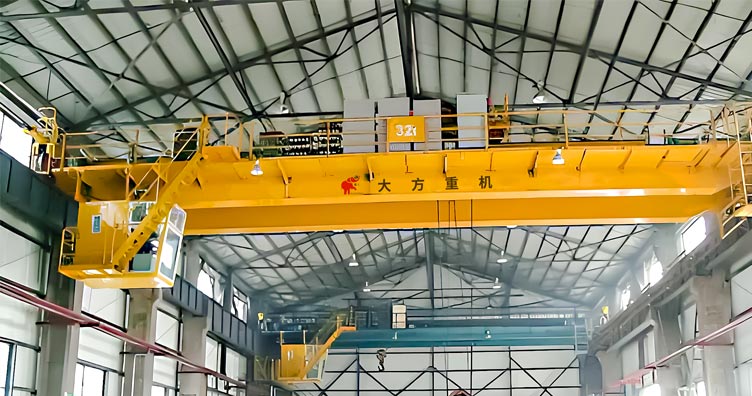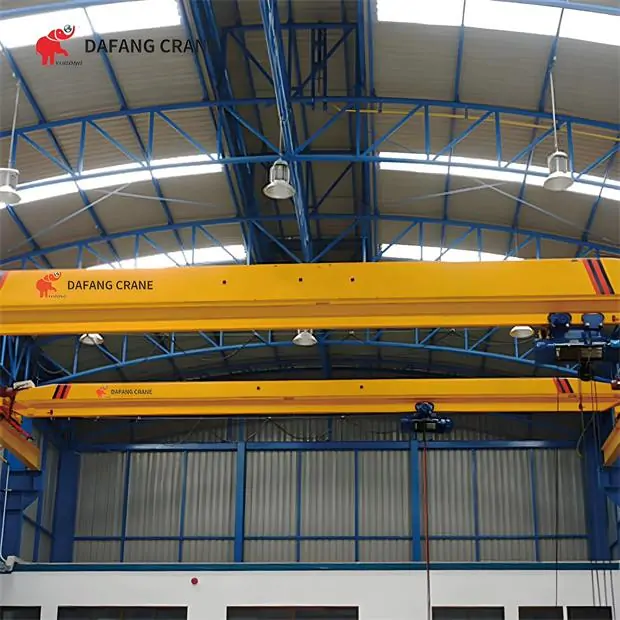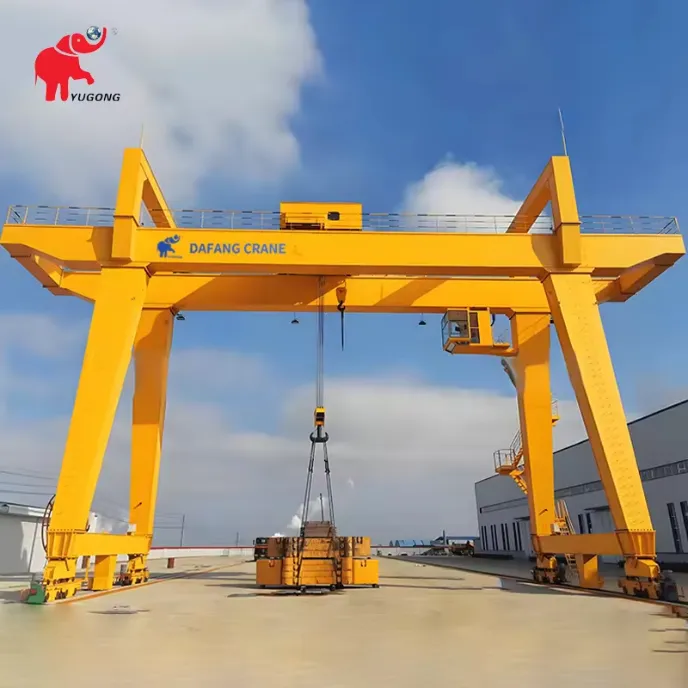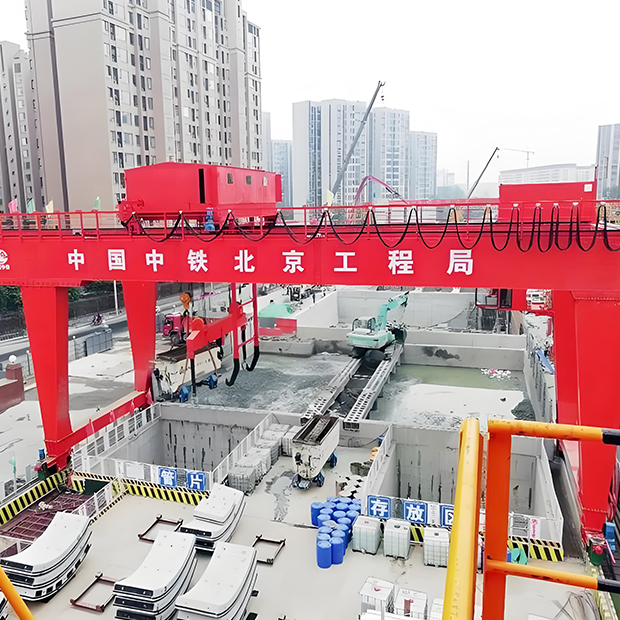

Choosing the right overhead crane control system comes down to three variables: where your operator needs to stand relative to the load, how hazardous the environment is, and how often the crane runs. Pendant controls are hardwired, always-on, and best for lower duty cycles in controlled environments. Radio remote controls free the operator from the cable, cover up to 100 m, and suit higher duty classes and hazardous bays. Cabin controls — a fixed operator station mounted on the bridge — remain the right choice when the crane runs continuously and the operator needs sustained sightlines across long travel distances. All three methods are used on Dafang's overhead cranes, gantry cranes, and electric hoists.
Most procurement teams narrow this down to two options — typically pendant vs radio remote — and miss the fact that the wrong choice for their specific duty class or site layout creates avoidable safety and maintenance costs. Cabin control, meanwhile, is often dismissed as "old technology" when it is actually the correct specification for continuous-use process cranes.
This article breaks down how each system works, what it costs to maintain (not just to purchase), which site conditions tip the decision one way, and what certifications to ask a supplier to confirm before you sign the order.
Quick Comparison: Three Overhead Crane Control Systems at a Glance
| Pendant Control | Radio Remote Control | Cabin Control | |
|---|---|---|---|
| Operator tether | Hardwired cable | None — up to 100 m range | Fixed to crane bridge |
| Operator mobility | Follows load along floor | Full freedom within range | Travels with bridge |
| Duty class fit | A3–A5 (low–medium cycle) | A3–A6, all duty classes | A5–A6 (continuous use) |
| Power source | Hardwired — no battery | Rechargeable Li-ion battery | Hardwired |
| Hazardous areas | ATEX-rated versions available | ATEX-certified option available | Enclosed cab offers protection |
| Precision control | Standard pushbutton | Pushbutton or joystick (proportional) | Joystick / lever console |
| Trip hazard | Trailing cable on floor | None | None (operator elevated) |
| Retrofit feasibility | Standard | High — receiver mounts to existing MCC | Complex — structural modification |
| Typical maintenance item | Cable and strain relief wear | Battery charging / transmitter care | Cab climate system, seating |
Get a quote tailored to your crane configuration
Get Free Quote
Pendant Control: Hardwired Simplicity With a Clear Safety Trade-Off
How pendant control works and when it is the right choice
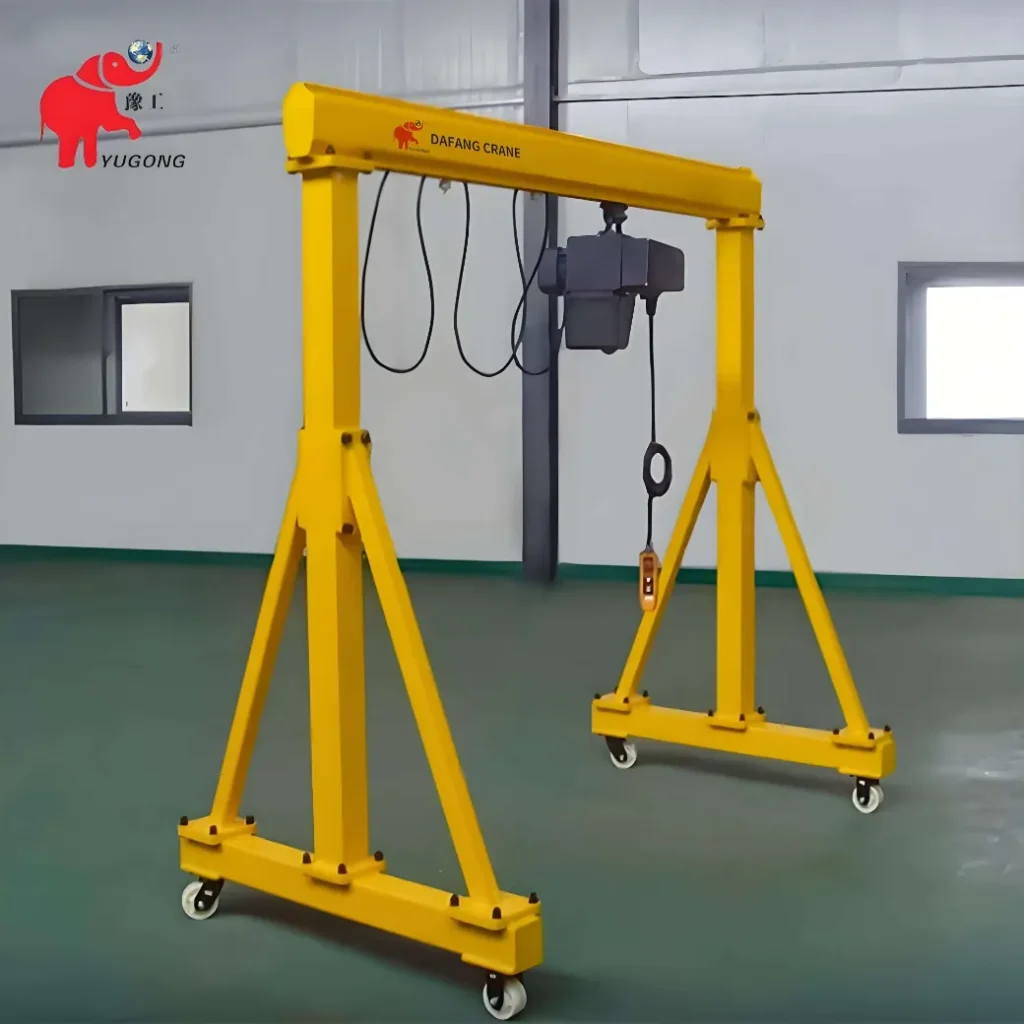
A pendant control station is a push-button enclosure suspended from the crane bridge or hoist via a festoon cable system, hanging down to operator level on the shop floor. There is no radio link, no battery, and no pairing procedure — the hardwired connection means the control is always live when the crane is powered. For Class A3–A5 cranes in a clean manufacturing or assembly environment, the pendant is the lowest-complexity solution available.
The real argument for a pendant is predictability: the control is physically attached to the crane, so it cannot be misplaced, and the operator has a physical connection that reinforces positional awareness relative to the load. In a narrow workshop bay where crane travel is short and the load path is consistent, that tether is not a meaningful limitation. Pendants are also the default specified control for explosion-proof cranes in many facilities because their hardwired design eliminates radio frequency considerations in ATEX zone classifications.
Where pendant control becomes a liability
The pendant becomes a problem the moment the operator's safe position diverges from the load path. When handling long structural steel sections, hot billets, or chemicals in an overhead crane bay, the operator walking alongside the load while holding a cable is exposed to every floor-level hazard — other machinery, trip obstacles, heat radiation, and the load itself swinging on the hook. At higher duty cycles (A5–A6), the crane moves down the runway faster than many operators can safely follow.
Cable wear is also a real maintenance cost that tends to be underestimated. In a high-cycle workshop, the festoon cable at the strain relief points can develop internal wire fatigue within 12–18 months of continuous use. Regular inspection of the cable, its entry points, and the push-button enclosure seals is required under ISO 4301 duty class service intervals — that maintenance burden does not disappear just because pendants are "simple."
Radio Remote Control: Operator Freedom and Proportional Precision
Why radio remote is now the standard choice for most applications
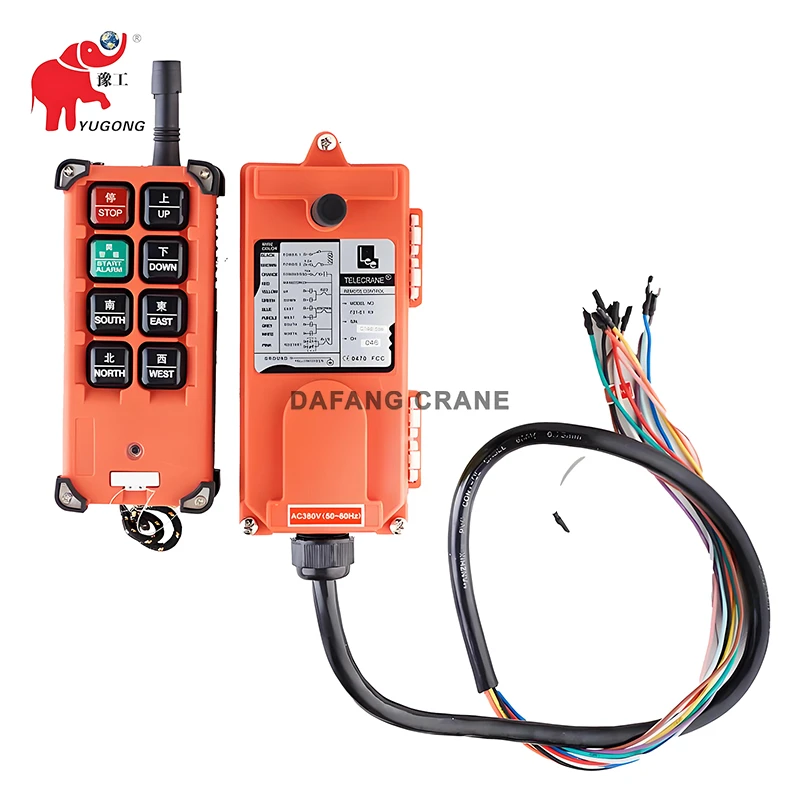
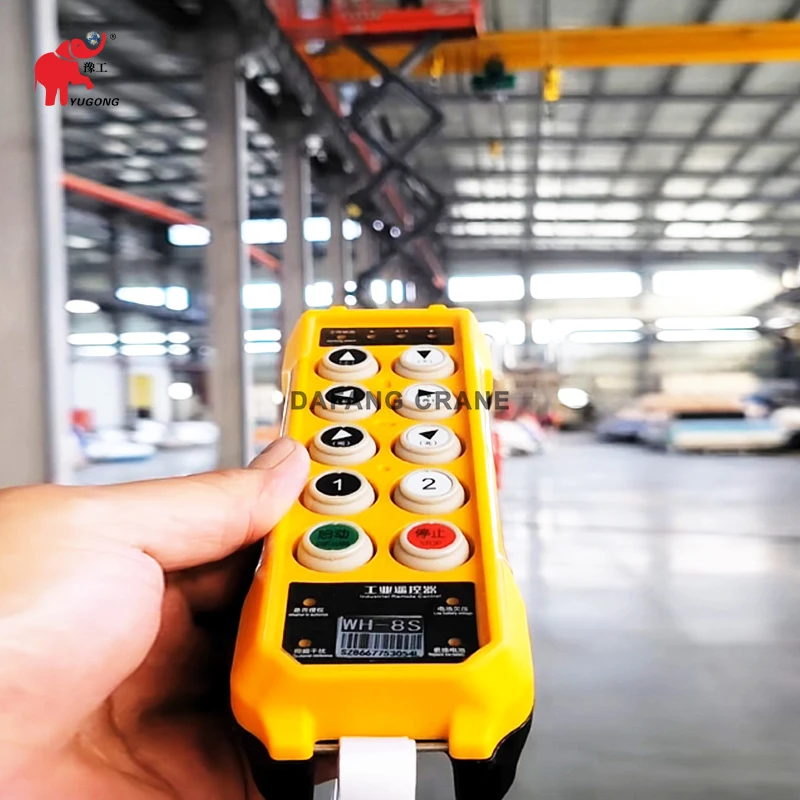
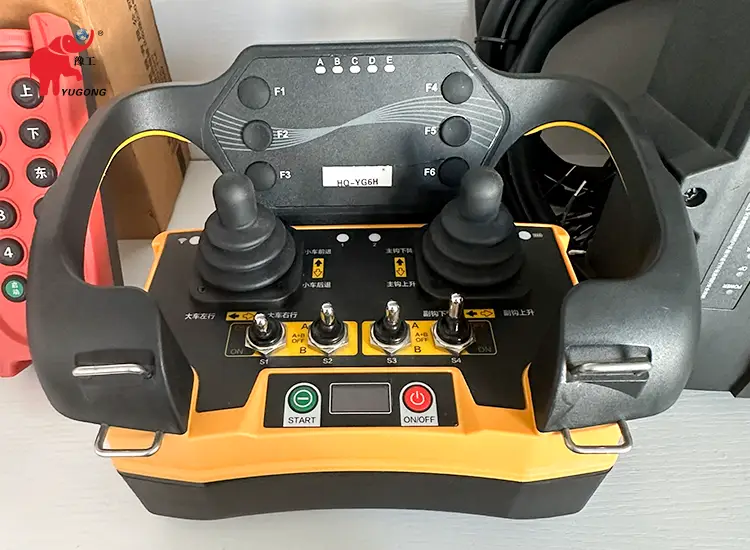
A radio remote control (also referred to as a cable-less controller) replaces the festoon cable with a 433 MHz or 915 MHz FHSS (Frequency Hopping Spread Spectrum) radio link between a handheld transmitter and a receiver unit mounted on the crane's MCC panel. The operator can stand anywhere within range — typically 50–100 m in a standard factory environment — and choose the vantage point that gives the clearest view of the load landing zone, rather than being forced to follow the cable path.
For Dafang's wireless control system, the FHSS radio hops automatically across 50+ channels to avoid interference, even in facilities running induction heating, welding, or multiple simultaneous crane operations. The transmitter is rated IP67 (fully dust-tight, immersion-protected to 1 m) and operates from −35°C to +80°C — relevant for outdoor gantry crane installations and indoor foundry environments alike. Safety shutdown — emergency stop, out-of-range halt, and low-battery cutoff — is rated ISO 13849 PL-d, which satisfies Category 3 crane control circuit requirements under EN 13849 and most industrial HSE audits.
One practical advantage that procurement teams often overlook: the retrofit path is straightforward. The receiver unit connects at the contactor level of the existing crane MCC panel, without requiring rewiring of drives or safety circuits on most standard EOT cranes. That means an existing pendant-controlled crane can typically be upgraded to wireless control without a full crane refurbishment.
Pushbutton vs joystick transmitter: matching the transmitter to the application
Radio remote transmitters come in two main configurations, and the choice between them depends on the precision requirement of the lift.
Pushbutton transmitters suit standard overhead crane and gantry crane operations with a fixed sequence of motions: hoist up/down, bridge travel, trolley traverse, and emergency stop. Single-speed and two-speed layouts cover most A3–A6 applications for general manufacturing, logistics, and warehousing. These are compact, ergonomic, and battery-efficient — Dafang's Li-ion units deliver over 16 hours of continuous use per charge.
Joystick transmitters provide proportional speed control: deflecting the joystick further increases speed smoothly, rather than switching between fixed speed steps. This matters for ladle cranes in steel mills, where sudden acceleration causes molten metal spillage; for precision assembly cranes in automotive or aerospace lines, where load placement accuracy below 20 mm is required; and for port container cranes with simultaneous multi-axis commands. The joystick transmitter is the standard specification for any double-girder overhead crane handling fragile or high-value loads.
Have a hazardous area or precision lifting application? Our engineers can specify the right transmitter type — pushbutton, joystick, or ATEX explosion-proof — for your site conditions.
Get Free QuoteCabin Control: The Right Answer for Continuous-Use and Long-Travel Cranes

When a cab-mounted operator station is still the correct specification
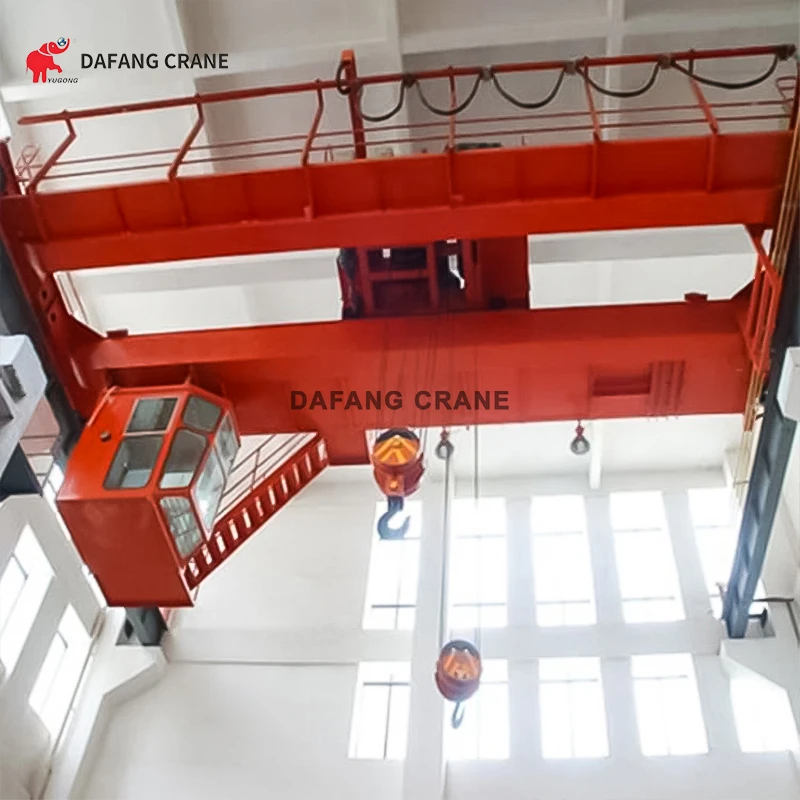
Cabin control — a glazed operator station mounted on the crane bridge, traveling with the crane — is the specification that many modern buyers dismiss without fully evaluating. It is genuinely the right choice in two scenarios: when the crane is in continuous use throughout a shift (duty class A5–A6) and when long-travel distances make floor-level operation impractical.
In a steelwork bay with a 200 m runway, a pendant operator cannot keep pace with the crane's travel speed. A radio remote operator can move freely but loses depth-of-field accuracy when the load is at the far end of the runway. A cab-mounted operator traveling with the bridge has consistent sightlines and can react to changing floor conditions in real time — which is why crane cabins remain standard on process cranes in steel mills, shipyards, and large logistics yards.
The cabin also provides thermal and acoustic protection in environments where floor-level operation is genuinely hazardous over a full shift: radiant heat from furnaces, fumes from casting operations, and ambient noise levels above safe exposure limits. In these environments, the cabin is not a preference — it is a health and safety requirement.
What to specify if the application requires a cabin
Cabin configurations vary: the cab can be fixed to one end of the bridge (the most common arrangement), fixed to the crab unit to travel with the trolley and maintain load sightlines, or configured as an observer cab without crane controls — allowing the operator to switch between cab position and pendant or remote control depending on the lift. For new crane orders, Dafang's engineering team can advise on cab placement relative to your specific runway length, load type, and bay geometry.
Cabin control is not typically retrofit-friendly on existing cranes without structural modification, which is a relevant cost consideration if you are evaluating a cabin upgrade vs a radio remote upgrade for an existing installation.
Certifications and Compliance: What to Ask Your Supplier
Which standards apply to overhead crane control systems
For buyers in the EU and markets accepting CE marking, overhead crane control systems must comply with the Machinery Directive 2006/42/EC. For radio remote systems specifically, the Radio Equipment Directive 2014/53/EU covers frequency type approval for 433 MHz and 915 MHz ISM bands. Functional safety of the emergency stop circuit is evaluated under ISO 13849-1, with most electric overhead travelling cranes requiring PL-d (Performance Level d) — the same level at which Dafang's wireless control system is rated.
For ATEX-classified zones (chemical processing, petrochemical, grain handling, or underground mining applications), control systems must carry the appropriate ATEX Directive 2014/34/EU certification. Standard pendant stations and radio remotes are not suitable for use in Zone 1 or Zone 2 without specific certification — this is a non-negotiable specification point, not a feature upgrade.
Why this matters for procurement and how to verify it
Certification affects customs clearance, insurance underwriting, and on-site HSE audits. An overhead crane installed with an uncertified control system in an ATEX zone creates regulatory liability regardless of whether the crane itself is certified. When evaluating a supplier, request the EC Declaration of Conformity for the control system (separate from the crane), the ISO 13849 PL-d assessment documentation, and — for ATEX configurations — the ATEX certificate and IECEx test report. Dafang supplies wiring diagrams and compliance documentation matched to the customer's existing control schematic before shipment, including for retrofit installations.
Contact Dafang to Specify Your Control System
Whether you are specifying a new overhead crane with the right control method from the outset, or evaluating a retrofit upgrade from pendant to wireless, Dafang's engineering team can advise on transmitter type, IP rating, ATEX configuration, and receiver compatibility with your existing MCC panel.

FAQ
Q1:What is the main difference between pendant control and radio remote control on an overhead crane?
Pendant control uses a hardwired cable connecting the push-button station to the crane's electrical panel; the operator must stay within cable reach of the load. Radio remote control replaces that cable with a 433–915 MHz radio link, giving the operator freedom to stand anywhere within the effective range — typically 50–100 m — and choose the safest or most visible vantage point for the lift.
Q2:Which overhead crane control option is best for a steel mill or foundry environment?
A joystick radio remote transmitter is the standard choice for steel mills and foundries. The proportional speed control prevents sudden load acceleration — critical when handling ladles of molten metal — and the operator can stand away from radiant heat and splatter zones. For cranes in continuous use on long runways, a cabin-controlled crane with joystick console is the alternative where operator safety over a full shift is the overriding consideration.
Q3:Can I retrofit a wireless radio remote to my existing overhead crane?
Yes, in most cases. The receiver unit for a radio remote system connects to the existing crane MCC panel at the contactor level, without requiring rewiring of the drive system. Dafang supplies a wiring diagram matched to your crane's existing control schematic before shipment. Cabin control, by contrast, typically requires structural modification and is not a practical retrofit option for most existing cranes.
Q4:How much does overhead crane control system pricing vary between pendant, radio remote, and cabin?
The three control types differ substantially in cost. Pendant systems are generally the lowest-cost option at the point of purchase but carry ongoing maintenance costs for cable and strain-relief wear. Radio remote systems have a higher initial cost (transmitter, receiver, and safety relay) but eliminate cable maintenance; the main running cost is battery management. Cabin control involves the highest upfront investment due to structural and fitout requirements. Exact pricing depends on transmitter configuration (pushbutton vs joystick), IP and ATEX rating, crane span, and whether the installation is new-build or retrofit — contact Stella at Dafang for a configuration-specific quote.
Q5:What safety certification should a crane radio remote control carry?
For general industrial use, look for CE certification under Machinery Directive 2006/42/EC and Radio Equipment Directive 2014/53/EU, and functional safety rated to ISO 13849 PL-d for the emergency stop circuit. For hazardous areas, the transmitter and receiver must both carry ATEX Directive 2014/34/EU certification at the appropriate zone classification. Ask the supplier for the EC Declaration of Conformity and the ISO 13849 PL-d assessment documentation as a minimum.