






An electric chain hoist is the most compact and cost-effective motorized lifting solution for loads between 0.5 and 30 tons, suited to workshops, production lines, warehouses, and crane systems where headroom is tight and cycle times matter. Compared to a wire rope hoist at equivalent capacities under 10 tons, a chain hoist costs roughly 40–60% less, requires simpler chain maintenance than wire rope drum inspection, and delivers a shorter hook approach distance — making it the default running gear for most single-girder overhead cranes, jib cranes, and standalone monorail systems.
If you've already decided you need a chain hoist and are now working out which configuration to order, the decision tree is less obvious than the capacity number suggests. Hook-mount or motorized trolley? Single-speed or dual-speed? Grade 80 or Grade 100 chain? And how much headroom does your building actually allow for? Getting these details wrong at the specification stage creates problems that a competitive unit price won't solve.
This guide covers the four main hoist types and when to use each, how to match capacity to duty class (the spec most buyers underweight), the critical dimensions to confirm before ordering — starting with headroom — a clear comparison with wire rope hoists, indicative price ranges by configuration, and the certifications worth verifying before issuing a purchase order.
Quick Reference: Electric Chain Hoist Types at a Glance
| Configuration | Horizontal Travel | Typical Capacity | Best Application |
|---|---|---|---|
| Hook-Mount (Stationary) | None | 0.5–30 T | Fixed lift stations, jib cranes |
| Push Trolley | Manual (operator pushes) | 0.5–5 T | Light workshop, occasional lateral moves |
| Motorized Trolley | Powered traverse | 0.5–30 T | Overhead cranes, production lines, gantry cranes |
| Dual-Speed / Double-Fall | Hook-mount or trolley | 1–30 T | Precision placement, low-headroom upgrades |
Know your load and span?
Get Free Quote
Types of Electric Chain Hoist: Matching Configuration to Your Application
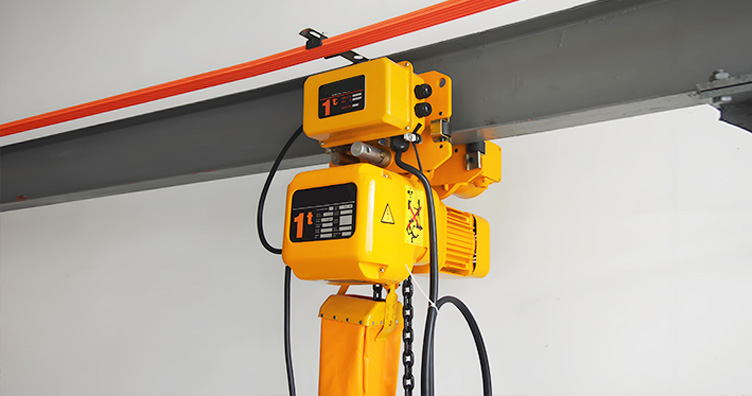
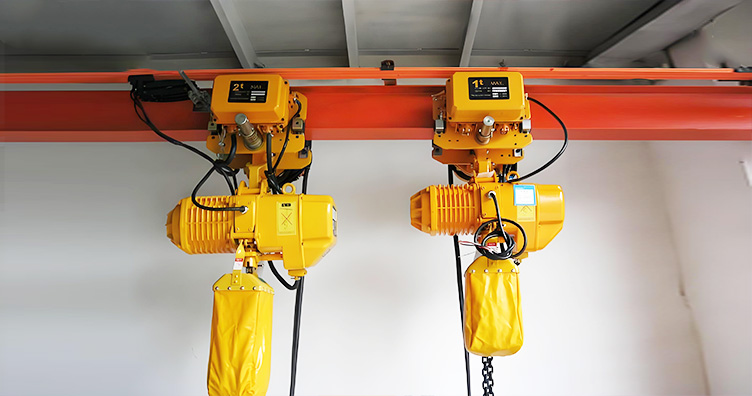
Hook-Mount Hoists: Lowest Headroom, Fixed Vertical Lift Only
A hook-mount electric chain hoist suspends from a fixed point and lifts loads vertically — no horizontal travel. It is the correct choice when the material always comes to the hoist rather than the hoist needing to travel to the material: dedicated assembly stations, maintenance pits, engine bays, and jib cranes where the cantilever arm provides the lateral reach and the hoist provides only the vertical lift.
The practical advantage is headroom. Because there is no trolley body adding height above the hoist frame, hook-mount units achieve the shortest hook approach distance of any configuration — the distance from the top hook centerline to the bottom hook at its highest raised position. In buildings with constrained ceiling heights, this is often the specification that makes the installation possible. Dafang electric chain hoists in hook-mount configuration cover 0.5 to 30 tons with lift heights from 3 to 30 meters, in a die-cast aluminum housing that minimises both unit weight and headroom consumption.
If your workflow requires moving loads laterally at any point in the process, you need a trolley variant.
Push Trolley vs Motorized Trolley: Which Traverse Method Fits Your Workflow
A push trolley mounts the hoist on a manually-moved carriage that rides along an I-beam or monorail, allowing the operator to slide the load horizontally by hand. It suits light-to-medium loads — generally under 3 tons — in workshops where lateral moves are infrequent and the operator can safely push the suspended load. Before ordering, confirm that the trolley's beam flange width adjustment range matches your actual beam profile; older or non-standard beams sometimes fall outside standard trolley adjustment ranges, which is an installation problem that surfaces only after delivery.
A motorized trolley adds a second motor driving the carriage along the beam, giving the operator full vertical and lateral control from the pendant or wireless remote. Travel speed on Dafang motorized trolley hoists runs 13–20 m/min. This is the standard configuration for single-girder and double-girder overhead cranes, gantry cranes, and jib (cantilever) cranes where the hoist must cover a full span and cycle time matters. For production environments, the motorized trolley is almost always the correct choice — the manual push variant is primarily a cost-saving option for very light, infrequent use.
Single-Speed vs Dual-Speed: When Precision Placement Matters
Single-speed electric chain hoists lift and lower at one fixed rate — straightforward, cost-effective, and adequate for bulk material moves where load placement is not particularly precise. Dual-speed models add a slow mode (typically around one-fifth of the fast speed) for final positioning: setting an engine onto mounting studs, lowering a steel beam into a bolted connection, or placing a mold into a press bed.
Dafang chain hoists are available in both configurations, with the dual-speed variant using either dual-speed motor coils for two fixed rates, or a frequency converter (VFD) for stepless control from near-zero to full speed. If your process involves frequent precision placement or delicate loads that must be landed softly, dual-speed is worth the additional cost. For warehousing, logistics, and bulk handling where the priority is throughput rather than placement finesse, single-speed performs the job at lower upfront and ongoing cost.
Capacity and Duty Class: Two Numbers That Must Both Be Right
Calculate Capacity from Your Heaviest Lift — Then Add Margin
The standard practice is to select a hoist rated at 125% of the maximum load you will ever lift — not just your typical load. This margin accounts for dynamic forces during acceleration and deceleration, shock loads when picking up resting material, and the reality that "maximum load" tends to grow over time. If your heaviest regular lift is 4 tons, specify a 5-ton hoist. Operating consistently at 100% of the rated working load limit (WLL) accelerates wear across every component — motor, reducer, brake, chain, and hook assembly.
Dafang electric chain hoists cover nine standard capacity steps: 0.5, 1, 2, 3, 5, 10, 15, 20, and 30 tons, with custom configurations available. The load chain is Grade 80 alloy steel as standard; Grade 100 is available where headroom constraints demand a more compact chain for the same capacity (Grade 100 offers roughly 25% higher strength-to-diameter ratio, meaning a shorter, lighter chain for equivalent WLL).
Duty Class Determines Whether the Hoist Survives Your Environment
Rated capacity tells you the maximum weight a hoist can lift. Duty class — defined under FEM 9.511 / ISO 4301 — tells you how intensively it can lift that weight over its service life: how many lifts per shift, at what fraction of WLL, over how many operating hours per day. A hoist that is capacity-correct but duty-class-underrated will fail prematurely regardless of how well it was made.
Practical mapping: M3 suits maintenance and infrequent shop use (under 15 lifts per shift, light cycles). M4–M5 covers general manufacturing, fabrication, and warehouse operations running a standard shift. M5 and above is the specification for production lines, automotive assembly, and any environment where the hoist runs four or more hours of active lifting per day. When in doubt, specify one duty class higher than your calculated requirement — the cost difference between adjacent classes is modest; the cost of premature motor burnout or brake failure in a production environment is not. Always request the FEM/ISO duty classification in writing, as a separate data point from rated capacity.
Indicative Market Price Ranges by Configuration
Electric chain hoist pricing varies by capacity, duty class, trolley type, and control configuration. Based on current ex-works market references from multiple sources:
- 0.5–2 ton, hook-mount or push trolley, standard duty: generally in the $300–$800 range for industrial-grade CE-certified units
- 3–5 ton with motorized trolley, M4 rated: typically $800–$2,500 depending on lift height, speed configuration, and control system
- 10 ton and above with motorized trolley and dual-speed: $2,000–$6,000+ depending on span, chain length, duty class, and IP specification
These are market references, not Dafang list prices. Actual ex-works or FOB pricing from Dafang depends on your specific configuration, quantity, destination port, and any customisation — contact the team directly for a formal quotation.
Critical Specifications to Confirm Before Ordering
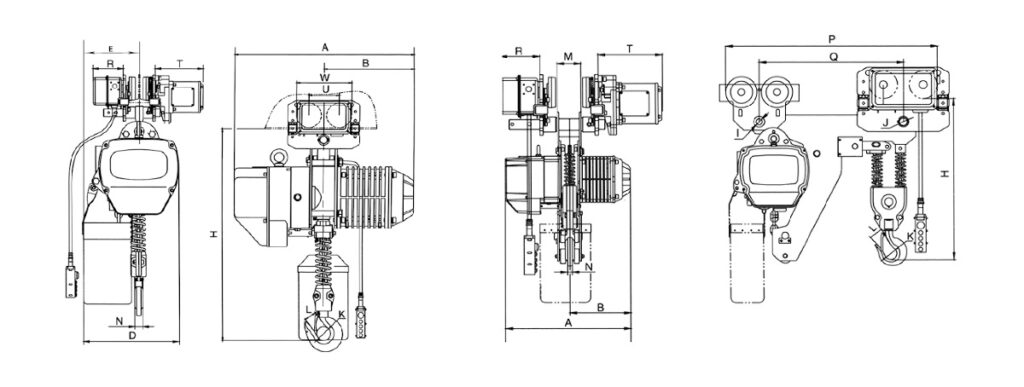
Headroom Is Your First Filter, Not a Detail to Check Later
Available headroom — the usable vertical distance in your facility minus the hoist's hook approach distance — determines whether a standard model fits your building and what effective lift height you can achieve. In facilities with 10-meter-plus ceilings this is rarely a problem. In older industrial buildings, mezzanines, low-bridge configurations, or tight overhead crane clearances, it can be the single factor that determines which model is even physically installable.
Measure the clearance from the underside of your beam (or trolley riding surface) to the floor. Subtract the hoist's hook approach distance (published in the technical datasheet — not estimated) to get your effective lift height. If the result is marginal for your process, discuss low-headroom trolley options with the supplier before placing the order. Dafang's engineering team can advise on configurations that minimise hook approach distance for constrained installations — this is a conversation better had at the specification stage than during commissioning.
Lift Height, Hoisting Speed, and Power Supply
Standard Dafang electric chain hoists are configured for 3–6 meters of lift as the baseline, with customisable lift heights up to 30 meters. Longer chain falls add unit weight and increase load sway during traverse — factor this in for tall facilities where the load travels a long vertical distance before the operator can bring it under control.
Hoisting speed runs 1.3–8 m/min depending on capacity and motor configuration, with traverse speed at 13–20 m/min on motorized trolley models. For high-volume logistics where operators wait on the hook frequently, faster lifting speed has a direct impact on throughput. For precision placement operations, the slow end of a dual-speed range matters more than the peak speed.
Power supply: most industrial chain hoists run on 380V/400V three-phase AC. Single-phase 220V is available on Dafang models up to 2 tons. Pendant control voltage on all Dafang units is 24V (low-voltage safety standard), and the electromagnetic DC brake is fail-safe — it engages immediately on any power interruption, holding the load in position.
IP Rating and Chain Grade: Match the Environment to the Spec
Standard Dafang electric chain hoists carry IP54/IP55 ingress protection, adequate for most indoor industrial environments including moderate dust, humidity, and occasional splash. For regular washdown, chemical exposure, or outdoor covered installations, IP65 or fully sealed variants should be specified — the additional cost at purchase is consistently less than premature corrosion damage and early replacement.
Grade 80 alloy steel chain is standard for most applications. Grade 100 is the right specification where headroom or weight constraints favour a more compact chain at the same rated capacity, or in high-frequency-cycle environments where chain weight becomes a meaningful factor in fatigue over time.
Comparing specific capacity steps or trolley configurations? Dafang's engineers can match your load, span, duty cycle, headroom, and power supply to the right configuration — and turn around a formal quotation within one business day.

Electric Chain Hoist vs Wire Rope Hoist: Clear Decision Criteria
A Chain Hoist Is the Right Tool for Most Applications Under 10 Tons
Electric chain hoists outperform wire rope hoists on three dimensions that matter for the majority of industrial buyers at under-10-ton capacities: unit cost (typically 40–60% lower at equivalent capacity), physical compactness (the chain collects in a bag rather than spooling onto a drum, reducing the hoist body depth and headroom consumption), and maintenance simplicity (chain inspection and lubrication is more straightforward than monitoring a multi-strand wire rope for broken wires, kinking, and drum groove wear).
They are the standard running gear for single-girder overhead cranes, jib cranes, monorail systems, and light gantry crane installations where capacities run 0.5–10 tons and lift heights stay under 10–15 meters. For those parameters, a correctly specified chain hoist — with the right duty class — will deliver reliable service life at materially lower total cost.
When to Step Up to a Wire Rope Hoist
Wire rope hoists become the appropriate specification when lift heights consistently exceed 10–15 meters (wire rope spools onto a grooved drum, making it more compact than an equivalent length of chain bag for long vertical travel), when loads regularly exceed 10 tons and heavy-duty-cycle precision is required, or when VFD stepless speed control at finer granularity than dual-speed chain hoists provide is critical to the application.
Double-girder overhead cranes in heavy industry, port equipment, and steel processing typically specify wire rope hoists for exactly these reasons. If your capacity is under 10 tons and your lift height is under 10 meters, a chain hoist is almost certainly the better value. If you're above either of those thresholds, it is worth a direct conversation with a Dafang engineer about which running gear fits the crane system — Dafang manufactures both product lines and can advise based on your specific parameters rather than a general preference for either type.
Certifications and Compliance
What markets require, and what to verify:
For European and most international markets, CE marking under the EU Machinery Directive 2006/42/EC is the baseline requirement. Always request the Declaration of Conformity (DoC) alongside the CE mark — a CE mark without accompanying DoC is not legally sufficient and cannot be verified. For duty class and design life assessment, request documentation referencing ISO 4301 / FEM 9.511 classification. ISO 9001 certification on the manufacturer covers quality management across the production process, not just the finished product.
For North American installations, ASME B30.16 (Overhead Hoists — Underhung) defines design and operational requirements, and OSHA 29 CFR 1910.179 compliance is legally required in U.S. industrial workplaces. For EAC (Eurasian Customs Union) markets, the relevant EAC TR certification applies. Dafang holds CE, ISO 9001, and OSHA-compliant documentation across its electric chain hoist range — available on request for any specific unit.
Why the paperwork check matters for procurement: Facilities operating non-compliant hoists face insurance voidance on lifting incidents, failed third-party safety audits, and potential regulatory citations. The documentation check takes minutes; dealing with any of those outcomes does not.
How to verify a supplier's compliance claims: Request the EC Declaration of Conformity, the load test certificate for the specific unit (not just the model series — a credible manufacturer tests each unit before dispatch), and the ISO 9001 certificate with its current validity date. A supplier who hesitates to provide these documents is providing a useful data point about their compliance posture.
What certifications should I require from the supplier?
For European and most international markets: CE Declaration of Conformity (Machinery Directive 2006/42/EC), ISO 9001 quality management certificate with current validity date, and ISO 4301 / FEM 9.511 duty class documentation. For North American installations: ASME B30.16 compliance documentation. For hazardous environments: ATEX certification (EU) or NEC Class/Division certification (North America). For all markets: the load test certificate for the specific unit shipped.
Ready to specify your electric chain hoist?
Dafang manufactures electric chain hoists from 0.5 to 30 tons with full customisation on lift height, trolley type, speed configuration, IP rating, and power supply. Manufacturing base: 850,000 m², 2,600+ staff, export to 60+ countries. CE, ISO 9001, and OSHA-compliant documentation provided with every unit.
FAQ
Q1:How do I calculate the right capacity for an electric chain hoist?
Start with the maximum load you will ever lift, then specify a hoist rated at 125% of that figure to cover dynamic loading forces and shock loads from picking up resting material. Never plan regular operations at 100% of rated WLL — standard practice is to keep repeated lifts below 80% of rated capacity for sustained service life. If your heaviest lift is 4 tons, order a 5-ton unit.
Q2:What is FEM/ISO duty class, and why does it matter more than capacity?
Duty class defines how intensively a hoist can operate — lifts per shift, hours per day, fraction of WLL per lift — over its design service life. A 5-ton hoist rated M3 (light duty) will fail prematurely in a production environment running 50+ lifts per shift; a 5-ton M5 unit handles that load without issue. Always specify duty class in writing as a separate requirement from rated capacity, and verify it on the supplier's documentation.
Q3:What does an industrial electric chain hoist cost?
Market reference ranges (ex-works, CE-certified): 0.5–2 ton units in the $300–$800 range; 3–5 ton with motorized trolley typically $800–$2,500; 10 ton and above with dual-speed and motorized trolley $2,000–$6,000+. Actual pricing from Dafang depends on duty class, lift height, trolley configuration, power supply, and order quantity — contact the team for a formal quotation against your specific requirements.
Q4:Can an electric chain hoist be fitted to an existing overhead crane or gantry crane?
Yes — motorized trolley chain hoists are the standard running gear for single-girder overhead crane systems. The trolley flange width adjustment must match your existing beam profile, and the combined weight of the hoist plus maximum load must fall within the crane's rated capacity. Provide your beam type, flange width, and crane rated capacity when requesting a quotation; Dafang can configure the trolley to suit.