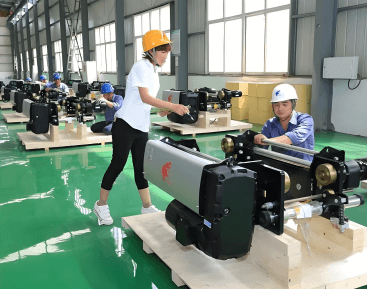







Building height is a fixed constraint that no amount of production planning can change. When a standard electric hoist consumes 800mm to over 1,000mm of vertical space between the crane beam and the hook at maximum elevation, that dead space directly reduces the usable lifting height for every operation the crane performs. In a workshop with 6 meters of clear height, losing nearly a meter to hoist geometry is an operational limitation that affects what the crane can actually do — not just in theory, but on every shift.
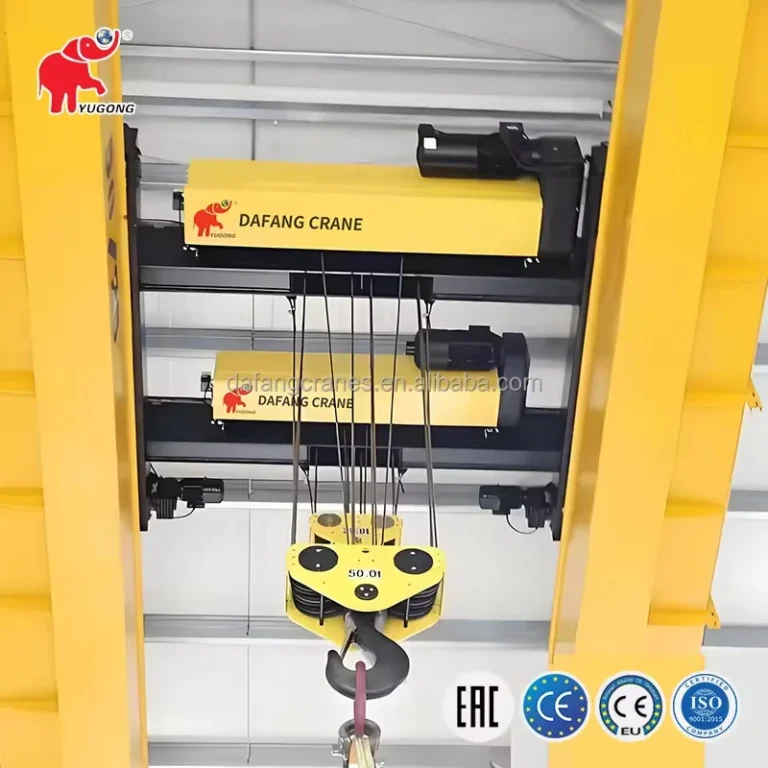
A low headroom electric hoist is a specially designed lifting device that minimizes the vertical space between the crane structure and the hook, allowing factories with limited building height to achieve greater lifting height and better space utilization. By redesigning the trolley profile, motor orientation, and drum arrangement, low headroom hoists recover 300mm to 500mm of usable hook travel within the same building — without structural modification, without raising the runway, and without compromising lifting capacity or duty life.
For Dafang Crane customers operating in existing buildings or designing compact production facilities, low headroom electric hoists are a practical, cost-effective solution to a problem that building modification cannot always solve economically.
Table des matières
Qu'est-ce qu'un palan électrique à faible hauteur sous plafond ?
Définition
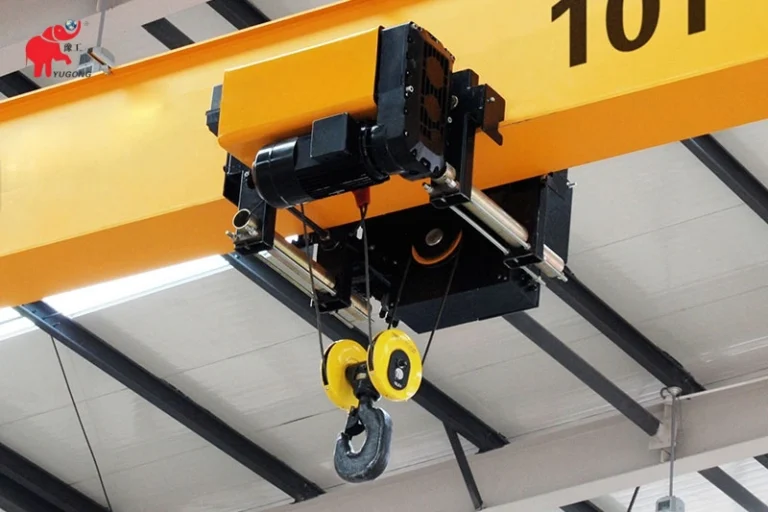
A low headroom electric hoist is an electrically powered lifting mechanism designed specifically to reduce the C-dimension — the vertical distance from the crane beam centerline (or bottom flange for under-hung configurations) to the hook at its highest position. Standard electric wire rope hoists have C-dimensions of 800mm to 1,200mm depending on capacity and design. Low headroom designs achieve 400mm to 700mm in the same capacity range.
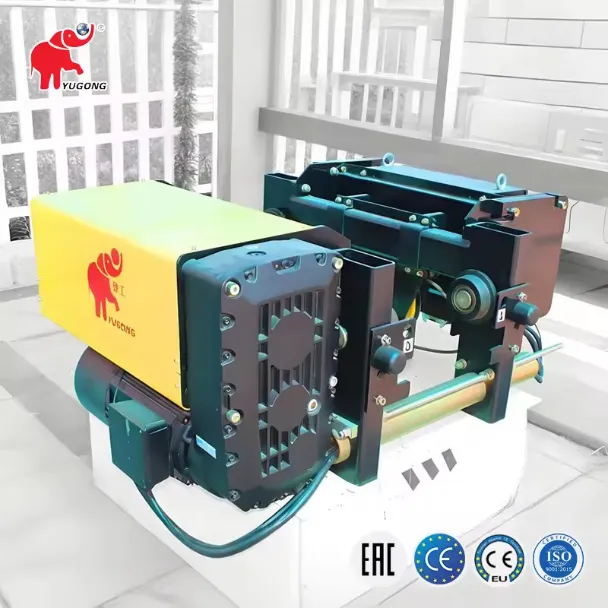
The reduction is achieved through compact mechanical arrangement: the motor is positioned parallel to the drum axis rather than above it, the trolley frame positions the hoist body to one side of the beam rather than centrally beneath it, and rope reeving may use additional sheaves to redirect the rope path. The result is that the hook travels significantly closer to the beam before reaching maximum travel — recovering vertical space that a standard hoist configuration cannot access.
Obtenir un devis gratuit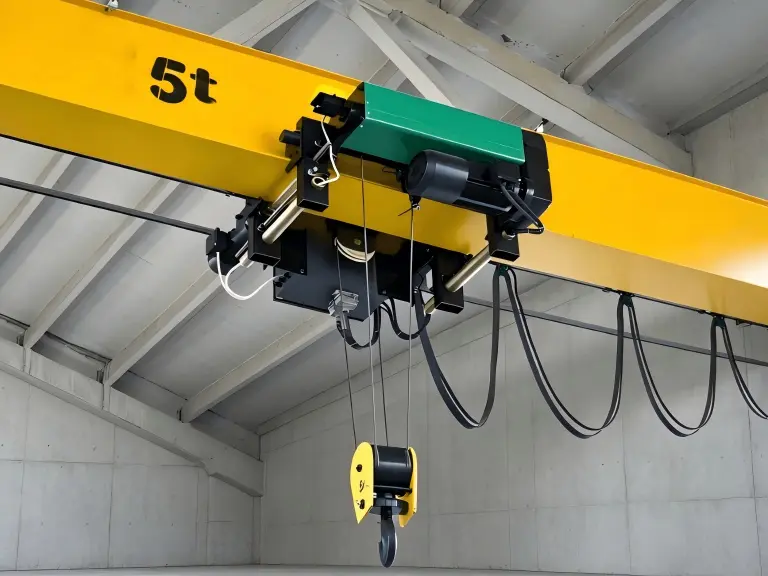
Key Characteristics
- Reduced C-dimension: 400mm to 700mm versus 800mm to 1,200mm for standard designs
- Motor positioned parallel to drum for compact profile
- Side-mounted or low-profile trolley design
- Compatible with single girder and double girder overhead crane systems
- FEM duty group classification available for documented performance compliance
- VFD control standard on production-grade configurations
Why Limited Height Workshops Need Low Headroom Hoists
Challenge 1: Limited Building Height
The majority of industrial facilities in operation today were not designed around modern crane specifications. Older manufacturing buildings, repurposed warehouses, and facilities constructed for lighter production processes commonly have ceiling heights of 5 to 7 meters. Installing a standard crane hoist in these buildings may reduce available hook travel to 3.5 to 4.5 meters — adequate for some operations, inadequate for others.
When a machine tool must be lifted to its mounting height, when a large mold must clear the injection press platens during installation, or when a fabricated sub-assembly must be positioned at elevated height during fitting, insufficient hook travel stops the operation. The choice becomes either an expensive structural modification or a correctly specified low headroom hoist that solves the problem within the existing building envelope.
Challenge 2: Existing Workshop Structure Cannot Be Modified
Many facilities operate in buildings where roof modification is not practically possible — tenanted industrial units, facilities shared with other operations, buildings with heritage or planning constraints, or structures where the cost of modification exceeds the value of the improvement. In these situations, the building height is fixed and the crane system must work within it.
Low headroom hoists allow crane installation within building envelopes that standard designs cannot serve. The hoist specification change recovers usable hook travel within the existing structure — delivering the operational capability that modification would otherwise be required to achieve, at a fraction of the cost.
Challenge 3: Maximum Hook Height Is Operationally Critical
Some production operations require the hook to reach a specific elevation that the building height minus standard hoist C-dimension cannot provide. Tall machinery installation, large component assembly where the load must be lifted above fixed obstructions, and maintenance operations requiring loads to be elevated to specific working heights all impose minimum hook height requirements that must be met for the operation to be physically possible.
A low headroom hoist that recovers 400mm of hook travel within a 6-meter building converts an installation that cannot be completed with standard equipment into one that can. That 400mm may represent the difference between a crane that serves the production process and one that does not.
How a Low Headroom Electric Hoist Works
Compact Trolley Design
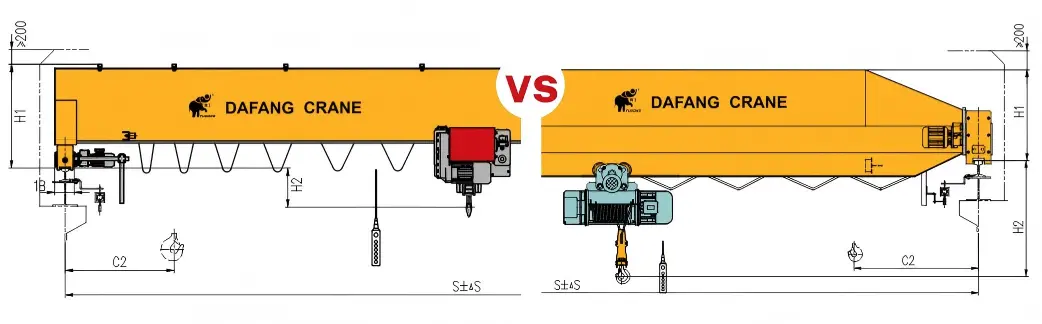
The trolley frame in a low headroom hoist positions the hoist body to one side of the crane beam — side-mounted rather than centrally suspended beneath the beam. This configuration allows the hook block to rise significantly closer to the beam centerline at maximum hook height, directly reducing the C-dimension. The motor and gearbox are arranged parallel to the drum axis, reducing overall hoist assembly height compared to conventional vertical arrangements.
Mouvement horizontal
The trolley travels along the crane beam — along the bottom flange for under-hung single girder configurations, or along top-running rails for double girder cranes. Motor-driven trolley travel with VFD control provides smooth, variable-speed positioning along the full beam length. End-of-travel buffers and limit switches stop trolley motion at the beam ends.
Vertical Lifting
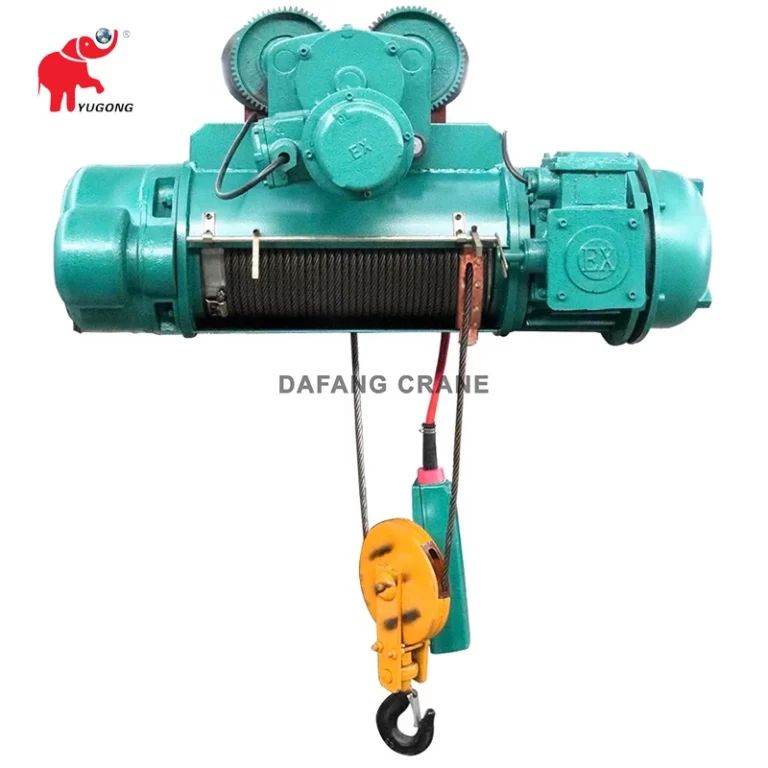
The electric motor drives the wire rope drum through a helical gear gearbox. As the drum rotates, wire rope winds on or off, raising or lowering the hook block and suspended load. VFD control on the hoist motor provides smooth acceleration from rest, variable speed across the full travel range, and controlled deceleration at stop — eliminating the jerk and load swing that fixed-speed hoist drives produce.
Système de contrôle
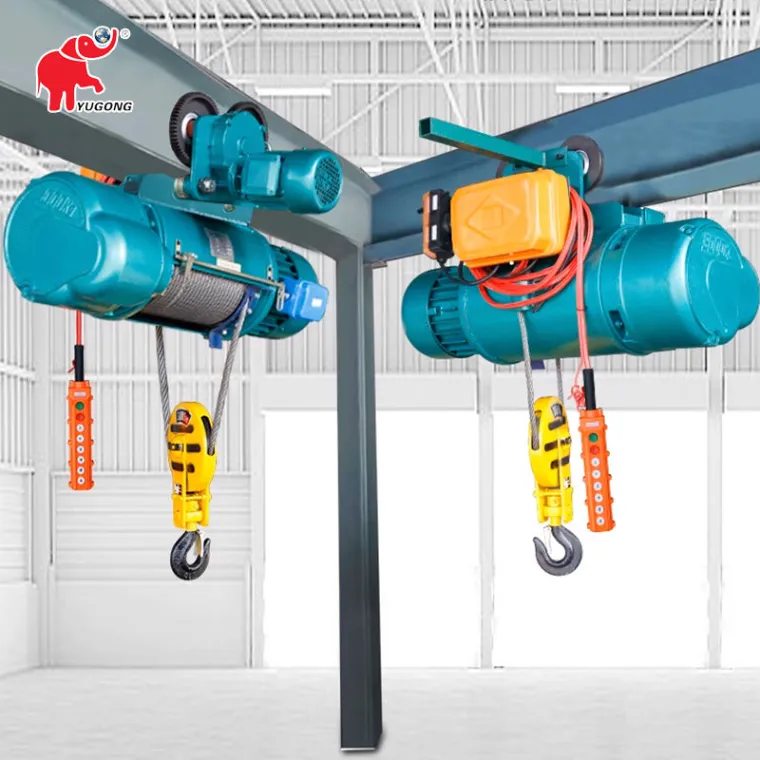
Pendant control. Standard wired pendant with separate buttons for hoist up/down, trolley left/right, and bridge travel (where integrated with crane controls). Push-to-run operation with button release stopping all motion.
Wireless remote control. Radio remote allows the operator to control the hoist from any position within the working area — improving safety when the load obscures visibility from a fixed pendant position and eliminating pendant cable management requirements.
Variable frequency drive (VFD). VFD control provides smooth start and stop, two-speed or infinitely variable speed, creep speed for precise load positioning, and regenerative braking during load lowering. For production applications where positioning accuracy and cycle time both matter, VFD control is the appropriate specification.
Key Technical Features of Low Headroom Electric Hoists
Maximized Lifting Height
The defining performance advantage. Reducing the C-dimension by 300mm to 500mm compared to a standard hoist in the same building directly adds that distance to the usable hook travel. For a facility with 6.5 meters of clear height, a 400mm crane bridge, and a 200mm runway beam, the available hook travel comparison is:
| Type de palan | Dimension C | Voyage au crochet disponible |
|---|---|---|
| palan électrique standard | 1 000 mm | 4 900 mm |
| palan électrique à faible hauteur sous plafond | 550 mm | 5 350 mm |
| Improvement | — | +450 mm |
That 450mm directly affects what the crane can lift to, and where loads can be positioned within the building.
Structure Compacte
The integrated trolley and hoist body design minimizes both the vertical extent and the horizontal footprint of the hoist assembly beneath the beam. In workshops with dense machinery layouts, the compact profile also reduces clearance conflicts with adjacent equipment during crane travel.
High Efficiency Operation
VFD-controlled low headroom hoists with two-speed or variable speed operation reduce cycle time per lift compared to single-speed hoists. High speed for bulk travel, creep speed for final positioning — the combination allows operators to work faster without sacrificing placement accuracy. Smoother motion also reduces pendulum swing that fixed-speed hoists generate during acceleration and deceleration.
Reduced Noise
Helical gear gearboxes and VFD-controlled motors operate significantly quieter than older spur gear designs with contactor switching. In production environments where multiple cranes operate simultaneously, lower hoist noise reduces the cumulative ambient noise level across the shift.
FEM Standard Design
FEM-classified low headroom electric hoists carry documented duty group certification under FEM 9.511 — confirming that structural fatigue life, gearbox service factor, motor thermal rating, and brake thermal capacity are all matched to the specified operating intensity. For procurement teams requiring CE certification and FEM documentation, classified hoists provide the technical basis for project acceptance that unclassified industrial hoists cannot offer.
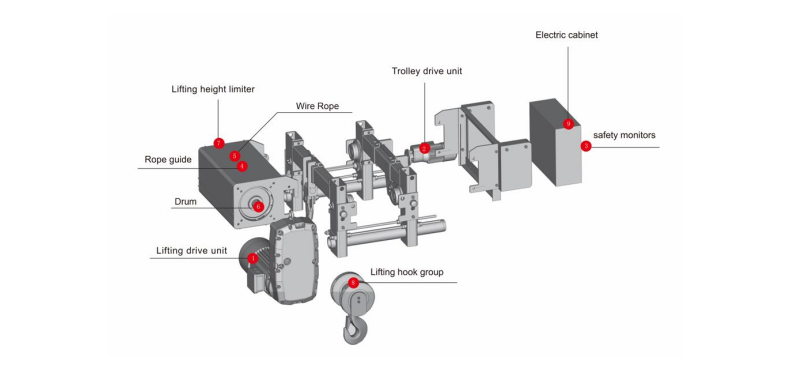
Low Headroom Electric Hoist vs Traditional Electric Hoist
| Fonctionnalité | palan électrique à faible hauteur sous plafond | Traditional Electric Hoist |
|---|---|---|
| C-dimension (beam to hook at max height) | 400–700mm | 800–1,200mm |
| Hook height in same building | Maximum — reduced dead space | Standard — larger vertical dead space |
| Space utilization | Higher — more usable lift height | Standard — ceiling height limits apply directly |
| Crane compatibility | Single girder (under-hung) and double girder (top-running) | Single girder and double girder; also monorail |
| Workshop suitability | Essential for buildings with 5–7 meter ceiling height | Adequate when building height is not a constraint |
| Mechanical complexity | Higher — compact layout requires engineered arrangement | Lower — conventional component arrangement |
| Initial cost | Moderately higher | En bas |
| VFD control | Standard on FEM-classified designs | Available as option |
| FEM duty group documentation | Standard on classified designs | Not always available |
| Maintenance access | Slightly more complex — compact layout | More straightforward component access |
Engineering explanation. The choice between low headroom and standard hoist is determined by one primary factor: does the standard hoist C-dimension leave adequate hook travel for the intended operations within the available building height? Calculate available hook travel with a standard hoist in your specific building. If that figure is adequate for all planned operations, the standard hoist is the cost-effective choice. If hook travel is constrained — or if a specific operation requires a higher hook position than the standard hoist can reach — a low headroom hoist is the correct specification.
Industrial Applications of Low Headroom Electric Hoists
Ateliers de fabrication
General manufacturing workshops in buildings with 5 to 8 meter ceiling heights — the most common range in existing industrial facilities — benefit most directly from low headroom hoist designs. Machine component handling, production material transfer, and assembly line support all require maximum hook height within the building envelope. A 400mm to 500mm improvement in hook travel may determine whether a crane can serve a specific production operation or requires that operation to be done by other means.
Automotive Industry
Automotive assembly and component manufacturing facilities use low headroom hoists for engine and transmission handling, body component positioning, tooling and fixture management, and press shop operations. Dense machinery layouts and enclosed production cells in automotive plants create both vertical and horizontal clearance constraints. FEM-classified low headroom hoists with VFD control and two-speed operation provide the positioning precision that automotive assembly tolerances require.
Steel Fabrication Plants
Steel fabrication workshops handle structural sections, plate, and fabricated assemblies that are heavy and require lifting to specific fixture heights for fitting and welding. Maximum hook height in the building determines whether the crane can position loads into fixtures without the load contacting other structures during the lift. Low headroom hoists recover the hook travel that allows fabricators to use the full vertical extent of their building productively.
Equipment Maintenance Facilities
Maintenance bays require cranes capable of lifting heavy components — engines, gearboxes, hydraulic assemblies — to specific working heights determined by the equipment being serviced. In existing maintenance facilities where roof height is fixed, a low headroom hoist provides the additional hook travel needed to complete maintenance operations at the required working elevation without requiring the technician to work in ergonomically compromised positions.
Warehouses with Limited Height
Warehouses and distribution centers in buildings with lower-than-standard ceiling heights use low headroom hoists on overhead cranes for equipment maintenance, heavy stock handling, and loading bay operations. The proportional benefit of the C-dimension reduction is greater in lower buildings — in a 5-meter warehouse, recovering 400mm of hook travel is an 8% improvement in usable height.
Low Headroom Electric Hoist for Overhead Crane Systems
Pont roulant monopoutre européen
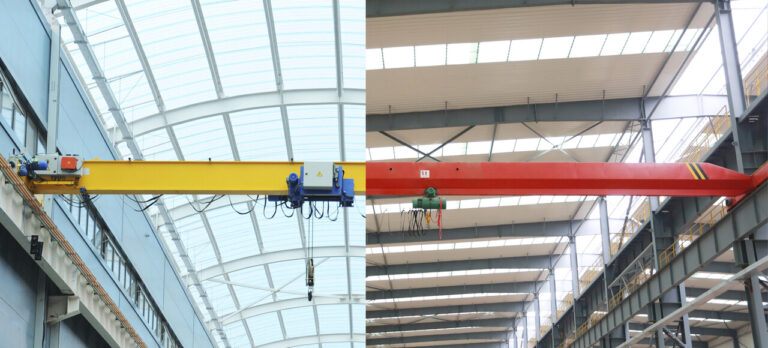
grues monopoutre with under-hung hoists are the most common low headroom application. The hoist body hangs entirely below the bridge girder bottom flange, and the C-dimension directly determines how much of the building height is consumed by the hoist. Low headroom hoists on single girder cranes recover 300mm to 500mm of hook travel compared to standard designs on the same runway — the single most effective specification change for improving crane performance in height-constrained single girder installations.
Pont roulant bipoutre
ponts roulants à double poutre use top-running trolleys that inherently provide better hook height utilization than under-hung single girder systems. Low headroom hoists on double girder cranes are specified when maximum hook height is operationally critical and every available millimeter matters, or when retrofitting a higher-capacity hoist into an existing crane structure where the trolley clearance envelope is fixed and cannot be changed.
Pont roulant pour poste de travail
systèmes de pont roulant pour postes de travail — lightweight runway systems in compact production cells — operate in the most height-constrained environments of any crane type. Ceiling heights of 3.5 to 5 meters are common. Low headroom hoists in the 125kg to 2,000kg capacity range are standard for workstation crane applications, where the proportional impact of C-dimension reduction on available hook travel is highest.
Comment choisir le bon palan électrique pour espaces à faible hauteur sous plafond
1. Determine Load Capacity
Start with the maximum load — including the weight of any below-hook devices, spreader beams, or rigging hardware — and apply a minimum 25% operational buffer. Common standard capacities are 1 ton, 2 ton, 3 ton, 5 ton, and 10 ton. Confirm that the crane bridge and runway structure are rated for the loaded hoist weight within the safe working load with the required margin.
2. Evaluate Workshop Height
Measure the building clear height from floor to the underside of roof structure. Subtract crane runway beam depth, crane bridge depth, and trolley structural depth to determine the available dimension for hoist body plus hook travel. Compare this against the hoist's C-dimension at maximum hook height to confirm the available hook travel. Define the minimum hook height required for every planned operation — the highest position the hook must reach with rated load — and confirm the calculation provides adequate margin.
3. Select Working Duty Class
FEM duty group selection requires two inputs: load spectrum (how actual loads distribute as a proportion of rated capacity) and total operating cycles over the design life. For general manufacturing with two to four daily operating hours, FEM 2m to 3m is typical. For continuous multi-shift production, FEM 4m is appropriate. Selecting a lighter duty group to reduce initial cost produces a hoist that reaches design life before the planned replacement date.
4. Choose Control System
- Pendant control for standard production applications where the operator works from a fixed position near the load.
- Radio remote control for applications where the operator needs to move freely around the load during lifting — large component handling, precision assembly positioning, and maintenance operations where visibility of the load from a fixed position is limited.
- VFD speed control for any application where smooth load control, creep speed for final positioning, or reduced mechanical shock loading are operational priorities. VFD control is the standard specification for production workshop applications.
Low Headroom Electric Hoist Solutions by Dafang Crane
Dafang Crane provides FEM standard low headroom electric hoist solutions designed for factories requiring maximum lifting performance in limited-height workshops. With 20+ years of crane and hoist manufacturing experience, Dafang's engineering team develops low headroom hoist configurations from the customer's operational requirements — building height, crane beam type, required hook height, capacity, duty cycle, and environmental conditions — rather than from catalogue selection.
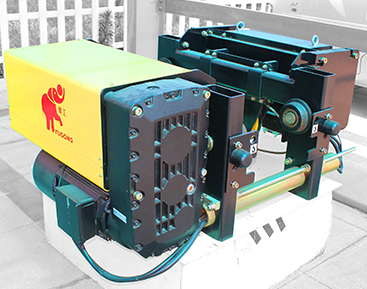
- Compact European design. Dafang's low headroom electric hoists follow the FEM 1.001 and FEM 9.511 design framework — optimized structural geometry, higher-strength materials, and documented duty group compliance. C-dimensions of 400mm to 700mm across the standard capacity range recover usable hook travel in buildings where standard hoist designs cannot deliver adequate performance.
- FEM duty group documentation. FEM-classified hoists are supplied with duty group calculation documentation, CE Declaration of Conformity, and factory load test certificate — the technical package required for project acceptance in European markets and internationally specified projects.
- High space utilization. Dafang's low headroom hoist designs minimize both the C-dimension and the horizontal hoist body profile — reducing interference with adjacent equipment during crane travel in dense machinery layouts.
- Reliable lifting performance. Helical gear gearboxes with oil-bath lubrication, IE3 efficiency class motors with Class F or H insulation, disc or conical rotor brakes with adequate thermal capacity for the specified duty group, and sealed bearing arrangements for production environments provide consistent performance across the hoist's design life.
- Customized configurations. Non-standard C-dimension targets, specific crane beam flange widths, unusual power supply voltages, high-temperature or dusty environment specifications, and food-grade or corrosion-resistant material requirements are all addressed through Dafang's engineering team rather than through catalogue compromise.

Questions fréquemment posées
Q1: Why choose a low headroom hoist for a limited-height workshop?
When a standard hoist's C-dimension reduces available hook travel below what production operations require, a low headroom hoist recovers 300mm to 500mm of that space — solving the operational constraint without requiring structural modification to the building. For facilities in existing buildings where raising the roof is impractical or uneconomical, a low headroom hoist specification is typically the most cost-effective solution to a hook height problem.
Q2: How much additional lifting height can a low headroom hoist provide?
The improvement is the difference between the standard hoist C-dimension and the low headroom C-dimension in the same installation — typically 300mm to 500mm. For a specific building, calculate: available hook travel = (floor to runway beam height) minus (crane bridge depth) minus (trolley depth) minus (hoist C-dimension). Compare this calculation for both standard and low headroom configurations. The difference is the additional hook travel the low headroom design provides in that specific building.
Q3: Can a low headroom hoist be used with any overhead crane?
Low headroom hoists are compatible with single girder overhead cranes (under-hung trolley on beam bottom flange) and double girder overhead cranes (top-running trolley on crane rails). Confirm trolley configuration compatibility: under-hung flange width for single girder applications, top-running rail gauge and section for double girder applications. Electrical supply compatibility — voltage, frequency, phase, and VFD communication protocol — should also be confirmed against the crane's existing electrical system for retrofit installations.
Q4: What is FEM classification for electric hoists?
FEM classification under FEM 9.511 defines the duty group of a hoisting mechanism based on two inputs: load spectrum (the distribution of actual loads as a proportion of rated capacity) and total operating cycles over the design life. Duty groups range from 1Am (lightest) to 5m (heaviest continuous duty). Each group defines structural fatigue requirements, gearbox service factor, motor thermal rating, and brake thermal capacity. FEM-classified hoists are designed — not just rated — for the specified operating intensity, providing a traceable engineering basis for service life expectation that unclassified hoists cannot offer.
Q5: Can Dafang Crane customize low headroom hoist solutions?
Yes. Dafang Crane's engineering team develops customized low headroom hoist configurations from the customer's operational requirements. Customization options include specific C-dimension targets for non-standard building heights, trolley configurations for specific crane beam flange widths and profiles, power supply specifications for non-standard voltages or frequencies, VFD control system integration with existing crane controls, environmental specifications for high-temperature, dusty, corrosive, or food-grade environments, and FEM duty group selection based on actual operating data rather than catalogue defaults. Provide building dimensions, crane beam specification, required hook height, capacity, duty cycle information, and environmental conditions to Dafang's engineering team for a specific solution recommendation.