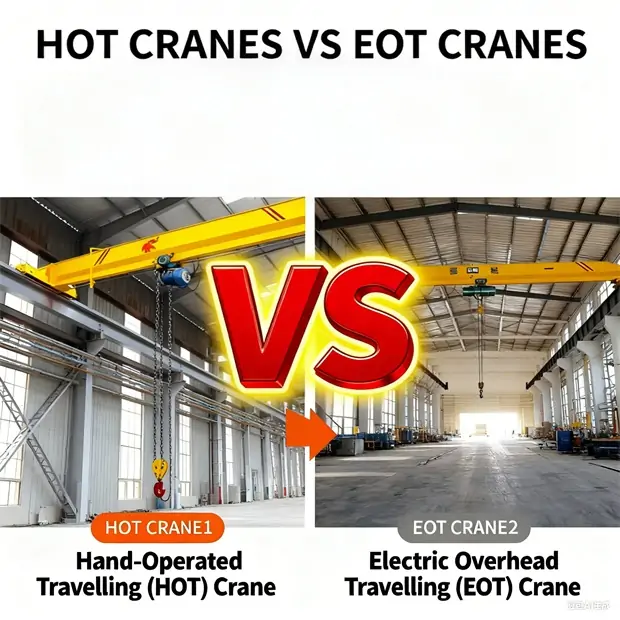







Choosing between a top running and underhung overhead crane is one of the first structural decisions in any factory crane project — and it is a decision that affects building requirements, lifting capacity, hook height, installation cost, and long-term expansion capability all at once.
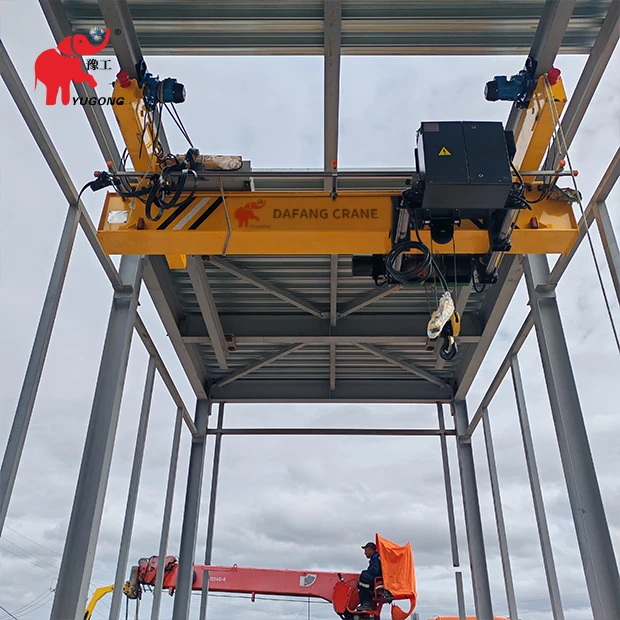
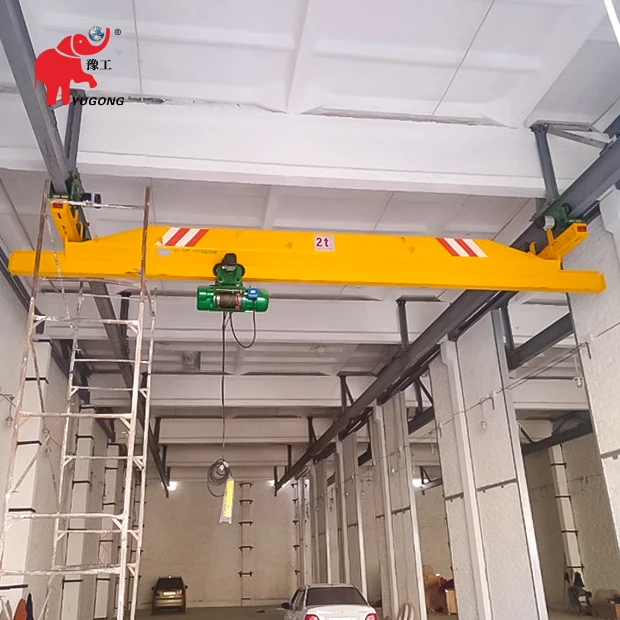
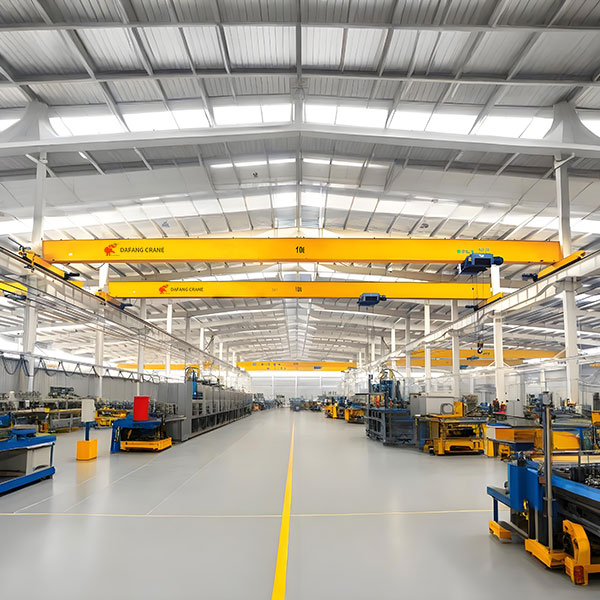
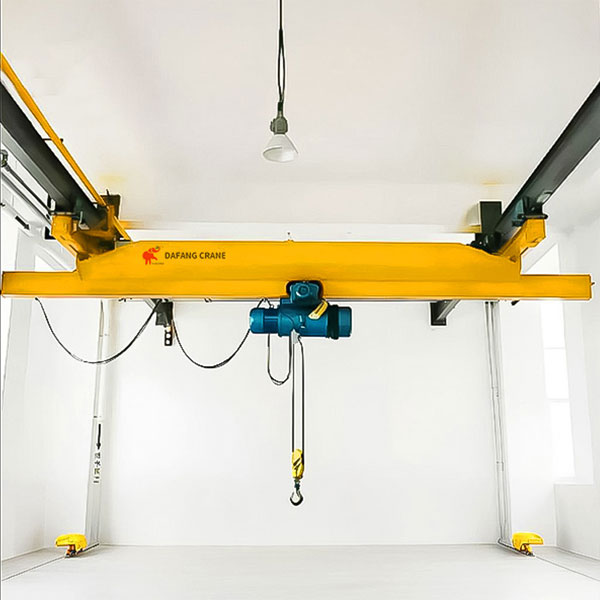
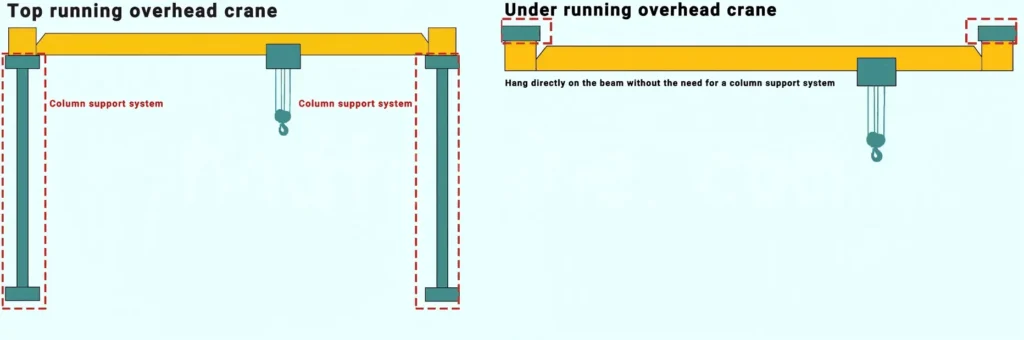
A top running overhead crane travels on rails mounted on top of the runway beams, supported by building columns or an independent runway structure. An underhung overhead crane — also called an under running crane — suspends beneath the runway beams, with the bridge and hoist hanging below the runway structure attached to the roof or ceiling.
The main difference is where the bridge travels relative to the runway beam. In a top running system, the end trucks ride on the top flange of the runway rail. In an underhung system, the end trucks hang from and travel along the bottom flange of the runway beam. This seemingly simple structural difference has significant downstream consequences for capacity, hook height, building requirements, and suitable applications.
The right choice depends on your building structure, required lifting capacity, available hook height, working area coverage requirements, and future expansion plans. This guide covers each factor in detail.
Índice
What Is a Top Running Overhead Crane
Definição
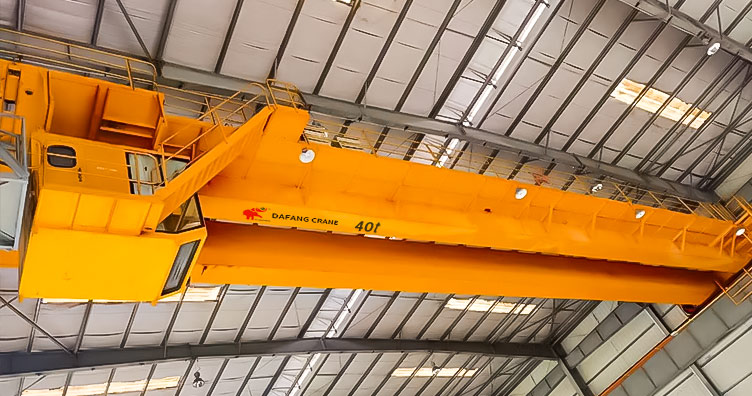
A top running overhead crane is a bridge crane system in which the bridge end trucks travel on rails mounted on top of the runway beams. The runway beams are supported by building columns, crane girders, or an independent steel runway structure. The hoist trolley travels across the top of the bridge girder — in double girder designs — or along the bottom flange of the bridge beam in top-running single girder configurations.
Princípio de funcionamento
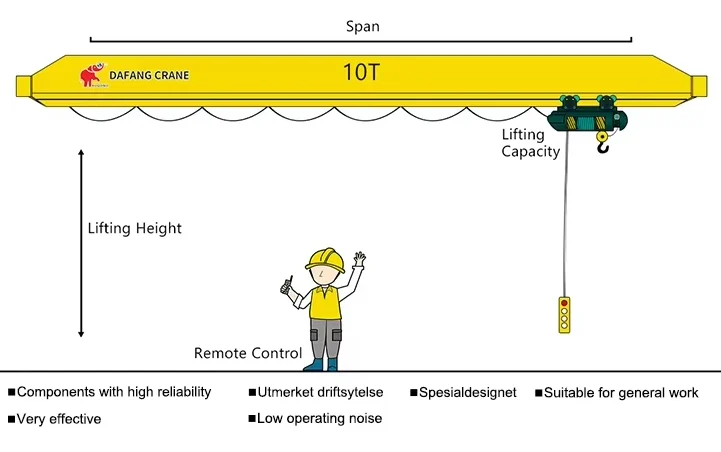
The system consists of four integrated elements. The runway beams run the length of the working area, supported on building columns or independent runway columns at defined intervals. End trucks at each end of the bridge carry the bridge load and travel along the runway rails. The bridge girder — single or double — spans the full working width between the two runway rails, carrying the hoist trolley. The hoist and trolley travel laterally across the bridge, positioning the hook at any point within the crane's working rectangle.
The combination of bridge travel (longitudinal) and trolley travel (lateral) allows the hook to reach any point within the full working area.
Vantagens
- Higher lifting capacity. Top running cranes support higher capacity than underhung designs because the runway beam carries load in bending rather than in suspension from the roof structure. Double girder top running cranes handle capacities from 10 tons to 500 tons or more. Single girder top running designs serve up to approximately 20 tons.
- Greater hook height. The top-running hoist trolley position above the bridge girder — in double girder designs — and the runway beam position above the crane allow maximum hook height utilization within the building. Hook height is limited only by the distance from the floor to the runway beam, minus the crane structural depth and hoist C-dimension.
- Larger span capability. Top running crane spans of 8 to 35 meters are standard. Larger spans with intermediate runway support are achievable in custom designs. The structural depth of the bridge girder is sized for the span and capacity without the weight limitations imposed by roof suspension.
- Heavy-duty operation. Top running cranes reach FEM A8 duty classification for the most intensive industrial applications. The structural system — runway beams on columns — handles the dynamic loads of high-cycle heavy lifting without transferring those loads to the roof structure.
- Easier future capacity upgrades. The runway structure can support crane capacity upgrades by replacing the bridge and hoist with heavier units, provided the runway was originally designed with adequate capacity margin. This upgradeability makes top running systems more adaptable to production growth.
What Is an Underhung Overhead Crane
Definição
Um underhung overhead crane — also called an under running crane — is a bridge crane system in which the bridge end trucks hang from and travel along the bottom flanges of the runway beams. The runway beams are attached to the roof structure, ceiling, or roof trusses. The hoist hangs below the bridge beam, and the hook travels beneath the bridge.
Princípio de funcionamento
O runway beams are suspended from or attached to the building's roof structure — roof trusses, ceiling beams, or purpose-installed structural members. End trucks with flanged wheels grip the bottom flange of the runway beam and travel along it. The bridge beam connects the two end trucks and spans the width of the working area. The hoist travels along the bottom flange of the bridge beam, positioning the hook beneath the entire crane assembly.
The entire crane hangs from the roof structure — the floor below is completely clear of crane support elements. This structural characteristic is the primary operational advantage of the underhung configuration.
Vantagens
- Ideal for limited floor space. No runway columns or support structures occupy the floor area. The full floor plan remains usable for production equipment, storage, vehicles, and personnel movement. In small workshops and assembly facilities where floor space is the primary constraint, this advantage is operationally significant.
- Better coverage around obstacles. Underhung cranes can be designed with curved or branching runway sections, allowing the crane to travel around fixed obstacles — building columns, equipment, fixed process installations — that a straight runway system cannot navigate. Switches between runway sections allow one crane to serve multiple working zones.
- Lower building modification cost for retrofit applications. In existing buildings with adequate roof structure, attaching runway beams to the existing structure is generally less expensive than installing new column-supported runway infrastructure. The critical constraint is confirming that the existing roof structure has adequate capacity for the added crane loads.
- Compact installation. The underhung configuration positions the runway at ceiling level and eliminates the runway column footprint. In factories where ceiling height is the limiting dimension rather than floor area, underhung systems make better use of the available building volume.
Top Running vs Underhung Overhead Crane: Detailed Comparison
| Caraterística | Top Running Overhead Crane | Underhung Overhead Crane |
|---|---|---|
| Runway position | Wheels travel on top of runway rail | Wheels hang from bottom flange of runway beam |
| Runway support | Building columns or independent runway structure | Roof structure, ceiling beams, or roof trusses |
| Maximum capacity | Up to 500 tons (double girder); up to 20 tons (single girder) | Typically 0.5 to 8 tons; up to 10 tons with adequate structure |
| Typical span | 8 to 35 meters (standard); larger spans available | 4 to 20meters |
| Hook height | Maximum — limited only by runway elevation minus crane depth | Reduced — runway at ceiling level, full crane depth below runway |
| Installation cost | Higher — column or runway structure required | Lower in retrofit applications with adequate roof structure |
| Building requirements | Column or runway support capable of full crane load | Roof structure capable of suspension loads — must be confirmed |
| Floor space impact | Runway columns occupy floor area | No floor-level obstruction — full floor clear |
| Duty class range | A3 to A8 — full industrial range | A3 to A5 — light to medium duty |
| Span flexibility | Straight runway; standard configuration | Curved, branching, and switch runway configurations available |
| Maintenance access | Good — runway beams accessible from floor level with standard equipment | More complex — runway beams at ceiling height |
| Expansion capability | Good — capacity and span can be upgraded with runway modifications | Limited by roof structure capacity |
| Best applications | Heavy manufacturing, steel plants, warehouses, high-duty production | Assembly, electronics, food processing, small workshops, cleanrooms |
Building Structure Requirements
Top Running Crane Requirements
Top running overhead cranes transfer crane loads — dead load of the crane structure plus dynamic loads during lifting and travel — to the runway support structure through the end truck wheel loads. The runway structure must be designed for these loads from the outset, or existing structures must be confirmed adequate by structural analysis.
- New buildings. Design the runway structure — beams, columns, and foundations — for the crane loads as part of the building structural design. Crane runway column spacing is typically 6 to 9 meters. Runway beam depth and section are determined by the crane capacity, span, and column spacing.
- Existing buildings with adequate columns. If the existing building columns have sufficient reserve capacity for the additional crane runway and crane loads, a runway beam can be attached at the appropriate elevation. This requires structural engineering analysis of the existing columns — a step that cannot be skipped regardless of how robust the columns appear visually.
- Existing buildings with inadequate columns. An independent runway structure — self-supporting steel frame within the building, independent of the existing structure — carries the crane loads without imposing them on the building structure. This is more expensive than using the existing structure but avoids structural reinforcement of inadequate columns.
- Runway rail. Top running cranes require a steel rail mounted on top of the runway beam. Rail section is selected based on crane wheel load and duty class. Rail clips or welded rail attachment methods affect the dynamic behavior of the runway system over time.
Underhung Crane Requirements
Underhung cranes impose suspension loads on the roof structure at runway beam attachment points. The roof structure must carry the runway beam dead load plus the crane dead load plus dynamic load factors without exceeding structural capacity.
- Structural confirmation is mandatory. Before specifying any underhung crane, have a structural engineer confirm that the existing roof structure has adequate capacity for the proposed crane loads at the proposed runway attachment points. This analysis must account for the existing dead loads on the roof structure before adding crane loads.
- Roof truss compatibility. Runway beams attached to roof truss panel points — where the truss members connect — impose lower bending moments on the truss than attachment between panel points. Wherever possible, runway beam hanger positions should align with truss panel points.
- Retrofit retrofit considerations. In older industrial buildings, the original roof structure capacity may be documented in original structural drawings or may require field investigation. If original drawings are not available, structural assessment of the existing roof before crane specification is the appropriate first step.
Load Capacity and Performance Comparison
Capacidade de elevação
Top running double girder cranes cover the full industrial capacity range — from 10 tons to 500 tons and beyond in custom designs. Top running single girder cranes serve up to approximately 20 tons for most applications. The column-supported runway structure can carry whatever capacity the crane is designed for, limited only by what the structural system is engineered to handle.
Underhung cranes are practically limited by the roof structure's suspension capacity. In standard industrial buildings, this limits underhung cranes to 0.5 to 8 tons for most retrofit applications. New buildings designed specifically for underhung crane loads can accommodate higher capacities, but the economics of this approach rarely compete with a top running system for loads above 8 to 10 tons.
Span Ranges
Top running crane spans of 8 to 35 meters cover the width of most industrial buildings. Custom designs extend this range. Double girder structures handle larger spans without excessive deflection better than single girder designs, which is why double girder is standard above approximately 18 to 20 meter spans.
Underhung cranes are generally practical to approximately 15 meter spans. Beyond this, the bridge beam weight and depth required for adequate stiffness impose suspension loads that typical roof structures cannot carry.
Hook Height
Top running cranes provide better hook height utilization than underhung systems in buildings of equivalent height. The top running runway beam can be positioned at the maximum practical elevation, with the crane bridge, trolley, and hoist below it. Hook height is maximized by the elevated runway position.
Underhung cranes, by contrast, have the runway at ceiling level — the full crane depth (runway beam, bridge beam, hoist) hangs below the ceiling. Available hook height is reduced by the combined depth of all these elements. In buildings with limited ceiling height, this depth reduction may be significant.
Classificação de direitos
Top running overhead cranes cover the full FEM duty range A3 to A8. The column-supported runway structure handles the dynamic load cycles of high-intensity operation without transferring fatigue loads to the roof. Underhung crane applications typically fall within A3 to A5 — light to medium duty — both because their capacity range suits lower-intensity applications and because high-cycle dynamic loading transferred to the roof structure is a design concern.
Cost Considerations
Custo do Equipamento
Top running cranes and underhung cranes of equivalent capacity have comparable equipment costs — the structural differences between the two systems are in the runway structure, not primarily in the crane bridge and hoist. For very light underhung cranes using aluminum runway systems, equipment cost is lower than equivalent-capacity top running systems.
Custo de Instalação
Top running crane installation in new buildings integrates crane runway design with the building structural design — the crane system cost is distributed across the overall building project. In retrofit applications, the cost of column assessment, potential reinforcement, and runway beam installation adds to the crane equipment cost.
Underhung crane installation in buildings with adequate roof structure is generally lower cost than top running alternatives — the runway beams hang from existing structure with relatively simple hanger connections. The critical cost variable is the structural assessment — if the existing roof requires reinforcement for the crane loads, this cost can exceed the crane equipment cost itself.
Custo de Manutenção
Top running cranes have runway beams at an accessible elevation — typically reachable with standard scissor lifts or mobile platforms for runway inspection and maintenance. Underhung runway beams at ceiling height are more difficult to access for inspection and maintenance, adding cost and complexity to scheduled maintenance.
Custo de Exploração a Longo Prazo
Top running systems with adequate initial specification for the duty class and anticipated production growth have lower long-term operating cost than underhung systems operating near their structural limits. The ability to upgrade top running crane capacity and span by replacing bridge components within an existing runway structure — provided the runway was originally designed with adequate margin — extends the economic life of the infrastructure investment.
Which Industries Use Each Crane System
Top Running Overhead Crane Industries
Steel industry. Steel mill cranes at all duty levels — from raw material handling to ladle cranes — use top running double girder configurations. The high capacity, high duty class, and heavy structural requirements of steel plant crane positions cannot be served by underhung systems.
Shipbuilding. Shipyard workshop cranes for block assembly, outfitting, and equipment installation use top running configurations with spans of 20 to 35 meters and capacities of 50 to 500 tons.
Automotive manufacturing. Body shop overhead cranes, stamping press die handling, and powertrain assembly use top running single and double girder cranes depending on capacity requirements.
Heavy machinery manufacturing. Machine tool assembly, large gearbox and motor handling, and press frame assembly all require top running cranes with capacities above the practical range of underhung systems.
Mining and mineral processing. Crusher maintenance, ball mill overhaul, and surface equipment workshops use top running double girder cranes for the heavy, irregular maintenance lifts that mining equipment requires.
Underhung Overhead Crane Industries
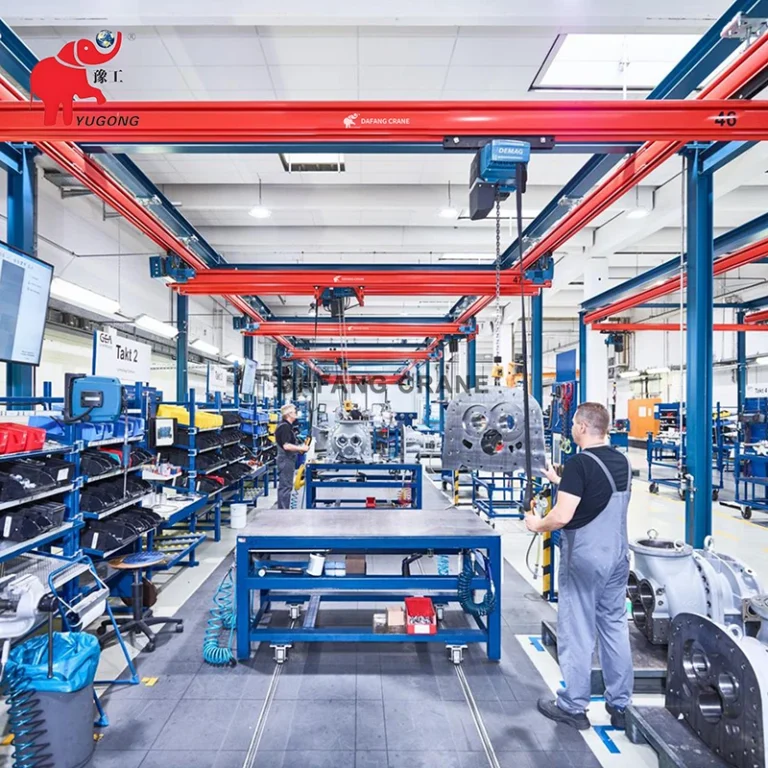
Electronics manufacturing. Clean, compact underhung crane systems in electronics assembly facilities handle component pallets, test equipment, and sub-assemblies without floor obstruction that limits production layout flexibility.
Pharmaceutical and medical device production. Clean room-compatible underhung crane systems provide material handling within validated production environments where floor-level support structures would compromise cleaning and contamination control.
Food processing. Underhung cranes in food processing facilities — specified with hygienic materials and sealed components — handle ingredient containers, processing equipment maintenance, and finished product handling without floor-level obstacles that impede cleaning.
Packaging and assembly. Light assembly lines and packaging operations use underhung workstation bridge cranes and underhung overhead cranes for ergonomic component handling at the workstation level.
Precision manufacturing. Precision machining, optical instrument manufacturing, and precision electronics assembly use underhung systems for the controlled, vibration-limited lifting these production processes require.
How to Choose the Right Overhead Crane System
The selection decision follows from a structured evaluation of five factors. Work through each in sequence — an early constraint often determines the answer before all five are evaluated.
1. Required Lifting Capacity
If your heaviest lift requires more than 10 tons, the choice is made: a top running crane system is required. If capacity is below 10 tons, underhung is practically viable — proceed to the next factors.
2. Available Building Structure
Have a structural engineer assess the existing building before deciding. For top running, confirm column capacity for runway loading. For underhung, confirm roof structure capacity for suspension loading. If the building structure cannot support either system without significant reinforcement, the reinforcement cost changes the relative economics of each option.
3. Hook Height Requirements
Calculate available hook travel for each system option in your specific building: floor-to-runway height minus crane structural depth minus hoist C-dimension. If the top running system provides adequate hook height but the underhung system does not, the choice is made. If both systems provide adequate hook height, proceed.
4. Working Area Coverage and Layout
If your production layout requires crane coverage around fixed obstacles — columns, equipment, process installations — the underhung system's ability to incorporate curved and branching runway sections provides an advantage that top running straight runway systems cannot match. If your working area is a simple rectangle, both systems provide equivalent coverage.
5. Future Expansion Plans
If production growth will require higher crane capacity within the planning horizon, specify a top running runway system with capacity margin for the anticipated future crane. Underhung systems have limited upgrade potential because roof structure capacity constrains expansion. If no capacity growth is planned, this factor does not drive the selection.
Por que escolher o guindaste Dafang?
Dafang Crane manufactures both top running and underhung overhead crane systems across the full capacity and application range — from 125 kg underhung workstation bridge cranes in electronics assembly facilities to 500-ton top running double girder cranes for heavy industrial applications.
- Customized overhead crane solutions. Standard catalogue configurations address common requirements. Non-standard spans, unusual building heights, specialized hoist configurations, and complex runway layouts are developed through in-house engineering rather than adapted from catalogue alternatives.
- FEM and CMAA design options. FEM-classified European standard cranes for projects requiring Certificação CE e FEM duty group documentation. CMAA-compliant designs for North American projects. Both standards are supported with complete engineering documentation.
- Engineering consultation. Dafang Crane's engineering team reviews building structural information, production requirements, and lifting specifications to recommend the appropriate system — top running or underhung — and develop the crane configuration from the operational requirements rather than from catalogue selection.
- Experiência em projetos internacionais. Top running and underhung crane systems delivered to manufacturing facilities across Southeast Asia, the Middle East, Africa, South America, and Europe. Export documentation, marine packing, and installation support at international sites are established capabilities.
- Quality manufacturing. ISO 9001 quality management system covering design, fabrication, assembly, and testing. Factory load testing to 125% of rated capacity with certified test documentation as standard deliverable.

Perguntas mais frequentes
Q1: What is the main difference between top running and underhung overhead cranes?
The fundamental difference is where the bridge end trucks travel. Top running cranes travel on rails mounted on top of the runway beams — the runway beams are supported by building columns or independent runway structures. Underhung cranes travel along the bottom flange of the runway beams — the runway beams are suspended from the roof structure. This structural difference determines capacity range, hook height, building requirements, span capability, and suitable applications.
Q2: Which crane provides greater hook height?
Top running cranes provide greater hook height in buildings of equivalent ceiling height. The top running runway beam can be positioned at maximum practical elevation, with only the crane structural depth and hoist C-dimension reducing available hook travel. Underhung cranes hang the full system — runway beam, bridge beam, and hoist — from the ceiling, consuming more vertical distance between ceiling and hook than the equivalent top running system. In buildings where hook height is the critical constraint, top running systems consistently outperform underhung alternatives.
Q3: Is an underhung crane suitable for heavy loads?
Standard underhung crane applications are limited to 0.5 to 8 tons by roof structure suspension capacity. This range covers assembly, electronics, food processing, precision manufacturing, and light maintenance applications. For loads above 8 to 10 tons, the suspension loads imposed on a typical roof structure exceed what most buildings can support without significant structural reinforcement. In those cases, a top running crane system is the appropriate specification.
Q4: Which overhead crane system is better for existing buildings?
It depends on the existing building's structural characteristics. If the existing columns have adequate reserve capacity for runway loading, a top running system integrates well into the existing structure. If the existing roof trusses or ceiling beams have adequate reserve for suspension loading, an underhung system attaches to the existing structure with minimal intervention. Have a structural engineer assess both options against the actual building before deciding — the answer depends on the specific building, not on a general rule.
Q5: Can underhung crane systems be expanded later?
Expansion options for underhung cranes are limited by the roof structure's suspension capacity. Adding a second underhung crane to an existing runway, extending the runway length, or increasing the crane's lifting capacity all add load to the roof structure. If the original structural assessment included capacity margin for anticipated expansion, these changes may be feasible. If the structure was specified to the original crane load only, expansion requires a new structural assessment and potentially structural reinforcement. Top running systems are generally easier to expand — the runway structure can be extended and the crane capacity can be upgraded more readily than underhung alternatives.